In the early twentieth century, public health reformers approached the task of ameliorating unsanitary conditions and preventing epidemic diseases with optimism. Using exhibits, they believed they could make systemic issues visual to masses of people. Embedded within these visual displays were messages about individual action. In some cases, this meant changing hygienic practices. In other situations, this meant taking up action to inform public policy. Reformers and officials hoped that exhibits would energize America's populace to invest in protecting the public's health. Exhibiting Health is an analysis of the logic of the production and the consumption of this technique for popular public health education between 1900 and 1930. It examines the power and limits of using visual displays to support public health initiatives.
- English
- ePUB (mobile friendly)
- Available on iOS & Android
eBook - ePub
About this book
Information
Publisher
Rutgers University PressYear
2020Print ISBN
9781978803268
9781978803275
eBook ISBN
9781978803282
Topic
MedicineSubtopic
North American HistoryChapter 1
Developing Exhibition as a Common Tool for Popular Education
Residents of East Harlem could window shop for health in 1924. The New York City Department of Health worked with the New York Tuberculosis and Health Association and another “twenty-odd voluntary health and welfare agencies” to create the East Harlem Health Center at 345 East 116th Street. Officials placed rotating exhibits in the Health Shop’s storefront to entice the residents of this working-class neighborhood, the majority of whom were Italian, to stop, think, and take action. These visual displays, which sometimes included animatronic models and live demonstrations, provided passersby with information about a myriad of topics ranging from infant care to social hygiene. They also invited residents to step inside for further instruction. The goal was to raise the “consciousness” of the neighborhood to its “health needs” and to formulate positive “health habits.”1
The Health Shop was an example of how reformers and public health officials began regularly using exhibits as a mechanism to disseminate information about public health with the goal of changing individual hygienic practices and fostering support for governmental apparatuses in the early twentieth century. The target audience for the first aim was working-class immigrants, especially non-English speakers from eastern and southern Europe. The intended audience for the second objective was middle-class men and women, typically white. Reformers viewed their two target groups as interrelated. They believed that responding to infectious diseases, which they statistically associated with urban immigrant neighborhoods, could only be achieved by changing individual health practices, especially in the home. Reformers hoped immigrants would voluntarily adopt new customs such as opening windows at night and brushing teeth daily. Reformers’ suspicions about immigrants, however, led them to advocate for the adoption of regulatory controls simultaneously. Spitting on the street, for instance, became a misdemeanor offense in cities throughout the nation.
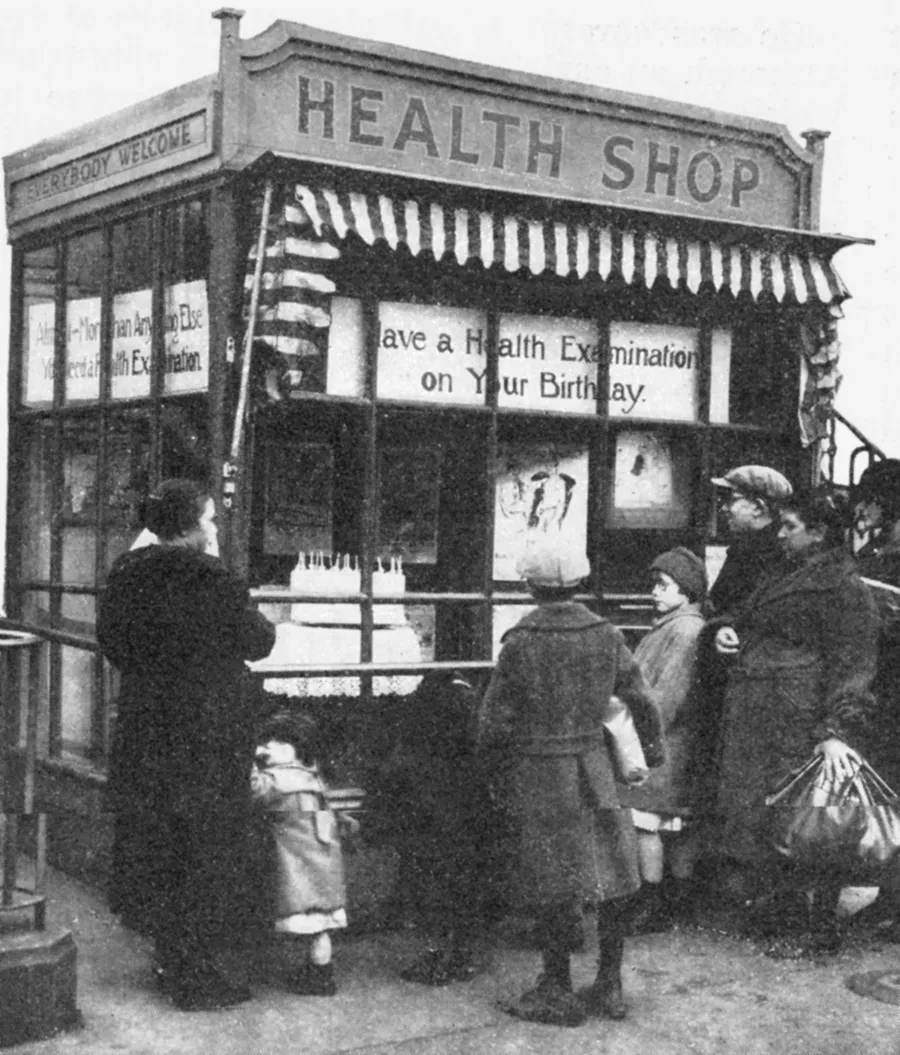
The East Harlem Health Center marketed “health” in its window. Source: Hygeia 9, no. 8 (August 1931).
The early twentieth century was a period within which social reformers witnessed remarkable regulatory success. Concerning federal legislation, for instance, President Theodore Roosevelt signed the Pure Food and Drug Act into law in 1906. In Muller v. Oregon, the U.S. Supreme Court ruled in 1908 that states could limit the number of hours women could work because of the pervading belief that protection of women benefited the public welfare. (Advocates of protective legislation capitalized on the dominant view that regarded women as both a dependent class and as potential mothers of future citizens.2) In 1912, Congress established the Children’s Bureau. In 1916, Congress passed the Child Labor Law. Successes did not come without setbacks. In 1917, for example, the U.S. Supreme Court found the Child Labor Law to be unconstitutional.
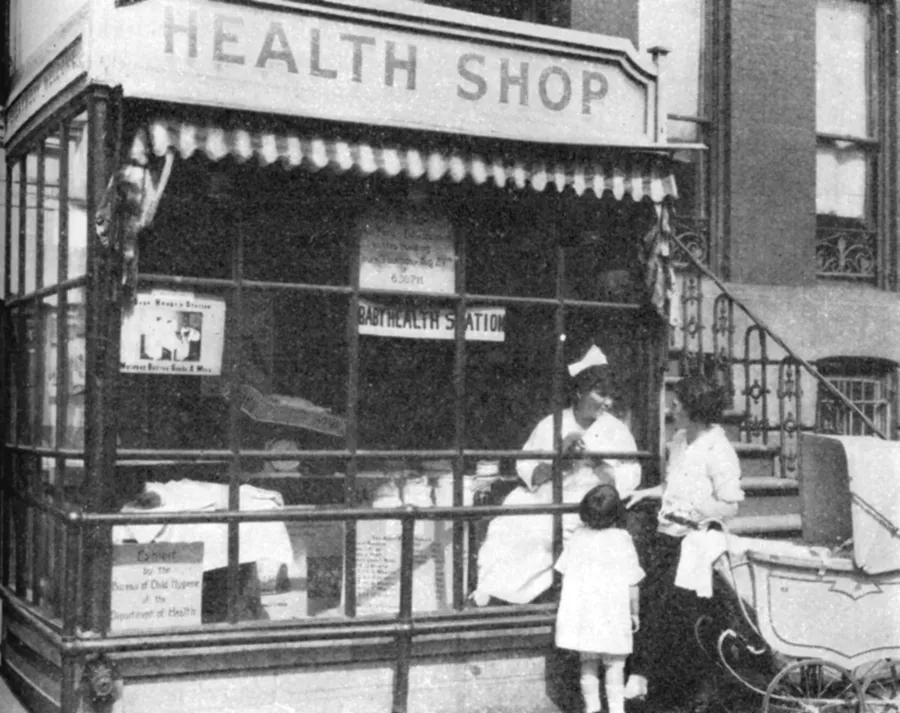
The East Harlem Health Center especially wanted to attract mothers to stop, look, and step inside. Source: Hygeia 9, no. 8 (August 1931).
In comparison to changing beliefs about what constituted the rights and responsibilities of citizens through the courts or legislation, exhibits appeared an economical response to the complications of modern capitalism. Many reformers believed that they needed to procure the public’s sentiment before they could succeed in securing protective legislation at the state and local levels for addressing health and safety issues related to food and work. Thus, exhibits supported rather than substituted for political action at the state and local levels. At the same time, reformers regarded the persuasive aspects of displays about personal hygiene as a potential failsafe if legislative efforts were reversed.
In general, health reformers and officials believed that visual displays, particularly those that included three-dimensional elements, served as a better mechanism to motivate changes in human behavior then just textual explanations. They thought that sensory materials sculpted sensibilities. Feelings, they assumed, undergirded people’s willingness to engage in transformative action. Using exhibits to provide information and act as a means of persuasion, however, was not unique to public health. Many advocates of systemic reform integrated exhibits into their programs for popular education at the beginning of the twentieth century.
An examination of the Charities and The Commons (and its successor the Survey), which was the communication hub for persons engaged in philanthropic endeavors of a social-service nature, provides documentation of the growing ubiquity of educational exhibitions. Between 1905 and 1928, over one hundred articles appeared in the journal about exhibits the editors believed would be of interest to their readers, who were mostly white and middle class. (There were so many exhibits that in 1913 the Survey incorporated a list of them into its classified section.3) These accounts described content, outlined goals, and enumerated critiques. Consequently, this periodical provides a critical lens through which to see how reformers conceptualized this new mode of instruction.
This chapter explores the development of the use of exhibition as an ordinary pedagogical tool for progressive reform as documented by the Charities and The Commons. It begins with the creation of exhibits on tuberculosis: first, a major exhibit in 1905—the American Tuberculosis Exhibition—and then the smaller exhibits that it inspired. There were several reasons that tuberculosis served as the genesis for this new form of popular education. First, at the turn of the twentieth century, tuberculosis was understood to be the “greatest cause of death” in the United States.4 Despite a reduction in the mortality rate from tuberculosis by 30 percent by 1920, as many as 10 percent of America’s population (15 percent in cities) still succumbed to the disease.5 Second, the inability of scientists to turn the discovery of the tubercle bacillus into a precise cure meant that physicians relied on relaying proscriptions for prevention to respond to the disease.6 Approaches to tuberculosis treatment changed throughout the twentieth century as states and sufferers from tuberculosis, armed with new knowledge about the disease, pressed for and against public interventions.7 Throughout the United States, physicians and laypersons created private organizations to offer advice and services. Municipalities and states also developed systems of surveillance and support for treatment. Private and public concerns often converged. Thus, the advent of exhibits for popular education arrived at the same moment that those looking to prevent the spread of tuberculosis were searching for a mechanism to combine medical information with social persuasion.
Based on the descriptions in the Charities and The Commons, it appears that advocates of reform for social-service-related activities used the tuberculosis exhibit as a model to produce exhibits on other social issues. The overlap makes sense in the context of the period. At the turn of the twentieth century, the United States was in the midst of a movement of reform. Middle-class citizens composed a myriad of organizations to bring order to the emerging social and economic circumstances engendered by urbanization and industrialization.8 Similar to tuberculosis, private organizations took the lead at first and then looked to make partnerships with local and state governments. Although reformers had different ideas about the exact responsibilities of a new activist government (should it be building playgrounds? legislating commerce?), they held a common optimistic belief that they could turn government into a tool for setting standards of living for the benefit of the general welfare.
Judging by the frequency of references in the Charities and The Commons, three interest groups in particular introduced exhibition into their reform efforts: urban planning, industrial safety, and child welfare. While different in their specifics, they also often overlapped in the types of materials displayed. Exhibits on urban planning usually included information about antituberculosis campaigns. Exhibits on industrial safety frequently contained data about child labor. Exhibits on child welfare typically incorporated material about tenement reform. Exhibitions, therefore, served as a space of intersection between different foci of reform and often became infused with public health. Reformers shared trust in the ability of exhibits to dramatize dangers and reveal remedies, a faith based on intuition rather than statistical proof, which prompted all of these various groups to invest private and public resources into this mode of popular education.
Tuberculosis as the Template
In late 1905, the National Association for the Study and Prevention of Tuberculosis (NASPT), an organization composed mostly of physicians, and the Committee on Tuberculosis of the New York Charity Organization Society (CSO), an organization comprising primarily laypersons, united to create a major exhibit at the American Museum of Natural History in New York City.9 It ran from November 27 to December 9 and included materials from around the nation to explain the etiology of tuberculosis, how it spread, how it could be cured, and how individuals could participate in prevention efforts.10 The goal for the NASPT was to support the “scientific treatment of tuberculosis.”11 The CSO’s mission was to ameliorate a significant cause of poverty.12 The organizers displayed models, charts, and photographs. They employed docents to explain the contents of the exhibits during the day and held accompanying lectures in the evenings. They also used foreign languages to reach immigrant audiences. The Charities and The Commons told its readers that there “can be no manner of doubt of the educational value of” this visual representation of this medical matter.13 The periodical declared that the impact of examining a “full-sized model of the dark, interior, tuberculosis-breeding bedroom” was more significant than previous strategies (lectures and leaflets) for popular education.14 Using statistics to measure success, the Charities and The Commons noted that the exhibit attracted over 10,000 visitors in the first week it opened.15
This exhibit was not the first time education about tuberculosis was put on display, but it was the first exhibit explicitly built to travel.16 Even before the exhibit closed, reporters noted that the organizers intended to transport it to Boston, Chicago, Newark, and Providence, all cities with large immigrant populations.17 The exhibit ended up being displayed in whole or in part in large and small cities in the United States as well as traveling to Canada and Mexico.18 By June 1906, approximately seven months after its initial opening, an estimated 216,000 people had seen the American Tuberculosis Exhibition in s...
Table of contents
- Cover
- Series Page
- Title Page
- Copyright
- Dedication
- Contents
- Introduction: Valuing the Visual in Public Health Education
- Chapter 1. Developing Exhibition as a Common Tool for Popular Education
- Chapter 2. The Art of Exhibit Making
- Chapter 3. Health Trains: An Experiment in Traveling Exhibits
- Chapter 4. Controversial Exhibits
- Conclusion: A Gradual Decline
- Acknowledgments
- Notes
- Index
- About the Author
- Series List
Trusted by 375,005 students
Access to over 1.5 million titles for a fair monthly price.
Study more efficiently using our study tools.
Frequently asked questions
Yes, you can cancel anytime from the Subscription tab in your account settings on the Perlego website. Your subscription will stay active until the end of your current billing period. Learn how to cancel your subscription
No, books cannot be downloaded as external files, such as PDFs, for use outside of Perlego. However, you can download books within the Perlego app for offline reading on mobile or tablet. Learn how to download books offline
Perlego offers two plans: Essential and Complete
- Essential is ideal for learners and professionals who enjoy exploring a wide range of subjects. Access the Essential Library with 800,000+ trusted titles and best-sellers across business, personal growth, and the humanities. Includes unlimited reading time and Standard Read Aloud voice.
- Complete: Perfect for advanced learners and researchers needing full, unrestricted access. Unlock 1.5M+ books across hundreds of subjects, including academic and specialized titles. The Complete Plan also includes advanced features like Premium Read Aloud and Research Assistant.
We are an online textbook subscription service, where you can get access to an entire online library for less than the price of a single book per month. With over 1.5 million books across 990+ topics, we’ve got you covered! Learn about our mission
Look out for the read-aloud symbol on your next book to see if you can listen to it. The read-aloud tool reads text aloud for you, highlighting the text as it is being read. You can pause it, speed it up and slow it down. Learn more about Read Aloud
Yes! You can use the Perlego app on both iOS and Android devices to read anytime, anywhere — even offline. Perfect for commutes or when you’re on the go.
Please note we cannot support devices running on iOS 13 and Android 7 or earlier. Learn more about using the app
Please note we cannot support devices running on iOS 13 and Android 7 or earlier. Learn more about using the app
Yes, you can access Exhibiting Health by Jennifer Lisa Koslow in PDF and/or ePUB format, as well as other popular books in Medicine & North American History. We have over 1.5 million books available in our catalogue for you to explore.