Although the "decline" of network television in the face of cable programming was an institutional crisis of television history, John Caldwell's classic volume Televisuality reveals that this decline spawned a flurry of new production initiatives to reassert network authority. Television in the 1980s hyped an extensive array of exhibitionist practices to raise the prime-time marquee above the multi-channel flow. Televisuality demonstrates the cultural logic of stylistic exhibitionism in everything from prestige series ( Northern Exposure ) and "loss-leader" event-status programming ( War and Remembrance ) to lower "trash" and "tabloid" forms ( Pee-Wee's Playhouse and reality TV). Caldwell shows how "import-auteurs" like Oliver Stone and David Lynch were stylized for prime time as videographics packaged and tamed crisis news coverage. By drawing on production experience and critical and cultural analysis, and by tying technologies to aesthetics and ideology, Televisuality is a powerful call for desegregation of theory and practice in media scholarship and an end to the willful blindness of "high theory."

- English
- ePUB (mobile friendly)
- Available on iOS & Android
eBook - ePub
About this book
Information
Publisher
Rutgers University Press ClassicsYear
2020Print ISBN
9781978816039
9781978816213
eBook ISBN
9781978816220
PART I
The Problem of the Image
CHAPTER 1
Excessive Style
The Crisis of Network Television
Television is to communication what the chainsaw is to logging.—Director David Lynch1There isn’t much out there that looks real.—Director/cameraman Ron Dexter2
Disruptive Practice
On the Friday, September 8, 1989, edition of ABC’s nightly news, erudite anchor Peter Jennings bemoaned the advent of what he termed “trash television.” Prefacing his remarks by reference to a previous report by ABC on the subject, Jennings described the phenomenon with a forewarning. Norms of quality, restraint, and decorum notwithstanding, the new and ugly genre would in fact shortly premiere. Citing H. L. Mencken’s adage about not overestimating the intelligence of the American people, Jennings signed off that evening with an obvious air of resignation. The class struggle, one sensed, might soon be lost.
Within two evenings, Jennings’s warning was fulfilled. The highly evolved intertextuality that characterized television of the late 1980s was about to witness one of its most extreme manifestations to date. On Saturday, September 9, independent station KHJ-Channel 9 of Los Angeles uncorked the one-hour premiere of American Gladiators in syndication to stations throughout the country. Two nights later superstation KTLA-Channel 5 of Los Angeles aired its own nationwide trash spectacular—a two-hour premiere version of a show named Rock-and-Rollergames. Later that fall, pay-per-view television made available to cable viewers nationwide a special called Thunder and Mud. This latter trash hybrid featured various low-culture luminaries, and included Jessica Hahn of the recent PTL–Jim Bakker sex scandal, female mud wrestlers, wild-man comedian Sam Kinison, and the all-woman heavy-metal rock group She-Rok. The Los Angeles Times labeled the spectacle “Sex, Mud, and Rock-and-Roll.” The producers, however, preferred the derivative punch of Thud to the official program title Thunder and Mud. To the show’s makers, Thud was a “combination female mud-wrestling act–heavy-metal rock concert–game show with some comedy bits thrown in.”3 If any doubts remained about mass culture’s reigning aesthetic in 1989, it was certainly clear that stylistic and generic restraint were not among its properties.
Rock-and-Rollergames was slated, interestingly, to air against the widely popular and front-running network sitcom Roseanne. Such competition was formidable given the vertically scheduled and heavily promoted sequence of shows that followed Roseanne Tuesday nights on ABC. Given trash television’s excessive and low-culture pretense, such competition was significant, since Roseanne was being celebrated as television’s premier “low-culture” hit; a status it had achieved with both viewers and tabloids during the previous season. By late fall, KHJ-TV had shifted Rock-and-Rollergames to Saturday mornings, and had renamed (and reduced) the spectacle to Rollergames, still in wide syndication in 1993. American Gladiators found itself shifted later in the year to the weekend schedule, and in subsequent years to late weekday afternoon strips. Together with its primetime airings, Gladiators found a lucrative niche by actively extending its competition out into the audience. Open trials were held throughout the country in highly publicized gladiator competitions at places like the Los Angeles Coliseum. Although trash television did not turn out to be an overwhelmingly dominant genre in primetime, Gladiators and other shows continued successfully in production with much success through the next four seasons. Musclebound, steroid-pumped women gladiators like Zap continued to grace the pages of TV Guide and the sets of celebrity talk shows through 1993.4 A medieval variant of the trash spectacular, called Knights and Warriors, entered the trash programming fray in 1992–1993. Nickelodeon hyped and cablecast its hyperactive trash-gladiatorial clones, Guts and Guts: All Stars, for the younger set throughout the 1993–1994 season.
Although the genre was defined from the start by its distinctive no-holds barred look, trash spectaculars were also symptomatic of a broader and more persistent stylistic tendency in contemporary television—one that was not always castigated as trash nor limited to low-culture content. That is, trash-spectaculars can be seen as a stylistic bridge between lower trash shows—like professional wrestling or The Morton Downey, Jr. shock-talk show (series that exploited very low production values to blankly document hyperactive onstage performances for the fan situated squarely in the stands or on the sofa)—and higher televisual forms that more extensively choreograph visual design, movement, and editing specifically for the camera. Even mid-1980s shows with higher cultural pretension or prestige, like Max Headroom or Moonlighting on ABC or MTV’s manic game show Remote Control, frequently stoked their presentational engines with excesses not unlike those that characterized trash spectaculars. Although broadcast manifestations of the televisual tendency took many shapes, stylistic excess has continued to rear its ostensibly ugly head—even in the ethically pure confines of Peter Jennings’s network news division.
Bells and Whistles and Business as (Un)Usual
We don’t shy away from the aesthetic nature of the business. We have one foot on the edge, and we have to keep it there.—Local station executive, WSVN-TV, Miami
Starting in the 1980s, American mass-market television underwent an uneven shift in the conceptual and ideological paradigms that governed its look and presentational demeanor.5 In several important programming and institutional areas, television moved from a framework that approached broadcasting primarily as a form of word-based rhetoric and transmission, with all the issues that such terms suggest, to a visually based mythology, framework, and aesthetic based on an extreme self-consciousness of style. This is not just to say that television simply became more visual, as if improved production values allowed for increasing formal sophistication. Such a view falls prey to the problematic notion that developments in technology cause formal changes and that image and sound sophistication are merely by-products of technical evolution. Rather, in many ways television by 1990 had retheorized its aesthetic and presentational task.6 With increasing frequency, style itself became the subject, the signified, if you will, of television. In fact, this self-consciousness of style became so great that it can more accurately be described as an activity—as a performance of style—rather than as a particular look.7 Television has come to flaunt and display style. Programs battle for identifiable style markers and distinct looks in order to gain audience share within the competitive broadcast flow. Because of the sheer scope of the broadcast flow, however—a context that simultaneously works to make televised material anonymous—television tends to counteract the process of stylistic individuation.8 In short, style, long seen as a mere signifier and vessel for content, issues, and ideas, has now itself become one of television’s most privileged and showcased signifieds. Why television changed in this way is, of course, a broader and important question. Any credible answer to the question is only possible after systematically and patiently analyzing representative program texts. By closely examining style and ideology in a range of shows and series that celebrate the visual, the decorative, or the extravagant a more fundamental reconsideration of the status of the image in television becomes possible.
Televisuality was a historical phenomenon with clear ideological implications. It was not simply an isolated period of formalism or escapism in American television or a new golden age. Although quality was being consciously celebrated in the industry during this period, the celebration had as much to do with business conditions as it did with the presence of sensitive or serious television artists.9 Nor was televisuality merely an end-product of postmodernism.10 The growing value of excessive style on primetime network and cable television during the 1980s cannot simply be explained solely by reference to an aesthetic point of view. Rather, the stylistic emphasis that emerged during this period resulted from a number of interrelated tendencies and changes: in the industry’s mode of production, in programming practice, in the audience and its expectations, and in an economic crisis in network television. This confluence of material practices and institutional pressures suggests that televisual style was the symptom of a much broader period of transition in the mass media and American culture. Yet historical changes are seldom total. Six principles—ranging from formal and generic concerns to economic and programming functions—further define and delimit the extent of televisuality. These qualifications will be more fully examined through close analysis in the chapters that follow.
1. Televisuality was a stylizing performance—an exhibitionism that utilized many different looks. The presentational manner of televisuality was not singularly tied to either low- or high-culture pretense. With many variant guises—from opulent cinematic spectacles to graphics-crunching workaday visual effects—televisuality cut across generic categories and affected some narrative forms more than others. For example, the miniseries proved to be a quintessential televisual form, while the video-originated sitcom—at least with a few notable exceptions—resisted radical stylistic change. Conceived of as a presentational attitude, a display of knowing exhibitionism, any one of many specific visual looks and stylizations could be marshaled for the spectacle. The process of stylization rather than style—an activity rather than a static look—was the factor that defined televisual exhibitionism.
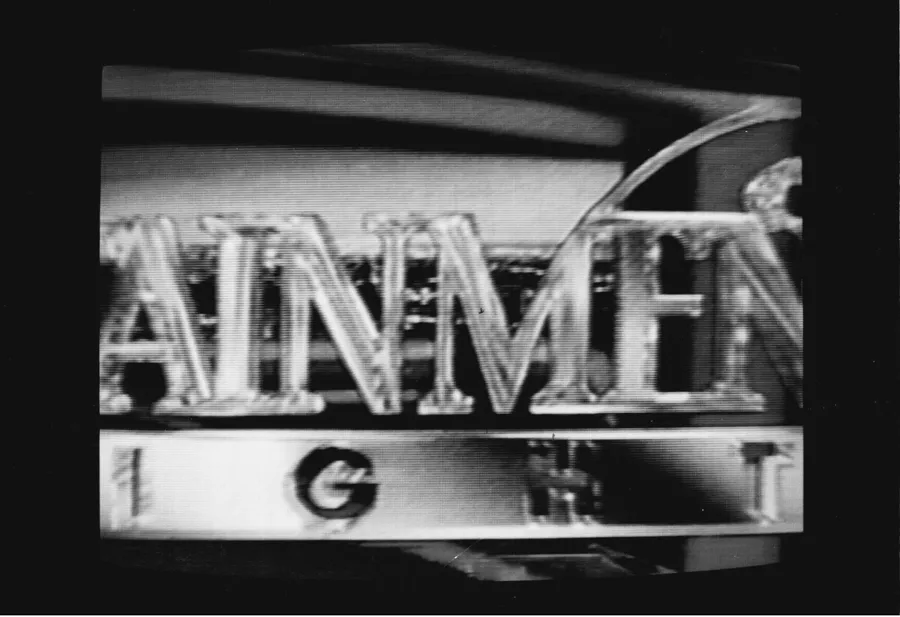
Bells-and-whistles TV. Nightly zooms through crystalline and chrome digital packaging on Entertainment Tonight. (Paramount)
Consider Entertainment Tonight, for example, a hallmark televisual show that influenced a spate of tabloid, reality, and magazine shows during the 1980s. Variety hailed ET, a forerunner of tabloid horses A Current Affair and Inside Edition, as “the granddaddy of all magazine strips” for its “brighter look and provocative stories.”11 Having survived over three thousand individual episodes and having prospered nationally in syndication for over a decade by 1993, the show’s executive producer explained the show’s secret to success: “We continued to update our graphics and other elements of production, the bells and whistles. If you look at our show, let’s say once a month for the last seven years, the only constants are the title, the theme, and John and Mary hosting the weekday show. Everything else continues to change. So we go through a continual process of reinventing the wheel.”12 ET, then, airing five days a week, year-round, defines itself not by its magazine-style discourse or host-centered happy talk, but by the fact that the viewer can always expect the show’s style—its visual and graphic “bells and whistles”—to change. Televisuality, then, is about constantly reinventing the stylistic wheel.
2. Televisuality represented a structural inversion. Televisual practice also challenged television’s existing formal and presentational hierarchies. Many shows evidenced a structural inversion between narrative and discourse, form and content, subject and style. What had always been relegated to the background now frequently became the foreground. Stylistic flourishes had typically been contained through narrative motivation in classical Hollywood film and television. In many shows by the mid-1980s however, style was no longer a bracketed flourish, but was the text of the show. The presentational status of style changed—and it changed in markets and contexts far from the prestige programming produced by Hollywood’s primetime producers.
Broadcasting magazine, for instance, described the dramatic financial reversal of the Fox television affiliate in Miami’s highly competitive market. The ratings success of WSVN-TV was seen as a result of the station “pumping out” seven hours of news “that mirrors the music video in its unabashed appeal to younger viewers—flashy graphics, rapid-fire images, and an emphasis on style.” While the trades saw the economic wisdom of stylistic overhauls like this one, television critics marveled at the station’s able use of an aggressive, wall-to-wall visual style to revive a dead station.13 Even the vice presidents at WSVN theorized the journalistic success of the station in artistic terms, as a precarious but necessary form of aesthetic risk taking.14 By marketing cutting-edge news as constructivist plays of image and text, even affiliate station M.B.A-types now posed as the avant-garde.
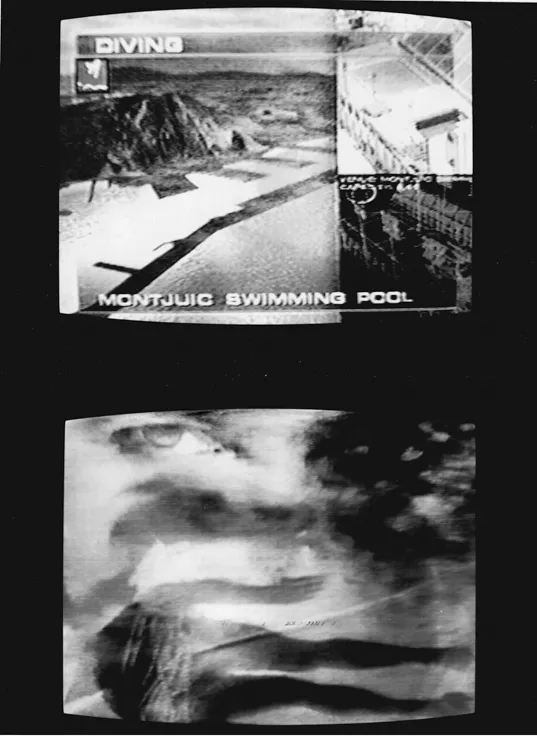
Cutting-through-the-clutter. Videographic televisuality ruled “live” coverage of the 1992 Barcelona Olympics, and included high-resolution virtual reality displays of Mediterranean geography and ...
Table of contents
- Cover
- More Praise for Televisuality
- Title Page
- Copyright
- Contents
- Preface
- Part I: The Problem of the Image
- Part II: The Aesthetic Economy of Televisuality
- Part III: Cultural Aspects of Televisuality
- Acknowledgments
- Notes
- Bibliography
- Index
- About the Author
Trusted by 375,005 students
Access to over 1.5 million titles for a fair monthly price.
Study more efficiently using our study tools.
Frequently asked questions
Yes, you can cancel anytime from the Subscription tab in your account settings on the Perlego website. Your subscription will stay active until the end of your current billing period. Learn how to cancel your subscription
No, books cannot be downloaded as external files, such as PDFs, for use outside of Perlego. However, you can download books within the Perlego app for offline reading on mobile or tablet. Learn how to download books offline
Perlego offers two plans: Essential and Complete
- Essential is ideal for learners and professionals who enjoy exploring a wide range of subjects. Access the Essential Library with 800,000+ trusted titles and best-sellers across business, personal growth, and the humanities. Includes unlimited reading time and Standard Read Aloud voice.
- Complete: Perfect for advanced learners and researchers needing full, unrestricted access. Unlock 1.5M+ books across hundreds of subjects, including academic and specialized titles. The Complete Plan also includes advanced features like Premium Read Aloud and Research Assistant.
We are an online textbook subscription service, where you can get access to an entire online library for less than the price of a single book per month. With over 1.5 million books across 990+ topics, we’ve got you covered! Learn about our mission
Look out for the read-aloud symbol on your next book to see if you can listen to it. The read-aloud tool reads text aloud for you, highlighting the text as it is being read. You can pause it, speed it up and slow it down. Learn more about Read Aloud
Yes! You can use the Perlego app on both iOS and Android devices to read anytime, anywhere — even offline. Perfect for commutes or when you’re on the go.
Please note we cannot support devices running on iOS 13 and Android 7 or earlier. Learn more about using the app
Please note we cannot support devices running on iOS 13 and Android 7 or earlier. Learn more about using the app
Yes, you can access Televisuality by John T Caldwell in PDF and/or ePUB format, as well as other popular books in Social Sciences & Television History & Criticism. We have over 1.5 million books available in our catalogue for you to explore.