eBook - ePub
Bible Readers and Lay Writers in Early Modern England
Gender and Self-Definition in an Emergent Writing Culture
- 246 pages
- English
- ePUB (mobile friendly)
- Available on iOS & Android
eBook - ePub
Bible Readers and Lay Writers in Early Modern England
Gender and Self-Definition in an Emergent Writing Culture
About this book
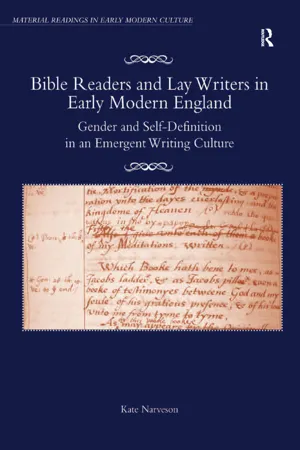
Bible Readers and Lay Writers in Early Modern England studies how immersion in the Bible among layfolk gave rise to a non-professional writing culture, one of the first instances of ordinary people taking up the pen as part of their daily lives. Kate Narveson examines the development of the culture, looking at the close connection between reading and writing practices, the influence of gender, and the habit of applying Scripture to personal experience. She explores too the tensions that arose between lay and clergy as layfolk embraced not just the chance to read Scripture but the opportunity to create a written record of their ideas and experiences, acquiring a new control over their spiritual self-definition and a new mode of gaining status in domestic and communal circles. Based on a study of print and manuscript sources from 1580 to 1660, this book begins by analyzing how lay people were taught to read Scripture both through explicit clerical instruction in techniques such as note-taking and collation, and through indirect means such as exposure to sermons, and then how they adapted those techniques to create their own devotional writing. The first part of the book concludes with case studies of three ordinary lay people, Anne Venn, Nehemiah Wallington, and Richard Willis. The second half of the study turns to the question of how gender registers in this lay scripturalist writing, offering extended attention to the little-studied meditations of Grace, Lady Mildmay. Narveson concludes by arguing that by mid-century, despite clerical anxiety, writing was central to lay engagement with Scripture and had moved the center of religious experience beyond the church walls.
Information
From Reading Skills to Writing Practices
Chapter 1
Reading the Bible: Clerical Prescriptions and Lay Reading Practices
Grace Mildmay was conscious of her lack of education. She warned her daughter to read her meditations “not looking for Eloquence, exact Method, or learning, which could not proceed from me, who have not been raised up in universitie learning.” Richard Willis similarly acknowledges “It was not my happines to be bred up at the University.”1 Yet despite their lack of schooling, both took great satisfaction in writing and produced books of their devotions. A clue to how this was possible appears in the funeral sermon for Elizabeth Gouge. The preacher, Nicholas Guy, declares, “With her own hand shee penned sundry devout Prayers … She hath also left written by her selfe many divine directions for Devotions. She further tyed her selfe by a set dayly taske to reade the holy Scriptures.”2 Godly writing is linked with Scripture reading.
Writing requires not only something to say but a sense of how to gather, organize, and phrase one’s ideas. A surprising number of ordinary lay people learned those compositional skills from the practices they were taught to use in reading Scripture. We need, therefore, to start by examining how they approached the Bible. What specific reading practices did they learn, and what habits of association and arrangement of ideas went with those practices?3 To answer those questions, we can look both at how the clergy sought to direct (and circumscribe) lay Scripture reading and at how the laity supplemented that instruction with textual habits acquired indirectly. Further, manuscript evidence allows us to detail the reading practices that determined the shape of the laity’s own scripturalist writing. Believers excerpted texts that addressed issues of personal concern and they recorded meaningful sentences. They copied others’ prayers and composed their own, they analyzed the spiritual significance of events, and they recorded their meditations. In their traces in religious manuscripts, we can see the origins of what came to be the characteristic modes of lay religious composition: occasional meditations, meditations on scripture, and prayers. And at some point, for some of them, a striking shift occurs. When they refer to their “book” it is no longer to a physical object, the blank sheets or notebook in which they record their reading. Rather, they are referring to “their book,” the book that they wrote, not merely a physical place for notes but a conceptual entity, a text of their own composing.
Modes of Reading and Clerical Ambivalence
The clergy were anxious. Even those committed to a voluntaristic lay piety were ambivalent. What troubles threatened when the church taught ordinary layfolk to read the Bible? Peter Kaufman has shown that the reformations in sixteenth-century England left successive and contradictory attitudes toward the laity. The rights of the laity to read Scripture were prominent in the rhetoric of the first generation of reformers, yet the developing page design of printed Bibles testifies to attempts to guide reading, and Elizabeth and her Council held “popularity” in deep suspicion as a threat to good order and social control.4 Certainly some clergy remained staunch believers in an educated and involved laity, but, when confronting the presbyterian movement of the 1570s and 1580s, most clergy denigrated the capacity of the common lay person. By the 1590s, parish governance was oligarchic, and “conformist critics had successfully claimed democracy was a monstrosity.”5 Still, the Church of England joined other Protestant churches in calling for lay Scripture literacy: “Men, women, young, old, learned, unlearned, rich, poor, priests, laymen, lords, ladies, officers, tenants, and mean men, virgins, wives, widows, lawyers, merchants, artificers, husbandmen, and all manner of persons of what estate or condition soever they be, may in this book learn all things that they ought to believe, what they ought to do, and what they should not do, as well concerning almighty God, as also concerning themselves and all others.” So proclaimed Thomas Cranmer in his prologue to the Great Bible in 1540.6 Ministers endorsed the value of Scripture reading in the household, nor was there significant debate about the value of individual Scripture reading even as rifts formed within the church over ecclesiology and worship.7 As the translators of the 1611 Authorized Version declare in their preface to the reader, “they are reproved that were unskilful in them” but “they are commended that searched and studied them,” for reading Scripture would give “light of understanding, stableness of persuasion, repentance from dead works, newness of life, holiness, peace, [and] joy in the Holy Ghost.”
The clergy, though, also found common ground in their concerns about the ability of unlearned readers to make sense (the right sense) of the “dark places” of Scripture. As Matthew Brown notes, in the eyes of the clergy “literacy was at once emancipatory, in that it delivered the devout from ‘popish tyranny,’ and regulatory, in that it maintained the hierarchical control of divinity-trained ministers.”8 Or rather, it hoped to maintain that control, asserting the laity’s need for the clergy’s expertise. Peter Lake recounts that in correspondence with his sister-in-law, Thomas Cartwright revised his own earlier defense of lay access to the vernacular Scripture to “emphasise once more the intercessionary role of the minister mediating between the actual text of the scripture and the people of God.”9 The clergy generally joined in agreeing that, as Ian Green puts it, “while everybody should study the scripture, the soundest interpreters were those with knowledge of the original languages in which the Bible was written.” As an emerging professional class, pastors were clear that lay interpretation must be guided by experts.10 Pastors therefore provided this guidance in the paratexts to printed Bibles and in directions for lay scripture reading that appeared both within larger works of practical divinity and as free-standing publications.11 Along with the concern about lay ability was an unspoken concern about maintaining professional standards. The professionalization of the English clergy was largely based on their training in what Lake characterizes as a “formidable array of linguistic, historical and theological skills … necessary for a proper understanding of the scripture.”12 How did the ministry’s call for lay Bible reading cohere with their sense of exegesis as a specialized professional skill? In some sense, that problem disappears when one reads clerical instructions for lay reading: the laity were not being called to interpret Scripture but to read it in order to solidify the grounds of doctrine already laid down elsewhere.13 Reading was enjoined on “all sorts” so “that they may be the better confirmed and settled in the things which they know, recall those things to memory … and by refreshing and renewing this knowledge, be the better able to walke themselves in this cleare light,” according to John Downame’s wishful account of lay Bible reading.14 In another sense, though, the problem hovers just below the surface, and the tensions it caused in pastoral thinking shaped the main outlines of clerical instructions. While prescriptions for reading cannot tell us how lay people actually read the Bible, they provide a useful starting point, since they indicate the basic modes of reading and attendant skills that would have been taught to simple readers.
On the most general level, guides to Scripture reading focus on “profit” or “fruit.” Believers were told that their reading must touch their hearts and they were taught to look for godly precepts for daily conduct. Should they find a passage obscure, they should consult learned men. Intensive reading and inter-textual consultation were thus conjoined in Protestant senses of what scripture reading required. One rereads and dwells on a text until it is deeply internalized, as in Downame’s vision of Bible reading as a practice that renews existing knowledge. This practice requires submission to the text. Downame urged lay people to approach Scripture “framing and fashioning our hearts unto it, and changing and varying our affections, as the matter is varied and changed” (647). Yet Protestant biblicism developed in tandem with humanism, and the clergy had a keen sense of the range of linguistic and historical knowledge needed to arrive at the true sense of the text. They responded by providing interpretive aids and methods which introduced lay readers to inter-textual reading, in which the reader looked away from the immediate passage to other parts of the text or to other sources of edification.15 For the clergy, intensive and inter-textual reading practices represent a two-pronged strategy of control, in one case fostering a passive submission to the text and in the other encouraging a deferential consultation of clerical authority.
The clergy’s uneasy mix of idealism and anxiety can be seen in Richard Rogers’ Seaven Treatises (1603), a best-selling guide to practical godliness.16 Rogers first gives a picture of reading that is orderly (“not here and there a chapter”), aims at thorough digestion, avoids novelty, and is subject to guidance “by the helpe of their faithfull teachers.” Further, believers should apply their reading to themselves, since “all precepts of dutie and good life, are set downe to direct us (not others onely)” (289). Thus far, Rogers promotes a model of intensive and deferential reading. But in Rogers’s two final directions, an otherwise suppressed recognition of the actual complexity of scripture reading creeps in. Rogers notes that weak readers must turn to stronger, and that strong readers should note their doubts, and “seeke resolution of them, at their learned pastors hands, or of some others: and mark the coherence of the Scripture, how it hangeth together … that thereby that which seemeth darke in one [place], is made easie in another” (290). In short, readers will confront parts of Scripture that they don’t understand and will have to take notes, seek help outside the text, and use hermeneutics such as the “analogy of faith.” But having admitted this much, Rogers breaks off. He notes that he could say a good deal more about the technical aspects of reading, but here he has aimed only to show how reading Scripture “may bee profitably used to helpe the Christian to be fruitfull in a godly life” (290). Rogers, in other words, sees a qualitative difference between the technical skills of learned reading and the simple passive reading that lay readers will undertake.
Rogers’s brief acknowledgement of the complications reflects clerical anxieties about how to regulate lay reading.17 Justin Champion has argued that the acceleration of historical biblical criticism in the late seventeenth century corroded “the confidence that Protestant churchmen displayed in their recommendations for Christian readers,” yet when we look closely at those recommendations, cracks in the confidence appear already in the early part of the century, although for different reasons.18 One example of clerical ambivalence appears in John Downame’s discussion of how to order the sequence of daily reading, part of his immense Guide to Godliness, published in 1622. It was generally held that lay people should follow an order of reading, using the texts for the day given in the Book of Common Prayer or one of the similar methods detailed in guides to Bible reading.19 Downame favors orderly reading of the whole Bible, yet his discussion evinces a pastor’s sense of complex practical realities, so that he gets bogged down in qualifications. His inclination to prescribe orderly reading is troubled by, on the one hand, an antipathy to rote practices, and on the other, his sense of the obstacles to full comprehension. True reading involves internalization through intense meditation. After all, Downame argues, even with books other than Scripture we need to re-read, for “men of ordinary capacities and memories can hardly in once or twice reading of a booke, attaine unto the true sense and meaning of the Author.” Therefore a reader must dwell on a passage before moving on (644–5). Yet what about keeping to one’s schedule? It is “better to reade five words with the understanding, then ten thousand when we understand the meaning of them no more, then if they were written in a strange language” (645), although (he is quick to add), “neither is my meaning, that in reading the Scriptures, men of ordinary callings and gifts should tye themselves to understand all they have read, before they proceede further” for many passages are “deepe and mysticall.” Downame will subsequently suggest modes of recourse for coming to understand “dark” places; his concern at this point is simply to note that “I would not have any negligently to slight over what they reade” (645). To that end, Downame insists that readers proceed “after an orderly maner” not “by fits and snatches, here a Chapter and there another, or onely the beginnings of bookes, and then laying them aside.” Further, in a warning that suggests a reaction against the practice of bibliomancy, Downame forbids readers to read “by pieces without order, as the Booke hapneth to open, when we take it into our hand” (647). However, he cannot on the other hand simply endorse a set course of reading:
their practice bringeth little profit, who set themselves (as it were) to their taske, in reading over the Bible every yeere, and so many Chapters every day, if they rest in the deede done, and have little care how they doe it, and take more paines in reading over the words, then in attaining to their meaning. (647)
The tension remains between dw...
Table of contents
- Cover Page
- Title Page
- Copyright Page
- Contents
- List of Figures
- Acknowledgments
- List of Abbreviations
- Introduction: Recovering Lay Writing in Divinity
- Part 1 From Reading Skills to Writing Practices
- Part 2 The Registration of Gender
- Conclusion: Lay Scriptural Devotion Stakes Its Claim
- Bibliography
- Index
Trusted by 375,005 students
Access to over 1.5 million titles for a fair monthly price.
Study more efficiently using our study tools.
Frequently asked questions
Yes, you can cancel anytime from the Subscription tab in your account settings on the Perlego website. Your subscription will stay active until the end of your current billing period. Learn how to cancel your subscription
No, books cannot be downloaded as external files, such as PDFs, for use outside of Perlego. However, you can download books within the Perlego app for offline reading on mobile or tablet. Learn how to download books offline
Perlego offers two plans: Essential and Complete
- Essential is ideal for learners and professionals who enjoy exploring a wide range of subjects. Access the Essential Library with 800,000+ trusted titles and best-sellers across business, personal growth, and the humanities. Includes unlimited reading time and Standard Read Aloud voice.
- Complete: Perfect for advanced learners and researchers needing full, unrestricted access. Unlock 1.5M+ books across hundreds of subjects, including academic and specialized titles. The Complete Plan also includes advanced features like Premium Read Aloud and Research Assistant.
We are an online textbook subscription service, where you can get access to an entire online library for less than the price of a single book per month. With over 1.5 million books across 990+ topics, we’ve got you covered! Learn about our mission
Look out for the read-aloud symbol on your next book to see if you can listen to it. The read-aloud tool reads text aloud for you, highlighting the text as it is being read. You can pause it, speed it up and slow it down. Learn more about Read Aloud
Yes! You can use the Perlego app on both iOS and Android devices to read anytime, anywhere — even offline. Perfect for commutes or when you’re on the go.
Please note we cannot support devices running on iOS 13 and Android 7 or earlier. Learn more about using the app
Please note we cannot support devices running on iOS 13 and Android 7 or earlier. Learn more about using the app
Yes, you can access Bible Readers and Lay Writers in Early Modern England by Kate Narveson in PDF and/or ePUB format, as well as other popular books in Literature & Literary Criticism. We have over 1.5 million books available in our catalogue for you to explore.