- 504 pages
- English
- ePUB (mobile friendly)
- Available on iOS & Android
eBook - ePub
About this book
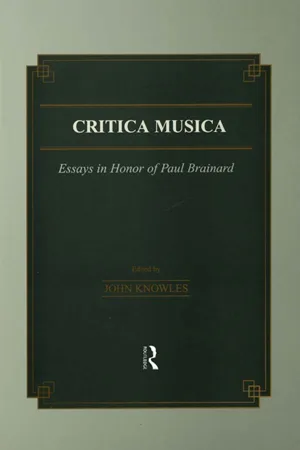
This is Volume 18 of eighteen in a book series on Musicology. Originally published in 1996, this is a collection of essays in honor or Paul Brainard. Critica Musica-thinking critically about music-is at the heart of Paul Brainard's long career, and of his legacy to his students, colleagues, and friends. As a scholar, performer, and teacher, Professor Brainard has embodied a thorough, meticulous, and reasoned approach to music and scholarship that has set a high standard for all who have come in contact with him.
Information
Twins, Cousins, and Heirs: Relationships among Editions of Music Printed in Sixteenth-Century Venice
Mary S. Lewis
In the middle years of the sixteenth century, the two leading Venetian music printers, Antonio Gardano and Girolamo Scotto, frequently published the same music—even the same collections of pieces—at approximately the same time, and at other times produced new editions of each other’s work within a year or two after the previous edition had appeared.
Many questions have arisen regarding the relationship of these similar editions. We do not know if Gardano or Scotto ever jobbed out projects to each other, if they copied each other’s publications, or if they obtained their music through different channels. Sorting out the relationships among these sources should contribute to our understanding of the dynamics of music publishing in Venice in the mid-sixteenth century, and of the way these printers chose, gathered, edited, printed, promoted, and distributed the music they dispersed all over Europe. We can then form a better picture of the nature of the repertory published in Venice, and about the printers’ sources of supply.
Since we have no documentary evidence in the form of agreements, letters, contracts, or lawsuits regarding the paired or similar editions, we must turn to the sources themselves for clues about their relationship, which can best be found by comparing the readings of some of the pieces they hold in common. Such a comparison may tell us if one publisher indeed copied the work of the other verbatim, or if more complex processes were involved. Presumably, the closer the correspondence of readings between two editions, the more likely the possibility one was copied—with or without permission—from the other. Heretofore only Thomas Bridges has worked to any extent on the readings, primarily those of the editions of Arcadelt’s first book of madrigals.1 My own work in this area is far from complete, and this report is preliminary, but I believe we can learn something from it of the dynamics of the music publishing process in Venice.
Interpretations of The Related Editions
Table 1 lists in chronological order the closely-related pairs or groups of editions that the two printers produced from 1539 through 1550. Scholars have ventured a variety of opinions regarding the implications of these closely-related publications. At one extreme are those who suggest that Gardano and Scotto were involved in cooperative ventures, farming out work to each other as necessary, or at least that they coexisted in a state of laissez-faire. The opposite, and until recently more widely-held view, has represented them as pirates, plagiarizing each other’s material in a bitter and protracted rivalry to gain the upper hand in a lucrative business.2
One of the first to address the problem of the paired editions was Robert Eitner, who wrote in 1907:
Although the publishers themselves again and again acquired a printing privilege…it wa...
Table of contents
- Cover
- Half Title
- Title Page
- Copyright Page
- Table of Contents
- Preface
- Principal Publications of Paul Brainard
- Introduction to the Series
- Some Considerations of the Sources of Cristóbal Galán’s Music
- The Speaking Body: Gaspero Angiolini’s Rhétorique Muette and the Ballet d’Action in the Eighteenth Century
- Costanzo Festa’s Inviolata, integra et casta es Maria: a Double Homage Motet
- Bach, Theology, and Harmony: A New Look at the Arias
- The Symphony and the Artist’s Creed: Camille Saint-Saëns and His Third Symphony
- The Letter as Convention in Seventeenth-Century Venetian Opera
- Poetic and Musical Forms in the Laude of Innocentius Dammonis
- Melody and Motive in Schenker’s Earliest Writings
- Twins, Cousins, and Heirs: Relationships among Editions of Music Printed in Sixteenth-Century Venice
- Rhetoric, Rhythm, and Harmony as Keys to Schütz’s Saul, Saul was verfolgst du mich?
- Bach’s tempo ordinario: A Plaine and Easie Introduction to the System
- Amorous Dialogues: Poetic Topos and Polyphonic Texture in Some Polytextual Songs of the Late Middle Ages
- The Violins in Bach’s St. John Passion
- French Opera in Transition: Silvie (1765) by Trial and Berton
- Kindling the Compositional Fire: Haydn’s Keyboard Phantasiren
- When Sources Seem to Fail: The Clarinet Parts in Mozart’s K. 581 and K. 622
- From Madrigal to Toccata: Frescobaldi and the Seconda Prattica
- Beethoven and Shakespeare
- Tenors Lost and Found: The Reconstruction of Motets in Two Medieval Chansonniers
- Index
Trusted by 375,005 students
Access to over 1.5 million titles for a fair monthly price.
Study more efficiently using our study tools.
Frequently asked questions
Yes, you can cancel anytime from the Subscription tab in your account settings on the Perlego website. Your subscription will stay active until the end of your current billing period. Learn how to cancel your subscription
No, books cannot be downloaded as external files, such as PDFs, for use outside of Perlego. However, you can download books within the Perlego app for offline reading on mobile or tablet. Learn how to download books offline
Perlego offers two plans: Essential and Complete
- Essential is ideal for learners and professionals who enjoy exploring a wide range of subjects. Access the Essential Library with 800,000+ trusted titles and best-sellers across business, personal growth, and the humanities. Includes unlimited reading time and Standard Read Aloud voice.
- Complete: Perfect for advanced learners and researchers needing full, unrestricted access. Unlock 1.5M+ books across hundreds of subjects, including academic and specialized titles. The Complete Plan also includes advanced features like Premium Read Aloud and Research Assistant.
We are an online textbook subscription service, where you can get access to an entire online library for less than the price of a single book per month. With over 1.5 million books across 990+ topics, we’ve got you covered! Learn about our mission
Look out for the read-aloud symbol on your next book to see if you can listen to it. The read-aloud tool reads text aloud for you, highlighting the text as it is being read. You can pause it, speed it up and slow it down. Learn more about Read Aloud
Yes! You can use the Perlego app on both iOS and Android devices to read anytime, anywhere — even offline. Perfect for commutes or when you’re on the go.
Please note we cannot support devices running on iOS 13 and Android 7 or earlier. Learn more about using the app
Please note we cannot support devices running on iOS 13 and Android 7 or earlier. Learn more about using the app
Yes, you can access Critica Musica by J. Knowles in PDF and/or ePUB format, as well as other popular books in Media & Performing Arts & Performing Arts. We have over 1.5 million books available in our catalogue for you to explore.