- 298 pages
- English
- ePUB (mobile friendly)
- Available on iOS & Android
eBook - ePub
Portuguese Colonial Cities in the Early Modern World
About this book
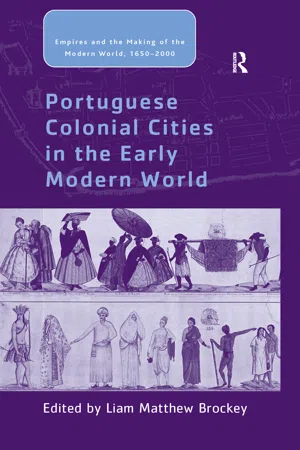
Portuguese Colonial Cities in the Early Modern World is a collection of essays on the cities of the Portuguese empire written by the leading scholars in the field. The volume, like the empire it analyzes, has a global scope and a chronological span of three centuries. The contributions focus on the social, political, and economic aspects of city life in settlements as far apart as Rio de Janeiro, Mozambique Island, and Nagasaki. Despite the seeming (and real) disparities between the colonial cities located in South America, Africa, and Asia, this volume demonstrates that they possessed a range of commonalities. Beyond their shared language, these cities had similar social, religious, and political institutions that shaped their identities. In many cases, the civic bodies analyzed in these essays such as the city councils or the Misericórdias (charitable brotherhoods), no less than the convents and houses of Catholic religious orders, contributed more to making these cities Portuguese than their allegiance to the crown in Lisbon. Rather than dividing the globe into Atlantic and Indian Ocean spheres, Portuguese Colonial Cities in the Early Modern World takes the novel approach of bringing together analyses of the social history of these cities in order to stress their shared aspects as well as to suggest paths for fruitful comparisons. By encouraging further scholarship in this rich, yet understudied subject, this collection will not only further comparisons between cities found within the Portuguese empire, but also raise important issues that will be of interest to historians of other European empires, as well as urban historians generally.
Information
PART I
Religion and Empire
CHAPTER 1
In the Shadow of Empire: Portuguese Jewish Communities in the Sixteenth Century
In the wake of a royal decree issued in December 1496, Jews lost their right to exist in Portugal in legal terms (in the sense of Latin term lege). The decree’s alleged reason for this move was that both Jews and Muslims were responsible for causing large numbers of Christians to abandon their faith.1 Although it was not specified in the texts of the decree, one can conclude that it sought to address the problems of New Christians, that is, those Jews and Muslims who had already converted to Christianity as well as those individuals who, in the opinion of Dom Manuel I, could be converted easily, under religious and political pressure, with the passage of time.
This notion of inevitable conversion lay at the heart of the problem, a fact that would endure for centuries. Jews and Muslims had been expelled from Portugal yet, despite the king’s political-messianic plans, they still represented a stumbling block for the crown. There had been ample proof, sufficiently recognized by that time both by Christians and Jews, that a significant number (yet not a quantifiable percentage) of New Christians had secretly retained the Jewish faith under a cloak of Christian behavior. There were several factors which contributed to this state of affairs: the secret links between New Christians and Jews living outside of Portugal; acts of resistance ranging from the clandestine recovery of books and worship spaces to the recourse to ‘masters’ who behaved secretly as rabbis (Mestre Thomas, Mestre Luís Dias, etc.); and indirect social and political pressures such as those which prevented the mingling of New Christians with the so-called Old Christians. This last form of pressure led New Christians to practice endogamy, a custom that would ensure the persistence, right down to the present, of such rites of resistance. Although these practices were modified by the weight of fear and secrecy, they were preserved, as evinced by the well-known Jewish community of Belmonte, in central Portugal.2
The Jewish question in Portugal was therefore transformed after 1496 into an internal question of Crypto-Judaism. In other words, whereas the original political impulse was to ensure the religious uniformity of the Portuguese population—one people and one faith—the reality was that assimilation had not always taken place, and that converts and their descendants were considered as a people apart. Moreover, one fundamental component of the New Christians’ identity remained in doubt, their religious reliability.3 This is not to say that one should ignore the problem of false Jews or the fabrication of Jews: the fact that many victims of official repression were not secret Jews, but that rather political and religious authorities such as the Inquisition needed to create targets for justifying their own existence as much as for ensuring the economic and social privileges of important sectors of the non-Jewish population.4 For present purposes, it will suffice to recall that the realization of the failure of D. Manuel’s policy of peaceful integration led to a shift in official attitudes during the reign of D. João III, when royal policymakers identified a ‘resurrection’ of the Jewish minority over which the state could vent its repressive energy. As part of the inexorable march to enforce the law, the body politic would be constrained to conform to a uniform mold: it should be wholly Christian.5
Despite the development of scholarship on the Sephardic diaspora in recent years, much remains to be learned about the routes taken by Jews who escaped official repression and about the regions where they settled. Perhaps most important, however, is the question of how many Jews from Iberia settled in each different region where they found refuge. Both Christian and Jewish sources can help to illuminate these lacunae. By merging the data derived from the writings of individuals such as Damião de Góis, Alonso de Santa Cruz, Ibn Verga, Eliah Capsali, Samuel Usque, and others, it is possible to draw up an overview of Sephardic migration. There is, however, a high degree of variance among such sources, both in terms of their author’s origins and the veracity of their accounts. Modern archival research, conducted by (or commissioned by) scholars such as Bernard Lewis and Amnon Cohen, to name just two of the best-known individuals in the field, has revealed that there are important facets of the history of the Jewish diaspora that have either been relegated to obscurity or ignored entirely.6 As such, documents produced by the Sublime Porte or other Muslim powers, letters written by Jewish merchants unearthed in the Cairo Geniza, and largely unknown or poorly interpreted accounts by Christian travelers, all make clear that there were important communities of exiles in North Africa outside of Morocco, in the Middle East, and even in points further east.
One must nevertheless realize that the historical realities of later centuries have left a coating of mystification on the sixteenth century. Many publications have appeared about the economic, social, and numerical importance of the Jewish population in the Ottoman Empire. Yet while recognizing the existence of many Sephardim in Turkish territories in the sixteenth century, one must not forget that there were also important communities of Jews who were not of Sephardic origin, such as the Romaniots, whose roots reached back to the centuries of the Byzantine Empire in the East, and groups of Jews from other regions, even Ashkenazim.7 Archival research has revealed that the great concentrations of Jews in Ottoman lands in the nineteenth and twentieth centuries who became the targets of the Nazi extermination campaign did not exist in the sixteenth century. Despite this fact, there were scattered pockets of Jews found throughout the Ottoman Empire, where every important urban center had Jews who retained the same socio-economic roles that they had once possessed in the Iberian peninsula.8
There is also a persistent legend which claims that during the period of the Expulsion, only seven or eight Jews fled to Morocco. In reality, there was a significant wave of emigration and that fact helps to explain the role played by Jews in the Portuguese settlements in North Africa.9 Of course, the tenacity of such beliefs is due to the assumption, drawn from an intellectualized vision of history with little regard for facts, about the socio-economic importance of those countries where Jews reside today or those which are considered to be or have been great powers. Only those scholars who are not burdened by such mental handicaps will be able to move beyond these stock views to enjoy other perspectives.
The Composite Character of Jewish Communities
The Jewish communities in the diaspora regions were marked by their composite character. How can it be ignored that the Istanbul Romaniots were above all individuals who had been deported from southern Anatolia, from the Black Sea coasts, from Macedonia, Thrace, and Bulgaria to the new Ottoman capital in 1453? And that these congregations were termed surguns, meaning ‘the expelled’? And that Moses Capsali was their grand rabbi and that he played an important role in the development of Ottoman power? It was thanks to the support of important Romaniots such as the grand rabbi Capsali himself that the Sephardim found it so easy to settle in the newly-created empire. And how can one ignore the arrival of the Provençal Jews, who arrived in the Ottoman Empire shortly after their expulsion from France in 1500? Or the fact that many Ashkenazi Jews who had been expelled from the Rhineland and Bavaria also took refuge in the Ottoman Empire between 1426 and 1450, before the arrival of the Sephardim? To overlook these groups would be to overlook the role of those contemporaries of the famed Nasci clan, such as Solomon ben Nathan Ashkenazi.10 The history of the relations between the different Jewish communities, figures, and interest groups, has yet to be written so that historiographical discussions can move beyond particularities toward a balanced vision of the Sephardic emigration and its protagonists.
Similar caution is necessary when approaching the subject of the other regions which received Jewish emigrés. Without overstating the political role or the demographic importance of the Sephardic Jews who settled in Morocco after their expulsion from Spain and Portugal, certain factors need to be assayed. Many Sephardim traveled to and settled for long periods in the cities on either side of the Strait of Gibraltar. The importance of the discord between the Sephardim and local peoples (whether Berbers, Palestinian Jews, or Sephardic Jews who had settled long before) reveals the political and cultural power of these longstanding residents. Even within Portuguese cities, contemporary documents indicate the presence of Jews labeled moriscos. By shifting perspectives to that of the indigenous population before the arrival of the expelled Sephardim, one can detect the vitality of these communities before the arrival of the outsiders.11
In the case of Kerala in Southern India, one finds that the Sephardim were easily integrated into the group termed the ‘pure’ or White Jews, a group of emigrés from Yemen and Syria who arrived in the tenth century. The early modern arrivals even assumed positions of leadership within the group in the sixteenth and seventeenth centuries, in light of the demographic decline of the group’s original core. This smooth integration should be understood in the context of a caste society where Jews were assimilated, in one way or another. They stood in opposition to a group considered to be their inferiors, that is, the Malabar Jews or Meshusrarim (‘liberated slaves’) who closely resembled the surrounding Indian population. It was only proper that the ‘Whites’ who came from Europe or the Middle East should have relations with others from the same pure, ancient source. Moreover, White Jews dominated the social relations both within the Jewish community and its links to external powers.12
These examples remind us of the precautions that are necessary when dealing with the subject of the expulsion and emigration of the Jews of the Iberian Peninsula. We must never lose sight of their relations with other communities or think that, regardless of their brilliant past, the Sephardim always reduced to naught the numerical, political, cultural, and economic importance of other large cores of Jews from different origins.
The Differences between the North African and Asian Cases
There were notable variations in the relationships between the Jews and the Portuguese in different regions of the Portuguese empire. My research into the Portuguese possessions in North Africa has revealed that political authorities allowed the Jews to settle there and even pressured them, albeit indirectly, to increase the size and importance of the members of the Jewish communities. The most striking events were the recognition of rabbis and the designation of ghettos, judiarias, in these cities after the Jewish minority in continental Portugal had ceased to enjoy a legal existence. The Jewish communities in the larger Portuguese cities of the Moroccan coast, Safi and Azamor, received letters of privileges in which D. Manuel recognized the legal existence of their judiarias in 1512 and 1514, respectively. In other, smaller, Portuguese holdings such as Arzila, Mazagão (modern El Jadida), and Santa Cruz do Cabo de Gué (modern Agadir), there were also families or individuals who resided under undisputed conditions of security and prosperity.13
No such legal recognition of free Jews was accorded in the cities of Portuguese Asia. There were important Sephardic figures in Cochin in the first half of the sixteenth century, in particular individuals who had come from Portugal. These had joined in with the New Christians of the nearby Portuguese settlement of Santa Cruz de Cochim to build, between 1544 and 1550, the so-called ‘New’ Synagogue. This sanctuary would later pass into the hands of the Malabar Jews who would call it Kadavumbagham, or Outlying, Synagogue.
In the 1560s, the old, powerful Jewish community of Cranganor (a city located to the north) decamped to Hindu Cochin. The Castiel lineage, the uncontested leaders of this g...
Table of contents
- Cover Page
- Title Page
- Copyright Page
- Contents
- List of Figures
- Acknowledgments
- Notes on Contributors
- Editors’ Foreword
- Introduction: Nodes of Empire
- PART I RELIGION AND EMPIRE
- PART II CITIES AND COMMERCE
- PART III POLITICS OF EMPIRE
- Index
Trusted by 375,005 students
Access to over 1.5 million titles for a fair monthly price.
Study more efficiently using our study tools.
Frequently asked questions
Yes, you can cancel anytime from the Subscription tab in your account settings on the Perlego website. Your subscription will stay active until the end of your current billing period. Learn how to cancel your subscription
No, books cannot be downloaded as external files, such as PDFs, for use outside of Perlego. However, you can download books within the Perlego app for offline reading on mobile or tablet. Learn how to download books offline
We are an online textbook subscription service, where you can get access to an entire online library for less than the price of a single book per month. With over 1.5 million books across 990+ topics, we’ve got you covered! Learn about our mission
Look out for the read-aloud symbol on your next book to see if you can listen to it. The read-aloud tool reads text aloud for you, highlighting the text as it is being read. You can pause it, speed it up and slow it down. Learn more about Read Aloud
Yes! You can use the Perlego app on both iOS and Android devices to read anytime, anywhere — even offline. Perfect for commutes or when you’re on the go.
Please note we cannot support devices running on iOS 13 and Android 7 or earlier. Learn more about using the app
Please note we cannot support devices running on iOS 13 and Android 7 or earlier. Learn more about using the app
Yes, you can access Portuguese Colonial Cities in the Early Modern World by Liam Matthew Brockey in PDF and/or ePUB format, as well as other popular books in Historia & Historia del mundo. We have over 1.5 million books available in our catalogue for you to explore.