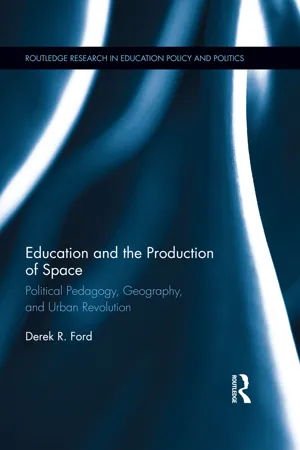
Emerging from a radical pedagogical tradition, Education and the Production of Space deepens and extends Henri Lefebvre's insights on revolutionary praxis by revealing the intimate relationship between education and the production of space. Synthesizing educational theory, Marxist theory, and critical geography, the book articulates a revolutionary political pedagogy, one that emerges as a break from within—and against—critical pedagogy. Ford investigates the role of space in the context of emerging social movements and urban rebellions, with a focus on the Baltimore Rebellion of 2015, and shows how processes of learning, studying, and teaching can help us produce space differently, in a manner aligned with our needs and desires.
eBook - ePub
Education and the Production of Space
Political Pedagogy, Geography, and Urban Revolution
- 136 pages
- English
- ePUB (mobile friendly)
- Available on iOS & Android
eBook - ePub
Education and the Production of Space
Political Pedagogy, Geography, and Urban Revolution
About this book
Information
1
Whither Critical Pedagogy? Breaking from within the Critical Tradition
One of the most remarkable achievements of the offensive waged by capital against working and oppressed people since the 1970s has been the ideological cleaving of politics and education, at least so far as this attack has manifested in the United States. That education and politics are explicitly connected has been an assumption of educational theorists, researchers, and policymakers dating back to Socrates and Plato. There have been countless debates over what form this relationship should take, but that the relationship exists and should be debated has been taken for granted. Yet contemporary discourse around education—and this is not limited to the discourse pulsing through the corporate mass media, but includes teacher education programs, professional educational organizations, and a variety of academic publishing outlets—is predicated upon the very severance of education from the political. Instead of political concerns over values, directions, goals, and purposes, educational debates are increasingly staged in a highly abstracted economic register. This does not mean that education is no longer political, and perhaps it would be more accurate to say that the political presuppositions of contemporary educational discourse are so well entrenched that they appear to be effaced. That education should be oriented toward the insertion of subjects into the global capitalist political economy is taken for granted not only by right-wing think tanks and venture philanthropists like the Bill and Melinda Gates Foundation or The Brookings Institute, but also by liberal education reformers like Linda Darling-Hammond and Diane Ravitch.1 The latter school only differs from the former in that it wishes to intervene slightly in the global political-economic order in an effort to smooth out growing contradictions and antagonisms. Neither Darling-Hammond nor Ravitch, then, want to do away with capitalism—and neither even mentions imperialism. They merely want to decrease inequity within the existing framework, making it more inclusive (at least for those in the US).
There remain, however, some strands of educational thought and praxis that continue to be theorized and enacted to expose and attack this tight wedding of education to global capitalism. One of these strands that is the most well known is critical pedagogy. At the most general level of abstraction, critical pedagogy is an approach to and a conception of education that categorically and unashamedly acknowledges the political nature of education; pedagogy and politics are seen as separate but indivisible pursuits. Embracing the notion of education as a profoundly political practice, Gert Biesta writes that critical pedagogy is “in one way or another committed to the imperative of transforming the larger social order in the interest of justice, equality, democracy, and human freedom.”2 It is organized around a liberatory socio-political vision, one that addresses and attempts to alleviate oppression, alienation, and exploitation. Endorsing the idea that there is an intimate relationship between means and ends, critical pedagogy at this general level attempts to construct a pedagogy that is both consistent with and works toward that liberatory vision (of course, what precisely that liberatory vision of “justice, equality, democracy, and human freedom” looks like is often loosely defined).
Understanding critical pedagogy is a difficult task. For one, critical pedagogy has a 40-year history, and the breadth and divergences in the field as a whole can be quite unwieldy. For two, there is the problem of demarcation, or the question of what precisely can be grouped under this signifier. The question, “What is critical pedagogy?” will no doubt elicit various and probably divergent, perhaps irreconcilable, answers. Or, on the other hand, the question will elicit answers that are simply unwieldy. Take Joe Kincheloe’s Critical Pedagogy Primer as an example.3 In this one book alone Kincheloe brings in the following concepts as foundational to critical pedagogy: post-discourse, critical enlightenment, critical emancipation, poststructuralism, hegemony, cultural studies, normative hermeneutics, semiotics, bricolage, and many others. This all takes place in one chapter. There is no mention as to how these concepts relate to or contradict each other, or how these relations and contradictions should be handled. I would contend that such an amalgamation of theoretical tendencies and philosophical schools is at best unmanageable, and at worst immobilizing. Much is written in critical pedagogy, but not much is actually said. For three, the field has been the subject of intense debate over the years, and the various attacks and responses have muddied the waters even more.
My position is that critical pedagogy is at a dead-end. This is not to say that it offers nothing valuable, but rather that it has been stagnant for some time (I would say at least since the beginning of the 21st century). As is the case with any moribund tradition, there is always the option of pursuing resuscitation. This is the path that Peter McLaren has taken with his development of revolutionary critical pedagogy, and a path that I, too, have ventured down before.4 The option that seems more preferable and useful to me at this point, however, is leaving the tradition behind. Critical pedagogy has served its purpose. Even McLaren’s work, so I proffer, has so significantly broken with the tradition that it is best understood not as revolutionary critical pedagogy, but as revolutionary pedagogy. As such, the educational theory that I develop in this book is situated in relationship to critical pedagogy—as any new development is related to previous historical developments—but ultimately apart from, beyond, and even against critical pedagogy. The way that I would like to articulate this theory in this chapter is by surveying some of the history of the critical traditions in education, including some theorists and tenants of critical pedagogy, pivotal concepts originating in Marx that undergird some of this work, and theoretical and empirical understandings of ideology, reproduction, and resistance.
Paulo Freire and the Question of Form
More than any other figure, Paulo Freire is credited with being one of the founders of—or at least inspirations for—critical pedagogy.5 His book, Pedagogy of the Oppressed, is undoubtedly the best-known work inside and outside of academia associated with the field. It is a book born from Freire’s reflections on his work in literacy campaigns, teaching poor peasants in Brazil how to read and write, or how to “name the world.”6 While Freire’s starting point in Latin America makes him an exception to other critical pedagogues, Freire spent many years in the US during exile. Freire was jailed in Brazil in 1964 and later exiled following a right-wing military coup in the country. Freire was targeted as a revolutionary educator because of his work with poor peasants. Peter McLaren gives a succinct example of this work:
In 1962, the town of Angicos, in Rio Grande de Norte, was witness to a remarkable event: Freire’s literacy program helped 300 rural farm workers learn to read and write in forty-five days. By living communally with groups of peasants and workers, the literacy worker was able to help campesinos identify generative words according to their phonetic value, syllabic length, and social meaning and relevance to the workers. These words represented the everyday reality of the workers. Each word was associated with issues related to existential questions about life and the social factors that determined the economic conditions of everyday existence.7
For Freire, that is, education must be rooted in the daily lives and experiences of students. Further, it must be oriented toward the transformation of those lives and experiences. Generative words and, later, themes are extracted from everyday life.
One strategy employed in this regard was the codification and decodification process. Codifications are generally photographs or other images that illustrate an everyday barrier or contradiction, but they can also be words or other symbols. In the decodification phase, students are asked to place the codified images in the context of larger historical and social forces, institutions, and processes. Codification is, then, a representation of an existential situation, and decodification is the critical understanding of that situation.8 This process is referred to as conscientização, or coming-to-critical-consciousness.
A decisive element to the location and direction of conscientização is the pedagogical relationship. This relates to Freire’s critique of the banking model of education and to his reconception of the teacher-student relationship. The banking model of education represents a vertical relationship between teacher and student in which the student is treated as an empty vessel for the teacher to fill with knowledge, information, skills, habits, and so on. Against this, Freire theorized a dialogical relationship between teacher and student, one which is more—but, and this is absolutely imperative, not completely—horizontal. In this schema:
The teacher is no longer merely the one-who-teaches, but one who is himself taught in dialogue with the students, who in turn while being taught also teach. They become jointly responsible for a process in which they all grow. … Here, no one teaches another, nor is anyone self-taught. People teach each other, mediated by the world, by the cognizable objects which in banking education are “owned” by the teacher.9
The teacher does not relinquish authority or power in Freire’s pedagogy. He later cautioned, “I cannot fall into the type of naïveté that will lead me to think I am equal to my students.”10
While the pedagogical relationship and process are important parts of Freire’s thought, they have tended to be isolated from Freire’s ideological commitments and have come to stand in for Freire’s entire work. This may be so because the first two chapters of Pedagogy of the Oppressed are often the most emphasized. This is not to say that the dialogical aspect of Freire’s pedagogy is not important, but rather that the methodological component of Freire’s pedagogy has been substituted wholesale for his broader conceptual work, his vocabularies and theories that generated new understandings of education and revolution. There is nothing inherent in the codification/decodification process or in dialogue that leads to progressive, critical understandings. For this to happen they must be placed in a particular context by a teacher. McLaren goes so far as to write that, “Political choices and ideological paths chosen by teachers are the fundamental stuff of Freirean pedagogy.”11 In a related manner, Tyson Lewis has shown how Freire’s pedagogical thought actually emerged from within Georg Lukács’ theory of the Party as a teacher. Lewis suggests that, “Freire, as a close reader of Lukács, furthered his project by providing the pedagogical techniques intonated yet lacking in the vanguardist position.”12 This reinforces the inseparability of theory and method, or of the critical and pedagogical, such that we cannot “detach the pedagogy of the oppressed as a method from its connections to leadership (and thus the thorny question of Marxist revolution).”13
Freire offers critical pedagogy an overall conceptual framework that connects pedagogy to the process of transformation. As McLaren puts it, Freire’s
working vocabulary of philosophical concepts and his intercourse of vocabularies from theology to the social sciences enables the world of the oppressed to become visible, to inscribe itself as a text to be engaged and understood by the oppressed and nonoppressed alike.14
Further, Freire’s thought and life sutures the means and ends of liberation by insisting on a more horizontal relationship between teachers and students. Or, better, it advances a dialectical conception of the teacher and student identity and relationship. Yet this aspect of Freire’s thought raises more problems than it solves. McLaren thus remarks that his “pronouncements on pedagogy can be highly frustrating, in that they index important concerns but do not fully p...
Table of contents
- Cover
- Title
- Copyright
- Contents
- Preface
- 1 Whither Critical Pedagogy? Breaking from within the Critical Tradition
- 2 Toward a Revolutionary Political Pedagogy
- 3 The 20th Century Is Not Yet Over
- 4 Educational Spaces and the Logic of Capital
- 5 Pedagogical Struggles in and for the City
- 6 A Revolutionary Political Pedagogy for Space: Learning,Studying, and Teaching in the Streets
- Conclusion
- Appendix: Becoming through Revolutionary Pedagogy: An Interview with Curry Malott and Derek R. Ford
- Index
Trusted by 375,005 students
Access to over 1.5 million titles for a fair monthly price.
Study more efficiently using our study tools.
Frequently asked questions
Yes, you can cancel anytime from the Subscription tab in your account settings on the Perlego website. Your subscription will stay active until the end of your current billing period. Learn how to cancel your subscription
No, books cannot be downloaded as external files, such as PDFs, for use outside of Perlego. However, you can download books within the Perlego app for offline reading on mobile or tablet. Learn how to download books offline
Perlego offers two plans: Essential and Complete
- Essential is ideal for learners and professionals who enjoy exploring a wide range of subjects. Access the Essential Library with 800,000+ trusted titles and best-sellers across business, personal growth, and the humanities. Includes unlimited reading time and Standard Read Aloud voice.
- Complete: Perfect for advanced learners and researchers needing full, unrestricted access. Unlock 1.5M+ books across hundreds of subjects, including academic and specialized titles. The Complete Plan also includes advanced features like Premium Read Aloud and Research Assistant.
We are an online textbook subscription service, where you can get access to an entire online library for less than the price of a single book per month. With over 1.5 million books across 990+ topics, we’ve got you covered! Learn about our mission
Look out for the read-aloud symbol on your next book to see if you can listen to it. The read-aloud tool reads text aloud for you, highlighting the text as it is being read. You can pause it, speed it up and slow it down. Learn more about Read Aloud
Yes! You can use the Perlego app on both iOS and Android devices to read anytime, anywhere — even offline. Perfect for commutes or when you’re on the go.
Please note we cannot support devices running on iOS 13 and Android 7 or earlier. Learn more about using the app
Please note we cannot support devices running on iOS 13 and Android 7 or earlier. Learn more about using the app
Yes, you can access Education and the Production of Space by Derek Ford,Derek R. Ford in PDF and/or ePUB format, as well as other popular books in Education & Education General. We have over 1.5 million books available in our catalogue for you to explore.