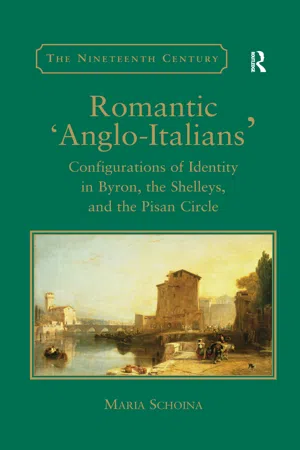
eBook - ePub
Romantic 'Anglo-Italians'
Configurations of Identity in Byron, the Shelleys, and the Pisan Circle
- 202 pages
- English
- ePUB (mobile friendly)
- Available on iOS & Android
eBook - ePub
Romantic 'Anglo-Italians'
Configurations of Identity in Byron, the Shelleys, and the Pisan Circle
About this book
Focusing on key members of the Pisan Circle, Byron, the Shelleys, and Leigh Hunt, Maria Schoina explores configurations of identity and the acculturating practices of British expatriates in post-Napoleonic Italy. The problems involved in British Romanticism's relations to its European 'others' are her point of departure, as she argues that the emergence and mission of what Mary Shelley termed the 'Anglo-Italian' is inextricably linked to the social, political, economic, and cultural conditions of the age: the forging of the British identity in the midst of an expanding empire, the rise of the English middle class and the establishment of a competitive print culture, and the envisioning, by a group of male and female Romantic liberal intellectuals, of social and political reform. Schoina's emphasis on the political implications of the British Romantics' hyphenated self-representation results in fresh readings of the Pisan Circle's Italianate writings that move them away from interpretations focused on a purely aesthetic or poetic attachment to Italy to uncover their complex ideological underpinnings. Recognizing that Mary Shelley was instrumental in conceptualizing the Romantics' discourse of acculturation expands our understanding of this phenomenon, as does Schoina's convincing case for the importance of gender as a major determinant of Mary Shelley's construction of Anglo-Italianness.
Information
Chapter 1
Anglo-Italian Spaces and Metaphors in the Cultural Discourse of the Late Eighteenth and Early Nineteenth Century
Her genius is more soft, harmonious, fine; Ours bolder, deeper, and more masculine: In short, as woman’s sweetness to man’s force, Less grand, but softening by the intercourse, So the two countries are, – so may they be, – England the high-souled man, the charmer Italy.
—Leigh Hunt, To the Right Honourable Lord Byron on his Departure for Italy and Greece, 1816
Now – Italy or London, which you will!
—P.B. Shelley, Letter to Maria Gisborne, 1820
A Tale of Two Countries
Based on a long history of cultural encounters and exchanges, for historians and literary critics, the relationship between England and Italy acquires particular interest in the Renaissance and in the long eighteenth century. During the Renaissance, Italy’s influence over England is so pervasive that, according to the critic Mario Praz, one can safely speak of an essential contribution to the formation and development of another culture, rather than of merely sporadic influence (7–8). By the eighteenth century Italy became the primary destination for the classically educated, upper-class Grand Tourists, and with the end of the Napoleonic Wars and the reopening of the European Continent, it attracts larger numbers of British middle-class travellers who wish to flee modernity and indulge their imaginations in the physical and artistic beauty of the country. Salient in the geography of the Romantic imagination for its classical associations, natural landscape and alluring, though destabilising, coincidentia oppositorum, Italy constitutes a pole of attraction for British poets, writers and artists. In the 1820s, Italianismo becomes associated with the English residents or expatriates in the peninsula, who often form groups, sects or colonies and claim affiliative bonds with Italianness. Nonetheless, as Grand Touring gradually changes to encompass a broader base of tourists, the attitudes of visitors to Italy change. Thus, Italy is being visited for pleasure as well as for instruction.
Much as this often-cited historical synopsis documents Italy’s uninterrupted presence in the English, and later, British immaginario from the Renaissance to the nineteenth century, it inevitably fails to register a whole series of equally important concurrent presences, issues and concerns which inform a phenomenon as broad and complicated as the interaction of cultures. Cultural theory has shown us, especially after the publication of Edward Said’s Orientalism and the revisionist literature it has generated,1 that the relationship with other countries is not natural, transparent or unproblematic, but rather involves a web of issues which relate to power, representation and ideology. Following the directions indicated by such a theoretical framework, recent scholarship in the area of Anglo-Italian relations has attempted a more in-depth reading of the complex historical, political and cultural contexts which formed and informed Europe in the long eighteenth century.2 Drawing on cultural theory in the analysis of literary texts and other cultural and historical documents, these studies have come to register the encounter of Britain with Italian culture and geography not as an uncomplicated, one-way trajectory, but as a map of cultural, political and economical intersecting itineraries. Accordingly, contemporary scholarship has set out to highlight and interpret not only the underlying causes of the Italian allure for the Anglo-Saxon imagination, but also the ambivalences, contradictions, fluctuations and modalities inherent in this cultural phenomenon, in the context of the rich and compelling interaction which informs the encounter of the British with the Italian world at the time.
It is worth noting, that Italy, particularly in the late eighteenth and early nineteenth century and despite its long established cultural authority over Britain, becomes a constant reference point in British narrative and material space through its fictionalisation and commodification. Italy is instantly codified in thought and language and is ‘trapped’ into rhetorical frames and representations which reproduce it according to specific value signs, socially and historically conditioned. As will be argued later in this chapter, Italy proves an exemplary case of a place whose geography was not merely represented but literally reshaped by the various topographies of British poets, novelists, and travel writers. Artemis Leontis’s proposition that ‘the citations of sites, through an act of repossession, may shape the sites of citations’ (23) aptly suggests how topoi of the imagination and literary geographies can, in the end, prove supremely territorial.3
All these facts add valuable insight into the intricate nature of power relations between the cultural coloniser and the culturally colonised, particularly if examined, as Shearer West suggests, in the context ‘of the complex and changing political, social and economic situations in a Europe that was increasingly cosmopolitan even while nations were promoting their distinct cultural identities more self-consciously’ (17). Although the Anglo-Italian encounter does not fall into the large-scale category of the cultural and material interchanges between the British nation and its non-European ‘others’ – such as India, China, or Africa – I believe it offers fertile and energetic reflection on the interaction of cultures and ideas. More specifically, it contributes to the consideration of intra-European relations typical of the Romantic period, and to the highly specific problematics posed by Britain’s interaction with its various European ‘others’ – such as France, Spain, Germany and Greece – a field that has not been subjected to the same sort of analysis as the interchanges between the empire and subaltern elements outside it. As Manfred Pfister observes, although intra-European Meridionism has not had the same far-reaching and devastating political consequences that Orientalism had, yet ‘it has played an incisive role in the formation of British and European self-understanding, in cultural representations, practices and politics’ (3).
To avoid a monolithic, coherent notion of Meridionism, this study assumes that Meridionism is not a closed system of cultural domination but a ‘contact zone’4 between Britain and Italy which is marked by mutual vulnerability, as the cultural identities of both the ‘coloniser’ and the ‘colonised’ are influenced in this encounter. More significantly, as the circulation of power involved in the exchange of authority perpetually reverses and undermines the two positions, the reversibility of ‘self’ and ‘other’ comes as a result of the constant negotiation between opposite forces and impulses. As Lisa Lowe, building on, Michel Foucault, states ‘power is not static, nor does it inhere in an agency or a position or practice in itself; rather, it is found in the spatial and relational nonequivalences of the discursive terrain, in the active shifting and redistribution of the sites of inscription’ (9). Given that the construction of identity involves establishing opposites and others, Italy and England would have imaginative recourse to each other in order to fulfil a sense of cultural/historical/national lack and thus enhance their self-image. In other words, by (temporarily) appropriating the other, and by invading each other’s spaces, they sought to remedy existing deficiencies. In fact, it was all these oppositions and differences – a mixture of fact and fiction perpetuated through the ideological discourse of the time – that defined the qualified attraction of the Italians for the English and of the English for the Italians. The result of this conscious juxtaposition in the cultural discourse of the time is the formation of a space between them which allows them to mirror one another, the space becoming a condition for self-reflexivity, which inevitably results in self-confrontation. Englishness and Italianness confront each other in an intermediate space, where previously set hierarchies fall and are reorganized, providing a constant renewal of the act of identification.
As Pfister argues, British constructions of Italy are based on an interconnected set of oppositions, which are relatively stable in content but shifting in emphasis, pitting Italy against Britain: North vs. South (not only in terms of geographical latitude, but also in racial terms of human physiology and character), Germanic vs. Latin, male vs. female, cold vs. hot, Protestant vs. Roman Catholic, modern achievement vs. classical heritage, efficiency vs. disorganisation, honesty vs. deviousness, civic liberty vs. papal despotism, political power vs. anarchy, and so forth (5). This set of binary oppositions aptly illustrates how the ‘other’ helps a culture – in this case Italy helps Britain – to establish and maintain an identity, ‘by serving as a screen onto which the self projects its unfulfilled longings, its repressed desires and its darker sides which it wishes and sees itself constrained to exorcise’ (4).
On the other hand, the reversibility and change in rank of the opposites in different historical eras creates a pluralisation of discourses about Italy, often in the form of two sharply contrasting discourses, ‘giving rise to the antithetical poles of italomania and italophobia’ (Ellul-Micallef 88). This apparent paradox is further reinforced by the fact that these diametrically opposed attitudes towards Italy not only existed, but co-existed at the time, perpetuating, though on a different scale of values, conflicting perceptions of Italy which had subsisted side by side since the sixteenth century. Thus, in the Renaissance, Italy was a land of cultural wealth and scholarship and, at the same time, a pattern of vice, popery, and religious superstition. Correspondingly, Romantic Italy is recast in the cultural discourse of the time as both self and other, as that which, in Homi Bhabha’s words, ‘is at once an object of desire and derision, an articulation of difference contained within the fantasy of origin and identity’ (The Location of Culture 67).
In the face of Anglo-Italian cross-cultural fantasies and premonitions, the literature of the time ventures unrestrained crossings and brings forth elaborate comparisons5 between the two countries. Rooted in historical coordinates, the imaginative geographies of the period – in painting, fiction, poetry – are infused with elements from both cultures and mentalities. Many works of art become an arena of Anglo-Italian encounters, as two distinct geographies, climates, mindsets and languages confront each other in fanciful ways and re-imagine/re-negotiate their borders, differences and affinities. In other words, the British cultural discourse of the time does not solely engage with the representation of Italian cultural, geographical, social and historical spaces but flirts with the idea(l) of hybridised, Anglo-Italian spaces. Notably, this experimentation with opposing geographies and poetics assumes a pan-European dimension, as it is pursued not only by the countries involved, but also by ‘outsiders’, such as the French author Madame de Staël. These ‘new’ spaces temporarily upset established dualities and oppositions by exploring the uncharted, interstitial passages which cross neatly defined domains, and by exposing in a strikingly (post)modern way the historical constructedness of geography. In this respect, P.B. Shelley’s light-hearted call to Maria Gisborne, cited in the epigraph, to make an instant choice between the two settings – Italy or London – cancels the function of the disjunctive mode and invites a variety of combinations to form cultural landscapes beyond the north/ south divide.
The present chapter argues that in the late eighteenth and early nineteenth century, a significant part of the British cultural discourse registers the Anglo-Italian encounter in the form of hybridised spaces, identities and narrative forms. These imagined culture-scapes configure alternative geographies of spaces and identities, in an age when real geography proves fluid and uncertain, in an age when, as Michael Wiley notes, ‘geography could become the basis of utopian texts’ (10). Notably, these Romantic geographical poetics signify an active engagement between imagined and real spaces, and by demonstrating what Henri Lefebvre calls ‘real possibilities’ (422), challenge existing ideologies and ultimately affect perceptions and practices in the material world. Therefore, the unorthodox conflation of spaces, the audacious relocation of borders and the problematisation of cultural identities in the collective imagination, on the one hand demarcate, and on the other hand contest the social, political, cultural and economic status quo. It is my suggestion that the propensity of the English to reinvent, depict and ultimately ground themselves as English and/or Italian in the long eighteenth century is directly related to their need to understand their historical destiny and role on the Continent in a fast changing age.
This chapter ultimately assumes that the British expatriates’ identity politics in the post-Napoleonic era draw on a pre-existing cultural geography of Anglo-Italianness. The hyphenated identity Mary Shelley invents in the 1820s to legitimize the young Romantics’ ‘elective affinities’ with the adopted country and its people is, to a degree, anticipated in the atypical inter-spaces and volatile bicultural landscapes created in the art and literature of the preceding century. At the same time, however, this cultural discourse pre-figures the contradictions, ambivalences, and modalities which are inherent in this Romantic identity. The Anglo-Italian, as figured and configured by Mary Shelley, Percy Shelley, Byron, Leigh Hunt and others crystallizes and consolidates not only British desires, anxieties and interests voiced or implied in the cultural practices of the late eighteenth century, but also the problematics that rise out of this long-lasting, idiosyncratic interaction.
My choice of these two cases as cultural paradigms for my argument – late eighteenth-century Capricci and Madame de Staël’s Corinne – has been partly determined by this very last parameter, namely, that in both of them the construction of an Anglo-Italian symbiosis, in the atypical form of a unitary space or identity, foregrounds its feasibility, as well as its vicissitudes. More importantly, and considering their immense popularity in their time, these works exemplify how imaginative geography affects real geography. Finally, the paradigms I am using not only engage with the current political, cultural, and social discourses that underpin the relations between England and Italy, but involve a more complex diorama of perspectives, which, however, enriches our view of the Anglo-Italian map. For instance, even though they are executed by Italian painters, the Capricci of London, which precede William Marlow’s work, are systematically commissioned by British aristocrats. On the other hand, the author of what is probably the most famous ‘Anglo-Italian’ novel is neither English nor Italian.
Before highlighting how the Anglo-Italian interaction is envisaged in the visual culture of the early Romantic era and in Madame de Staël’s prolific cross-cultural novel, it will be helpful to establish a more concrete sense of the wider historical contexts concerning the two countries. First by examining how the changing cultural, political, and social conditions modify intercultural perception, and secondly, by prefiguring the established ideological premises in the works I employ that challenge relations between England and Italy via their non-canonical configurations. Moreover, the anchorage of the figure of the Anglo-Italian to its ideological forerunners both in the eighteenth century and in earlier times – to the English Italianate of the Reformation in particular – will, I hope, reinforce an underlying assumption of this book, namely that the fashioning of special identities is historically contingent, and it emerges when a country’s politics, religion or culture seek self-definition or redefinition in times of c...
Table of contents
- Cover Page
- Title Page
- Copyright Page
- Contents
- List of Illustrations
- General Editors’ Preface
- Acknowledgements
- Abbreviations and Short Titles
- Introduction Roots, Routes and Hyphens: Reconsidering Romantic Identity
- 1 Anglo-Italian Spaces and Metaphors in the Cultural Discourse of the Late Eighteenth and Early Nineteenth Century
- 2 Mary Shelley, Anglo-Italicus
- 3 ‘My heart is all meridian’: Byron’s Poetics of Acculturation
- 4 Rooting the Anglo-Italian: Place and Identity in the Pisan Circle
- Epilogue (Post)Romantic Reflections on Acculturation
- Bibliography
- Index
Trusted by 375,005 students
Access to over 1.5 million titles for a fair monthly price.
Study more efficiently using our study tools.
Frequently asked questions
Yes, you can cancel anytime from the Subscription tab in your account settings on the Perlego website. Your subscription will stay active until the end of your current billing period. Learn how to cancel your subscription
No, books cannot be downloaded as external files, such as PDFs, for use outside of Perlego. However, you can download books within the Perlego app for offline reading on mobile or tablet. Learn how to download books offline
Perlego offers two plans: Essential and Complete
- Essential is ideal for learners and professionals who enjoy exploring a wide range of subjects. Access the Essential Library with 800,000+ trusted titles and best-sellers across business, personal growth, and the humanities. Includes unlimited reading time and Standard Read Aloud voice.
- Complete: Perfect for advanced learners and researchers needing full, unrestricted access. Unlock 1.5M+ books across hundreds of subjects, including academic and specialized titles. The Complete Plan also includes advanced features like Premium Read Aloud and Research Assistant.
We are an online textbook subscription service, where you can get access to an entire online library for less than the price of a single book per month. With over 1.5 million books across 990+ topics, we’ve got you covered! Learn about our mission
Look out for the read-aloud symbol on your next book to see if you can listen to it. The read-aloud tool reads text aloud for you, highlighting the text as it is being read. You can pause it, speed it up and slow it down. Learn more about Read Aloud
Yes! You can use the Perlego app on both iOS and Android devices to read anytime, anywhere — even offline. Perfect for commutes or when you’re on the go.
Please note we cannot support devices running on iOS 13 and Android 7 or earlier. Learn more about using the app
Please note we cannot support devices running on iOS 13 and Android 7 or earlier. Learn more about using the app
Yes, you can access Romantic 'Anglo-Italians' by Maria Schoina in PDF and/or ePUB format, as well as other popular books in Letteratura & Critica letteraria. We have over 1.5 million books available in our catalogue for you to explore.