- 324 pages
- English
- ePUB (mobile friendly)
- Available on iOS & Android
eBook - ePub
About this book
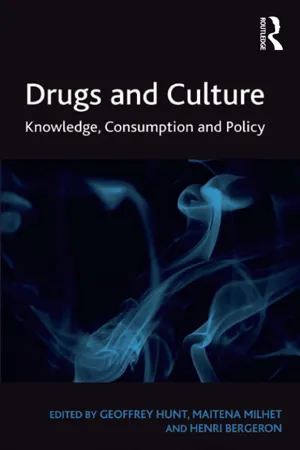
Current approaches to drugs tend to be determined by medical and criminal visions that emerged over a century ago; the concepts of addiction, on the one hand, and drug control on the other, having imposed themselves as the unquestionable central notions surrounding drug issues and discourses. Pathologization and criminalization are the dominant perspectives on psychoactive drugs, and it is difficult to describe drug consumption in any terms other than those of medicine, or to conceive of regulation except in terms of control and eradication. Drugs and Culture presents other voices and understandings of drug issues, highlighting the socio-cultural features of drug use and regulation in modern societies. It examines the cultural dimensions of drugs and their regulation, with special attention to questions of how consumption of specific psychoactive substances becomes associated with particular social groups; the social dynamics involved in our coming to think of these phenomena as we do; and the factors that determine the political and policy responses to drug use. Adopting approaches from anthropology, sociology, history, political science and geopolitics to challenge the prevailing pathologization and criminalization of drug use, this book provides international and comparative perspectives on drug research, based on the latest research in Europe, the USA, the Middle East and Hong Kong.
Information
Knowledge: Science, Medicine, and Discourses on Drugs
Chapter 1
Social Fear, Drug-Related Beliefs, and Drug Policy
Introduction: The Drug Problem, Beliefs and Fears
How each of us understands the world around us will depend on the configuration of beliefs we hold. Most of us will hold a conglomeration of beliefs that to some degree attempt to merge into a broader worldview and where possible retain a level of relational consistency, in other words, to have consistency between the beliefs and ideas we hold. These are the conceptual building bricks that allow us to navigate our way through the world ideationally. However, it will be the case that for any one individual different areas of “knowledge” (e.g., about “race,” gender, or illicit drug effects) will be more or less evidence based. Some things that we know about and maintain beliefs systems around will be informed by experience, practice, and perhaps in some cases even extensive critically focussed research. Knowledge and beliefs about other things will be picked up along the way as folk-knowledge, out-dated ideas, as “fact” through the media or through anecdote and hearsay and will also be separate to any experiences we have had or practices that we engage in. A population will also be differentiated by greater or lesser degrees of critical awareness. Some will be sceptical of almost all they confront, always looking to more reliable evidence as a route to understanding whereas others accept information much more willingly as it suits.
The “drug problem,” as it is commonly presented and understood, is perhaps an archetype of how prominent these building blocks can be. They illustrate the extent to which beliefs can resist erosion when the topic is one that evokes fear, mistrust, and disgust, and has historically been formulated around moral and political concerns that sit “beyond” the supposed focus of the issue (drugs) and provide a broad conceptual framework that colors much that new or emergent knowledge provides. It is the position of this chapter that the drug problem, as it has been historically constructed, but also as it continues to be, is fundamentally informed not by the science of pharmacology or that revolving around the addictions but by a number of resistant primary “drug myths” that provide a broader conceptual framework within which new policy and evidence is situated rather than evidence that refutes or questions it. It is a further contention that rather than looking for the root of understanding of the drug problem in the various empirical risks that drug use may carry that we would do better to consider the nature of the fears that surround drugs, around those that sell them and of those that use them.
That drugs such as heroin, cocaine, ecstasy and cannabis (and newly “discovered” drugs on an almost annual basis1 are conceived as constituting a significant problem needs not be rehearsed at length here. International treaties declare the inherent risks to individual, society and nation and the United Nations, in this vein have decreed that:
Drugs destroy lives and communities, undermine sustainable human development and generate crime. Drugs affect all sectors of society in all countries; in particular, drug abuse affects the freedom and development of young people, the world’s most valuable asset. Drugs are a grave threat to the health and well-being of all mankind, the independence of States, democracy, the stability of nations, the structure of all societies, and the dignity and hope of millions of people and their families. [United Nations General Assembly 1998: 3]
Politicians wage political wars and campaigns around drug issues (Reinarman and Levine 1997, Reinarman and Duskin 1992) whilst the media relays tragedy after tragedy and scare story after scare story revealing the inherent destructiveness of illicit drug use and the markets that grow up to supply it (Coomber 2006, Boyd 2002, Coomber, Morris, and Dunn 2000, Brownstein 1996, Goode and Ben-Yehuda 1994, Reinarman and Duskin 1992). As Jenkins (2009) wrote in The Guardian:
Researching drug use is pointless since policy on the subject has nothing to do with evidence, only emotion. It has to do with fear of the unknown, the taboo of other people’s escapist narcotics (or worse, those of one’s children). Politicians could not care less what experts say … They care only for the rightwing press, whose editors suffer a similar taboo. [Jenkins 2009, in The Guardian]
There are, however, a range of key beliefs that I have previously argued operate as lynchpins or supports to the broad aggregate framework of beliefs to what is thought about illicit drugs, drug users and drug markets in the West (Coomber 2006). Because these key beliefs provide the broad aggregated framework for how we understand the drug problem they impact on policy activity both at the macro (national and international) level and at the micro (local, community) level. Without these key beliefs the drug problem would have to be conceptualized very differently and policy options would change.
Foundational Beliefs that Provide a Framework for Fears Around Drugs and Frame Policy Responses
The key set of beliefs I want to refer to are: dangerous adulteration (the so-called “cutting” of street drugs with poisonous substances); instant addiction; predatory (and “evil”) drug “pushers;” inherently violent drug dealers/markets, and the offer of free drugs to the young and innocent in order to get them “hooked” for the purpose of increasing clientele. These activities although often reported and seen as distinct are in fact intertwined and each to some degree relies on the existence of the others to be credible. If these activities, and thus the belief in them, were shown to be untrue or sufficiently different to render them unhelpful as a way of understanding drugs/drug markets/drug dealers then it is my contention that understandings of the “drug problem” would also be fundamentally altered. Likewise, a perpetuation of the widespread acceptance of these activities enables a position to be taken regarding the essential evilness of street drugs and those that sell them to frame policy responses.
Dangerous Adulteration
Essentially, the idea that various street drugs such as heroin, cocaine, ecstasy, amphetamine and so on are “cut” with all sorts of noxious substances is a commonly held belief (Coomber 1997a, b, c, 2006). The activity is believed to centre on the idea that either, street user-dealers desperate for their next “hit” but with too little resources to pay for it grab anything they can to dilute (or replace) the drug to make up the money needed:
There are a lot of smackheads turning up [dead]. A junky runs out of funds for his habit so he peddles whatever … instant coffee as cheeba, baby laxative as china, draino (in the 70’s) as skag … to make enough $$$ to cop real dope. This time its some bug shit … all he could find. “Hell,” he figures, “that cat will surely taste it before he cooks and slams it.” Well, I guess he didn’t make the guy for being as sick as he was … dude couldn’t take the time for a test … fellow’s blue, works hanging outta his arm, and he didn’t even get the plunger all the way down. [1998 Internet posting on the alt.drugs.hard newsgroup responding to a discussion started by the posting of the questionnaire related to this research]
Alternatively, it is thought that drug dealers are simply so evil in character that in pursuit of profit they routinely cut the drugs they sell and use anything that is cheap, available and about the right color—regardless what it is. These ideas are believed by the police, the media, drug users, non-drug users, drug service workers, many drug field researchers and (unsurprisingly) by most drug dealers too (of which more later).
The problem is, and this goes to the very heart of the matter, regular and purposive dangerous adulteration is essentially mythical. It may happen (as heinous acts are committed by many people), or may have happened, but it is neither common, routine or presents a major aspect of the risks related to street drug use. This is in direct contrast to beliefs about it. Reports that users are playing “Russian Roulette” with their lives each time they use a street drug because of the use of rat-poison (strychnine); ground-light bulbs; scouring powders and other poisonous substances put there by uncaring/evil dealers is simply not true (Coomber and Maher 2006, Maher, Swift, and Dawson 2001, Coomber 1997a, b, c, d, e, 1999, 2006). Extensive forensic profiling of street drugs over many years does not show the cutting of street drugs with dangerous (akin to those described above) substances nor does it show the “lacing” of LSD tabs with poisons, or ecstasy and other dance drugs with heroin. Some cutting of street drugs does of course take place but the nature of it is very different to how it is popularly understood. By and large what is found (particularly with heroin) are substances put in at the point of manufacture. This is shown by the fact that purity levels on the street are similar to those seized before they enter the country (Coomber 1997d, 2006). Street dealers are thus, in the great majority of cases, not the ones doing the (or any) cutting. Those substances that are found are also as far from being related to haphazard and/or chaotic activity as described by the quote above as they could be. The substances used to supposedly simply dilute are often more purposive in nature. They include a variety of sugars and less powerful substances that mimic aspects of a drug, for example, caffeine, paracetamol (acetaminophen in the US), lactose, glucose, and mannitol. However, on occasion they also enhance a drug in ways that would be unexpected. Caffeine in heroin for example actually increases the amount of heroin available to the user that inhales (smokes, “chases”) the drug than if the caffeine was absent.
It is also the case that far less cutting takes place than is assumed. The stereotype model is of cutting progressively taking place down through the chain of distribution with the drug, for example, heroin becoming increasingly less pure. The reality however, as stated is that little cutting takes place at any point after manufacture. Interviews with drug dealers confirmed the forensic evidence but also provided insight into the motivations (not) to cut street drugs—particularly with dangerous substances: “why would I want to hurt anyone”; “I want to be known to sell good gear”; “I don’t need to, I just skim off the top”; “the comeback”; “why would I want to kill my customers?” The latter point especially seems obvious when pointed out but few bother to think that far and simply accept the practice as common. One last significant point about dangerous adulteration is that it is so engrained into the lay and professional consciousness that even drug dealers believe it. They don’t admit to it themselves and the forensic evidence, as stated, shows that this is really what happens but drug dealers believe that other drug dealers do it (Coomber 1997b). This demonstrates that even those closest to a phenomenon actually may have little idea about what happens even when they think they do and is a corrective to those that think “key person” interviews/beliefs or ethnographic accounts can be accepted uncritically.
Instant Addiction
The notion that some drugs are instantly, or almost instantly, addictive is again commonplace and accepted—within some parts of the addiction treatment industry as well as more generally (Coomber and Sutton 2006). The fear associated with heroin and addiction in part comes from this notion, an idea that presents drugs as incredibly powerful and irresistible and addiction as enslaving. Instant addiction has historically been associated with heroin as testified by the title of a prominent drug field book It’s So Good Don’t Even Try it Once (Smith and Gay 1972). More recently instant addiction has been inappropriately attributed to crack cocaine (WHO/UNICRI 1995) and sometimes methamphetamine (King 2006) amongst others. Some see the fact that chemical changes take place in the brain after just a few uses of heroin as indicative of instant addiction taking place whilst others refer to some experimental evidence based on “captive” individuals in unnatural settings administered doses under artificial conditions (Krivanek 1988). For most, anecdote and media coverage acts as sufficient evidence. This view, however, fundamentally misunderstands the nature or essence of the addicted state which is not simply a biochemical response, and a multidisciplinary understanding ably demonstrates this (Orford 2001, Edwards and Lader 1991) and is evidenced by other types of research that considers individual timeframes and processes towards addiction.
A range of research—based on use in natural settings—has related that not only is addiction not instant “on the street” but that it usually takes months and in many cases a year or longer for a user to move from first use and even regular use to daily addicted use (Krivanek 1988, Bennett 1986, Kaplan 1985). Most recently, Coomber and Sutton (2006) found in their sample of 72 heroin addicted users that the mean time from first use to addicted use was 13 months (median = 6 months) and that even for those who were using regularly (e.g., at weekends only) the point from beginning regular use to daily, addicted use, the mean was 6 months (median = 3 months). What emerged as clear from the qualitative data in this research was that individual circumstances, decisions about drug/heroin use and broader group and other environmental contexts impacted meaningfully on the rate of transition towards addiction. The idea of “one or two hits and you’re hooked” has little credence in the real world. Addiction in natural settings is also a social process, not one of simple bio-chemical reaction (Rhodes and Coomber 2010).
Dealers Trying to “Hook” the Young and Innocent (Non-users) with Free Drugs
Another widespread fear relates to how quickly heroin use and addiction can spread through, and decimate, communities. This concern has much of its aetiology in historical reporting of how opium use supposedly ripped through China in the eighteenth century, leaving the nation weakened from within (morally and physically) and from without, at the mercy of Imperialist powers such as England, Holland, Germany and the US. Such reports, however, have been shown to be wild exaggerations and distortions of what really happened, politically and morally motivated, and based on a weak understanding of the process of addiction and of opium itself (Coomber 2006, Dikötter, Laamann, and Xun 2004). Not too dissimilarly, the idea that drug dealers purposively pursue children (“dealers at the school gates”) and other non-users to gain new clients is reliant on the idea of instant addiction. Dealers are presented as giving away free drugs and/or lacing sweets with addictive drugs to entice and thus enslave their unsuspecting prey. Apart from the fact that children rarely have sufficient money to support a drug habit, tend to talk to parents and others about such occurrences and thus represent a genuine risk to a dealer’s liberty and business, because addiction is far from instant and would take many months of use to “turn” a neophyte into an addict the whole idea is unsustainable—and, in the research literature unsubstantiated. There is, however, within this particular theme a consistent historical pattern of blaming and scapegoating “others,” often foreigners, with the introduction and immoral use of street drugs and a consequent spread of addiction through predatory supply. This is a pattern that has more to do with prejudice and fear of the “other” than it does actual knowledge of drugs, drug users and those that supply them (Dikötter, Laamann, and Xun 2004, Courtwright 1995, Kohn 1992, Berridge and Edwards 1987, Musto 1987, Bean 1974).
Inherently Violent Drug Markets
Drug dealers and drug markets are seen as almost inherently violent. In part this is because drug dealers, supposedly consistently carrying out the acts outlined above are seen as essentially bereft of morals and pursue their own profits remorselessly and single-mindedly. This is because they are seen as either fundamentally evil individuals and/or because their own drug use has robbed2 them of the sensibilities that normally curtail violent impulse. The activities referred to above (if believed) “prove” both their evilness and their capability to harm others. Combined with the fact that huge sums of money are potentially to be made in the supply of drugs and that the penalties for being a drug supplier are usually harsh, the market context within which drug supply takes place is one of high risk (and for some versions of liberal market analysis) the likelihood for drug-market related violence is increased. Indeed there is no doubt that illicit drug markets, on aggregate, are much more violent than licit markets and many other illicit markets. It is not the case, however, that this is either regular or consistent throughout the drug market and across types of supply/supplier. Simply put this is because drug dealers are not all the same. Elsewhere (Coomber 2004, 2006) I have argued that it is unhelpful to have essentially homogenous concepts of the drug dealer or drug market when they/it are clearly highly differentiated. Friend dealers, brokers, woman dealers, middle-class dealers, violent dealers and non-violent dea...
Table of contents
- Cover Page
- Half Title page
- Title Page
- Copyright Page
- Contents
- List of Figures and Tables
- Notes on Contributors
- Foreword
- Acknowledgements
- Introduction: Drugs and Culture
- Part I Knowledge: Science, Medicine, and Discourses on Drugs
- Part II Consumption: Cultures of Drug Use
- Part III Policy or Politics? The Cultural Dynamics of Public Responses
- Index
Trusted by 375,005 students
Access to over 1.5 million titles for a fair monthly price.
Study more efficiently using our study tools.
Frequently asked questions
Yes, you can cancel anytime from the Subscription tab in your account settings on the Perlego website. Your subscription will stay active until the end of your current billing period. Learn how to cancel your subscription
No, books cannot be downloaded as external files, such as PDFs, for use outside of Perlego. However, you can download books within the Perlego app for offline reading on mobile or tablet. Learn how to download books offline
We are an online textbook subscription service, where you can get access to an entire online library for less than the price of a single book per month. With over 1.5 million books across 990+ topics, we’ve got you covered! Learn about our mission
Look out for the read-aloud symbol on your next book to see if you can listen to it. The read-aloud tool reads text aloud for you, highlighting the text as it is being read. You can pause it, speed it up and slow it down. Learn more about Read Aloud
Yes! You can use the Perlego app on both iOS and Android devices to read anytime, anywhere — even offline. Perfect for commutes or when you’re on the go.
Please note we cannot support devices running on iOS 13 and Android 7 or earlier. Learn more about using the app
Please note we cannot support devices running on iOS 13 and Android 7 or earlier. Learn more about using the app
Yes, you can access Drugs and Culture by Geoffrey Hunt, Maitena Milhet in PDF and/or ePUB format, as well as other popular books in Social Sciences & Sociology. We have over 1.5 million books available in our catalogue for you to explore.