- 278 pages
- English
- ePUB (mobile friendly)
- Available on iOS & Android
eBook - ePub
About this book
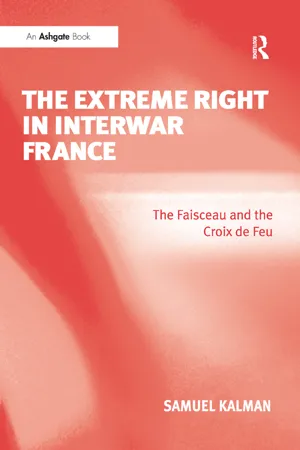
Historians of the French extreme right frequently denote the existence of a strong xenophobic and nationalist tradition dating from the 1880s, a perpetual anti-republicanism which pervaded twentieth-century political discourse. Much attention is habitually paid to the interwar era, deemed the zenith of this success, when the leagues attracted hundreds of thousands of members and enjoyed significant political acclaim. Most works on the subject speak of 'the French right' or 'French fascism', presenting compendia of figures and organizations, from the Dreyfus Affair in the 1890s through the notorious Vichy regime, the authoritarian construct which emerged following the defeat to Nazi Germany in June 1940. However, historians rarely discuss the programmatic elements of extreme right-wing doctrine, which demanded the eradication of parliamentary democracy and the transformation of the nation and state according to group principles. Instead, most detail the organization and membership of various organizations, and often recount their quotidian activities as political actors within (and in opposition to) the Third Republic. This book offers a new interpretation of the extreme right in interwar French politics, focusing upon the largest and most influential such groups in 1920s and 1930s, the Faisceau and the Croix de Feu. It explores their designs for extensive political, economic, and social renewal, a project that commanded significant attention from the leadership and rank-and-file of both organizations, providing the overarching goal behind their aspiration to power. The book examines five components of these efforts: A renewal of politics and government, the establishment of a new economic order, a revaluation of gender and familial relations, the role of youth in the new socio-political construct, and the politics of exclusion inherent in every facet of Faisceau and CDF doctrine. In so doing it contributes to a historical understanding of the programmatic elements of the interwar extreme-right, while simultaneously situating its most prominent exponents within their broader historical context.
Chapter One
Vers un ordre politique nouveau: Renovating State and Government
‘France is gravely stricken by deep infected wounds’, wrote Lucien Rebatet in his 1942 work Les Décombrés. ‘Those who attempt to disguise this fact, for whatever reason, are criminals.’1 Acollaborator in Nazi-occupied France, Rebatet expresses an oft-repeated sentiment prevalent on the extreme right during the Third Republic years. The conviction that parliamentary democracy had bled the nation to death, and that republicans were crooks out to murder the true France, had been repeated ad nauseam by the far right since the 1880s. For men like Rebatet, there was but one solution to the electoral malaise: An authoritarian governing system which restored tradition, hierarchy, and elitism to the political sphere. This project attracted both doyens and plebeians to the wartime Vichy regime and Nazi European order, regarded as the embodiment of the social and political principles for which they had fought so fervently in the preceding decades. Yet if Vichy was the first success of its kind for the French extreme right, it was by no means the only attempt to create, by force if necessary, a new anti-democratic political order.
From its beginnings the Third Republic was beset by accusations of corrupt practices and ineptitude, charges that emanated from both the right and the left. The arch-conservative Robert de Jouvenel quipped famously before the Great War that ‘there is less difference between two deputies, when one is revolutionary and the other is not, then between two revolutionaries, when one is a deputy and the other is not’. Simultaneously on the centre-left, Anatole France dedicated a section of his Île des Pingouins to the corruption endemic in the Chamber of Deputies and the capitalist system which it served. Anti-parliamentarism was in vogue by the turn of the century, appearing seemingly everywhere. Cartoons, popular novels, and cabarets often mocked the opportunism, buffoonery, and incompetence of parliamentarians.2
For all their complaints, most citizens actively expressed their exasperation in light-hearted satire, or more earnest sarcasm at the expense of the government; few of them actively contemplated the eradication of the Republic. The extreme-right, however, went far beyond mere jest. Maurice Barrès, the prominent author whose works on Alsace-Lorraine and Gallic deracination schooled a generation of young Frenchmen in the redemptive concepts of the soil and the dead, claimed that the deputy had no redeeming qualities. His only concern was the satisfaction of constituent electoral committees, Barrès jeered, which were deemed of greater importance than public service.3 Worse still, claimed Charles Maurras, leader of the royalist Action française, the Republic itself – le pays légal – contradicted the will of the people – le pays réel. Maurras viewed parliamentary democracy as a conspiracy against the common good, ‘the regime of windbags’, and a malignant affliction that would destroy France if untreated. ‘There is only one way to improve democracy’, seethed the vieux maître royaliste: ‘to destroy it’.4
Barrès and Maurras wrote during a time of weakness for the right, and especially the extreme-right. The defeat of Boulanger, the acquittal of Dreyfus, and the staunchly anti-Catholic policies of the Waldeck-Rousseau and Combes ministries left conservatives in disarray before the Great War. Although they rejected laicism and despised the Radical Party, often referring to the Republic as la gueuse and the left-centre bloc as its pimp, even die-hard traditionalists like Albert de Mun and Jacques Piou rallied to the status quo. Furthermore after the 1903–1904separation of church and state, and the landslide radical victory in 1906 elections, only the extreme-rightist Action française embraced anti-republicanism. Lacking a broad electoral base in a nation where only 25 per cent of the populace supported a right wing, Catholic agenda, newer conservative voices like Raymond Poincaré accepted the status quo and pledged to work within the framework of democracy and the Chamber of Deputies.5
However, their fortunes improved dramatically in the interwar period. The right enjoyed a postwar political resurgence, electing a Bloc national majority from 1919–1924 in the Chambre Bleu-Horizon, and again from 1926–1932 under Poincaré and André Tardieu. Such electoral popularity effectively rehabilitated right-wing antiparliamentary sentiment. The success of the left, first apparent in the strike wave in 1919–1920, and again with the election of the Cartel des Gauches government in 1924, led both conservatives and the extreme-right to believe that a Bolshevik coup was possible in France. On the traditional right André Thibaudet warned that a new leftist political class, groomed exclusively at the École normale supérieure, desired to create a République des professeurs. Others were far more blunt: The title of Camille Aymard’s best-selling 1926 treatise Bolchévisme ou fascisme, Français il faut choisir became a rallying cry for right-wing anti-republicans during the remainder of the interwar period.6
In the 1930s the right grew still more restless, as the depression struck France, the Hanau, Oustric, and Stavisky banking scandals publicly revealed governmental corruption at the highest levels, and Hitler loomed menacingly across the Rhine. With the rise of the French Popular Front and its 1936 electoral victory, right-wing anti-democratic sentiment became even more widespread. Faced with wildcat strikes and factory occupations across the country, conservatives watched in horror as Léon Blum’s socialist government negotiated the Matignon Accords, granting labour the eight hour day, paid vacations, and participation in management. Believing the ‘Sovietization of France’ to be imminent, Victor Perret of the Republican Federation called for the elimination of the Chamber, because ‘the great majority of all Frenchmen today condemn parliamentarism’.7 Far greater threats to the stability of the Republic were the extreme-rightist leagues, whose hundreds of thousands of members and ominous street presence directly challenged the existing order. The 6 February 1934 riots, in which the leagues, together with veterans associations and the royalist Action française, marched on the Chamber of Deputies, shook the French populace. Initially gathered in protest against real and imagined revelations of corruption arising from the Stavisky Affair, the increasingly menacing crowd turned violent, forcing the resignation of Premier Edouard Daladier. The next two years were marked by street battles with communists and mass meetings denouncing democracy. The banning of the leagues in June 1936 had little effect; most simply transformed themselves into political parties and continued their anti-parliamentary agitation, attracting hundreds of thousands of new members. Given the relative strength of the interwar extreme-right, Jean Estèbe relates, ‘the transformation of summer-fall 1940, where a democratic nation seemed to instantly accept a counter-revolutionary and racist dictatorship, was prepared well in advance’.8
The largest extreme-rightist leagues in 1920s and 1930s France respectively were the Faisceau and the Croix de Feu/Parti social français. Like their liguer confreres, both groups prioritized the revitalization of French politics, predicated upon the transformation of the feeble and corrupt Republic into a robust authoritarian state. For the Faisceau this meant the installation of an État combattant, directed by a new elite composed of war veterans. Defending Catholic morality and French tradition while enforcing social justice and enshrining economic modernity, their reinvigorated state aimed to eliminate materialism, restoring the values of family, church, and nationalism to France.
Despite a prevailing agreement on these general principles, two opposing sets of expectations existed within the Faisceau. For group leader Georges Valois, the new political order preserved French tradition and identity, while simultaneously acting as a hyper-modern agent of governmental and economic efficiency. The state would be run by an elite drawn from all classes, working ceaselessly to rejuvenate the nation. Hence Valois’s fascist dictatorship was a transitory one, necessary only to create favourable conditions for the renovation of government. He certainly employed much of the rhetoric of the contemporary extreme-right, espousing corporatism, referring to the nation as an organic whole, and praising nationalism and Catholic virtue as essential components of any French renaissance. Valois further invoked the experience of the Great War to lend legitimacy to his project, often speaking of the need to recreate the fraternity and mentality of the trenches within the new fascist state. Yet he idolized Georges Sorel, Le Corbusier, and Henry Ford as much as Maurras and Barrès, and his proposals were dominated by a planiste spirit more commonly associated with the left than the extreme-right. Far from reactionary, his combattant elite was expected to make France suitable for the ‘age of electricity’.9 Valois’s arguments thus rejected many programmatic elements common to the extreme-right during the Third Republic, including the notion that any new regime exclusively imposed Catholic values and French tradition, and a wariness of progressive ideas, which were associated with the anticlerical and socialist Cartel des Gauches.
Valois’s progressive bent was not shared by many of his Faisceau colleagues. The modernism of Sorel and Le Corbusier meant nothing to Hubert Bourgin, Jacques Arthuys, or Philippe Barrès, Faisceau leaders whose politics emphasized the inculcation of tradition, hierarchy, discipline, and order. Valois was brought up in a working-class milieu, beginning his political trajectory on the anarcho-syndicalist left before joining the Action française in 1906. Although they were his closest confidantes within the group, Arthuys and Barrès both came from traditional right-wing backgrounds, born into conservative, privileged families. The son of a career army officer, Arthuys was a lawyer and highly decorated war veteran, owner of a Roubaix-Tourcoing industrial concern, and a supporter of the Action française. Barrès’s father was the extreme-rightist author and deputy Maurice Barrès, veteran of Boulangism and staunch anti-Dreyfussard. The son wrote for several conservative newspapers and in 1921 authored a nationalist book about the Great War, entitled La Guerre à vingt ans. Bourgin graduated from the École normale supérieure, a docteur ès lettres, and a veteran of the Ligue des patriotes and the Action française. These three men were joined in the conservative faction of the Faisceau by founding members Maurice de Barral and Marcel Bucard, the decorated war veteran and future leader of the fascist Francistes movement.
Apart from the obvious differences in social and political background, the conservative faction expected the Faisceau to follow the pattern of the established extreme-rightist leagues. Their fascism consisted of the conquest of state by the paramilitary Légions, followed by the construction of an authoritarian regime, the living embodiment of the national will. Employing social Darwinist rhetoric, they favoured bellicose nationalism to restore French predominance. Thus a meritocracy represented heroism, patriotism, and discipline; far from constructing a new world, its mission was to preserve the old one. Faisceau conservatives thus dismissed the rationalization of politics and espoused order, hierarchy, and the preservation of the past, rejecting fascist ‘revolution’ in favour of a moral and physical cleansing of the masses.10
No such divisions existed within the ranks of the CDF/PSF, whose political plan straddled the traditional and extreme-right, and bore no resemblance to Valois’s modernizing bent. Like the Faisceau, the CDF/PSF composed a program for state and government, to be implemented once the group had either seized or been elected to power. Yet their model exclusively resembled that proposed by Faisceau conservatives, an authoritarian construct in the service of French tradition. Despite their frequent public proclamations to the contrary, the group was rabidly anti-parliamentary, deriding the Republic and its officials as corrupt, immoral, and self-centred. They thus demanded the institution of discipline and trumpeted the primacy of the national over individual interest. If the CDF/PSFrejected fascism, they were far from republican; even as they sent deputies into the chamber after June 1936, the group championed authoritarianism, characterized by the restoration of strong central authority to combat parliamentary ‘excess’ and restraints on ‘anarchic’ liberty.
During the Croix de Feu years this vision of the new state was linked to the esprit combattant of the Great War. References to the fraternity of the trenches abounded in various tracts and the group newspaper, which continually claimed that their sacrifice granted veterans the moral authority to lead France. However, after their 1936 transformation into the parliamentary Parti social français, their emphasis shifted to social Catholicism and nationalism, in the vein of La Tour du Pin and Maurice ...
Table of contents
- Cover
- Half Title
- Title Page
- Copyright Page
- Table of Contents
- List of Tables
- Acknowledgements
- List of Abbreviations
- Introduction
- 1 Vers un ordre politique nouveau: Renovating State and Government
- 2 Vers un ordre économique nouveau: The Traditional and the Modern in the New Economy
- 3 La Politique du foyer: The Role of Women and the Family in the National Community
- 4 Health, Virility, and Patriotism: The Physical and Moral Transformation of Youth
- 5 The Politics of Exclusion: Jews and Foreigners in the New Nation and State
- Conclusion
- Bibliography
- Index
Trusted by 375,005 students
Access to over 1.5 million titles for a fair monthly price.
Study more efficiently using our study tools.
Frequently asked questions
Yes, you can cancel anytime from the Subscription tab in your account settings on the Perlego website. Your subscription will stay active until the end of your current billing period. Learn how to cancel your subscription
No, books cannot be downloaded as external files, such as PDFs, for use outside of Perlego. However, you can download books within the Perlego app for offline reading on mobile or tablet. Learn how to download books offline
Perlego offers two plans: Essential and Complete
- Essential is ideal for learners and professionals who enjoy exploring a wide range of subjects. Access the Essential Library with 800,000+ trusted titles and best-sellers across business, personal growth, and the humanities. Includes unlimited reading time and Standard Read Aloud voice.
- Complete: Perfect for advanced learners and researchers needing full, unrestricted access. Unlock 1.5M+ books across hundreds of subjects, including academic and specialized titles. The Complete Plan also includes advanced features like Premium Read Aloud and Research Assistant.
We are an online textbook subscription service, where you can get access to an entire online library for less than the price of a single book per month. With over 1.5 million books across 990+ topics, we’ve got you covered! Learn about our mission
Look out for the read-aloud symbol on your next book to see if you can listen to it. The read-aloud tool reads text aloud for you, highlighting the text as it is being read. You can pause it, speed it up and slow it down. Learn more about Read Aloud
Yes! You can use the Perlego app on both iOS and Android devices to read anytime, anywhere — even offline. Perfect for commutes or when you’re on the go.
Please note we cannot support devices running on iOS 13 and Android 7 or earlier. Learn more about using the app
Please note we cannot support devices running on iOS 13 and Android 7 or earlier. Learn more about using the app
Yes, you can access The Extreme Right in Interwar France by Samuel Kalman in PDF and/or ePUB format, as well as other popular books in History & World History. We have over 1.5 million books available in our catalogue for you to explore.