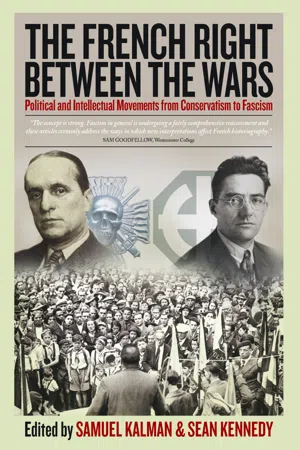
During the interwar years France experienced severe political polarization. At the time many observers, particularly on the left, feared that the French right had embraced fascism, generating a fierce debate that has engaged scholars for decades, but has also obscured critical changes in French society and culture during the 1920s and 1930s. This collection of essays shifts the focus away from long-standing controversies in order to examine various elements of the French right, from writers to politicians, social workers to street fighters, in their broader social, cultural, and political contexts. It offers a wide-ranging reassessment of the structures, mentalities, and significance of various conservative and extremist organizations, deepening our understanding of French and European history in a troubled yet fascinating era.
eBook - ePub
The French Right Between the Wars
Political and Intellectual Movements from Conservatism to Fascism
- 274 pages
- English
- ePUB (mobile friendly)
- Available on iOS & Android
eBook - ePub
The French Right Between the Wars
Political and Intellectual Movements from Conservatism to Fascism
About this book
Trusted by 375,005 students
Access to over 1.5 million titles for a fair monthly price.
Study more efficiently using our study tools.
Information
PART I
POLITICAL MOVEMENTS

CHAPTER 1
CROWD PSYCHOLOGY, ANTI-SOUTHERN PREJUDICE, AND CONSTITUTIONAL REFORM IN 1930S FRANCE
The Stavisky Affair and the Riots of 6 February 1934
On 6 February 1934, several tens of thousands of members of right-wing leagues and veterans associations converged on the Place de La Concorde in central Paris.1 They were protesting against the installation in the Chambre des députés on the other side of the Seine of a center-Left government under the Radical-Socialist Édouard Daladier. The most determined demonstrators attempted to force their way across the Pont de la Concorde and into the Chamber, some of them hoping to ignite a “national revolution.” In the ensuing riots, fourteen demonstrators and one policeman died, and two more of the former succumbed some months later. The next day, Daladier tendered his resignation, frightened by the reluctance of the judiciary and forces of order to defend him. His party switched its support to a government dominated by the Right, under the elderly ex-President Gaston Doumergue, which promised to reform the constitution and implement budget cuts. On 12 February, fearful that France was about to fall to fascism, the trade unions organized a general strike. The Communist and Socialist parties formed the alliance that would become the Popular Front. Years of violent Franco-French conflict began.
The Right justified the riots on two grounds. First, it accused Daladier of sacking the anti-communist Paris prefect of police, Jean Chiappe, in order to secure left-wing support for his new government. Secondly, it charged Daladier’s Radical-Socialist predecessor, Camille Chautemps, with covering up a financial fraud, orchestrated by Alexandre Stavisky.2 The latter had sold bonds of the Crédit municipal de Bayonne against overvalued or non-existent security. The fraud was discovered before Stavisky could reimburse investors with the proceeds of another scam involving Hungarian bonds. Joseph Garat, Bayonne mayor, Radical-Socialist deputy, and Freemason, was arrested for his part in the affair. On 9 January 1934, another Radical-Socialist, Colonial Minister André Dalimier, resigned because back in 1932 he had advised official social welfare funds to invest in the bonds. On the same day, the police “discovered” Stavisky’s body in his Alpine chalet. Skeptics claimed that Chautemps had ordered Stavisky’s death, and that his brother-in-law, Public Prosecutor Georges Pressard, had prevented a junior colleague, Albert Prince, from prosecuting Stavisky. That both Chautemps and Pressard were Freemasons brought more grist to the conspiracy theory mill, as did the discovery of Prince’s dead body on a railway line on 24 February.
By previous standards, the Stavisky Affair was not especially serious.3 Yet the Right, from the royalist Action française to the moderate republican Alliance démocratique, saw it as evidence of a deep crisis. The latter claimed that the bloodstains would never be washed from Daladier’s hands, and demanded prosecution of mysterious grands responsables.4 The Right agreed that the Stavisky Affair was more than a judicial matter, and that only constitutional reform and strengthening of the executive could solve the Republic’s problems, not least through budget cuts.
For decades, the conviction persisted in the historiography that the Republic was intrinsically incapable of dealing with economic and international difficulties and scandals seemingly confirmed this impression. We may still glimpse the assumption in works that casually list economic problems, parliamentary instability, and social conflict as if they automatically explained calls for reform of the Republic and the emergence of the leagues. More importantly, until recently, historians such as Michel Winock and François Monnet unwittingly recycled the protagonists’ own notions of “progress” and “modernization” to understand the “defects” of the regime, and used crowd psychology, with its elite/mass distinction, to make sense of 6 February itself.
Implicitly, these historians divide the protagonists of 6 February into three categories, according to their degree of awareness of the problems of the regime. First an elite, including right-wing politicians such as André Tardieu, understood the nature of the crisis and its solution. Such figures battled against the grain, suffered for contesting “common sense,” and ended their careers as heroic failures—at least until Charles de Gaulle, after his own period in the wilderness, solved the problems of French history. By association, Winock and Monnet belong to this elite, for they possess historiographical understanding of the course of history and the national interest. Secondly, ordinary French people, possessed of the good sense of the crowd, were vaguely aware of the regime’s failures, without possessing the elite’s capacity for detached analysis. Indeed, the “mass” was vulnerable to passions that “demagogic” politicians could exploit. Demagogues constituted the third category. They included the dwindling band of hereditary opponents of the regime, who exploited the anger of the normally sensible mass. Demagogues of a different kind led the Left.
Historians use these categories differently. Serge Berstein believed that the Republic’s faults were exaggerated, and attributed the riots to a “mass” that suffered from real problems in daily life, and so was “available” to (demagogic) parties that proposed simplistic solutions.5 Whereas Berstein’s interpretation resembles that of the 1930s moderate Left, Winock’s is closer to the moderate Right’s. He contends that the 6 February riots brought together elite reformers with a reasonable majority that wanted to correct the Republic’s real defects. Insofar as the riots expressed anti-republicanism, it was the work of a clique of right-wing demagogues who had exploited the Stavisky Affair.6 Nevertheless, Winock argues, the demagogues ultimately won. He contends that for the Left the “trauma” of 6 February reactivated outdated myths of conflicts between republicans and their enemies, and installed “the demonology of civil war in the collective psychology, and provoked rumors of fascism and communism.” Extremists “exasperated the passions” and provoked the victory of the Popular Front.7
Winock and Monnet assume that the Stavisky Affair and 6 February riots expressed an objective crisis of the Republic, to which the solutions were technical rather than ideological. Indeed, in La fièvre héxagonale, Winock combined positivism and crowd psychology to diagnose the ills of French society—Dr. Gustave Le Bon had the same ambition. Winock sought the “laws” underlying the successive crises of French history, and argued that however prone the French were to “fevers” and simplistic antiparliamentarianism, the riots of 6 February stemmed from a half-conscious recognition on the part of a “profoundly moderate” country of real defects in the Republic.8
Certainly, events since the Left’s victory in the elections of May 1932 alarmed the Right. In 1932, they had experienced a stinging electoral defeat. Subsequently, four left-wing governments had come to grief on financial issues and another fell on the related US debts question. The Right accused the majority of failing to implement budget cuts, which it believed to be necessary to counter the effects of the world economic crisis in France. Meanwhile, in October 1933, Hitler’s departure from the Disarmament Conference portended another war.
It is not self-evident that the government should have been held accountable for the aforementioned difficulties. It is even less obvious that conservatives should have believed that confronting economic and international dangers required a change of constitution, or even regime, rather than a change of government. Nor does it go without saying that the Stavisky Affair signified the corruption of the regime rather than the criminality of individuals. To understand how contemporaries understood crisis we must distinguish their ideas and purposes from academic conceptualizations of evolving social structures, even though these changes were an important part of the context in which contemporaries operated. So far as contemporaries are concerned, we must ask “crisis of what” and “crisis for whom?” On the one hand, the Right was so convinced that the parliamentary regime endangered the nation that it was prepared to endorse the overthrow of an elected government through street violence. On the other hand, the Left saw a crisis of capitalism, but after 6 February denied that the Republic was in crisis, and took to the streets to defend it.
Indeed, much research nuances the view that the Third Republic was flawed. Ministerial instability was as much apparent as real,9 the interchangeability of parliamentary majorities may have permitted flexible responses to new problems,10 and the Right was wrong to believe that the Republic was ruled by over-promoted provincial nobodies.11 It is an open question as to how much influence governments in the 1930s had on the economy, given the available knowledge and machinery. The Republic’s response to the economic crisis was not obviously worse than that of any other regime, and plausibly parliamentary opposition spared France the extreme deflation that damaged other economies. The question of the Republic’s response to the rise of Hitler is equally complex. One cannot read French history backward from the defeat of June 1940,12 and anyway war was not necessarily the supreme test of the “fitness” of a political system.13 Paul Jankowski argues convincingly that responses to the scandals of the Third Republic owed more to their cultural and social context than to their actual gravity.14
In fact, none of these revisionist accounts prove that the Third Republic was, after all, “effective” or “modern.” My point is rather that expectations of the Republic were historically constructed, and evaluation of its effectiveness depended on perspective. Thus, state intervention during the Great War had encouraged the belief that government policy was decisive in orienting the economy, and André Tardieu’s governments of 1929–1930 had explicitly staked their future on prosperity. Likewise, the Right’s (often underestimated) Darwinist assumptions engendered the fear t...
Table of contents
- Cover Page
- Title Page
- Copyright Page
- Contents
- Acknowledgements
- List of Abbreviations
- Introduction
- PART I. POLITICAL MOVEMENTS
- PART II. GENDER AND THE RIGHT
- PART III. INTELLECTUAL AND CULTURAL TRENDS
- PART IV. HISTORIOGRAPHY
- Notes on Contributors
- Selected Bibliography
- Index
Frequently asked questions
Yes, you can cancel anytime from the Subscription tab in your account settings on the Perlego website. Your subscription will stay active until the end of your current billing period. Learn how to cancel your subscription
No, books cannot be downloaded as external files, such as PDFs, for use outside of Perlego. However, you can download books within the Perlego app for offline reading on mobile or tablet. Learn how to download books offline
Perlego offers two plans: Essential and Complete
- Essential is ideal for learners and professionals who enjoy exploring a wide range of subjects. Access the Essential Library with 800,000+ trusted titles and best-sellers across business, personal growth, and the humanities. Includes unlimited reading time and Standard Read Aloud voice.
- Complete: Perfect for advanced learners and researchers needing full, unrestricted access. Unlock 1.5M+ books across hundreds of subjects, including academic and specialized titles. The Complete Plan also includes advanced features like Premium Read Aloud and Research Assistant.
We are an online textbook subscription service, where you can get access to an entire online library for less than the price of a single book per month. With over 1.5 million books across 990+ topics, we’ve got you covered! Learn about our mission
Look out for the read-aloud symbol on your next book to see if you can listen to it. The read-aloud tool reads text aloud for you, highlighting the text as it is being read. You can pause it, speed it up and slow it down. Learn more about Read Aloud
Yes! You can use the Perlego app on both iOS and Android devices to read anytime, anywhere — even offline. Perfect for commutes or when you’re on the go.
Please note we cannot support devices running on iOS 13 and Android 7 or earlier. Learn more about using the app
Please note we cannot support devices running on iOS 13 and Android 7 or earlier. Learn more about using the app
Yes, you can access The French Right Between the Wars by Samuel Kalman, Sean Kennedy, Samuel Kalman,Sean Kennedy in PDF and/or ePUB format, as well as other popular books in History & 20th Century History. We have over 1.5 million books available in our catalogue for you to explore.