- 258 pages
- English
- ePUB (mobile friendly)
- Available on iOS & Android
eBook - ePub
Socrates in the Nineteenth and Twentieth Centuries
About this book
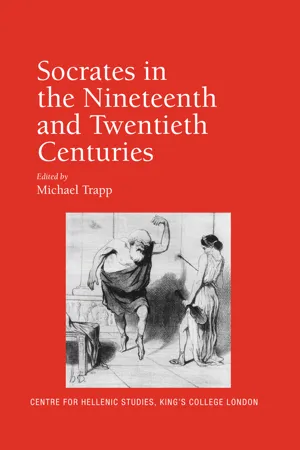
Socrates, son of Sophroniscus, of Alopece is arguably the most richly and diversely commemorated - and appropriated - of all ancient thinkers. Already in Antiquity, vigorous controversy over his significance and value ensured a wide range of conflicting representations. He then became available to the medieval, renaissance and modern worlds in a provocative variety of roles: as paradigmatic philosopher and representative (for good or ill) of ancient philosophical culture in general; as practitioner of a distinctive philosophical method, and a distinctive philosophical lifestyle; as the ostensible originator of startling doctrines about politics and sex; as martyr (the victim of the most extreme of all miscarriages of justice); as possessor of an extraordinary, and extraordinarily significant physical appearance; and as the archetype of the hen-pecked intellectual. To this day, he continues to be the most readily recognized of ancient philosophers, as much in popular as in academic culture. This volume, along with its companion, Socrates from Antiquity to the Enlightenment, aims to do full justice to the source material (philosophical, literary, artistic, political), and to the range of interpretative issues it raises. It opens with an Introduction summarizing the reception of Socrates up to 1800, and describing scholarly study since then. This is followed by sections on the hugely influential Socrateses of Hegel, Kirkegaard and Nietzsche; representations of Socrates (particularly his erotic teaching) principally inspired by Plato's Symposium; and political manipulations of Socratic material, especially in the 20th century. A distinctive feature is the inclusion of Cold War Socrateses, both capitalist and communist.
1
Socrates in Hegel*
Glenn W. Most
Does Socrates' irony conceal any positive doctrine beneath its negative surface? And if so, what is it? These questions probably seem to many scholars nowadays to be the central Ones that must be answered by any serious attempt to provide an interpretation of the figure of Socrates, and certainly they have determined the general structure of the reception of that figure, at least in the past several Centuries. And while they are certainly not necessarily entailed by the peculiar ways in which Socrates seems to have presented himself to his contemporaries, and by the no less odd ways in which they and their immediate successors passed him on to posterity, they are just as certainly entirely compatible with and closely related to them. For, as is well known, on the one hand Socrates stubbornly insisted upon seeking a rational logos for all human values and actions, but on the other hand he obstinately refused to commit to writing any substantial view of his own concerning the specific content of that logos (and it is even far from certain to what extent he was willing to entrust any such view of his, if indeed he had one, to the form of an extended monological oral discourse). This fundamental paradox has fascinated and perplexed, irritated and challenged his real and virtual interlocutors for many centuries, starting already in the tensions and contradictions within and among the three earliest and most substantial sources of our knowledge about him, the writings of Aristophanes, Plato, and Xenophon. What is more, it generates a whole series of smaller paradoxes and tensions: Socrates is said to be the wisest of the Greeks, yet we cannot define just what the positive content of his wisdom is; he demands the absolute sincerity of his interlocutors, yet he does not seem prepared to offer his own in exchange; he claims that he knows that he does not know, yet he cannot explain satisfactorily just how it is that he knows this; he is said to be indispensable for the survival of Athens, yet he is condemned to death by the Athenians themselves; he is irresistibly seductive precisely by virtue of his unmistakably unique individuality, yet he inevitably lends himself to being used as a mouthpiece or symbol for other people's different and often more general positions. For all these paradoxes, and for the many other ones associated with his name, it is Socrates' loquacious but impenetrable silence that generates all the noise around him. If he had a positive theory, why did he not write it down? If he did not have a positive theory, what authorized him to pester his fellow-citizens, or us? If he is a martyr, then just what is the salvational doctrine to which his death testifies? Is he a saint – or a fraud?
To be sure, it helps in understanding the figure of Socrates to remember that one of the basic features of ancient philosophy, and one of its most striking differences with regard to contemporary philosophy, is that philosophy was usually thought of in ancient times not only, and not principally, as a matter of explicitly formulated doctrines and arguments, but much more as a way of life, as an exercise in spiritual self-transformation, as an unremitting discipline of self-control.1 In this light, Socrates is certainly a characteristic phenomenon. But he is more: he is an extreme phenomenon, almost as extreme as his great follower in Late Antiquity, Secundus the Silent Philosopher, to whom Ben Edwin Perry devoted an instructive and entertaining study.2 For Socrates' insistence that other people assume positions and defend them with arguments, combined with his simultaneous refusal to do so himself, means that logical argument itself becomes the form of his life, without it being easy to discern any particular philosophical content to that form. If Socrates had actually written a book, or even just delivered a single lecture on the Good, he would have turned out to have been just one more philosopher like all the others, ready to be admired where necessary and refuted where possible. But as it is, his garrulous silence makes him the black box of Greek philosophy. What secret, if any, does he conceal? From shortly after his death, if not indeed already during his very lifetime, people have been trying urgently and repeatedly to find some way to prise him open and read his instruments, to find out why the sleek jet of Athenian culture which was bearing him aloft was about to nosedive and crash, and finally did.
In the long history of attempts to open that black box, Hegel's interpretation of the figure of Socrates is perhaps the only one that can be compared with Plato's, for depth of philosophical penetration and for richness of historical imagination. On both counts, in the end, there is no doubt that Plato wins; but Hegel, precisely by reconceiving on a novel and far more profound basis the traditional notion of Socrates as a turning-point in the history of philosophy, himself determined a decisive turning-point in the reception of Socrates and laid the foundation for most later versions of that figure. It is with Hegel, as much as with Socrates himself, that such nineteenth century philosophers as Kierkegaard and Nietzsche are in dialogue when they write about the Greek philosopher; and Hegel's questions, and at least some of his answers, have become part of the modern philosophical koine not only in Germany, but throughout the West. If the questions with which I began seem to many of us to be self-evidently the crucial ones to be asked, then this is not a fact of nature but is largely due to the legacy of Hegel.
To understand the force of Hegel's innovation, we must take a step back, into the eighteenth century.3 For the Age of the Enlightenment, with few exceptions, Socrates was less an instrument for philosophical reflection than an occasion for moral outrage. For most of the philosophes who had constituted themselves in that century as a new-fangled class of intellectuals, remote from, in opposition against, and hence superior to the institutions of political power, Socrates was a model and a martyr, an embodiment, like themselves, of reason and virtue in a corrupt, vicious, brutal polity. In what happened to him they read, and denounced, what they feared for themselves. Their Socrates was morally upright and socially beneficial, or at the very least quite innocuous; how the Athenians could possibly have ever thought of poisoning him was a mystery explicable only with reference to the evil of individuals and the corruption of society. What the exact lineaments of Socrates' philosophy might have been were of relatively little concern, and his irony was treated as a genial and ultimately quite harmless form of Courteous civility, of witty Attic salt. In short, the Enlightenment's Socrates was, by and large, Xenophon's Socrates: helpful, affable, sociable, officious. One small group of exceptions is provided by several texts, like Nicolas Fréret's Observations sur les causes et sur quelques circonstances de la condamnation de Socrate (1736) and Siegmund Fridrich Dresig's De Socrate iuste dumnato (1738), which attempt to explain the condemnation of Socrates historically in terms of the specific political and religious conditions which reigned in Athens at that time;4 another, of considerable philosophical interest, is Hamann, who, especially in his Sokratische Denkwürdigkeiten (1759), used the mask of Socratic irony to demonstrate enigmatically against the Enlightenment the limits of human reason and the inescapability of a truly theological, supra-human dimension.5 Plato's dialogues, of course, continued to be read throughout the eighteenth century – in London and in Paris, in Amsterdam and in Geneva, in Lessing's Hamburg and in Mendelssohn's Berlin – but they were usually read, though the spectacles of Xenophon, not so much as presentations of Socratic philosophy but as models of Attic prose and of Athenian etiquette.
The French Revolution, which transformed so many more important matters, also wrought profound changes in the image of Socrates. His opposition, in the name of reason, to the existing social forms could now be reinterpreted as a revolutionary expression of human liberty against antiquated and unexamined political institutions. Above all the Wissenschaftslehre of the German post-Kantian philosopher Fichte – the philosophical doctrine which began, like a kind of exasperated Cartesian cogito, by positing the absolute subject, and then, by introducing the opposition of the non-subject, tried to deduce gradually the whole domains of transcendental knowledge and action – was correlated by the German Romantic writer Friedrich Schlegel with the French Revolution as two of the foremost tendencies of the age: both expressed the absolute freedom of the subject to set himself in his imagination over any existing limitations and to create a world of pure subjectivity in whatever image he liked.6 To this movement of absolute subjective freedom, devoid of any particular conceptual content which might define and thereby limit it, Schlegel gave the name of Romantic irony, and assigned Socrates to it as its patron saint.7 Schlegel himself was one of the most original German Hellenists, if not one of the most erudite ones, of the remarkable decade of the 1790's, and his invocation of Socrates was not just a stab in the dark: Schlegel had reread the sources creatively, and above all had supplemented the traditional eighteenth century texts on Socrates – Xenophon, Diogenes Laertius, Lucian, and of course Plato – with one further source which had never been entirely absent but which Schlegel himself was the first to place in the very center of the Socratic question, namely Aristophanes. After a century of a rather staid, proper, somewhat boring Xenophontic Socrates, a new Socrates burst upon the European stage thanks to Schlegel and German Romanticism: nihilistic, capricious, explosive, comic – in short, Aristophanic, even if we must be careful to take the term here not so much in the sense of Socrates as Aristophanes portrayed him in the Clouds (where, after all, he is also a ludicrous windbag and fraud) as rather in that of Aristophanes himself as the irrepressibly, anarchically creative comedian.
This was the context within which Hegel's view of Socrates was formed, and these are the interlocutors against whom almost every sentence in Hegel's account is polemically directed, sometimes explicitly, usually tacitly. Hegel was fascinated by Socrates and returned to him over and over again in almost all his writings. Indeed, the very earliest text published in his collected works, the 'Fragments on Popular Religion and Christianity' that he wrote as a 23-year-old in 1793—4 in Bern, includes a lengthy comparison between Jesus and Socrates as oral teachers of a circle of disciples,8 a highly traditional comparison that recurs, usually in favour of Jesus, elsewhere in his later writings, including his lectures on The Philosophy of Religion (Hegel 1970, 17.278, 286–7). There are important references to Socrates in Hegel's Logic (Hegel 1970, 6.557–9), his Philosophy of Right (Hegel 1970, 7.259–60), the Encyclopaedia (Hegel 1970, 8.174), Aesthetics (Hegel 1970, 14.135, 374), and Philosophy of Religion (Hegel 1970, 16.217; 17.152–3, 286–7), and an extended discussion in his Philosophy of History (Hegel 1970, 12.326—30); but, as we might expect, it is in his lectures on The History of Philosophy that Hegel presents his lengthiest, most detailed, and most deeply considered exposition of Socrates (Hegel 1970, 18.441–516). Indeed, so substantial is this chapter that Hegel closes it, uncharacteristically, with something almost approaching an apology for its length, which he justifies by the importance of the subject and the harmonious way all the details he presents seem to him to fit together (Hegel 1970, 18.516).
The world historical importance of Socrates is emphasized by Hegel already in the very first sentences of this chapter:
This is how far consciousness had gotten in Greece when Socrates appeared in Athens – the great figure of Socrates. In Socrates, the subjectivity of thinking was brought to consciousness in a more specific, more penetrating way. But Socrates did not grow out of the earth like a mushroom: rather, he stands in a specific continuity with his age. He is not only a highly important figure in the history of philosophy – the most interesting in the philosophy of antiquity – but he is also a world historical person. He is a major turning point of the spirit into itself: this turning represented itself in him, in his manner of thinking. (Hegel 1970, 18.441)
According to Hegel, it is in Socrates that for the first time the freedom of the subjectivity of thought is introduced in its fullness into Greek culture and thereby into world history. By asking what courage, piety, moderation, and other virtues were, not in particular nor in a specific case nor for some individual person alone but in general and in all cases and for all people, and by requiring that his interlocutors answer these questions for him and with him, Socrates demonstrated that these concepts did not exist autonomously and independently outside of human thought, but rather that they were answerable to the requirements of human consciousness. No concept of virtue was to be admitted which could not satisfy the requirements of human rationality – not just yours or mine, but anyone's. Consciousness recognized in itself, in its own capacity for reason, the ultimate arbiter of meaning. As Hegel puts it, the spirit, after having moved outside of itself to discover the world, now turns back into itself and discovers its own capabilities for the very first time (Hegel 1970, 18.441 ['Hauptwendepunkt'] cf. 468 [Umkehr'], 516 ['Wendungspunkt'], 17.152 ['Umkehrung']).
It is evident that Hegel's understanding of Socrates' novelty must depend upon his view of the nature of Greek culture before Socrates: for him, Socrates is no mushroom. This view of his has both a philosophical and a moral component.
In philosophical terms, Hegel considers that the Presocratics thought about the physical world but did not reflect upon their thinking as an object in itself: that is, that they did not recognize the extent to which it is the nature of human thought itself which helps determine the objects it can understand and which therefore must be a prime object of that thought for itself. Evidently, Hegel is thinking of the ancient Commonplace, found in its most celebrated form in a passage of Cicero9 which he quotes (Hegel 1970, 18.445), according to which whereas the Presocratics had studied the cosmos, it was Socrates who had brought philosophy down from the heavens onto the earth and introduced it into men's houses and marketplaces: by inviting people to define what virtue is, Socrates was directing them away from the physical world outside them and towards the intrinsic nature of their very own thought. How Hegel can claim that Socrates' focus upon the activity of thought itself, his reflexive thematization of the mind, can be entirely novel, given Heraclitus' study of logos and inquiry into himself10 and Anaxagoras' doctrine of nous,11 to mention only these, is a question which we may well be inclined to ask, but which Hegel does not stay to answer. Be that as it may, according to Hegel, after the natural philosophers' absolute objectivity the Sophists had fallen into the opposite extreme, a kind of exaggerate...
Table of contents
- Cover
- Half Title
- Title
- Copyright
- Contents
- Foreword
- Contributors
- List of figures
- Introduction: the nineteenth- and twentieth-century Socrates
- 1. Socrates in Hegel
- 2. A simple wise man of ancient times: Kierkegaard on Socrates
- 3. Nietzsche's Socrateases
- 4. Later views of the Socrates of Plato's Symposium
- 5. Anselm Feuerbach's Das Gastmahl des Platon
- 6. From amor Socraticus to Socrates amoris: Socrates and the formation of a sexual identity in late Victorian Britain
- 7. The thorn of Sokrates: Georg Kaiser's Alkibiades Saved and Bertolt Brecht's Sokrates Wounded
- 8. 'Socrates knew . . .' affect (Besetzung) in Britten's Death in Venice
- 9. Effacing Socratic irony: philosophy and technê in John Stuart Mill's translation of the Protagoras
- 10. Totalitarian Socrates
- 11. 'Gadfly in God's Own Country': Socrates in twentieth-century America
- General bibliography
- Index
Trusted by 375,005 students
Access to over 1.5 million titles for a fair monthly price.
Study more efficiently using our study tools.
Frequently asked questions
Yes, you can cancel anytime from the Subscription tab in your account settings on the Perlego website. Your subscription will stay active until the end of your current billing period. Learn how to cancel your subscription
No, books cannot be downloaded as external files, such as PDFs, for use outside of Perlego. However, you can download books within the Perlego app for offline reading on mobile or tablet. Learn how to download books offline
Perlego offers two plans: Essential and Complete
- Essential is ideal for learners and professionals who enjoy exploring a wide range of subjects. Access the Essential Library with 800,000+ trusted titles and best-sellers across business, personal growth, and the humanities. Includes unlimited reading time and Standard Read Aloud voice.
- Complete: Perfect for advanced learners and researchers needing full, unrestricted access. Unlock 1.5M+ books across hundreds of subjects, including academic and specialized titles. The Complete Plan also includes advanced features like Premium Read Aloud and Research Assistant.
We are an online textbook subscription service, where you can get access to an entire online library for less than the price of a single book per month. With over 1.5 million books across 990+ topics, we’ve got you covered! Learn about our mission
Look out for the read-aloud symbol on your next book to see if you can listen to it. The read-aloud tool reads text aloud for you, highlighting the text as it is being read. You can pause it, speed it up and slow it down. Learn more about Read Aloud
Yes! You can use the Perlego app on both iOS and Android devices to read anytime, anywhere — even offline. Perfect for commutes or when you’re on the go.
Please note we cannot support devices running on iOS 13 and Android 7 or earlier. Learn more about using the app
Please note we cannot support devices running on iOS 13 and Android 7 or earlier. Learn more about using the app
Yes, you can access Socrates in the Nineteenth and Twentieth Centuries by Michael Trapp in PDF and/or ePUB format, as well as other popular books in History & World History. We have over 1.5 million books available in our catalogue for you to explore.