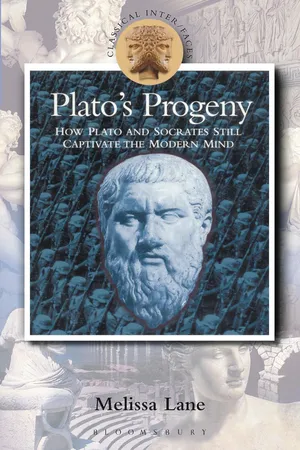
Socrates wrote nothing; Plato's accounts of Socrates helped to establish western politics, ethics, and metaphysics. Both have played crucial and dramatically changing roles in western culture. In the last two centuries, the triumph of democracy has led many to side with the Athenians against a Socrates whom they were right to kill. Meanwhile the Cold War gave us polar images of Plato as both a dangerous totalitarian and an escapist intellectual. And visions of Plato have proliferated at the heart of postmodern critiques of the very idea of metaphysics and politics.
Plato's Progeny begins with an account of modern responses to the trial of Socrates and the controversial question of Socrates' relation to Plato. At its centre are two chapters exploring the idea of Platonic origins in and for philosophy, and of Platonic foundations for philosophical politics. Exploring unfamiliar as well as familiar invocations of Plato, Melissa Lane argues that twentieth-century ideological battles have obscured the importance of Socratic individualism, the nature of Platonic ethics, and the value of Platonic politics. Succinct and clearly written, this is an ideal guide for everyone interested in the way philosophers are still writing footnotes to Plato.
- 176 pages
- English
- PDF
- Available on iOS & Android
eBook - PDF
About this book
Information
Table of contents
- Cover
- Contents
- Note on References and Bibliography
- Acknowledgements
- 1. Introduction
- 2. Who Was Socrates?
- 3. Plato on Forms and Foundations: the First Metaphysician?
- 4. The Political Plato: the First Totalitarian, the First Communist, the First Idealist?
- 5. Conclusion
- Notes
- Further Reading
- Index
Trusted by 375,005 students
Access to over 1.5 million titles for a fair monthly price.
Study more efficiently using our study tools.
Frequently asked questions
Yes, you can cancel anytime from the Subscription tab in your account settings on the Perlego website. Your subscription will stay active until the end of your current billing period. Learn how to cancel your subscription
No, books cannot be downloaded as external files, such as PDFs, for use outside of Perlego. However, you can download books within the Perlego app for offline reading on mobile or tablet. Learn how to download books offline
Perlego offers two plans: Essential and Complete
- Essential is ideal for learners and professionals who enjoy exploring a wide range of subjects. Access the Essential Library with 800,000+ trusted titles and best-sellers across business, personal growth, and the humanities. Includes unlimited reading time and Standard Read Aloud voice.
- Complete: Perfect for advanced learners and researchers needing full, unrestricted access. Unlock 1.5M+ books across hundreds of subjects, including academic and specialized titles. The Complete Plan also includes advanced features like Premium Read Aloud and Research Assistant.
We are an online textbook subscription service, where you can get access to an entire online library for less than the price of a single book per month. With over 1.5 million books across 990+ topics, we’ve got you covered! Learn about our mission
Look out for the read-aloud symbol on your next book to see if you can listen to it. The read-aloud tool reads text aloud for you, highlighting the text as it is being read. You can pause it, speed it up and slow it down. Learn more about Read Aloud
Yes! You can use the Perlego app on both iOS and Android devices to read anytime, anywhere — even offline. Perfect for commutes or when you’re on the go.
Please note we cannot support devices running on iOS 13 and Android 7 or earlier. Learn more about using the app
Please note we cannot support devices running on iOS 13 and Android 7 or earlier. Learn more about using the app
Yes, you can access Plato's Progeny by Melissa Lane in PDF and/or ePUB format, as well as other popular books in Philosophy & Ancient Languages. We have over 1.5 million books available in our catalogue for you to explore.