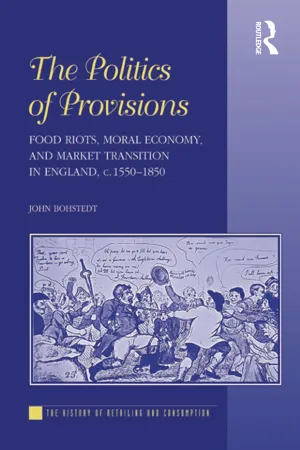
eBook - ePub
The Politics of Provisions
Food Riots, Moral Economy, and Market Transition in England, c. 1550–1850
- 324 pages
- English
- ePUB (mobile friendly)
- Available on iOS & Android
eBook - ePub
The Politics of Provisions
Food Riots, Moral Economy, and Market Transition in England, c. 1550–1850
About this book
The elemental power of food politics has not been fully appraised. Food marketing and consumption were matters of politics as much as economics as England became a market society. In times of dearth, concatenations of food riots, repression, and relief created a maturing politics of provisions. Over three centuries, some eight hundred riots crackled in waves across England. Crowds seized wagons, attacked mills and granaries, and lowered prices in marketplaces or farmyards. Sometimes rioters parleyed with magistrates. More often both acted out a well-rehearsed political minuet that evolved from Tudor risings and state policies down to a complex culmination during the Napoleonic Wars. 'Provision politics' thus comprised both customary negotiations over scarcity and hunger, and 'negotiations' of the social vessel through the turbulence of dearth. Occasionally troops killed rioters, or judges condemned them to the gallows, but increasingly riots prompted wealthy citizens to procure relief supplies. In short, food riots worked: in a sense they were a first draft of the welfare state. This pioneering analysis connects a generation of social protest studies spawned by E.P. Thompson's essay on the 'moral economy' with new work on economic history and state formation. The dynamics of provision politics that emerged during England's social, economic and political transformations should furnish fruitful models for analyses of 'total war' and famine as well as broader transitions elsewhere in world history.
Chapter 1
‘We’d Rather be Hanged than Starved!’: The Politics of Provisions
The laws concerning corn may everywhere be compared to the laws concerning religion. The people feel themselves so much interested in what relates either to their subsistence in this life, or to their happiness in a life to come, that government must yield to their prejudices, and, in order to preserve the public tranquillity, establish that system which they approve of …
Adam Smith, An Inquiry into the Nature and Causes of the Wealth of Nations, Book IV, chapter 5, § 3, p. 507. (1776; rep. New York, 1937.)
If we should die trying to live, then at least we die like human beings.
Tuvia Bielski, Defiance (Paramount Vantage, 2009)
Although food supply is a sine qua non for complex societies, the full measure of provision politics has not been taken. Our most famous Western prayer entreats, ‘Give us this day our daily bread,’ the ‘our’ implying both ‘We need it’ and ‘It is due us.’ Karl Marx declared that before we can fight or pray or write, we must eat. In order to obtain our daily bread we labor, and that opens the way for the ‘haves’ to exploit the ‘have-nots.’ Despite, or perhaps because of, the profundity of that thesis, it did not immediately launch common people into revolt.
But let us stop at ‘we must eat.’ For centuries in times of dearth—scarcity and high prices—driven by gut-feelings of hunger and justice, and steered by memory and calculation, English communities sought forcible remedy, declaring their right to survive, and demanding action from the wealthy and powerful. That potency waxed strongest in time of war, when rulers most needed the people. What I mean by the politics of provisions is physical struggle over bread and breadstuffs—igniting into riots and armed repression, but often enough winning relief supplies of food. In other words, provision politics could be summed up as common people’s collective actions to avert acute hunger, and their rulers’ responses. This book seeks to explain and explore the rise and fall of the politics of provisions in England and Wales. That trajectory can illuminate other contests over food in the last three centuries and even today.1
Between 1550 and 1820, driven by more than 700 food riots, a politics of provisions emerged, reached its golden age, and abruptly declined as England became the first national market economy. Eighteenth-century English men and women rioted on many occasions: over the Hanoverian succession, religion and excise taxes; against legal relief for Catholics and Jews; against turnpikes and enclosures, militia balloting and press gangs; as a part of Parliamentary elections; and even against the medical dissection of hanged felons’ corpses!2 But food riots were the most frequent and basic kind of collective violence. Once or twice each decade harvests failed; bread and other provisions grew scarce and ‘dear’ (high-priced); and contemporaries bewailed ‘dearth.’ Since working-class households spent the lion’s share of their budgets on food and most of that on bread, the fuel of work, dearth caused acute social tensions. For three centuries, from Elizabeth’s reign to Victoria’s, food rioters seized wagons of wheat, sacks of flour, pecks of potatoes, and sometimes whole marketplaces. By the eighteenth-century, crises in provision politics generated hundreds of riots, so that episodes of crowd force became so common as to be commonplace. Although patterned by repetition and tradition, their outcomes could not be known. Rioters knew they risked being hanged or shot. Hence their banner cry became, ‘We’d rather be hanged than starved!’ (Chapter 4).
Because crowd violence struck at law and order, riots required magistrates to respond. Food riots were not legitimate in magistrates’ eyes, because they infringed the ‘state’s’ monopoly of force and rule of law, and eroded property and order. Riots were not merely protests, scripted rituals or ‘theater,’ for ‘live’ physical struggle had unpredictable but material results.3 Rulers had brutally crushed Tudor popular uprisings that challenged settlements in church and state over prayer-books or enclosures in general, and that threatened to coincide with dynastic or elite factions.4 Elites at the head of relatively weak standing forces feared that popular coercions might undermine authority along with order. Magistrates wheedled, bargained with and exhorted cornmasters, farmers and rioters, not simply to parley, but more often to negotiate in action and reaction through social turbulence, just as a boatman negotiates rapids with a skill as much dance as design. They had to balance force with remedy in order to rejuvenate paternalist mythology. Sometimes they called in armed troops—ambivalent regulars, militiamen or Volunteers, or avid amateur mounted Yeomen—to disperse crowds, protect property, and seize ringleaders. Later grim justice might make awful examples. As Adrian Randall puts it, ‘Militant communities … remembered their victories but they also shared a darker memory of having seen their leading sons sent to prison or to dance on the gibbet.’5 In a full cycle of disruption and return to social equilibrium, the balance of physical forces was tried and tempered, and authority rebuilt.
But rule by physical force—an Irish or French solution—was repulsive and expensive, so paternalism had also to be palpably acted out. At bottom, provision politics also meant provisioning. Crowds demanded by their actions that gentlemen perform their end of the ‘social contract’: common folk would acquiesce in inequalities of power, property and wealth so long as men of privilege mobilized wealth and power to provision them in emergencies. Peremptorily recalled to their obligations, gentlemen subscribed their guineas in town meetings to bring in relief supplies. Paternalism lubricated political authority, allowing both sides to believe that the polity rested on reciprocal consent rather than simply brute force. Paternalism was as much a matter of class rule as charity. Riot re-activated social contract, and called forth paternalistic relief to sheathe the sword.6
Local and national provision politics—public ‘trials by ordeal’ of force and persuasion, and the learning that resulted—were fundamental to the evolutions of England’s governance and political economy between 1550 and 1850. In those centuries, profound transformations altered the contexts for the politics of provisions. Broadly speaking, England evolved from a mainly agrarian society to a mixed economy by 1800, in which the new majority that did not work the land were fed by a minority that did. Population waxed and waned, agricultural productivity improved, rural industries proliferated, and a master process of commercialization connected producers and consumers, trades and regions, towns and hinterlands, into a mutually interdependent market system, one which increasingly stretched overseas. Those processes created fertile conditions for dearth riots, not so much in resistance to change as in response to crises and opportunities.
Food markets were not simply functions of supply and demand, but were politically constructed, permeated by power and normative judgments, high and low, and modified by social contestations, some dimensions of which I examine here.7 Abstract ‘markets’ did not set prices, people did, often within contested arenas. A lot of English grain, perhaps most grain by mid-eighteenth century, was sold outside marketplaces, as we shall see in Chapters 2 and 4, so many riots occurred outside marketplaces. (I use the word ‘marketplace’ to mean physical locations in towns, and the word ‘market’ to mean the wider networks and sums of transactions.) In times of dearth, marketplaces were shadowed by the threat of popular intervention; the story of provision politics was to end when armed state power excluded popular interference. ‘Free markets’ were ultimately freed, not simply from state regulation, but also from crowds’ direct action. It was a trial of strength as much or more than of rhetoric; a trial of emergent national markets that transcended local marketplaces; and a trial of gentlemen’s and ‘principal inhabitants’’ prudential marshalling of relief supplies to avert riot. Ultimately that state power was to disappear from view, its battles won, but that should not allow us to imagine an aboriginal ‘free’ market. Markets remained implicitly political, resting on physical force, social codes and political choices, historically intertwined.
Political transitions were also profound. Two seventeenth-century revolutions helped create a political system featuring widely-distributed ‘ownership’ by a political nation, thus combining dynamism with stability. England was able to engage France in a century of struggle for world primacy while averting the French collapse from fiscal bankruptcy, political breakdowns, and popular uprisings, as England’s strong national polity tapped ample reservoirs of wealth and popular nationalism.8 Internally, England’s ship of state was highly resilient. Captained by a strong King-in-Parliament, and steered by the Privy Council, the ‘state’s’ oarsmen were voluntary stakeholders, justices of the peace, equipped by both office and the ‘natural’ powers of landed property to govern the counties in Quarter Sessions and more frequent divisional petty sessions. Such magistrates were the local face of the state so far as rioters and cornmasters were concerned. The governing zeal of many ‘natural rulers,’ the greater gentry, waned by mid-eighteenth century, perhaps because the relentless press of local administration made the London season all the more attractive. The state recruited Anglican clerics in increasing numbers to be workhorses of county governance, along with men arrived at newly-bought estates from trade and the professions. That may have led to more detached professionalism on the part of the magistrates, although the variety is too great to permit simple generalization. In the last quarter of the century elite families reclaimed a stake in local governance for a variety of reasons.9 Meanwhile, the ‘little commonwealths’ of the towns were governed by very different officials of bewildering variety, ranging from Manchester’s competent boroughreeve, Thomas Butterworth Bayley, to the oligarchs and plutocrats of the great cities’ corporations, to the ‘mere tradesmen’ of small towns, or to more than 100 ‘towns’ partly under the sway of county justices.10 Importantly, the proportion of the English population living in ‘towns’ of 2,500 or more was growing from 19% in 1701 to 31% in 1801.11 More significantly, probably two in three food riots took place in, or were launched in, such towns.12 Very different venues for riot, the thickening rural industrial districts were likely to be only thinly supervised by resident magistrates.
Magistrates, be they gentry, nouveau riche or clerics, were animated by a mixture of family interest and public duty. Politically they functioned as brokers, balancing central directives from the Privy Council with local knowledge and interests. The corresponding flexibility of the law, as Parliament laid more and more work on summary courts (justices acting alone, in pairs, or in divisional petty sessions), meant that justices as both administrators and judges had considerable latitude in dealing with both public order and marketing. Peter King’s work has established that the eighteenth century was ‘the golden age of discretionary justice’: in cases involving theft, magistrates acting in summary courts examined both victims and accused to decide between dismissal, some form of restitution, forced enlistment in the forces, or confinement in repulsive, unsanitary gaols for further examination and trial. Pretrial procedures comprised ‘layer upon layer of negotiation opportunities and discretionary choices,’ from which only ‘a small residue’ of cases were sent on for trial at Quarter Sessions or Assizes.13
How much more complex were the layers of negotiation in the violent conflicts over food that straddled the boundary between crime and politics! Provision politics seemed to mesh with early modern state-formation.14 Ownership of ‘the state’ by a voluntary political nation of executors gave the polity a very hardy resilience. Indeed early-modern historians have reached a working consensus that state-formation involved, not so much fixed institutions, but rather power flowing through networks of relationships accessible to many. In a sense, the state was what the state did, and that use of state power extended all the way ‘down’ to the yeomen of the village in their vestries and poor-law boards of guardians.15 A little more broadly, John Walter proposes that we ‘define politics in terms of the process by which power is grounded, exercised, maintained and contested.’16 I almost agree. Power and force are defining parameters of politics. Rioters were contesting applications of power rather than its structure, but their ‘bargaining by riot’ became a familiar dimension of the polity. Struggles over food were political in the sense that they involved the distribution of goods (‘who gets what?’), under widely-held though contested public norms, within a system of rules and authorities, sanctioned ultimately on both sides by physical force: the power of crowds vs. the power of muskets and gallows. In short, ‘riots were a dynamic constituent moment in the system of property and power.’17 The everyday dynamics of power—extra-institutional politics sometimes called ‘informal politics’ to distinguish it from both partisan contest and radical movements—is how I treat politics in thi...
Table of contents
- Cover Page
- Dedication
- Title Page
- Copyright Page
- Contents
- General Editor’s Preface
- Lists of Figures, Tables and Maps
- Acknowledgments
- 1 ‘We’d Rather be Hanged than Starved!’: The Politics of Provisions
- 2 The Genesis of Provision Politics, 1580–1650
- 3 The Recession of Provision Politics, 1650–1739: A Political Nation of Producers
- 4 Bolting Mills and Marketplaces: The Formative Generation of Provision Politics, 1740–1775
- 5 A Viable, but Doomed, Provision Politics, 1782–1812
- 6 The Decadence of the Politics of Provisions, 1812–67
- 7 Conclusions: Provision Politics from the Book of Orders to World War I
- Bibliography of Works Cited
- Index
Frequently asked questions
Yes, you can cancel anytime from the Subscription tab in your account settings on the Perlego website. Your subscription will stay active until the end of your current billing period. Learn how to cancel your subscription
No, books cannot be downloaded as external files, such as PDFs, for use outside of Perlego. However, you can download books within the Perlego app for offline reading on mobile or tablet. Learn how to download books offline
Perlego offers two plans: Essential and Complete
- Essential is ideal for learners and professionals who enjoy exploring a wide range of subjects. Access the Essential Library with 800,000+ trusted titles and best-sellers across business, personal growth, and the humanities. Includes unlimited reading time and Standard Read Aloud voice.
- Complete: Perfect for advanced learners and researchers needing full, unrestricted access. Unlock 1.5M+ books across hundreds of subjects, including academic and specialized titles. The Complete Plan also includes advanced features like Premium Read Aloud and Research Assistant.
We are an online textbook subscription service, where you can get access to an entire online library for less than the price of a single book per month. With over 1.5 million books across 990+ topics, we’ve got you covered! Learn about our mission
Look out for the read-aloud symbol on your next book to see if you can listen to it. The read-aloud tool reads text aloud for you, highlighting the text as it is being read. You can pause it, speed it up and slow it down. Learn more about Read Aloud
Yes! You can use the Perlego app on both iOS and Android devices to read anytime, anywhere — even offline. Perfect for commutes or when you’re on the go.
Please note we cannot support devices running on iOS 13 and Android 7 or earlier. Learn more about using the app
Please note we cannot support devices running on iOS 13 and Android 7 or earlier. Learn more about using the app
Yes, you can access The Politics of Provisions by John Bohstedt in PDF and/or ePUB format, as well as other popular books in History & World History. We have over 1.5 million books available in our catalogue for you to explore.