eBook - ePub
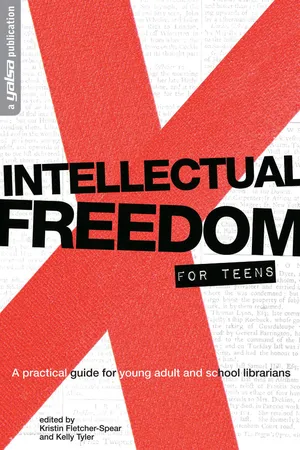
Intellectual Freedom for Teens
A Practical Guide for Young Adult & School Librarians
- 144 pages
- English
- ePUB (mobile friendly)
- Available on iOS & Android
eBook - ePub
Intellectual Freedom for Teens
A Practical Guide for Young Adult & School Librarians
Information
Chapter 1
Intellectual Freedom and Young Adult Librarianship
An Overview
IN 1999 TOM REYNOLDS asked readers of Alki, the Washington Library Association’s journal, to consider what age group is most affected by intellectual freedom issues:
The answer … is teenagers. Take a look at ALA’s list of the most frequently challenged or banned books …. What do these eighty titles have in common? Most are either written for or are popular with teen readers, or are of such literary value that they regularly appear on high school reading lists.1
He also questions the wisdom of withholding digital content from minors, explaining that libraries have a responsibility to teach young adults how to use the Internet rather than blocking material that may be questionable.
Reynolds’s article, with updates to some of the names and dates, could have been written now, more than a decade later. In 2011 seven of the top ten most challenged books, based on instances reported to the ALA’s OIF, were written for teens (and strong argument could be made to consider an eighth, To Kill a Mockingbird, in that category).2 The Children’s Internet Protection Act (CIPA): passed in 2001, “imposes certain types of requirements on any school or library that receives funding for Internet access or internal connections from the E-rate program.”3 Those requirements often mean filtering, but also mandate that schools create Internet safety policies and educate students on how to safely and smartly navigate content online. Privacy, whether learning how to maintain it on social networking sites or ensuring that a teen’s borrowing history remains known to that teen only, is another aspect of intellectual freedom for YA library staff to consider.
“Society and libraries vacillate between allowing YAs to behave responsibly while at the same time wanting to protect them,” Patrick Jones, Michele Gorman, and Tricia Suellentrop noted in 2004, hitting at the very heart of what makes defining intellectual freedom for young adults so tricky for parents and educators as well as library staff.4 In the Library Bill of Rights, ALA argues that libraries should offer materials on all viewpoints, challenge censorship, and ensure that each person’s right to accessing all library materials is open and not prevented by race, religion, or age, among other factors. But the profession’s ideals do not always match up with those espoused by governments and school boards, political groups, or individuals. This is where a school librarian, YA librarian, or library worker’s expertise in protecting teens’ freedom to read and ability to access material online is most important.
Defining Intellectual Freedom
Intellectual freedom, broadly speaking, is an individual’s right to seek out information of any kind and enjoy the free expression of ideas and information. It is the foundation of democracy and a cornerstone of librarianship.
In the context of librarianship, intellectual freedom is sometimes seen simply as fighting against banning books or challenging libraries’ ability to keep certain items in their collections. While challenges and book bans are the more highly charged or visible aspects of intellectual freedom, to limit the definition to challenges and book banning is highly reductive.
Carrying controversial materials and defending a young adult’s right to access them do likely rank highly in a teen librarian’s intellectual freedom priorities. But library staff who work with teens may find themselves defending the rights of their patrons beyond materials: they may need to argue in favor of teens’ ability to hang out in the library’s public computer lab after school or the right to privacy, explaining to parents that they cannot see a list of materials recently borrowed by their children; school librarians may need to explain to administrators why the school should consider unblocking YouTube for educational use during the Young Adult Library Services Association (YALSA) Teen Tech Week. Intellectual freedom within libraries has grown to include the rights of library patrons to access digital content on library computers, to have their checkout records maintained privately, to enjoy the same access to public spaces within a library, all no matter a patron’s age, personal political viewpoints, race, or religion, among other factors. It can also mean examining whether a library self-censors by deciding not to collect materials that could engender controversy or undue attention. This book intends to offer guidance and consideration to the ever-expanding universe of intellectual freedom for teen library staff and school librarians.
ALA and Intellectual Freedom
The Library Bill of Rights was first published by ALA in 1939 and has been amended six times. ALA’s commitment to intellectual freedom issues is stated clearly and plainly within:
The American Library Association affirms that all libraries are forums for information and ideas, and that the following basic policies should guide their services.
Books and other library resources should be provided for the interest, information, and enlightenment of all people of the community the library serves. Materials should not be excluded because of the origin, background, or views of those contributing to their creation.
Libraries should provide materials and information presenting all points of view on current and historical issues. Materials should not be proscribed or removed because of partisan or doctrinal disapproval.
Libraries should challenge censorship in the fulfillment of their responsibility to provide information and enlightenment.
Libraries should cooperate with all persons and groups concerned with resisting abridgment of free expression and free access to ideas.
A person’s right to use a library should not be denied or abridged because of origin, age, background, or views.
Libraries that make exhibit spaces and meeting rooms available to the public they serve should make such facilities available on an equitable basis, regardless of the beliefs or affiliations of individuals or groups requesting their use.
Adopted June 19, 1939, by the ALA Council; amended October 14, 1944; June 18, 1948; February 2, 1961; June 27, 1967; January 23, 1980; inclusion of “age” reaffirmed January 23, 1996.5
Given the profession’s commitment to supporting intellectual freedom, ALA created OIF in 1967, charging it with “implementing ALA policies concerning the concept of intellectual freedom as embodied in the Library Bill of Rights, the Association’s basic policy on free access to libraries and library materials.”6 OIF’s mission remains educating libraries and the general public about intellectual freedom and the important role that it plays in libraries. Led by Judith Krug until her death in 2009 and currently led by Barbara Jones, OIF collects statistics about intellectual freedom, particularly challenges, and offers support and resources for library staff handling intellectual freedom issues. In addition, OIF publishes The Intellectual Freedom Manual, soon to be in its ninth edition; creates toolkits to aid library staff in understanding intellectual freedom issues; and sponsors Banned Books Week, a celebration founded in 1982 by Krug to honor authors and books that faced censorship and to draw attention to the First Amendment.
In 1969 ALA established the Freedom to Read Foundation (FTRF) as a First Amendment legal defense fund, although the foundation does more than support librarians and libraries embroiled in free speech–related litigation. FTRF is directly involved in legal cases, both as plaintiff and amicus, and defends library customers by arguing against access to confidential records at the library. In addition, FTRF offers legal and financial help, including grants, to libraries, librarians, and other literary professionals (including publishers, authors, booksellers, journalists, and others) facing attempts to restrict materials and services. FTRF is an affiliate of ALA but works closely with the organization.
Intellectual Freedom for Young Adults
In the same year that ALA founded OIF, its members debated whether intellectual freedom applied to children and teen library users during a preconference event in San Francisco. More than 400 librarians attended the session, “Intellectual Freedom and the Teenager.” Panelist Edgar Z. Friedenberg was emphatic that those under 18 deserved the same rights as any other library visitor: “The library is just one more place where kids are taught they are second-class citizens. They learn this … from the very atmosphere of the place.”7 Preconference attendees agreed strongly with Friedenberg, enough that age was added as an area of concern to the next revision of the Library Bill of Rights. American courts have also found that minors should be allowed First Amendment protections, although not quite as many as those over the age of 18. The U.S. Supreme Court has argued over the years that minors must have access to “a broad range of information for intellectual growth,” arguing that “students ‘do not shed their constitutional rights … at the schoolhouse gate’” and “‘[p]eople are unlikely to become well-functioning, independent-minded adults and responsible citizens if they are raised in an intellectual bubble.’”8
Even with these legal protections and the generally supportive view of library staff, minors still face roadblocks to content at the library, school or public, including the removal or restriction of print materials and the filtering of online content.
Challenges and the YA Librarian
Intellectual freedom plays an important role in the professional lives of YA librarians and school librarians because the vast majority of challenges to materials and access is aimed at those under 18. OIF maintains a database of challenges, tracking the number of challenges per year, the reasons for challenges, the initiators of challenges, and the types of institutions in which a challenge takes place. Since 1990 OIF has logged nearly 11,000 challenges; more than 60 percent of them were originated by a parent, with more than two-thirds of challenges taking place in schools or school libraries.9
A book challenge is a form of censorship and can lead to a ban, but it is important not to use these terms interchangeably. Challenges and book banning are facets of censorship, which cuts a far broader swath against intellectual freedom than the facets alone. Censorship is a systematic approach to preventing speech that may be considered objectionable. A challenge is a “formal, written complaint, filed with a library or school requesting that materials be removed because of content or appropriateness,” and OIF only tracks those challenges that are reported to them or seen in the news; they assume that as many as four or five incidents occur for every one that is reported or covered by media.10 For a book to be considered banned, it must be removed from a library. Each year, OIF compiles a list of the most frequently challenged books, drawn from challenges reported to them. Approximately 300 to 500 challenges are reported to OIF each year, and it is fair to assume that many of them begin in either the children’s or teens’ department.
Challenges are launched for a variety of reasons and are not limited to any side of the political spectrum. Huckleberry Finn and To Kill a Mockingbird have been challenged for offensive language by left-leaning individuals and organizations over their use of the word nigger; the picture book And Tango Makes Three is one of the most challenged books in the United States over its depiction of two penguins as being gay, even though it contains no sexually suggestive or explicit content. Challenges are aimed at books that are currently breathtakingly popular (The Hunger Games and Harry Potter series) or are older or more obscure (The Summer of My German Soldier, originally published in 1973, appeared on the 2001 most-challenged list).11 The most oft-cited reason for challenging materials is sexually explicit content, followed by offensive language, and “unsuited to age group,” according to OIF. It is worth noting, however, that the fourth most popular reason for challenging materials is “other.”
Challenges take place in all kinds of libraries and come from a variety of sources. The stereotypical challenge begins with an agitated, organized group or an irate parent, but it can originate from any source. YA specialists can talk about books that individual patrons have suggested be added to a restricted area rather than the YA section, or when a colleague from another department expressed shock that the YA...
Table of contents
- Cover
- Title Page
- Copyright Page
- Contents
- Acknowledgments
- Introduction
- Chapter 1: Intellectual Freedom and Young Adult Librarianship: An Overview
- Chapter 2: Before a Challenge Occurs: How to Prepare Yourself and Your Staff
- Chapter 3: What to Do When a Challenge Happens to You
- Chapter 4: Intellectual Freedom: Programming and Marketing
- Chapter 5: Access in the Digital World
- Appendix A: Most Challenged YA Books, 2006–2011
- Appendix B: The Value of Young Adult Literature
- Appendix C: YALSA’s Competencies for Librarians Serving Youth: Young Adults Deserve the Best
- Appendix D: Current Research Related to Young Adult Services, 2006–2009: A Supplement Compiled by the YALSA Research Committee
- Appendix E: Interpretations of ALA’s Library Bill of Rights
- Index
Trusted by 375,005 students
Access to over 1.5 million titles for a fair monthly price.
Study more efficiently using our study tools.
Frequently asked questions
Yes, you can cancel anytime from the Subscription tab in your account settings on the Perlego website. Your subscription will stay active until the end of your current billing period. Learn how to cancel your subscription
No, books cannot be downloaded as external files, such as PDFs, for use outside of Perlego. However, you can download books within the Perlego app for offline reading on mobile or tablet. Learn how to download books offline
Perlego offers two plans: Essential and Complete
- Essential is ideal for learners and professionals who enjoy exploring a wide range of subjects. Access the Essential Library with 800,000+ trusted titles and best-sellers across business, personal growth, and the humanities. Includes unlimited reading time and Standard Read Aloud voice.
- Complete: Perfect for advanced learners and researchers needing full, unrestricted access. Unlock 1.5M+ books across hundreds of subjects, including academic and specialized titles. The Complete Plan also includes advanced features like Premium Read Aloud and Research Assistant.
We are an online textbook subscription service, where you can get access to an entire online library for less than the price of a single book per month. With over 1.5 million books across 990+ topics, we’ve got you covered! Learn about our mission
Look out for the read-aloud symbol on your next book to see if you can listen to it. The read-aloud tool reads text aloud for you, highlighting the text as it is being read. You can pause it, speed it up and slow it down. Learn more about Read Aloud
Yes! You can use the Perlego app on both iOS and Android devices to read anytime, anywhere — even offline. Perfect for commutes or when you’re on the go.
Please note we cannot support devices running on iOS 13 and Android 7 or earlier. Learn more about using the app
Please note we cannot support devices running on iOS 13 and Android 7 or earlier. Learn more about using the app
Yes, you can access Intellectual Freedom for Teens by Kristin Fletcher-Spear,Kelly Tyler in PDF and/or ePUB format, as well as other popular books in Languages & Linguistics & Library & Information Science. We have over 1.5 million books available in our catalogue for you to explore.