Introducing the basic concepts of clinical forensic medicine and death investigation, this book covers the main areas of forensic investigation . It provides an introduction to forensic science and coverage of injury patterns, natural disease, accidental trauma, child injury and fatalities, and domestic violence. Anyone who has direct contact with death, crime, and the medicolegal system, including nurses, physicians, attorneys, death investigators, forensic pathologists, and police detectives, will find this an invaluable reference.
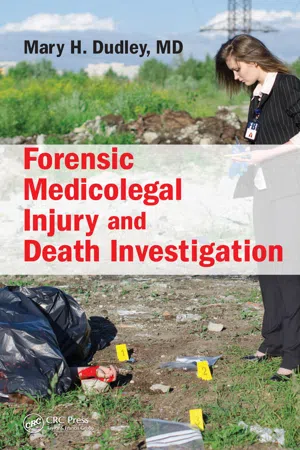
- 262 pages
- English
- ePUB (mobile friendly)
- Available on iOS & Android
eBook - ePub
Forensic Medicolegal Injury and Death Investigation
About this book
Information
I Introduction
To Forensic
Investigation
1
Forensic Investigative Systems
OBJECTIVES
Upon completion of this chapter and the corresponding reference material, the reader will be able to
- Describe roles and responsibilities of specialists within forensic investigative systems
- Describe a psychological autopsy and a forensic autopsy
- Explain how his or her particular role interacts with those of other specialists described in this chapter
- Discuss how local resources differ from state to state, from county to county, from urban areas to rural areas
- Describe how first responders to a death scene can interact with the forensic investigators
Introduction
Forensic investigative systems provide important contributions for medicolegal analysis to the criminal justice system. Many professional and technical specialists are necessary to make the forensic investigative system operate smoothly. Depending on statutes and ordinances, differences exist for reporting deaths within states, counties, and cities. Differences also occur among coroner systems, medical examiner systems, and combined systems. Additionally, the number and responsibilities of individuals within each type of system vary. The overall goal of each system, however, is to determine the identity of the decedent and the cause, mechanism, and manner of death.
Guidelines as to what constitutes a case for the medical examiner (ME)/coroner are based on types of death, reporting procedures, and state statutes. Some states have a “24 hour rule” that requires a report of death be made to the ME/coroner in the case of a presumed natural death that occurs during the first day of a hospital admission. Other states do not have this rule unless the circumstances are covered under state statute.
Most states require report of certain deaths to a law enforcement officer and the ME/coroner by any person having knowledge of the death of a human being. Generally, failure to report such death is classified as a misdemeanor, punishable by a fine or imprisonment.
Categories of death that require a law enforcement or ME/coroner report include
- Death that occurs when not under the care of a physician
- Death that occurs when an attending physician is not available to sign the death certificate
- Death from violence
- Sudden death in an otherwise healthy individual
- Death in prison
- Death of a prisoner or while in custody
- Death that occurs in a suspicious, unusual, or unnatural manner
- Death related to accident or disease associated with the decedent’s occupation
- Death that is believed to have presented a public health hazard
- Death that occurs during surgery or while under anesthesia
Examples of Reportable Deaths
- Falls
- Blunt force or crushing injuries
- Stabbing or sharp force injuries
- Fatal gunshot wounds
- Fatal electric shocks or lightning strikes
- Fatal explosions
- Strangulations or asphyxial deaths
- Fatal motor vehicle accidents
- Drug overdoses or poisonings
- Fatal burns or fires
- Stillborns or newborn deaths if associated with trauma or illicit drug abuse
- Rapid fatal illnesses
- Occupational deaths
- Persons found dead
- Clustering of undiagnosed infectious disease
Legal Issues Regarding Death
Numerous legal issues are associated with a death including notification of the next of kin, death certification, estate transfers, worker’s compensation claims, criminal and civil investigations, insurance claims, and settlements. The key to all of the above issues is proper identification of the decedent. Identification may require assistance from multiple forensic specialists including forensic pathologists, police agencies for fingerprints, forensic anthropologists for skeletal examination and comparison, forensic odontologists for dental identification, DNA experts, and a host of other types of experts, depending on the case. Use of forensic team experts is especially needed if the individual cannot be visually identified in circumstances such as fire deaths, decomposition, aircraft accidents, or skeletal remains.
Notification of the next of kin is most properly done in person rather than by telephone. It should be accomplished by law enforcement personnel or the forensic medical investigator.
Proper determination of the manner of death is important for both criminal and civil investigations as well as for insurance claims. A careful ME/coroner examination and scene investigation are required to determine whether the death was by accident or by suicide. For example, some insurance policies will compensate the next of kin with “double indemnity” in an accidental manner of death but will pay nothing in a suicide manner of death. The manner of death is determined by investigation of the circumstances of death determined at the death scene.
Transplantation (Organ and Tissue Donation)
Permission to transplant organs or tissue is requested of and granted by the next of kin of the decedent. In addition, the ME/coroner must grant permission for donation in a medicolegal case prior to donation.
Specialties in Forensic Medical Investigation
Forensic Pathology
Pathology is the study of injury or natural disease; forensic pathology is the interface between pathology and the law. Forensic pathology became a recognized medical specialty in 1959.
The forensic pathologist is a medical doctor with 4 or 5 years of residency training in anatomic and clinical pathology as well as 1 year of fellowship training in forensic pathology. The forensic pathologist is generally appointed as an ME or may be elected to the ME/coroner’s office. Forensic pathologists may also contract with the ME/coroner’s office to provide forensic autopsy services. Forensic pathologists determine the cause, mechanism, and manner of death for cases that are under their jurisdiction. The forensic pathologist may be called to the scene of death. Rarely, the forensic pathologist may be the one who pronounces the victim dead. The forensic pathologist performs the forensic autopsy, issues an autopsy report, preserves tissue samples as required by state law, and creates a death certificate. As ME/coroner, the forensic pathologist also will grant permission for cremation and will provide court testimony as an expert witness. The forensic pathologist generally coordinates the involvement of forensic specialist consultants. Forensic pathologists are board certified by the American Board of Pathology.
Forensic Medical Investigation
Scene investigation is of paramount importance in any medicolegal inquiry of a death. As in clinical medicine where a comprehensive medical history provides 50%–75% of the information necessary for a diagnosis, a properly conducted scene investigation can provide the majority of information significant to a particular case for the forensic pathologist. The forensic medical investigator functions as the “eyes and ears” of the forensic pathologist and relays pertinent information to the forensic pathologist prior to autopsy. Authority and primary responsibility of crime scene investigation remain with the law enforcement agency whereas the forensic pathologist/ME/coroner has state statutory authority and responsibility to conduct a medicolegal investigation and has jurisdiction of the body at the scene.
The forensic medical investigator has a basic knowledge of medicolegal death investigation and clinical forensic investigation (the “living” forensic cases). Medicolegal death investigators are nationally certified by the American Board of Medicolegal Death Investigators. Forensic medical investigators are generally full-time employees of the ME/coroner’s office and function under the direction and supervision of the ME.
Forensic Odontology
Forensically trained, licensed dentists who work for the ME/coroner system are known as forensic odontologists. Depending on the size and structure of the ME/coroner department, the dentist may be employed in forensics on a full-time basis or as a consultant on a contractual basis.
The scope of the forensic odontologist’s responsibilities generally involves the identification of victims based on dental comparison in individual situations such as fire deaths and decomposition or in mass disasters such as explosions, building collapses, or aircraft accidents. One major aspect of forensic odontology is the comparison of antemortem and postmortem dental x-rays to make confirmed identities. Forensic odontologists are also called upon to identify and match characteristics of bite marks that may be related to a death. Forensic odontologists can identify evidence of child abuse from oral soft tissue or dental injuries such as a torn frenulum or avulsed tooth sustained from a blow to the mouth of a child. Additionally, as with forensic pathologists, the forensic odontologist may be called upon to testify about his or her findings in a court of law. Forensic odontologists are board certified by the American Board of Forensic Odontology.
Forensic Anthropology
Forensic anthropology involves the study of skeletal remains associated with forensic issues including human identification and trauma. Forensic anthropologists can distinguish between human and nonhuman bones and can determine the age, sex, race, and stature from human skeletal analysis. The forensic anthropologist assists the medical examiner in scene recovery of buried or burnt remains. Forensic anthropologists are board certified by the American Board of Forensic Anthropology.
Forensic Psychology
Forensic psychologists who work with the ME/coroner’s office to investigate deaths generally focus on the psychological autopsy of the deceased. The psychological autopsy is a document obtained by interviewing next of kin and friends of the deceased and by reviewing psychiatric history to determine the mental state of the individual at the time of death to help in determination of the manner of death, for example, suicide vs. accident. Within the realm of criminalistics and law enforcement, the forensic psychologist consults on the previous mental health of the decedent as well as that of the assailant. Psychological profiles of the perpetrators offer valuable clues regarding mental state at the time of the crime and/or competency to testify. The forensic psychologist may also be called upon to offer testimony for the defense and/or prosecution in a court of law.
Forensic psychologists have obtained an advanced ...
Table of contents
- Cover
- Half Title
- Title Page
- Copyright Page
- Contents
- Preface
- Acknowledgments
- Author
- Contributors
- Section I INTRODUCTION TO FORENSIC INVESTIGATION
- Section II INJURY RECOGNITION
- Section III NATURAL AND ACCIDENTAL DEATHS
- Section IV CHILD FATALITIES AND DOMESTIC VIOLENCE
- Index
Trusted by 375,005 students
Access to over 1.5 million titles for a fair monthly price.
Study more efficiently using our study tools.
Frequently asked questions
Yes, you can cancel anytime from the Subscription tab in your account settings on the Perlego website. Your subscription will stay active until the end of your current billing period. Learn how to cancel your subscription
No, books cannot be downloaded as external files, such as PDFs, for use outside of Perlego. However, you can download books within the Perlego app for offline reading on mobile or tablet. Learn how to download books offline
Perlego offers two plans: Essential and Complete
- Essential is ideal for learners and professionals who enjoy exploring a wide range of subjects. Access the Essential Library with 800,000+ trusted titles and best-sellers across business, personal growth, and the humanities. Includes unlimited reading time and Standard Read Aloud voice.
- Complete: Perfect for advanced learners and researchers needing full, unrestricted access. Unlock 1.5M+ books across hundreds of subjects, including academic and specialized titles. The Complete Plan also includes advanced features like Premium Read Aloud and Research Assistant.
We are an online textbook subscription service, where you can get access to an entire online library for less than the price of a single book per month. With over 1.5 million books across 990+ topics, we’ve got you covered! Learn about our mission
Look out for the read-aloud symbol on your next book to see if you can listen to it. The read-aloud tool reads text aloud for you, highlighting the text as it is being read. You can pause it, speed it up and slow it down. Learn more about Read Aloud
Yes! You can use the Perlego app on both iOS and Android devices to read anytime, anywhere — even offline. Perfect for commutes or when you’re on the go.
Please note we cannot support devices running on iOS 13 and Android 7 or earlier. Learn more about using the app
Please note we cannot support devices running on iOS 13 and Android 7 or earlier. Learn more about using the app
Yes, you can access Forensic Medicolegal Injury and Death Investigation by M.D. Dudley in PDF and/or ePUB format, as well as other popular books in Medicina & Derecho penal. We have over 1.5 million books available in our catalogue for you to explore.