
eBook - ePub
Russia in the Nineteenth Century
Autocracy, Reform, and Social Change, 1814-1914
- 304 pages
- English
- ePUB (mobile friendly)
- Available on iOS & Android
eBook - ePub
Russia in the Nineteenth Century
Autocracy, Reform, and Social Change, 1814-1914
About this book
This is a comprehensive interpretive history of Russia from the defeat of Napoleon to the eve of World War I. It is the first such work by a post-Soviet Russian scholar to appear in English. Drawing on the latest Russian and Western historical scholarship, Alexander Polunov examines the decay of the two central institutions of tsarist Russia: serfdom and autocracy. Polunov explains how the major social groups - the gentry, merchants, petty townspeople, peasants, and ethnic minorities - reacted to the Great Reforms, and why, despite the emergence of a civil society and capitalist institutions, a reformist, evolutionary path did not become an alternative to the Revolution of 1917. He provides detailed portraits of many tsarist bureaucrats and political reformers, complete with quotations from their writings, to explain how the principle of autocracy, although significantly weakened by the Great Reforms in mid-century, reasserted itself under the last two emperors. Polunov stresses the relevance, for Russians in the post-Soviet period, of issues that remained unresolved in the pre-Revolutionary period, such as the question of private property in land and the relationship between state regulation and private initiative in the economy.
Chapter 1
On the Path to Reform
At what point does the story of the abolition of serfdom in Russia begin? Historians have answered this question in various ways. Some consider the starting point to be the era of Catherine II, when serfdom reached its apogee but, at the same time, open protests against it rang out at the Legislative Commission. Others cite Aleksandr Radishchev’s revolutionary call to destroy autocracy and serfdom. Still others focus on the first practical steps toward emancipation taken under Alexander I. To be sure, all these events played an important part in Russia’s history. For the movement to eliminate serfdom to become irreversible, however, a major shock was required, one that affected every segment of society and clearly pointed to the inevitability of change. That shock was provided by the War of 1812.
The war affected Russian society so strongly that Alexander Herzen called it “the beginning of real Russian history (until then we had only prehistory).”1 The invasion of Russian territory by enemy forces—for the first time since the Time of Troubles at the beginning of the seventeenth century—called forth an outburst of patriotism that united all segments of the population. Popular resistance began the moment Napoleon crossed the Russian frontier. Peasants withdrew from the path of the Grande Armée, destroyed supplies, burned houses, and attacked separate detachments of French troops. Patriotic demonstrations took place in the towns, thousands of men enrolled in the militia, and vast sums were donated to the defense of the country. The voice of public opinion grew louder and was not afraid to make demands on the tsar. In the threatening atmosphere of the war, the concepts of “tsar” and “fatherland” did not always coincide. The popular general Mikhail Kutuzov, whom the tsar reluctantly had to appoint commander-in-chief, became the national hero, not Alexander.
The two outstanding events of the war were the Battle of Borodino on August 26/September 7, 1812, in which the Russian army withstood the attack of Napoleon’s main force, and the burning of Moscow, Russia’s ancient capital, which the population had abandoned before the French troops entered it. In effect, Napoleon was shut up in Moscow, deprived of reinforcements and provisions, and forced to begin retreating from Russia. The retreat gradually turned into flight. The European campaigns of the Russian army in 1813–14 led to the creation of a new anti-Napoleonic coalition consisting of Russia, England, Austria, and Prussia, which completed the rout of the French emperor. On March 18/30,1814, a Russian colonel, Mikhail Orlov, accepted the surrender of Paris.2
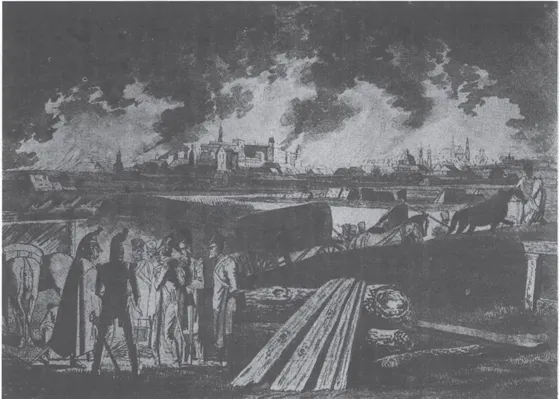
“The Buring of Moscow” (1812). Nineteenth-century watercolor.
The brilliant victory over Napoleon significantly elevated Russia’s international authority and for a long time secured for it a preeminent position in Europe. The contrast between the country’s power in foreign affairs and the backwardness of its internal structure became all the more striking, however. The free ancestors of the Russians “would look with horror upon the contemptible position of their descendants,” exclaimed Major Vasily Raevsky, a participant in the War of 1812. “They would tremble in amazement, not daring to believe that Russians had become slaves, and that we whose name and power extend from the inaccessible North Pole to the shores of the Danube, from the Baltic Sea to the Caspian, and give laws and rights to innumerable tribes and peoples, in all our grandeur fail to see our own abasement in the slavery of the peasants.”3
As many contemporaries recognized, the victory over Napoleon could not have been achieved without the active participation of the peasants, who returned to floggings and the chains of serfdom. “The war was still going on,” Aleksandr Bestuzhev-Marlinsky, an officer and writer, recalled, “when the soldiers, upon their return home, began to spread murmurs of discontent among the people. ‘We shed our blood,’ they said, ‘and they are forcing us again to toil at labor service. We saved the country from a tyrant, and the lords are again tyrannizing over us.’ ”4 These contradictions seemed so sharp and glaring that immediately after the army’s return from its foreign campaigns a revolutionary movement arose within the officer corps. The conspiracy later came to be called the “Decembrist movement,” after the attempt by its participants to carry out an uprising in December 1825.
The Decembrist uprising resembled the revolutions of the 1820s in Spain, Portugal, Italy, and Greece, but it differed in one significant respect. Unlike southern Europe, Russia was not subject to foreign rule or threatened by a powerful neighbor. Therefore the Decembrists, who regarded their protest against social oppression as a continuation of their patriotic mission, had to invent “foreign” oppressors. The Decembrists accused the emperor of “patronizing Germans” and denounced the “foreign origins” of the ruling dynasty. It was characteristic that they protested the introduction of a constitution in the Polish lands that Russia acquired in 1815. As the Decembrist Dmitry Zavalishin wrote, “Russians were offended at the granting of a constitution to defeated and conquered Poland before one was given to Russia, which had vanquished it.”5 Indignation arose not over constitutional principles themselves, which fully corresponded to the Decembrists’ views, but over Alexander’s imprudent effort to begin reform in the western borderlands. This was taken as evidence of the emperor’s contempt for “native Russians.”
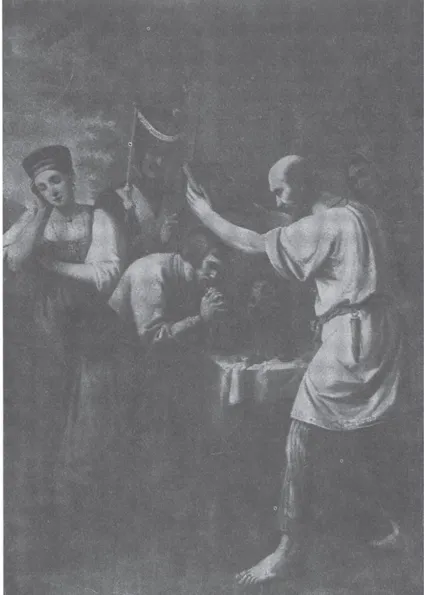
“Blessing the Militia.” Nineteenth-century painting.
A heightened sense of patriotism permeated every aspect of the Decembrists’ outlook. It found various forms of expression, such as searching for models of “sacred freedom” in the national past, attempting to counteract the “influx of Germans” into the Russian service, substituting “immemorially Russian” words for European political terms, and proposing that the emperor be killed for supposedly planning to “cede Russian lands to Poland.” In its most extreme form the Decembrists’ patriotism could take on features of aggressive nationalism, as in the program of Pavel Pestel [see page 36],
The Decembrists, of course, recognized the similarity of their movement to the revolutions of southern Europe and were inspired by their example. They tried to take as their model the Greek Hetairia and the Italian Carbonari.6 They found it extremely difficult, however, to transfer the European experience to Russia. The revolutionary movements in Europe, though they arose within secret societies, had broad support within the bourgeoisie and intelligentsia. In Russia, the revolutionary movement at the beginning of the nineteenth century remained confined almost entirely to the nobility. The Decembrists recognized that because of the distinctive features of Russian history their social base was very narrow, and therefore they adopted the tactic of military revolution as their chief method of action. They understood that European slogans of constitutional liberties meant nothing to the common people, and that the fury of a mass uprising would fall upon all the nobles, including the Decembrists themselves. These considerations prompted the Decembrist officers, while sincerely devoted to the welfare of the masses, to keep them as far from the insurrection as possible, and to be very cautious about disclosing the true aims of their movement even to their soldiers.
How did the Decembrist movement develop? The first secret society, the Union of Salvation, arose in 1816. This extremely small organization of just thirty officers employed conspiratorial methods. In 1818, signs of a more liberal turn in the government’s policies encouraged them to form a new society, the Union of Welfare, with a membership of about 200. The members of the Union of Welfare attempted to disseminate enlightened views. They spoke out in salons against serfdom and the brutal treatment of soldiers, gave help to starving peasants, created mutual-instruction schools in the army (a system in which the more advanced pupils helped teach the others), purchased the freedom of talented self-taught serfs, and served in the courts and administrative institutions. Educational work did not satisfy the revolutionary zeal of the majority of the Decembrists, however. The government’s definitive turn to reaction at the beginning of the 1820s impelled them to disband the Union of Welfare and to create two secret organizations, the Northern and Southern societies, which resolved to prepare a military revolution.
The sentiments of the young officers, and perhaps even the very existence of the secret societies, became known to Alexander I. He himself shared many of the ideas that inspired them. He was speaking of the Decembrists when, at a late stage in the development of their movement, he said, “it is not for me to punish them.” From the time when he was still the heir to the throne, Alexander had dreamed of limiting autocracy and abolishing serfdom, but he intended, of course, to pursue the path of peaceful reforms from above. He believed that the end of the Napoleonic wars had created the best conditions to carry out those reforms. The calamities of war and revolution would incline governments and peoples to compromise and accustom them to mutual concessions. At Alexander’s insistence, after the defeat of Napoleon a constitutional structure was preserved in Switzerland and introduced in France and a number of the German states. Even within the Russian Empire, Finland, which had been conquered from Sweden, received a constitution in 1809. To guarantee the postwar structure of Europe, Alexander insisted on the conclusion of the Holy Alliance, in which the monarchs of Europe promised to treat their subjects “like the fathers of families” and each other “in a spirit of brotherhood.”7
The heart of Alexander’s postwar policy was the annexation of central Poland (the “Kingdom of Poland”) to Russia, and the granting to it of a constitution. Alexander hoped that this measure would simultaneously eliminate a hotbed of tension in the center of Europe and advance constitutional reforms in Russia. A reform project entitled The Constitutional Charter of the Russian Empire was drawn up in the office of Alexander’s old friend Nikolai Novosiltsev, whom he had appointed imperial commissioner of the Kingdom of Poland. The charter proposed the creation in Russia of a two-chamber parliament to be called a Sejm; elections on the basis of a property qualification; fundamental civil freedoms of speech, conscience, and the press; inviolability of person and private property; and equality of all subjects before the law. The most important innovation was to be the transformation of Russia into a federation. According to the charter, the country would be divided into twelve autonomous “lieutenancies,” or regions, each with its own parliament.8
Although usually cautious and secretive, Alexander felt it necessary in this instance to make a public announcement of his intention to extend “the salutary influence of free and legally defined institutions.… to all the countries that Providence has entrusted to my care.” At the opening session of the Polish parliament (Sejm) on March 15, 1818, the Russian emperor gave a speech that became the last and most complete exposition of his liberal convictions. Alexander said to the Poles:
Show your contemporaries that free and legally defined institutions [les institutions libérales], the sacred principles of which they confuse with the destructive doctrines that have threatened the social order with a disastrous collapse in our times, are not a dangerous dream, but that, on the contrary, when such institutions are implemented with a righteous heart and are directed with pure intentions to the attainment of an objective that is useful and salutary for mankind, they are fully in accord with order and general tranquillity and establish the true prosperity of nations.9
While making plans for constitutional reform, the government prepared the reorganization of Russia on the federal principle.10 Alexander also ordered discussions within the government to investigate different ways to eliminate serfdom, such as a gradual redemption of the landowners’ serfs by the state and the introduction of various forms of private property in land. In 1816–19, a peasant reform was carried out in the Baltic region, giving the peasants freedom without land. One can scarcely call the basic principles of the peasant reform in the Baltic progressive. Nevertheless, as the historian Sergei Mironenko has observed, it was “the first act in several centuries by which the autocracy neither deepened nor expanded serfdom, but, on the contrary, terminated it, if only in part of the territory of the enormous Russian Empire.”11 The so-called “Baltic version” of serf emancipation now became part of the autocracy’s arsenal of social policies and a possible model for resolving the peasant question in Russia. The abolition of serfdom in the Baltic region increased the chances for constitutional reform in Russia. Yet, despite the emperor’s forthright declarations and the great number of preparatory measures, he did not implement any of the reforms. How can we explain such a paradoxical result?
Above all, the good intentions of the tsar-reformer and his government came up against the insuperable opposition of most Russian landowners. The unpaid labor of the serfs suited most of the gentry very nicely, they lacked a long-term perspective, and the country’s international position seemed unshakable after the victory over Napoleon. “Our blessed fatherland has always been and will always be tranquil,” declared State Secretary Aleksandr Shishkov, an eminent dignitary, during the discussion of the peasant question in the State Council in 1820. “It is more successful and more prosperous than any other nation … Under such circumstances, it would appear that if it really were necessary to make some changes, this is not the time to consider them. We clearly see the grace of God upon us. The right hand of the All-High is protecting us. What more could we want?”12 The resistance of the nobility prevented the implementation not only of peasant reform but of constitutional reform as well. It was clear that political freedom would inevitably entail the abolition of serfdom. Mindful of his father’s sad fate, Alexander decided not to oppose the wishes of the nobility.
As time went on, Alexander himself began to lose interest in the idea of reform, and particularly in the prospect of limiting his own power. The principle of compromise, which the emperor strove to follow in every situation, in this instance presupposed the combination of the incompatible: West European constitutionalism and traditional Russian autocracy. Prince Adam Czartoryski wrote: “The emperor loved the external forms of liberty as people are captivated by theatrical spectacles. He liked the phantom of a free government, and he boasted of it, but he sought only the forms and the external appearance, without allowing them to become a reality. In a word, he would gladly have granted liberty to the entire world on the condition that everyone voluntarily submit exclusively to his will.”13
International events contributed to the reactionary turn in Alexander’s policies. It became clear that the peoples of Europe were not inclined to s...
Table of contents
- Cover
- Half Title
- Title Page
- Copyright Page
- Table of Contents
- List of Illustrations
- Foreword, Larissa Zakharova
- Foreword, Thomas C. Owen
- Preface and Acknowledgments
- Introduction
- 1. On the Path to Reform
- 2. "A Time of External Slavery and Internal Freedom"
- 3. A Colossus with Feet of Clay
- 4. The End of Serfdom
- 5. The Great Reforms: Sources and Consequences
- 6. Russia's Economy and Finances after the Emancipation of the Serfs
- 7. The Opposition Movement in Post-Reform Russia: From "Thaw" to Regicide
- 8. Russia and the World, 1856-1900
- 9. Under the Banner of Unshakable Autocracy
- 10. Nicholas II: A Policy of Contradictions
- 11. Opposition and Revolution
- 12. On the Eve of Great Changes
- Conclusion
- Notes
- Index
- About the Author
Trusted by 375,005 students
Access to over 1.5 million titles for a fair monthly price.
Study more efficiently using our study tools.
Frequently asked questions
Yes, you can cancel anytime from the Subscription tab in your account settings on the Perlego website. Your subscription will stay active until the end of your current billing period. Learn how to cancel your subscription
No, books cannot be downloaded as external files, such as PDFs, for use outside of Perlego. However, you can download books within the Perlego app for offline reading on mobile or tablet. Learn how to download books offline
Perlego offers two plans: Essential and Complete
- Essential is ideal for learners and professionals who enjoy exploring a wide range of subjects. Access the Essential Library with 800,000+ trusted titles and best-sellers across business, personal growth, and the humanities. Includes unlimited reading time and Standard Read Aloud voice.
- Complete: Perfect for advanced learners and researchers needing full, unrestricted access. Unlock 1.5M+ books across hundreds of subjects, including academic and specialized titles. The Complete Plan also includes advanced features like Premium Read Aloud and Research Assistant.
We are an online textbook subscription service, where you can get access to an entire online library for less than the price of a single book per month. With over 1.5 million books across 990+ topics, we’ve got you covered! Learn about our mission
Look out for the read-aloud symbol on your next book to see if you can listen to it. The read-aloud tool reads text aloud for you, highlighting the text as it is being read. You can pause it, speed it up and slow it down. Learn more about Read Aloud
Yes! You can use the Perlego app on both iOS and Android devices to read anytime, anywhere — even offline. Perfect for commutes or when you’re on the go.
Please note we cannot support devices running on iOS 13 and Android 7 or earlier. Learn more about using the app
Please note we cannot support devices running on iOS 13 and Android 7 or earlier. Learn more about using the app
Yes, you can access Russia in the Nineteenth Century by A. I. U. Polunov,Thomas C. Owen,L. G Zakharova in PDF and/or ePUB format, as well as other popular books in Business & Vendite. We have over 1.5 million books available in our catalogue for you to explore.