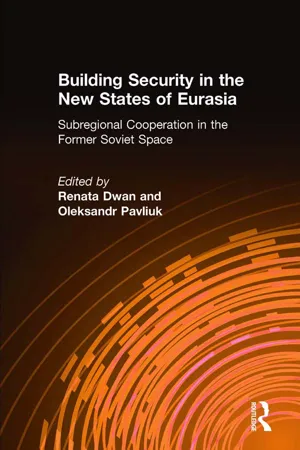
eBook - ePub
Building Security in the New States of Eurasia: Subregional Cooperation in the Former Soviet Space
Subregional Cooperation in the Former Soviet Space
- 304 pages
- English
- ePUB (mobile friendly)
- Available on iOS & Android
eBook - ePub
Building Security in the New States of Eurasia: Subregional Cooperation in the Former Soviet Space
Subregional Cooperation in the Former Soviet Space
About this book
This pathbreaking study brings together international experts to consider security issues and the experience and potential for cooperation in the subregions of the former Soviet Union. Appendices to the volume provide maps, a guide to acronyms, profiles of existing subregional organizations, and a chronology of cooperative agreements signed in the region since 1991.
1
Trade Initiatives in Central Asia
The Economic Cooperation Organization
and the Central Asian Economic Community
and the Central Asian Economic Community
Richard Pomfret
During the 1990s, Central Asia was the most fluid region in the Eurasian space in terms of international economic relations and subregional initiatives. The five new independent states had no experience of statehood, little national identity, and almost no warning that they would become independent in 1991. The next few years were dominated at home by nation building and institution creation, and abroad by a search for groupings and allies within and beyond the region.1
After initial attempts to cushion themselves from the economic shocks of the dissolution of the USSR by remaining within the ruble zone, by the end of 1993 Kyrgyzstan, Turkmenistan, Kazakhstan, and Uzbekistan had all embarked on more independent economic policies. Relations with Russia and other members of the Commonwealth of Independent States remained dominant, but their importance diminished rapidly during the remainder of the 1990s.2 Despite much talk of intra-CIS regional trade arrangements, only Kazakhstan and Kyrgyzstan sought to formalize such arrangements by joining the Russia-Belarus customs union in March 1996. The Tajikistan regime remains heavily dependent on Russian support, but this was a bilateral arrangement until February 1999.3 Uzbekistan and Turkmenistan have remained outside formal CIS economic arrangements, because they are opposed to the Russian domination of external commercial policy that they consider to be inevitable in any CIS customs union.
Looking beyond the historic Soviet links, the new independent states have also explored possible subregional groupings based on geography, language, culture, or other links. The linguistic ties between Turkey and Kazakhstan, Kyrgyzstan, Turkmenistan, and Uzbekistan, and between Iran and Tajikistan, have led to associations of Turkic- and Farsi-speaking nations, with little economic content. Associations centered on the Caspian Sea or the Black Sea play a role as fora for discussing maritime issues, but, with the possible exception of the Black Sea Economic Cooperation arrangement, have little broader significance. The two most important types of groupings are a narrower Central Asia association, represented by the Central Asian Economic Community (CAEC), and a broader grouping of all non-Arab Islamic countries west of India, represented by the Economic Cooperation Organization (ECO).
This chapter analyzes the development of the CAEC and of ECO, and assesses their prospects. As with other subregional arrangements, the origins and evolution of both organizations have been strongly influenced by politics. Central Asia is riven by competition, especially between Uzbekistan and Kazakhstan, for leadership within the region, and between Iran, Turkey, and Pakistan for influence over their landlocked Central Asian neighbors.4 The political aspects cannot be ignored, but this chapter focuses on the economic aspects of the subregional groupings, which are critical to their long-term impact.
The first section of the chapter analyzes the trade policy options facing the new independent states after the dissolution of the USSR in late 1991. The second section analyzes the Central Asian countries’ trade within the Commonwealth of Independent States, which represents continuity of former intra-USSR links. The third and fourth sections deal with the CAEC and ECO, respectively, as the two major new regional initiatives. Section five then analyzes the prospects for greater intra-regional trade, and draws some conclusions.
Trade Policy Options for Former Soviet Republics
With the sudden collapse of the Soviet Union in late 1991 and the emergence of fifteen new independent states, international trade policy had to be considered in the new capitals. The economic arguments for all of the smaller republics were clear: as small and open economies, they would benefit most from liberal non-discriminatory trade policies.5 The new governments were, however, concerned with the adjustment costs of bringing domestic prices in line with world prices, which would be likely to impose a drastic change in the output mix. One way of reducing the adjustment costs was to sustain old demand and supply links by retaining a common currency and by refraining from imposing restrictions on intra-CIS trade.
Discriminatory trade policies encourage trade with a favored partner even when that partner is not the least-cost supplier of a good. In a customs union or free trade area where trade among members is duty-free, if the price of imports from the least-cost supplier, including tariffs, exceeds the tariff-free price of imports from a fellow member, then consumers will buy the latter good even though the former would be cheaper for the nation (because the tariff revenue paid by consumers is redistributed to benefit residents). Such trade diversion from the least-cost to a higher-cost producer hurts the importing country and misallocates global resources, although the favored trading partner benefits.6
Free trade areas (FTAs) are easier to negotiate than customs unions (CUs) because each FTA member retains its own external trade policy. In a customs union, the members have to agree on their common commercial policy and on how the tariff revenue will be used. Nevertheless, successful FTAs are uncommon, because of the problem known as trade deflection: importers will bring a good into the FTA through the member country whose external trade barriers are lowest and then move the good across the FTA’s internal borders to satisfy import demand in the more highly protected markets. Such trade deflection will be less severe if transport costs are high, but for contiguous FTA members trade deflection is difficult to avoid. Rules of origin may be introduced, requiring documentation of the national origin of goods, but checking origin documents at borders is a significant cost when one goal of FTAs or CUs is to do away with time-consuming paperwork at internal borders. Moreover, rules of origin are ineffective for any fungible goods that are produced in the less protectionist FTA member; external imports will enter the low-protection member, displacing some domestic output that will be exported, duty-free, to the more protectionist internal markets, and this process will continue until prices are equalized across the FTA. The member country trying to protect domestic producers will be unable to do so, and it will not even receive any customs revenue. Thus, the economic pressure is for each member to cut its own tariffs in order to be the entry point at which tariffs are paid. Ultimately, FTAs tend to collapse or be transformed into CUs.
The USSR was a customs union with centrally planned internal and external trade. With the end of central planning and emergence of the new independent Soviet successor states, the customs union was transformed into a free trade area with a mixture of market-determined and regulated prices. This created many new opportunities for profitable internal trade, some desirable and others not. The situation from the perspective of the five Central Asian countries is analyzed below.
The USSR was, of course, not just a customs union, but a complete economic and political union. Customs unions are often formed as part of nation building (as in Canada in 1867 and Australia in 1901) or as a step towards future political union (as with the German Zollverein before 1871). The European Union (EU) is the most important current example of politically driven economic integration. Many European countries that are in transition from central planning have chosen to seek EU membership. This decision has a political dimension that outweighs perceived economic benefits or costs. Free trade areas have also usually had a political dimension. The European Free Trade Association (EFTA), for example, was a vehicle for European countries unhappy with the supranationality of the EU to form a common negotiating group; it succeeded in establishing an EFTA-EU free trade area in manufactured goods in 1972 while avoiding the need for the EFTA members to comply with the EU’s common agricultural policy and common commercial policy. In the long run, however, EFTA has dwindled in size and significance as members have defected to the EU. Despite the poor long-term economic records of free trade areas, politicians view their formation as a low-cost means of signaling political closeness or solidarity; the North American Free Trade Agreement (NAFTA) or Mercosur are examples in the western hemisphere.
The conflict between the political hopes vested in FTAs or CUs and the economic costs of discriminatory trading arrangements underlies the ambivalent approach in international trade law to such agreements. The first article of the General Agreement on Tariffs and Trade (GATT), signed in 1947 and subsumed by the World Trade Organization (WTO) since 1995, contains a strong statement in favor of nondiscrimination, requiring all signatories to treat trade with all other signatories equally by granting them unconditional most-favored-nation (MFN) treatment. Yet in Article XXIV, an exception is made for CUs and FTAs, as long as they cover substantially all trade among their members and do not raise external trade barriers. Article XXIV recognizes that CU or FTA formation cannot be prevented, but tries to limit the economic costs by outlawing piecemeal discrimination; preferential treatment of trading partners is permitted if preferential treatment is total, in the sense of removing all tariff barriers on practically all bilateral trade, but it is banned otherwise.
Regional trading arrangements sometimes go beyond CUs or FTAs into deeper economic integration without including political integration. For example, the 1983 Closer Economic Relations agreement between Australia and New Zealand involved, or foreshadowed, a whole series of deeper integration measures, harmonizing regulations in several sectors of the two countries’ economies.7 Asia-Pacific Economic Cooperation (APEC) is a looser forum aimed at trade facilitation and embodying “open regionalism,” in contrast to the exclusivity of CUs or FTAs.8
Within Asia, especially, there has also been a phenomenon of subregional economic zones (SRZs) that cross national frontiers and involve only parts of national economies.9 The best-known SRZ is the Singapore-Johor-Riau (Sijori) zone that includes parts of Malaysia and Indonesia. A similar growth triangle in the Pearl River Delta incorporates Hong Kong and part of Guangdong Province of China. There has been some debate over the appropriate role of governments in promoting subregional economic zones, but Sijori and the Pearl River Delta zone were overwhelmingly market-driven, spilling over from the city-state economies of Singapore and Hong Kong in the 1980s and 1990s. Comparable growth poles exist around Bangkok and Shanghai, but these cross provincial rather than national borders and are rarely included in lists of SRZs. Deliberate governmental attempts to promote new SRZs such as the East Asian Growth Area (EAGA, involving the southern Philippines, Sabah and Sarawak, Brunei, Sulawesi, and the Moluccas) or the Tumen River Area Development Program have experienced little economic success (although the Tumen project may have played a small but positive role in reducing political tensions in northeast Asia).10 However, the existence of a regional organization, the Association of Southeast Asian Nations (ASEAN), may have provided the necessary political stability and economic trust for a cross-border phenomenon such as the Sijori SRZ to flourish where neighbors had been enemies a few decades earlier.11
An important distinction between subregional economic zones and APEC’s open regionalism on the one hand and discriminatory arrangements such as CUs or FTAs on the other hand is that the former do not breach the GATT/WTO unconditional MFN principle describe...
Table of contents
- Cover
- Half Title
- Title Page
- Copyright Page
- Table of Contents
- Preface
- List of Abbreviations and Acronyms
- List of Contributors
- Introduction
- 1. Trade Initiatives in Central Asia: The Economic Cooperation Organization and the Central Asian Economic Community
- 2. GUUAM: The Maturing of a Political Grouping into Economic Cooperation
- 3. The Customs Union of Five and the Russia-Belarus Union
- 4. Russian Regions in Subregional Cooperation
- 5. Russian Policies and Non-Policies Toward Subregional Projects Around Its Borders
- 6. Subregional Cooperation and Security in the CIS
- 7. Energy Development and Transport Network Cooperation in Central Asia and the South Caucasus
- 8. Ethnicity and Subregional Relations: The Role of the Russian Diasporas
- 9. Islam, Transnationalism, and Subregionalism in the CIS
- Conclusion
- Selected Chronology of Cooperative Initiatives in and around the CIS 1991-99
- Maps
- Index
Trusted by 375,005 students
Access to over 1.5 million titles for a fair monthly price.
Study more efficiently using our study tools.
Frequently asked questions
Yes, you can cancel anytime from the Subscription tab in your account settings on the Perlego website. Your subscription will stay active until the end of your current billing period. Learn how to cancel your subscription
No, books cannot be downloaded as external files, such as PDFs, for use outside of Perlego. However, you can download books within the Perlego app for offline reading on mobile or tablet. Learn how to download books offline
Perlego offers two plans: Essential and Complete
- Essential is ideal for learners and professionals who enjoy exploring a wide range of subjects. Access the Essential Library with 800,000+ trusted titles and best-sellers across business, personal growth, and the humanities. Includes unlimited reading time and Standard Read Aloud voice.
- Complete: Perfect for advanced learners and researchers needing full, unrestricted access. Unlock 1.5M+ books across hundreds of subjects, including academic and specialized titles. The Complete Plan also includes advanced features like Premium Read Aloud and Research Assistant.
We are an online textbook subscription service, where you can get access to an entire online library for less than the price of a single book per month. With over 1.5 million books across 990+ topics, we’ve got you covered! Learn about our mission
Look out for the read-aloud symbol on your next book to see if you can listen to it. The read-aloud tool reads text aloud for you, highlighting the text as it is being read. You can pause it, speed it up and slow it down. Learn more about Read Aloud
Yes! You can use the Perlego app on both iOS and Android devices to read anytime, anywhere — even offline. Perfect for commutes or when you’re on the go.
Please note we cannot support devices running on iOS 13 and Android 7 or earlier. Learn more about using the app
Please note we cannot support devices running on iOS 13 and Android 7 or earlier. Learn more about using the app
Yes, you can access Building Security in the New States of Eurasia: Subregional Cooperation in the Former Soviet Space by Renata Dwan,Oleksandr Pavliuk in PDF and/or ePUB format, as well as other popular books in History & World History. We have over 1.5 million books available in our catalogue for you to explore.