- 279 pages
- English
- ePUB (mobile friendly)
- Available on iOS & Android
eBook - ePub
Information
Year
2011eBook ISBN
9780870033452
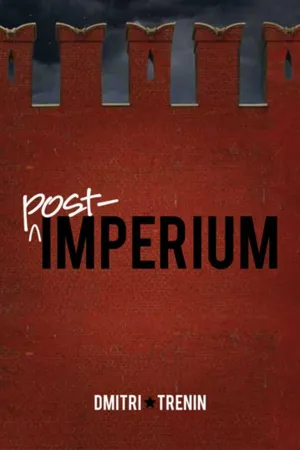
Imperial Exit and Post-Imperial Condition
When Russians—and many other post-Soviets—discuss the Soviet Union, they do it differently than most people in the West. The latter view it as an empire at minimum, and often as an evil empire, to use Ronald Reagan’s famous formulation. Ordinary Russians seldom view the USSR as an empire par excellence. To them, it stands above all for the communist regime, which some reject as totalitarian and murderous, while others look back on its paternalistic aspects with nostalgia.
As to the imperial element, Russians prefer to see the USSR as a “big country,” which used the resources of the center—mainly the Russian Republic and Ukraine—to develop the borderlands: a core function of an empire. This “social” interpretation of the Soviet Union is still strong,1 including in its non-Russian parts, such as Ukraine.2 It is a fact, however, that it was only by the late 1950s that the Soviet population’s living standards reached the level it had enjoyed in 1913. All things considered, it was World War I and the Bolshevik Revolution that grew out of it that deserve to be called the greatest catastrophe in Russia’s twentieth-century history.
Public Perceptions
Leonid Brezhnev, who died in 1982 after eighteen years as head of the Soviet Communist Party, is now remembered vaguely but generally fondly, with the emphasis on the Soviet welfare state, science and technology, education, culture and the arts, and, although not in the first instance, the military. Gorbachev started with inspiration and ended with disillusionment. Yeltsin’s years are generally—and unfairly—associated with crisis and chaos. At the end of his term, in the late 1990s, 40 percent of Russians said in a poll that they would prefer to live in the USSR, against the 45 percent who preferred contemporary Russia. Thus, the Russian people see the Soviet Union much more as a way of life than as a superpower or an empire.3
It is no wonder that, when the going was hard, they felt sorry for what they had left behind. A decade after the fall of the USSR, 73 percent of Russians regretted its passing.4 Still, the end of the Soviet Union has not registered in the Russian collective mind as the most tragic event of the century by far. And, for the vast majority, the disintegration of the Union is not the most important problem now.
Only around 15–16 percent of those polled favored restoration of the USSR in 1998, 2004, and 2009. The support for a new voluntary union state based on the CIS first dropped from 34 percent to 28 percent, and then to 13 percent in the respective polls.5 A purely Slavic state of Russia, Belarus, and Ukraine was favored by 13 percent. A seemingly “easy” Russo-Belarusian merger had a minuscule popularity of 2–3 percent. The share of those who preferred the Russian Federation to go it alone increased to 28 percent by 2004 from 25 percent in 1998.
The trend is clear: In 1995, restoration of the USSR and Russia’s Alleingang was each favored by 23 percent of those polled. By 2004, the ratio was 2–1 in favor of the stand-alone Russian state. There was also far less of a difference between the near and far abroad than there used to be. The share of “imperial nostalgics” has dropped from 25 to 15 percent—but even there it is the economic and humanitarian concerns, not the power factor, that dominate.6 The people who reject today’s Russia do so not because it is not big enough for them, but because it is not quite their own.7 They feel alienated. Even Vladimir Zhirinovsky, a mirror of Russian nationalism, publicly eschews the word “empire”8 and cautions that Russia would unite with new states or territories only if doing so were deemed advantageous to Russia. He argues that Russia absolutely needs to pursue its self-interest with respect to the former borderlands.
Territory and Borders
Starting from the mid-1980s, Russia has gone through a four-dimensional crisis. It let go of its governing ideology-cum-political system, communism; its centrally planned economic system; its superpower foreign policy of Cold War confrontation; and the imperial state. While the first three issues dealt with the legacy of the 1917 Bolshevik Revolution, the last crisis ended more than four hundred years of Russia’s imperial history. Now that the empire itself was history, what has remained of Russia? Witte’s famous dictum had to be rethought.
The present-day Russian Federation is roughly three-quarters the size of the old Soviet Union. With the former borderlands in the west and south now independent states, the core of the “old country”—historical Muscovy, or simply Russia, as it is often called east of the Urals; Siberia, its most important resource base; and key outposts: St. Petersburg and Kaliningrad on the Baltic coast; Novorossiysk on the Black Sea; Astrakhan on the Caspian; and the entire Pacific seaboard from Vladivostok to Petropavlovsk-Kamchatsky to Chukotka, plus the Arctic coast from Murmansk to the Bering Strait, and the islands—continues to be in Russian hands. The Russian contiguous empire has shed some weight, but it retained a strong and solid platform for building a Russian nation-state.
Moreover, the dismantlement of the USSR has been a positive development for Russia. It drew the line, for the first time, between the country and its former empire, which is now referred to as the Commonwealth of Independent States. It relieved Moscow from the need to keep the Balts and Moldovans under control. It released Russia from quasi-colonial responsibilities in Central Asia and the South Caucasus. Finally, it created a basis for close and equitable relations between the Russian Federation and the Soviet Union’s other bigger republics, Ukraine, Kazakhstan, and Belarus. Viewed from Moscow, the territorial settlement was rather generous toward the new states and created no real irredentist claims. For their part, the Russians have rather quickly adjusted to the emergence of new states in the former borderlands. Today, most of these former imperial Russian possessions engender scant public interest in the Russian Federation.
Furthermore, and very important, Russia itself has been able to live within the 1991 borders that had been branded “unnatural,” “ahistorical,” and, by extension, unsustainable by a number of nationalist commentators.9As pointed out earlier, these borders do have parallels in history. The Russian Federation, composed of the territories that did not secede after two imperial collapses—in 1917 and 1991—can be well termed the hard core of the historical empire, that is, the otherwise elusive metropolitan area. Thus, for more than three centuries what people sometimes referred to as “new” Russia—the Russian Federation—has been in fact an alternative-in-waiting to the imperial expansion.10
Here, it is important to note that the only parts of the present-day Russian Federation that were not part of the 1650 Tsardom of Muscovy are the North Caucasus in the south; St. Petersburg and Vyborg in the north; Transbaikal, the Maritime Provinces, and the Pacific islands in the east; and Kaliningrad in the west. Today, all these regions, with the exception of St. Petersburg, are geopolitically vulnerable, albeit for different reasons. Since 1991, Russia has lost no more territory, though it went through border adjustments, which fixed its new frontiers.
Border Adjustments
Rather than keeping its new borders open in the hope of extending them at the right momenta, the Russian Federation embarked on a policy of fixing them in treaties and on the ground. In three takes—under Gorbachev, in 1991; under Yeltsin, in 1996; and under Putin, in 2004—Moscow managed to solve the most serious border issue by far, fixing the 4,355-kilometer boundary with China. By 2008, the demarcation of the border was complete.
In exchange for Beijing’s agreement with the border—which, to many in China, is still the product of “unequal treaties” of 1858 and 1860 between St. Petersburg and the Qing dynasty—Russia conceded that the border would follow the high-water channel in the middle of the Amur and Ussuri rivers. The Soviet-era claim that both rivers, all the way to their Chinese banks, belonged to Russia, was dropped. Thus, Russia ceded to China two-and-a-half islands with a total area of 375 square kilometers. This created mild commotion nationally: 52 percent of Russians politely disagreed with the handover,11 and some street protests took place along the Chinese border. The residents of Khabarovsk in particular were unhappy to see China advancing to within a few kilometers of the city center. However, no trouble followed.
Putin later called this deal the biggest foreign policy achievement of his eight-year presidency. With good reason. Unless the border issue was resolved, the Chinese could, over time, claim ownership of some 1.5 million square kilometers that Russia received under the 1858 and 1860 treaties. Putin and others in the Russian leadership, watching China’s rise, understood that it was folly to leave the entire border issue open as the balance of power between the two countries was changing heavily in China’s favor. Moscow also expected that, for several decades, Beijing would stay rational and be primarily focused on domestic economic and social development.
In contrast to the China deal, Russia refused to accommodate Japan’s claims to the four islands in the Kuril chain. The most Putin was prepared to do was to return to the 1956 Moscow declaration, ratified in both countries, and hand over two smaller pieces of territory, Habomai and Shikotan, which add up to a mere 7 percent of the area claimed by Tokyo.
Japan’s position, unlike China’s, is inflexible. Putin’s 2000 attempt to reach a deal with Prime Minister Yoshiro Mori at their meeting in Irkutsk fell through. The politics of Japan make it next to impossible for any Japanese cabinet to agree to a territorial compromise: The four islands are essentially an indivisible claim. Their symbolic significance as a vestige of Japan’s humiliation after World War II far outstrips their practical importance, significant as it is in terms of fish and seafood resources. In this situation, Moscow’s attempts at compromise, such as joint economic exploration of the islands, have been flatly rejected.
Russia has no incentive to move: Japan is not a threat, real or potential, and economic cooperation with it is dictated by the economic conditions on the Russian side, not by the status of the islands, controlled by Moscow since 1945. In 2010, Medvedev became the first Russian leader to ever visit the southern Kuril Islands, all Japanese protests notwithstanding.
Russia was more successful in signing border treaties with its new neighbors Ukraine (2003), Kazakhstan (2004), Azerbaijan (2010), and the three Baltic states: Lithuania (1997), Latvia (2005), and Estonia (2007: still unratified). It was also able to agree with Kazakhstan (1998) and Azerbaijan (2002) on the division of the shelf in the northern Caspian, pending a general agreement on the Caspian Sea that is being blocked by Iranian and Turkmen claims. The Caspian’s unresolved legal status prevents building a pipeline across the lake to transport Turkmen gas via the Caucasus to Europe, much to the advantage of Gazprom, the Russian energy giant.
Russia has come up with claims of its own, in the Arctic.12 In a well-publicized move, a Russian undersea capsule in 2007 planted a small titanium tricolor on the ocean floor on the North Pole. At the same time, Moscow filed a legal claim with a UN commission to some 1.2 million square kilometers of the Arctic continental shelf. If it is internationally recognized as Russia’s economic zone, it may add 30 percent to Russia’s natural gas deposits. Also, the Northern Sea Route along Russia’s Siberian coast—heretofore of limited importance as requiring the use of ice-breakers and lacking coastal infrastructure—may become commercially viable as the shortest link between the Atlantic and the Pacific. The warming of the Arctic and the rising importance of energy supply are driving Moscow’s policies in the region.
Russia’s burst of activity in the High North initially evoked concerns in the West, particularly in Canada. However, Moscow was later careful to allay those fears. In 2010, after forty years of negotiations, Russia agreed with Norway on a 50–50 deal on the disputed maritime area in the Barents Sea. For political reasons, the Russians are also determined to keep their coal mine settlements in Spitsbergen, allowed under the 1920 treaty. Interested in international recognition of its interests, Moscow made it very clear it will seek a legal or negotiated solution to the territorial issues in the Arctic.13
Territorial Status of the New States
Not only have all former Soviet republics survived, which was not a given in 1991, but they have largely kept their territory.
Other former Soviet republics have mostly consolidated their territory now as independent states. Very important, Ukraine has kept the territory of the Ukrainian Soviet Socialist Republic, which was put together by Lenin, Stalin, and Khrushchev. Fortunately, there was no question of official Polish, Czech, or Slovak claims on the territories, now in Ukraine, which the Soviet Union annexed in 1939 and 1945. The Soviet-era land border between Ukraine and Romania was sealed in a treaty signed in 1997. However, the issue of the continental shelf in the Black Sea remained unresolved until 2009 when the International Court ruled that Ukraine’s Snake Island was in fact a rock, not warranting an economic zone around it. Kiev had to accept this judgment.
The issue of Crimea was much more important, and volatile. In 1954, Khrushchev transferred the largely Russian-populated peninsula from the Russian republic to the Ukrainian republic, to mark the three hundredth anniversary of what was officially called at the time “Russo-Ukrainian reunification.” As long as the Soviet Union existed, this hardly mattered much, the more so since Sevastopol, a “closed city” as the headquarters of the Soviet Black Sea Fleet, was administered directly from Moscow. The issue, however, became very emotional amid the dissolution of the USSR. Indeed, the Crimea was the only territory outside of the perimeter of the new borders of the Russian Federation about which most Russians, irrespective of their political orientation, felt strongly.
In 1991, Yeltsin chose not to insist on the restoration of the peninsula to Russia, in exchange for Ukraine’s renunciation of the portion of the Soviet nuclear arsenal deployed on its territory.14 In 1993, the anti-Yeltsin Russian Supreme Soviet (parliament) laid claim to Sevastopol, arguing, on the strength of its Soviet-era special administrative status, that the city had not been handed over to Ukraine with the rest of the Crimea. The Kremlin ignored that claim. In early 1994, pro-Russian irredentists and separatists won the presidency of the Republic of Crimea, constituted within Ukraine since 1991. This was probably the most dangerous moment for the territorial unity of Ukraine. The tension subsided quickly, as Yeltsin defeated the Supreme Soviet in October 1993 and, in December 1994, moved against the Chechen separatists. Lacking Russian support, the Crimean republic presidency was abolished in 1995 and its status reduced to an autonomy the following year. As Leonid Kuchma, Ukraine’s second president (1994–2005), later observed, had it not been for Yeltsin’s principled position in 1993–1994, a war might have erupted between Russia and Ukraine over the Crimea.15
In 1997, Russia signed a treaty with Ukraine recognizing the borders that existed at the time of the breakup of the Soviet Union, thus confirming Crimea’s status within Ukraine. Since those boundaries within a unitary Soviet state had never been demarcated, this still allowed for disputes, but on a micro-level. An example of that is the almost comical standoff in 2003 over Tuzla Island/peninsula in the Kerch Strait, which links the Black Sea with the small and virtually landlocked Sea of Azov. However, Russian commentators16 were warning, darkly, that in the case of Ukraine’s NATO accession, “every hillock, every ravine” along the border could become a flash point.
More seriously, Ukraine’s internal cohesiveness was put to the test at the time of the Orange Revolution, when a number of regional and local authorities in eastern and southern Ukraine—unhappy about developments in Kiev—established a coordinating body to oppose the policies of newly elected President Viktor Yushchenko, deemed to be a representative of western Ukraine. This brought into stark relief the different geopolitical situations of western Ukraine, leaning toward Central Europe, and of the country’s eastern and southern regions, which culturally feel closer to Russia. These different identities actually threatened to tear Ukraine apart in case the country was confronted with a clear choice, such as NATO enlargement.
When President Putin told NATO leaders at Bucharest in April 2008 that Ukraine was “not even a state” and would “break apart,”17 he was probably highlighting the brittleness of Ukraine’s unity, which would not survive a serious test. This is not to say that Moscow had no strong views on the subject. It was clear then that Russia would support Ukraine’s unity only as long as the country stayed neutral. Kiev’s accession to NATO would lead Moscow, at minimum, to support Crimean irredentists. As if to underline this point, Crimean separatism suddenly became an issue again in 2008 after the Bucharest promise of NATO membership to Ukraine and Georgia and the war in the Caucasus. It died down quietly in 2009 when the NATO option receded, and it became totally docile with the advent of Viktor Yanukovych’s presidency in 2010.
Between Russia and Belarus, there are no border posts or documents checks. Minsk, however, has not so much preserved its territory—as in Ukraine’s case, Poland laid no claim to the territories lost in 1939—as asserted its sovereignty vis-à-vis Russia. In the 1990s, many analysts felt that Belarus, lacking a proper identity and nearly totally Russophone, wo...
Table of contents
- Title Page
- Copyright Page
- Dedication
- Contents
- List of Maps and Tables
- Foreword, Jessica T. Mathews
- A Note From the Author
- Acknowledgments
- Introduction: Life After Death?
- Chapter 1: Imperial Exit and Post-Imperial Condition
- Chapter 2: Geopolitics and Security
- Chapter 3: Economics and Energy
- Chapter 4: Demographics and Immigration
- Chapter 5: Culture, Ideology, and Religion
- Conclusion
- Notes
- Index
- About the Author
- Carnegie Endowment for International Peace
Trusted by 375,005 students
Access to over 1.5 million titles for a fair monthly price.
Study more efficiently using our study tools.
Frequently asked questions
Yes, you can cancel anytime from the Subscription tab in your account settings on the Perlego website. Your subscription will stay active until the end of your current billing period. Learn how to cancel your subscription
No, books cannot be downloaded as external files, such as PDFs, for use outside of Perlego. However, you can download books within the Perlego app for offline reading on mobile or tablet. Learn how to download books offline
Perlego offers two plans: Essential and Complete
- Essential is ideal for learners and professionals who enjoy exploring a wide range of subjects. Access the Essential Library with 800,000+ trusted titles and best-sellers across business, personal growth, and the humanities. Includes unlimited reading time and Standard Read Aloud voice.
- Complete: Perfect for advanced learners and researchers needing full, unrestricted access. Unlock 1.5M+ books across hundreds of subjects, including academic and specialized titles. The Complete Plan also includes advanced features like Premium Read Aloud and Research Assistant.
We are an online textbook subscription service, where you can get access to an entire online library for less than the price of a single book per month. With over 1.5 million books across 990+ topics, we’ve got you covered! Learn about our mission
Look out for the read-aloud symbol on your next book to see if you can listen to it. The read-aloud tool reads text aloud for you, highlighting the text as it is being read. You can pause it, speed it up and slow it down. Learn more about Read Aloud
Yes! You can use the Perlego app on both iOS and Android devices to read anytime, anywhere — even offline. Perfect for commutes or when you’re on the go.
Please note we cannot support devices running on iOS 13 and Android 7 or earlier. Learn more about using the app
Please note we cannot support devices running on iOS 13 and Android 7 or earlier. Learn more about using the app
Yes, you can access Post-Imperium by Dmitri V. Trenin in PDF and/or ePUB format, as well as other popular books in Politics & International Relations & Diplomacy & Treaties. We have over 1.5 million books available in our catalogue for you to explore.