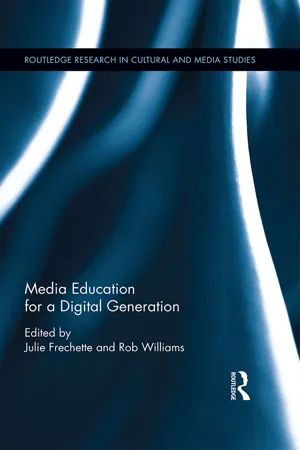
Media education for digital citizenship is predicated upon the ability to access, analyze, evaluate and produce media content and communication in a variety of forms. While many media literacy approaches overemphasize the end-goal of accessing digital media content through the acquisition of various technology, software, apps and analytics, this book argues that the goals for comprehensive and critical digital literacy require grasping the means through which communication is created, deployed, used, and shared, regardless of which tools or platforms are used for meaning making and social interaction. Drawing upon the intersecting matrices of digital literacy and media literacy, the volume provides a framework for developing critical digital literacies by exploring the necessary skills and competencies for engaging students as citizens of the digital world.
eBook - ePub
Media Education for a Digital Generation
- 300 pages
- English
- ePUB (mobile friendly)
- Available on iOS & Android
eBook - ePub
Media Education for a Digital Generation
About this book
Information
Part I
Self
The first section of Media Education for a Digital Generation focuses on the construct of SELF as it is being reconceptualized and affected by digital media. In 1965, Marshall McLuhan presciently used the analogy of the media as “extensions of man” that affect us through their design and structure. Similarly, the chapters in this section consider how the design, structures, and functions of digital media affect the nature and delivery of our communication and social engagement in the Digital Age. Mobile devices, apps, and the portability of the Internet now serve as human appendages or extensions of ‘the self,’ as our sense of identity is increasingly defined by the technologies we use to represent ourselves as we interact in the digital world. In this section you will find explorations of the ‘Selfie,’ and arguments for adding visual literacy and photographic communication into the digital media literacy mix as a means to enhance self-representation. You’ll also find an empirical study that questions whether or not marginalized individuals can leverage the power of social media platforms like Facebook to make inroads into more equitable self-representation. By design, we’ll also consider the ways in which digital media literacy education teaches us to comprehend and make smart choices about our self-explorations online, especially given the ways in which we are increasingly tracked by the new surveillance economy that profits from following our every step. Collectively, these chapters offer pedagogical possibilities as a means of empowering us to make knowledgeable and creative choices in this new era.
1 The Selfie, Photographic Communication, and Digital Literacy
Comedian Jena Kingsley created a “selfie free” zone in New York City’s Central Park and recorded herself mock-ticketing people taking selfies within her designated boundaries. By creating the video she was trying to make the point that the act of taking selfies has gotten out of control. A few years ago, the word “selfie” held very little meaning to adults and was predominantly used only by socially networked teens. A lot has changed in a few years. In 2014, ABC aired a short-lived sitcom titled, “Selfie.” The Chainsmokers song “#Selfie,” a humorous account of club goers taking selfies, became a recent viral sensation. A selfie of Ellen DeGeneres and other A-list celebrities at the 86th Academy Award celebration made major headlines when it became the most retweeted microblog to date, surpassing President Obama’s election night record. When the Oxford Dictionary deemed “selfie” the 2013 word of the year is when the media really took notice (Killingsworth, 2013) and the term entered mainstream vernacular.
The Oxford Dictionary defines selfie as “a photograph that one has taken of oneself, typically one taken with a smartphone or webcam and uploaded to a social media website” (Oxford Dictionaries, n.d.). Today, due to the popularity of social networking platforms, online representations of the self have become a necessity in both our professional and social lives. Selfies are one form of photographically representing the self to others online. Digital literacy curricula need to stay current and incorporate practical applications of how young people use social media in an image-based culture. Teaching students, especially teenagers, how to make ethical choices regarding photo composition can prepare students for more positive social interactions and give them a sense of professionalism in their digital presence. This type of training can foster a shared understanding of the consequences of posting and sharing images online. Digital literacy education should focus on issues such as privacy, the permanency of the social web, and practicing patience and caution when posting images online.
The importance of personal photography has gained attention recently due to the widespread adoption of photo-based sharing sites and social media (Duggan, 2013). In addition, the technical advances of digital cameras on mobile phones have allowed sending and sharing photographic images to become a fluid and common practice. Mobile phone adoption is significantly increasing among teenagers with text and image messaging the preferred method of communication by teens (e.g., Lenhart, Ling, Campbell, & Purcell, 2010). While “digital natives” are often considered to be visually literate, research testing this claim has found that individuals who have grown up using digital tools are not particularly proficient in interpreting or producing visual imagery (Brumberger, 2011). Photographic communication, defined as the exchange of messages primarily consisting of photographs, allows people to communicate through a rich medium and to tell image-based stories to their peer groups (Hunt, Lin, & Atkin, 2014b). These images can be markedly personal or a documentation of shared experiences. Whether people are frequent posters or those who occasionally update their profile, they will need to determine the type of image they will use to represent who they are to online audiences.
There are two objectives of this chapter. The first is to highlight the key areas that educators should focus on when teaching digital literacy skills related to photographic representation of the self. The second goal is to provide a lesson plan framework demonstrating how digital literacy skills for photographic communication can be taught through Kolb’s Experiential Learning Model (Kolb, 1984). By adopting Kolb’s model educators can balance teaching both theoretical and practical applications of photographic communication. By teaching important theoretical concepts students can better understand the consequences of their online behaviors, develop an ethical awareness for photo sharing, and foster a sense of accountability for their actions. The practical applications will increase students’ visual literacy in regards to both image creation and analysis. This chapter will begin by outlining the relevant research on photographic communication. Subsequent sections will present a framework for curricula involving photographic composition and image analysis. Finally, the four stages of Kolb’s model will be presented as they apply to photographic communication and digital literacy. In the following section, research on photo sharing will be discussed.
PHOTOGRAPHIC COMMUNICATION
In the last decade, scholars have studied people’s motives for sending and sharing photographs. These motives can be grouped into five key areas: relationship maintenance, relationship formation, memory, self-expression, and self-presentation (Van House & Davis, 2005). The last two motives, related to the self, are of particular concern to digital literacy educators. Goffman (1959) explained that there are two types of expressions given off when making an impression, intentional and unintentional cues. When sharing photographs both types of cues contribute the symbolic representation of one’s social self. Self-presentation refers to images of the self, such as the selfie or a portrait, but also includes images of personal belongings and objects with emotional meaning to the creator. Images of self-expression typically are more creative, abstract representations taken from the viewpoint of the creator. When individuals share images of the self, they form impressions online that contribute to their perceived self-image. Motivations to express and represent oneself online increase the frequency in which users send and shared images to their peers (Hunt, Lin, & Atkin, 2014a). The quantity and frequency of shared images can create problems, especially for younger content creators.
Digital literacy educators need to teach students about privacy and image content when photo sharing. The transitory nature of image sharing and the permanence of the social web are also of particular concern to educators. There have been instances where images posted on social networking sites have been stolen and used to create a false identity (Reznik, 2013). There is evidence that employers have elected to not hire individuals after reviewing applicants’ social media profiles and finding inappropriate photos (Weber, 2014). As educators we can provide students with formative photo sharing experiences that will help them to foster a solid comprehension of their image sharing choices.
Certain images of the self should not be shared publicly. While this seems obvious, for young image producers creating photo-sharing boundaries can be problematic. Educators need to include course modules that explain how to set up privacy filters on social media platforms. More importantly, teaching students the power of exercising patience before capturing and sharing images is of critical importance. The instant gratification of using social platforms has been one reason for their growth and enjoyment but it does not come without consequences. When posting an image, often one does not stop and ask questions such as “who will see this image” and “how long will this image exist on the web.” Murray (2008) commented that photo sharing “has become less about the special or rarified moments of domestic living, and more about an immediate, rather fleeting, display and collection of one’s discovery and framing of the small and mundane” (p. 147). Murray’s words also highlight the trivial nature of the image content shared online. The decision to post a photo is made in a fleeting moment and too often is not thought about until after the fact. Hand (2012) explains that “after the fact ethics” is more common in the world of ubiquitous photography. Digital literacy can serve as a preventive measure against such acts.
One of the most important and overlooked areas of digital photo sharing is the permanency of the social web. The shelf life of online content is much longer than what one expects. We have become so accustomed to constant contact and instant gratification that we lose sight of practicing self-control and patience. It is almost impossible to un-forget a powerful image. It is equally difficult to remove an unwanted image from the social web once it is in the hands of someone else. In today’s mediated world, imagery is part of one’s personal brand. Students need to find a balance between incessant, narcissistic posting and developing their personal brand online. Many of these issues can be controlled if students learn the principles of photographic composition and image analysis before sharing photos online.
PHOTOGRAPHIC COMPOSITION
Several online media outlets, such as The Huffington Post and W Magazine, provide tips on how to take a good selfie. Articles such as these represent the growing concern for photographic self-presentation. While some digital literacy educators might not want to teach students to “create” media, many would agree creating media helps students develop stronger digital literacy skills. Messaris (2012) noted visual literacy should move beyond developing an understanding of digital manipulation and should endorse the creative opportunities afforded by digital technology. Some of the basic rules of photographic composition include avoiding mergers, the rule of thirds, simplicity, lines, balance, and framing. By developing a sense of photographic composition, photo sharing will be a deliberate process and the photographer’s aesthetic schema should provide caution to them before posting images online.
When teaching photography, one of the most important areas covered is the subject of the image. Often in the interest of time, the photographer will forget about secondary elements that are in the background of a photograph. By teaching compositional elements students will learn to consider the layers within their images of the self and will also be more cognizant of distracting background elements when using photographic representations of the self. These background elements, especially when documenting personal events, often reveal unwanted information to audiences. Examples of these instances can be seen the multitude of “selfie fails” images curated online.
The rule of thirds and framing will help students learn to compose aesthetically pleasing images. Avoiding mergers and using lines will help students develop the focal point of their image and become aware of distracting background elements. By considering how to frame images and create balance in photographs the final product will most likely be an image that represents the true intentions of the photographer. Images of self-expression and self-representation will be of a higher caliber and less likely to cause post-sharing regret. Image creation is only one part of this process. To increase one’s digital literacy in the area of photographic communication, one must also learn to analyze images.
IMAGE ANALYSIS
While there are several analytical strategies for image deconstruction and analysis, visual semiotics is well suited for teaching students the consequences of photo posting behavior. Visual semiotics involves deciphering the layers of meaning within a photograph, specifically the denotative meaning and the connotative meaning (Barthes, 1977). The denotative meaning involves understanding the face value of the image while the connotative meaning involves a complex comprehension of the various image elements. One might examine the aesthetics, pose, objects, syntax, and photogenia while examining the connotative layer of an image (Barthes, 1977).
At the connotative level, students will decipher the multiple interpretations of an image’s meaning. They will learn how photographic technique and digital enhancement can change the meaning of a photograph. They will begin to understand how certain poses contain implicit meanings to viewers and learn how the presence or absence of certain objects also changes the meaning of the image. The syntax of the image might also be considered—the corresponding text or categorization of the image could reveal unintended messages to audiences. An awareness and understanding of these concepts is of critical importance in an image-based society.
By teaching visual semiotics, the learner will begin to understand how the various elements of a photograph work individually and collectively to create various meanings. Students of digital literacy will benefit from this awareness of implicit meaning when they view photos and when they create images. Both image creation and image analysis can be powerful tools that are most effective if taught through experiential learning.
EXPERIENTIAL LEARNING
Many teachers of new media have developed lesson plans that incorporate experiential learning. Kolb’s Experiential Learning Model (Kolb, 1984) is a four-stage cycle of experiential learning. In the cycle, the stages are concrete experiences, reflective observation, abstract concepts, and active experimentation. Using this model, educators can teach photographic communication in a way that meets course objectives and provides a practical learning experience for students.
While learners can enter the cycle at any point in time, there are benefits to starting with reflective observation. In reflective observation, students might review the images posted by members of their network and use visual semiotics to analyze the images. Students will learn how the various layers of meaning impact their perceptions. Areas of focus during this stage might include how one’s frame of reference and background influence their perceptions of the various layers of meaning within the photograph.
Next students should be taught concepts such as impression management, privacy, narcissistic behavior, ethics, and developing a personal brand. Through these activities students enter the stage of abstract conceptualization. This stage helps learners make connections between their observations and important digital literacy concepts. One useful exercise at this stage is to have students develop a photo-sharing code of ethics. The code can be tied to a larger discussion on moral philosophy or to a discussion of professional codes. Privacy can be discussed related to the technical settings of social networking sites and to help students develop boundaries between their private and social lives. Challenging students to become aware of narcissistic behaviors related to posting could also be covered in this stage of the model. Mendelson and Papacharissi’s (2010) discussion of whether frequent photo posting is a step towards self-reflection and self-actualization or a form of self-absorption would make for an engaging discussion. During this stage, students should learn the difference between how they choose to present and express themselves online.
Following the cognitive stage of abstract conceptualization, students engage in active experimentation. In this stage of the cycle, students create and share images with their classmates on a simulated or closed social networking site. This will provide students with a practical application of photographic composition as it relates to sharing images of the self. Elements of photogr...
Table of contents
- Cover
- Half Title
- Title Page
- Copyright Page
- Dedication
- Table of Contents
- Foreword
- Preface
- Acknowledgments
- Introduction
- PART I Self
- PART II Social
- PART III Local
- PART IV National
- PART V Global
- Contributors
- Index
Trusted by 375,005 students
Access to over 1.5 million titles for a fair monthly price.
Study more efficiently using our study tools.
Frequently asked questions
Yes, you can cancel anytime from the Subscription tab in your account settings on the Perlego website. Your subscription will stay active until the end of your current billing period. Learn how to cancel your subscription
No, books cannot be downloaded as external files, such as PDFs, for use outside of Perlego. However, you can download books within the Perlego app for offline reading on mobile or tablet. Learn how to download books offline
Perlego offers two plans: Essential and Complete
- Essential is ideal for learners and professionals who enjoy exploring a wide range of subjects. Access the Essential Library with 800,000+ trusted titles and best-sellers across business, personal growth, and the humanities. Includes unlimited reading time and Standard Read Aloud voice.
- Complete: Perfect for advanced learners and researchers needing full, unrestricted access. Unlock 1.5M+ books across hundreds of subjects, including academic and specialized titles. The Complete Plan also includes advanced features like Premium Read Aloud and Research Assistant.
We are an online textbook subscription service, where you can get access to an entire online library for less than the price of a single book per month. With over 1.5 million books across 990+ topics, we’ve got you covered! Learn about our mission
Look out for the read-aloud symbol on your next book to see if you can listen to it. The read-aloud tool reads text aloud for you, highlighting the text as it is being read. You can pause it, speed it up and slow it down. Learn more about Read Aloud
Yes! You can use the Perlego app on both iOS and Android devices to read anytime, anywhere — even offline. Perfect for commutes or when you’re on the go.
Please note we cannot support devices running on iOS 13 and Android 7 or earlier. Learn more about using the app
Please note we cannot support devices running on iOS 13 and Android 7 or earlier. Learn more about using the app
Yes, you can access Media Education for a Digital Generation by Julie Frechette, Rob Williams, Julie Frechette,Rob Williams in PDF and/or ePUB format, as well as other popular books in Education & Education Curricula. We have over 1.5 million books available in our catalogue for you to explore.