Made in Latin America serves as a comprehensive introduction to the history, sociology, and musicology of contemporary Latin American popular music. Each essay, written by a leading scholar of Latin American music, covers the major figures, styles, and social contexts of popular music in Latin America and provides adequate context so readers understand why the figure or genre under discussion is of lasting significance. The book first presents a general description of the history and background of popular music, followed by essays organized into thematic sections: Theoretical Issues; Transnational Scenes; Local and National Scenes; Class, Identity, and Politics; and Gendered Scenes.
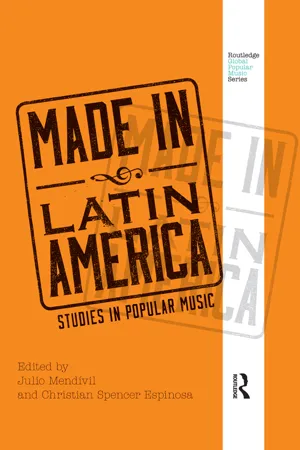
eBook - ePub
Made in Latin America
Studies in Popular Music
- 182 pages
- English
- ePUB (mobile friendly)
- Available on iOS & Android
eBook - ePub
Made in Latin America
Studies in Popular Music
About this book
Information
Part I
Music Scenes and Historical Issues
The ethnologist Nicholas Thomas wrote in Out of Time (1996) that history is often introduced to deny its significance. Although the sentence seems to be a contradiction, it clarifies that history—like ethnographies—tends to freeze realities by constructing a static discourse about a fact or an epoch. But reality is not static and discourses are not frozen entities. Facing this contradiction, historians currently try to conceive history not as a discipline that discovers documents of the past in order to describe and interpret it correctly, but as a research field within which one reads both the present and the past in an interdependent way.
The history of popular music in Latin America did not attract the attention of historians and musicologists for a long time. Due to the supposed musical inferiority of the popular, researchers did not look at the music of the working class, ethnic or migrant minorities, concentrating their efforts on exploring and interpreting the art music of the upper class or racializing the Others’ musical practices. However, in the second half of the twentieth century popular music became at first a legitimated topic inside music studies, changing the “static discourses” for the search of the traces of the non-written history of Latin American music. Nowadays historians, musicologists, sociologists, anthropologists, and ethnomusicologists are analyzing and evaluating chronicles, administrative documents, newspapers, video documentation, oral history, and music recordings from the past in order to gain an insight into the history of Latin American popular music.
The two texts of this section deal with historical issues. The Venezuelan musicologist Juan Francisco Sans applies phenomenologically the concept of “music scene” to the nineteenth century Spanish American Salon. Discussing the canonic literature about scenes, Sans analyzes salon music as a “translocal” phenomenon throughout the Americas. Although there were particularities in every country, he concludes that salon music functioned as a continental and intercontinental network, disseminating repertoires and genres through Latin America.
Besides the Spanish American Salon having never been studied as a music scene, there are other undocumented histories that still need to be ethnohistorically reconstructed. This is the goal of the Mexican musicologist and ethno-historian Natalia Bieletto, who examines administrative documents from the early twentieth century to construct an ethnohistory of the carpas shows in Mexico City. Following a deconstruction method, Bieletto interprets the documents, contextualizing the subject’s sensibility, ideology, social position, and public behavior rules, decoding the last as mechanisms of regulation and strategies of body control in social spaces. Bieletto also shows that the boundaries between urban and rural spaces in Mexico City were fluent at that time, inquiring whether music scenes are really an urban phenomenon or whether they have simply been reduced to a post-industrial phenomenon that should be reconsidered.
Reference
Thomas, Nicholas. 1996. Out of Time: History and Evolution in Anthropological Discourse. Ann Arbor, MI: The University of Michigan Press.
1
The Carpas Shows in Mexico City (1900–1930)
An Ethno-Historical Perspective to a Musical Scene
The Mexican people palpitated; the blood of the youth was in effervescence, the new race, the sons of the Revolution. Not having anywhere to express themselves, people turned to the fairs and squares full of our typical archetypes, such as street vendors, the taco and food stalls, and the lottery games where corn grains were thrown on the floor, which the vagrants gathered seeking the alms. There, the huarache [indigenous sandals] mingled with patent leather, and white cotton Indian pants mingled with English cashmere and denim. The carnivals and fairs—but first and foremost “The Carpa”—had the virtue of making and creating the happiness that had barely begun to clean the streets of the blood that had been shed for the sake of Revolutionary freedom.
(Pedro Granados, Carpas de México: Leyendas, anécdotas e historia del teatro popular, 1984)1
In this retrospective account, Pedro Granados remembers the urban environment of downtown Mexico City in the years following the armed phase of the war of Revolution (1910–1917). As he recalls, while the streets “had not been entirely cleaned from the blood shed”, people of all social classes mingled and participated in public activities. In an implicit, though clear, reference to the myth of the “cosmic race” crafted by the nationalist ideologue José Vasconcelos (1925), Granados conjures the nationalistic sentiment instilled in public life during those days.2 However, the goal of his recollection is not to praise the nation, but rather to guide his readers through his memories of the “carpa” as a much-needed source of happiness and social repair.
“La carpa” was a form of musical entertainment very popular in Mexico City during the first half of the twentieth century. The plural term carpas, by which these shows came to be known from the 1930s on, is a direct reference to the canvas tents—carpas in Spanish—that were used as ceilings to cover the small, wooden, informal theaters in which itinerant companies settled throughout the streets and squares of the city. These shows were coetaneous to similar modalities of transhumant forms of musical entertainment at the end of the nineteenth century throughout the Americas, such as the North American vaudeville and the bufos cubanos. Towards the end of the nineteenth century the carpas companies transitioned to a semi-stable way of life, settling in both Northern borderline cities such as San Antonio in Texas, and in Mexican cities such as Mexico City, Guadalajara, Mérida and Puebla (Haney 2004; Martínez 2006). In the capital city many of these companies built small and informal wood theaters—which were then called jacalones—and installed them in corners, squares, and plazas of the city, hence reducing their formerly transhumant nature to travel only from one neighborhood to the other within the boundaries of the urban space.
By staying in the city, people working in these companies changed their relationship with both the place and the spaces where they performed as well as with the people who enjoyed their varieties. With the passing of time, these shows fostered unprecedented patterns of sociability that eventually became crucial in forging ideas about the urban working class at a time when the Mexican government would benefit from a clear line between the urban and the non-urban. I thus claim that the vivid musical life hosted at these jacalones can be understood as a “musical scene” to the extent that a sense of community and belonging to the urban space emerged.
The most widely spread characterizations of “music scenes” have been too often grounded on presentist perspectives that overemphasize the ways in which urban culture, the music industry and, most recently, globalization and digital technology have determined the ways in which people shape musical consumption, reception, and uses of music in everyday life (Cohen 1995; Bennett 2004; Straw 2004). By contrast, less attention has been devoted to studying the ways in which music-making in the past, particularly before the advent of the music industry or during its nascent years, assisted processes of identity and locality construction—something that music scenes avowedly do.
Informed by the carpas shows, a musical culture that predates the recording industry, I propose a revision to the predominant tenets that have nurtured such presentist views around the category “music scene.” Taking recourse on an historical approach influenced by ethnographic methods, I outline the ways in which these shows clearly conform to the rubric “music scene.” By discussing the instances in which the carpa shows are more difficult to map under the “scenes” framework, I discuss the underlying presumptions shaping said framework and criticize the limitations of the category in its current state.
The Carpas Shows and Mexico at the Turn of the Century
At the end of the nineteenth century relevant political and economic changes were taking place in Mexico. After nearly a century of social and political turmoil, general Porfirio Díaz’ thirty-four year presidential reign brought some political and economic stability to the country (1874–1910). Given the international economic context, the president understood that capitalism was the only feasible means to attain the “progress” and “civilization” whereby Mexico’s sovereignty would be internationally recognized, especially by colonial and ex-colonial powers. He thus prioritized industrialization and foreign investment over other projects. The increased demand for a labor force in the city led to an unprecedented wave of migration to the capital. Incoming people were not only former peasants from the countryside but also many foreign entrepreneurs who sought to invest in Mexican business by taking advantage of the economic buoyancy extolled first by the Porfirian government and then by post-revolutionary governments (1922–1950).
Porfirio Díaz’ cabinet was deeply invested in forging a capital city of cosmopolitan appeal. Taking inspiration from cities such as Paris, Vienna, London, Berlin, and New York, Diaz’ urban planners embarked on a project to refurbish the city in order to make it look both beautiful and modern (Moya Gutiérrez 2012). Big avenues, new gardens, refurbished squares and new French stylized shopping centers began to replace colonial buildings, old squares, small alleys, and traditional markets.
In this journey towards cosmopolitanism, the role of musical entertainment was crucial. Towards the mid nineteenth century the elites and government officials considered opera to be the “civilizing instrument” par excellence, thus prompting the building of grandiose theaters to host this form of musical theater (Gruzinski and Zárate Toscano 2008). Concordantly, the local press provided daily detailed accounts of the music that had been premiered in European and North American metropolises (Reyes de la Maza 1968). Towards the end of the nineteenth century, the zarzuela in Madrid had become the most popular form of musical theater, and although Madrid no longer served as an inspirational model for Mexico City’s ruling classes, the close cultural connection between these two cities propitiated the translocalization of both the Spanish zarzuela and the Madrilean revista musical, not only in Mexico City but also in other Latin American cities.
Díaz’ government increased employment opportunities in the city, but the emergent economic system faced serious limitations in accommodating newcomers. As a result, informal jobs in the streets offered an alternative means of subsistence for the disfavored sectors (Barbosa Cruz 2008). Along with the architectural embellishment implemented by the government, the streets of downtown hosted many unofficial economic activities, the carpas shows being a prime example. While entire blocks were demolished to erect new buildings, vacant lots multiplied in the city, thus opening spaces where variety companies could settle their musical salons under circus tents. As the testimony of Luis Ortega, an urban chronicler and a former member of the carpas’ audience corroborates:
These little theatres, like the poor circus, proliferated and found a spot to settle in any vacant lots, of which there were many in the barrios, [neighborhoods] and even in central areas where the project of urban refurbishing had demolished old buildings.
(Luis Ortega, in Granados 1984, 14).
Due to the increasing demand for zarzuelas, it was not a surprise that the extant carpas, then called salones de diversiones, adopted both the zarzuela and the género ínfimo, a shorter, one-act version of the zarzuela, prompting the sale of musicals by the hour, through units of measure called tandas. Soon after, these Spanish music genres alternated with acrobatic and magic acts, as well as puppet shows and local music. Because the zarzuela was the main attraction, these venues started to be also known as jacalones de zarzuela.
The inclusion of género psicalíptico, an erotic version of género ínfimo mostly performed by voluptuous female singers, increased the appeal of the carpas shows among male audiences. Out of the central square but not too far from downtown, these nocturnal shows became very common. Although the authorities considered these shows to be “inappropriate” for the moral standards of the city, they were not closed down. Ostensibly, carpa managers convinced censorship inspectors to allow these shows by persuasively arguing that their licentiousness endowed the city with a more cosmopolitan appeal. Catching on to the government officials’ aspiration to turn Mexico into a metropolis of international acclaim, they stated that these shows “were a result of the progress of civilization” and that they would “elevate the city to the standards of Berlin, Vienna, New York, Paris, and other cities in Europe and North America” (see AHDF-SDP).3 Officers condoned what they saw as their “lewd” morality because they believed it was a way “to keep people away from crime” (ibid). Around the 1920s these theaters were known as Teatros de tolerancia (Tolerance theaters) and, because officers proposed that honorable women were not allowed in these shows, they were also called Teatros para hombres solos (Theaters for men only) (ibid). The authorities’ lenience was a result of the desire of post-revolutionary governments to distance themselves from the constrictive Porfirian morality. Clearly then, the nonchalance, eroticism, and superficial topics of these genres called “frivolous” by music critics, were apt for the new political agenda.
Besides género chico zarzuela and Spanish couplet, the carpas shows equally hosted musical repertory that could nowadays be read under the disparate labels “erudite” and “popular”, although such categories were not used at the time. The typical division that prescribed separate venues of performance for what the nowadays listener understands as two different musical styles and repertories was in those years still diffuse. Many of the musicians at the carpas (whose ethnic background is in most cases untraceable) had been trained in western instruments, therefore the retrospective marking of class according to the use of musical repertory is also hard to map for the historian. Needless to say, the appropriation of the western canonical repertory by musicians of the carpas in unorthodox ways was very common. Liszt’s Hungarian Rhapsody was played on the marimba for a carpa musical number called Sueño de una gitana, and the incorporation of Ravel’s Bolero in the musical revue La Guerra de los Pasteles are just a couple examples of such appropriations (Granados 1984, 86–87); not to mention the many string quartets that were regularly played as part of the carpa’s shows.
Noticeably, the emerg...
Table of contents
- Cover
- Title
- Copyright
- Dedication
- Contents
- List of Illustrations
- Series Foreword
- Preface
- Introduction: Debating Genre, Class, and Identity: Popular Music and Music Scenes from the Latin American World
- Part I: Music Scenes and Historical Issues
- Part II: Imaginaries, Identity, and Politics
- Part III: Cumbia, Class, and Nation
- Part IV: Global Flows
- Part V: Beyond Music Scenes
- Afterword
- Final Remarks
- Notes on Contributors
- Index
Trusted by 375,005 students
Access to over 1.5 million titles for a fair monthly price.
Study more efficiently using our study tools.
Frequently asked questions
Yes, you can cancel anytime from the Subscription tab in your account settings on the Perlego website. Your subscription will stay active until the end of your current billing period. Learn how to cancel your subscription
No, books cannot be downloaded as external files, such as PDFs, for use outside of Perlego. However, you can download books within the Perlego app for offline reading on mobile or tablet. Learn how to download books offline
Perlego offers two plans: Essential and Complete
- Essential is ideal for learners and professionals who enjoy exploring a wide range of subjects. Access the Essential Library with 800,000+ trusted titles and best-sellers across business, personal growth, and the humanities. Includes unlimited reading time and Standard Read Aloud voice.
- Complete: Perfect for advanced learners and researchers needing full, unrestricted access. Unlock 1.5M+ books across hundreds of subjects, including academic and specialized titles. The Complete Plan also includes advanced features like Premium Read Aloud and Research Assistant.
We are an online textbook subscription service, where you can get access to an entire online library for less than the price of a single book per month. With over 1.5 million books across 990+ topics, we’ve got you covered! Learn about our mission
Look out for the read-aloud symbol on your next book to see if you can listen to it. The read-aloud tool reads text aloud for you, highlighting the text as it is being read. You can pause it, speed it up and slow it down. Learn more about Read Aloud
Yes! You can use the Perlego app on both iOS and Android devices to read anytime, anywhere — even offline. Perfect for commutes or when you’re on the go.
Please note we cannot support devices running on iOS 13 and Android 7 or earlier. Learn more about using the app
Please note we cannot support devices running on iOS 13 and Android 7 or earlier. Learn more about using the app
Yes, you can access Made in Latin America by Julio Mendívil, Christian Spencer Espinosa, Julio Mendívil,Christian Spencer Espinosa in PDF and/or ePUB format, as well as other popular books in Media & Performing Arts & Music. We have over 1.5 million books available in our catalogue for you to explore.