- 256 pages
- English
- ePUB (mobile friendly)
- Available on iOS & Android
eBook - ePub
About this book
First Published in 1995. In this second volume of classic articles by the Glasgow University Media Group, the focus is on industrial and economic news reports of the 70s and 80s, and includes previously unpublished work on the media and politics in the 80s and 90s.
Information
Part I
Industrial and economic reporting
Chapter 1
‘And now they’re out again’
Industrial news*
Most meetings are at 7.30 as we start work. Being on strike, the unions fixed them all for two hours later, which gave us more time to read the papers and listen to the radio and in the end the morale went.
(BL worker on the defeat of the 1981 Leyland strike, Guardian, 4 November 1981)
When we began our research we were interested in the picture given of the industrial world: of what were presented as its problems and potential solutions. Our method was to look first at the possible explanations for the economic crisis, for what was causing problems in industry; then to see which of these occurred in news coverage and which were excluded. Second, we examined how some explanations were featured prominently and how others were downgraded.
One of our first detailed studies was of coverage of the car industry. We found ourselves looking mainly at strikes and wage claims. These are not of course the only things that happen in industry, but they are what is called the news. In January 1975 a dispute occurred at British Leyland. This received extensive coverage over a period of five weeks. The association of British Leyland with strikes has now entered the folklore of our society: no football match is complete without a barrier proclaiming that ‘KENNY [or whoever] STRIKES FASTER THAN LEYLAND’. In January 1979 the Daily Telegraph reported: The public in every opinion poll shows that it believes the trade union situation to be more responsible than any other factor for the nation’s problems.’ We wanted to see how much this view underpinned television news coverage and how it was related to other possible causes of the car industry’s problems.
WHAT’S WRONG WITH LEYLAND?
At the time of our study much ‘alternative’ information on the car industry was available. This fell into two main areas: low investment and bad management. British industry as a whole has suffered from underinvestment for at least thirty years. In the case of the car industry, the Daily Express reported in February 1975 that a Toyota worker in Japan was working with machinery worth the equivalent of £11,780 while a British Leyland worker had only £1,000 worth. There are a number of reasons for this lack of investment. One is that capital is being exported from Britain to countries such as South Africa where profits are higher. Another is that within the British economy, people with money choose to invest it where they will receive the highest return. This is often not the manufacturing industry. For speculative reasons, literally thousands of millions of pounds have, over the years, been directed away from production into areas such as the buying up of property and land. In the period 1974–5 each of the top three property companies in London had assets greater than the total value of British Leyland. A third factor is the distribution of profits as dividends to shareholders.
The Ryder Report on Leyland commissioned by the government, showed that between 1968 and 1972 the company had distributed 95 per cent of its profits as dividends. In these years Leyland had made £74 million in profits; of this only £4 million was retained for reinvestment, while £70 million was distributed as dividends. Leyland had more obsolete and worn-out machinery than its competitors. The most important effects of this were that cars cost more per unit to produce and also that the machinery was likely to break down. In 1975, the management’s own figures showed that they were losing more through ineffective machinery, and factors such as management errors, than they were losing through strikes at Leyland. At this time Leyland was a hotchpotch of all the different parts which had been absorbed into it and different sections produced models which were in competition with each other. Management and organizational structure were obviously chaotic.
Such explanations conflict with the more common accounts that the problems of industry are caused by strike-prone workers.
‘AND THERE WAS MORE TROUBLE TODAY’
On 3 January 1975 Harold Wilson, then Prime Minister, made a speech at his Huyton constituency. In it he dealt with the future of government investment in industry and criticized the past record of car production using the words ‘manifestly avoidable stoppages of production’. The precise origin of these stoppages and who was to blame were left ambiguous. Here is the way it was presented on the first BBC bulletin of that night:
The Prime Minister, in a major speech tonight on the economy, appealed to management and unions in the car industry to cut down on what he called ‘manifestly avoidable stoppages’. He said this was especially important now that government money was involved. The decision to help British Leyland was part of the government’s fight against unemployment, but the help couldn’t be justified if it led to continuing losses. Mr Wilson singled out for particular blame British Leyland’s Austin-Morris division, which he said were responsible last year for a fifth of the stoppages in man days of the whole car industry.
(BBC 1, Early Evening News, 3 January 1975)1
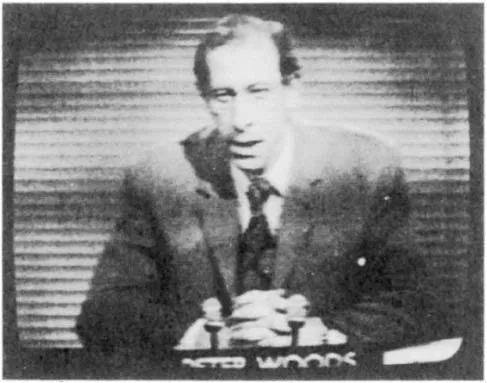
‘The Prime Minister, in a major speech tonight on the economy, appealed to management and unions.’
The bulletin continued with filmed extracts of Wilson speaking:
This is an industry which itself makes a disproportionate contribution to the loss of output through disputes, because with just over 2 per cent of the total employees, 2 per cent of all those working in the whole of Britain, it accounted for one-eighth of all the man days lost in 1974 through disputes and that was a year, of course, which was inflated by the coal-mining dispute, which we rapidly brought to an end, and it accounted for getting on for one-third of the total national loss through disputes in 1973. Whether this loss of production was acceptable or not with private capital involved, or whether it was simply that private capital was unable to deal with such problems, is a matter now for historical argument. What is not a matter for argument for the future, is this: with public capital and an appropriate degree of public ownership and control involved the government could not justify to parliament or to the taxpayer the subsidizing of large factories involving thousands of jobs, factories which could pay their way but are failing to do so because of manifestly avoidable stoppages of production.
(BBC 1, Early Evening News, 3 January 1975)
There are three points in Wilson’s speech which are of interest here. First, the introduction, where Wilson is reported as having criticized ‘management and unions’. Second, in all the sections of the speech we are shown, Wilson does not use the word ‘strike’ but uses the less emotive term ‘dispute’. He even rewords well-known phrases such as ‘the coal-miners’ strike’ into ‘the coal-mining dispute’. Third, he singles out the problems of what he calls ‘private capital’ and notes that ‘whether this loss of production was acceptable or not with private capital involved, or whether it was simply that private capital was unable to deal with such problems, is a matter now for historical argument’.
On the same channel an hour and forty-five minutes later, these three things have changed. The speech is now introduced as an appeal to workers alone. It is referred to from now on as a speech about strikes and the sections on the problems of private capital are no longer shown.
The Prime Minister has appealed to workers in the car industry to cut down on avoidable stoppages. He said the industry had a record of strikes out of proportion to its size, and he singled out for particular blame, British Leyland’s Austin-Morris division, which he said was responsible last year for a fifth of the industry’s lost production through strikes. Mr Wilson said that unless labour relations improved, government help for British Leyland would be put in doubt.
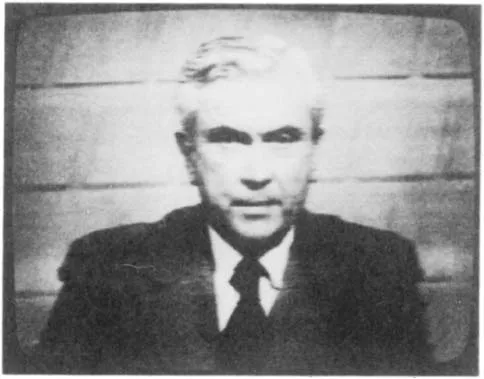
‘The Prime Minister has appealed to workers in the car industry.’
The bulletin continued with these extracts from the speech:
Parts of the British Leyland undertaking are profitable, others are not, but public investment and participation cannot be justified on the basis of continued avoidable loss-making. Our intervention cannot be based on a policy of turning a private liability into a public liability.
[BBC cut here] What is not a matter for argument for the future is this. With public capital and an appropriate degree of public ownership and control involved, the government could not justify to parliament, or to the taxpayer, the subsidizing of large factories which could pay their way, but are failing to do so because of manifestly avoidable stoppages of production.
(BBC 1, Late News, 3 January 1975)
The BBC 2 coverage that evening was still working with the definition of the speech as being about both sides. It was introduced as a ‘blunt warning to the car industry’ and later in the bulletin there was a discussion between an industrial correspondent and the newscaster in which they made it quite clear that the speech was not simply a criticism of the work force.
NEWSCASTER: Many of the phrases in the Prime Minister’s speech are pointed directly at the unions and the labour force, some are pointed at management, like the need for more efficient working methods. Do the management accept that they have got to do some pretty radical rethinking about production methods and that sort of thing?
(BBC 2, 23:16, 3 January 1975)
This is important as the speech was referred to on a very large number of occasions (forty-four in all) in conjunction with the coverage of the dispute at Leyland. This was the last time it was referred to as being critical of management.
The ITN coverage at no point acknowledged these criticisms. In the introduction Mr Wilson was said to have given ‘workers a blunt warning’. In addition to showing excerpts from the speech ITN also had a reporter on the spot who summarized to a camera what he believed it to be about. These summaries again emphasized the speech as an appeal to the workforce:
This was a stern message to come from a Labour Prime Minister, but it was received politely enough by the audience here in a Labour club in his constituency; but the speech was clearly prompted by the growing number of companies going to the government for help and the large sums of public money involved. Mr Wilson clearly expects a greater degree of restraint from the workforce in firms where the government has stepped in to help and he has appealed directly to working people not to rock an already very leaky boat.
(ITN, 22:00, 3 January 1975)
This bulletin continued with reports of attitudes to the speech and to the source of Leyland’s difficulties. Elsewhere the alternative history of these difficulties was well documented. The problems of investment and distribution of dividends were in fact highlighted as early as 1972, as for example in this excerpt from the journal Management Today:
Capital expenditure had been very low for many years, and depreciation was correspondingly small. The high profits about which so many boasts were made, were thus derived from a declining asset base and too high a proportion was paid out to shareholders.
(Management Today, August 1972)
But such alternative accounts were reduced on the news to mere tokens. In the above ITN bulletin, the story on Leyland lasted over 5 minutes, and the first 4 minutes and 50 seconds were taken up with the speech, summaries of it and the definition of it as being about the workforce. The bulletin continued immediately with a 15-second reference to the alternative view. Leslie Huckfield MP, was quoted as saying that the main problem in Leyland was the management failure to invest. This account was immediately ‘sandwiched’ by following it with two other views that refuted it, those of the Leyland management and of Mr Prior, the Conservative spokesman.
Mr Wilson’s comments on British Leyland got a cool reception from one Labour MP, Mr Leslie Huckfield of Nuneaton. He said the Prime Minister clearly knew very little about the car industry, the real cause of the trouble was the chronic failure of management to invest, he said. But the opposition’s employment spokesman Mr James Prior, and the British Leyland spokesman, both supported Mr Wilson’s remarks. Mr Prior said Mr Wilson was at least stating some home truths which others have been expressing for a long while.
(ITN, 22:00, 3 January 1975)
Huckfield’s view is effectively discounted, all the more since it was heavily parenthesized with a double ‘he said’. ITN left us in no doubt as to which side they wished to emphasize. They literally ‘underlined’ one interpretation of the speech and used this to introduce their coverage of the dispute. The above bulletin continued:
As if to underline Mr Wilson’s remarks, British Leyland’s Austin-Morris plant in Cowley announced that 12,000 men are being laid off because of a strike by 250 workers. The striking workers are engine tuners, who want to be graded as skilled workers. They rejected a plea to call off the strike which could cut production by a thousand cars a day.
(ITN, Late News, 3 January 1975)
The BBC used the same form of ‘sandwich’ and also linked the speech and the dispute. We know here that the BBC is about to talk of strikes since it uses the words ‘and there was more trouble today’:
Mr Wilson’s speech has been welcomed by the opposition spokesman on employment, Mr James Prior. He said the Prime Minister had told car workers some home truths, although it was a pity he hadn’t done so before, but Mr Leslie Huckfield, a Labour MP with a lot of car workers in his constituency of Nuneaton, said the speech was disgraceful. The real culprits were the management, not the workers. British Leyland said tonight they shared Mr Wilson’s exasperation at the series of futile disputes in the corporation and there was more trouble today. Twelve thousand workers at the Cowley plant near Oxford were laid off because of a strike by 250 in the tuning department.
(BBC 1, Late News, 8 January 1975)
This sets the pattern for the subsequent use of the speech in relation to the dispu...
Table of contents
- Cover
- Half Title
- Title Page
- Copyright Page
- Table of Contents
- List of illustrations
- Acknowledgements
- Introduction
- Part I Industrial and economic reporting
- Part II War reporting: Northern Ireland, the Falklands and the Gulf War
- Part III Politics and media
- Index
Trusted by 375,005 students
Access to over 1.5 million titles for a fair monthly price.
Study more efficiently using our study tools.
Frequently asked questions
Yes, you can cancel anytime from the Subscription tab in your account settings on the Perlego website. Your subscription will stay active until the end of your current billing period. Learn how to cancel your subscription
No, books cannot be downloaded as external files, such as PDFs, for use outside of Perlego. However, you can download books within the Perlego app for offline reading on mobile or tablet. Learn how to download books offline
Perlego offers two plans: Essential and Complete
- Essential is ideal for learners and professionals who enjoy exploring a wide range of subjects. Access the Essential Library with 800,000+ trusted titles and best-sellers across business, personal growth, and the humanities. Includes unlimited reading time and Standard Read Aloud voice.
- Complete: Perfect for advanced learners and researchers needing full, unrestricted access. Unlock 1.5M+ books across hundreds of subjects, including academic and specialized titles. The Complete Plan also includes advanced features like Premium Read Aloud and Research Assistant.
We are an online textbook subscription service, where you can get access to an entire online library for less than the price of a single book per month. With over 1.5 million books across 990+ topics, we’ve got you covered! Learn about our mission
Look out for the read-aloud symbol on your next book to see if you can listen to it. The read-aloud tool reads text aloud for you, highlighting the text as it is being read. You can pause it, speed it up and slow it down. Learn more about Read Aloud
Yes! You can use the Perlego app on both iOS and Android devices to read anytime, anywhere — even offline. Perfect for commutes or when you’re on the go.
Please note we cannot support devices running on iOS 13 and Android 7 or earlier. Learn more about using the app
Please note we cannot support devices running on iOS 13 and Android 7 or earlier. Learn more about using the app
Yes, you can access The Glasgow Media Group Reader, Vol. II by Greg Philo in PDF and/or ePUB format, as well as other popular books in Social Sciences & Media Studies. We have over 1.5 million books available in our catalogue for you to explore.