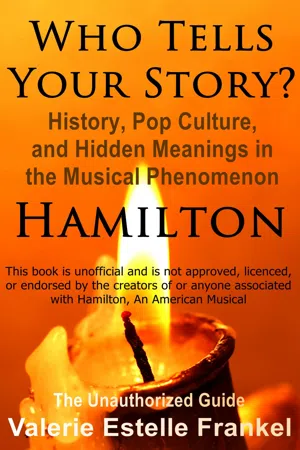
Hamilton, the hip-hop rap musical, has revolutionized theater. It's the story of an immigrant, "young, scrappy, and hungry," who kicked off the Revolutionary War and built the central government of today. Within this book appears the musical's backstory with many deeper insights. How do the Schuyler Sisters' signature colors reveal their personalities? Which stage equipment best amplifies the themes? What of the words like "Satisfied" and "My Shot," with so many double and triple meanings? Most importantly, we'll explore how the show hauntingly echoes today's political climate and hottest issues. As the musical extends a mirror of vibrant, diverse, passionate America, it captivates all who discover it.
eBook - ePub
Who Tells Your Story?
History, Pop Culture, and Hidden Meanings in the Musical Phenomenon Hamilton
- English
- ePUB (mobile friendly)
- Available on iOS & Android
eBook - ePub
Who Tells Your Story?
History, Pop Culture, and Hidden Meanings in the Musical Phenomenon Hamilton
About this book
Information
Subtopic
TheatreAct II
Enter Jefferson
With a purple coat and exaggerated swagger, Jefferson enters by descending a staircase with far more pomp than Hamilton once did: Washington has appointed the former minister to France as secretary of state. His slaves line up adoringly, prepared to back up his song.
“Thomas Jefferson is a little older, so he dresses like Morris Day and sings jazzy R&B” (Hiatt). He echoes Prince, or any other celebrity fop. Miranda explains:
It’s about eliminating distance. If your mission is to make a story that happened 200-odd years ago resonate with contemporary audiences, what are the ways in which you can eliminate distance? And, man, does that purple suit with a frilly blouse do that. Just like when we pull out those microphones for that Cabinet battle. It’s the only anachronistic prop in the show. (Binelli)
Historically, Jefferson actually overdressed and designed his own special soldiers’ uniforms.
“What’d I miss?” he asks arrogantly, dancing amid his servants as the light turns red. (In a sly joke, “What’d I miss” echoes the theatergoers back late from intermission.) With the crowd of attendants and the red and purple light and clothing, he parallels King George and his privilege. The chorus drag his staircase around in a way that disturbingly echoes slavery’s manual labor, and Jefferson addresses his slave mistress Sally Jenkins – the ugliness of the Founding Fathers is fully on display. The historical Hamilton writes of Jefferson’s arrogance and hatred of a central government:
In France he saw government only on the side of its abuses.…He came here probably with a too partial idea of his own powers and with the expectation of a greater share in the direction of our councils than he has in reality enjoyed. I am not sure that he had not peculiarly marked out for himself the department of the finances. He came electrified plus with attachment to France, and with the project of knitting together the two countries in the closest political bands…. (“Letter to Edward Carrington”)
James Madison greets him, eager for help. Madison was a very wealthy plantation owner who dressed like a parson. He served in Congress during the war instead of the front lines. He’d never done manual labor.
In fact, Madison had been Hamilton’s ally in the fight to ratify the new Constitution, but he and Thomas Jefferson came to prefer power for state governments. As early as 1792, Hamilton complained, “Mr. Madison cooperating with Mr. Jefferson is at the head of a faction decidedly hostile to me and my administration” (“Letter to Edward Carrington”). Miranda notes that this split occurs during the intermission.
To pass the Constitution, Madison spoke at Virginia’s Ratifying Convention, countering Patrick Henry’s emotional rhetoric with logic and facts he and Hamilton had worked out. He also vowed to balance the Constitution with the Bill of Rights, which he drafted (a point Madison quickly interjects in “Washington on Your Side”). Madison was soon elected to Congress. However, once there, Madison led Congress’s unsuccessful attempt to block Hamilton’s national bank and other Federalist projects. He went on to be the fourth President of the United States from 1809 to 1817. Ironically, during the War of 1812, he had difficulty because of the weak national army and bank, so after, he came closer to Hamilton’s point of view.
With Madison fully clothed in grey and Jefferson in plum, the characters have graduated from the ensemble’s white suits to be fully actualized. They won’t keep switching roles but will stay politicians for all of Act II. The coat changes suggest growth as well as the passage of time – new outfits mean new roles and responsibilities. Washington wears stately black with Hamilton now fully in green. Hamilton adds glasses eventually, showing his age by the end. Green nods to his treasury role and financial success. The green also sets him in opposition to Jefferson, whose loose hair, long purple coat, and velvet waistcoat all stress his love of luxury.
Of course, Hamilton hasn’t learned to be smooth and gracious. Chernow comments, “He’s so capable, so kind of self-consciously brilliant in a way, that he makes an amazing number of enemies” (Alexander Hamilton: American Experience). Berkin adds:
He was really sort of the bull in the china shop. I think one of his greatest difficulties was that, time and time again, he proved he was smarter than other people, and so he could not understand why they didn’t shut up and listen to him. He had very little training in the art of politics as a young man. I mean, think about all of these men of the revolutionary generation. Their fathers were in the colonial legislature, their grandfathers were. Politics was talked about at the dinner table. You heard mistakes that people made. You learned finesse. Hamilton never had that. (Alexander Hamilton: American Experience)
Moments after their introduction, Hamilton starts a rap battle with Jefferson…with Washington as the referee. “The rap battles, I think, are ‘you think our country should be like this, our country should be like that,’ and if you win, our country goes to ruins” Miranda adds (“Hamilton: A Founding Father”). Hip-hop is important for a war of ideas since “we get more language per measure than any other musical form” (“Hip-hop and History Blend”). Thus the battles are some of the most popular scenes, perfectly reimagined for the contemporary era. Washington addresses the audience directly, inviting them to participate and welcoming them to the show.
Explaining the predicament they were debating, Berkin notes:
We owed money to our own army. We owed money to the officers of the army, many of whom had spent their entire fortunes equipping and taking care of the regiments that they had put together. We owed little old ladies who had given over supplies and horses to the army and gotten a piece of paper that said, “we’ll pay you for this.” We couldn’t pay them. So there was no confidence in the government, there was no confidence in the economy. And so we were in a serious economic depression, and no one was certain how to get out of it. (Alexander Hamilton: American Experience)
Chernow adds:
It would have been easy enough, and almost predictable, for a revolutionary government to repudiate that debt. But Hamilton felt that unless the debt was paid off, the United States would never be able to borrow money again, and that this would weaken it as a great power. Hamilton had developed this theory that unless you could establish the credit of the state, you could never have a mighty country…He felt that if the federal government assumed the debt from the states, that all of the creditors would feel that they had a direct financial stake in the survival of the still shaky, new federal government – because that became the government that was going to pay them off. (Alexander Hamilton: American Experience)
Thus Hamilton fights for national responsibility for the states’ debts. Jefferson believed that America’s success lay in its classic farming tradition. Hamilton favored more innovative manufacture and commerce. In this and basically every other political decision, Hamilton and Jefferson warred, to a personal degree. Hamilton writes:
In the question concerning the Bank, he not only delivered an opinion in writing against its constitutionality and expediency, but he did it in a style and manner which I felt as partaking of asperity and ill humor towards me. As one of the trustees of the Sinking Fund, I have experienced, in almost every leading question, opposition from him. When any turn of things in the community has threatened either odium or embarrassment to me, he has not been able to suppress the satisfaction, which it gave him… (“Letter to Edward Carrington”)
This animosity appears in the personal insults and anger of the first cabinet rap battle. The brief interlude “No John Trumbull” (cut from the final version of the show) contrasts the famous stately historical painting with the angry, squabbling reality (Dreamcatcher). Indeed, in Trumbull’s classic painting Declaration of Independence, everyone looks mature, stately and dignified – a far contrast with the anger of the cabinet meeting. Freeman com...
Table of contents
- Introduction
- A Close Reading of the Musical – History, Themes, Symbols, Staging, & Deeper Meanings
- Act I
- Act II
- Appendix
Trusted by 375,005 students
Access to over 1.5 million titles for a fair monthly price.
Study more efficiently using our study tools.
Frequently asked questions
Yes, you can cancel anytime from the Subscription tab in your account settings on the Perlego website. Your subscription will stay active until the end of your current billing period. Learn how to cancel your subscription
No, books cannot be downloaded as external files, such as PDFs, for use outside of Perlego. However, you can download books within the Perlego app for offline reading on mobile or tablet. Learn how to download books offline
Perlego offers two plans: Essential and Complete
- Essential is ideal for learners and professionals who enjoy exploring a wide range of subjects. Access the Essential Library with 800,000+ trusted titles and best-sellers across business, personal growth, and the humanities. Includes unlimited reading time and Standard Read Aloud voice.
- Complete: Perfect for advanced learners and researchers needing full, unrestricted access. Unlock 1.5M+ books across hundreds of subjects, including academic and specialized titles. The Complete Plan also includes advanced features like Premium Read Aloud and Research Assistant.
We are an online textbook subscription service, where you can get access to an entire online library for less than the price of a single book per month. With over 1.5 million books across 990+ topics, we’ve got you covered! Learn about our mission
Look out for the read-aloud symbol on your next book to see if you can listen to it. The read-aloud tool reads text aloud for you, highlighting the text as it is being read. You can pause it, speed it up and slow it down. Learn more about Read Aloud
Yes! You can use the Perlego app on both iOS and Android devices to read anytime, anywhere — even offline. Perfect for commutes or when you’re on the go.
Please note we cannot support devices running on iOS 13 and Android 7 or earlier. Learn more about using the app
Please note we cannot support devices running on iOS 13 and Android 7 or earlier. Learn more about using the app
Yes, you can access Who Tells Your Story? by Valerie Estelle Frankel in PDF and/or ePUB format, as well as other popular books in Media & Performing Arts & Theatre. We have over 1.5 million books available in our catalogue for you to explore.