eBook - ePub
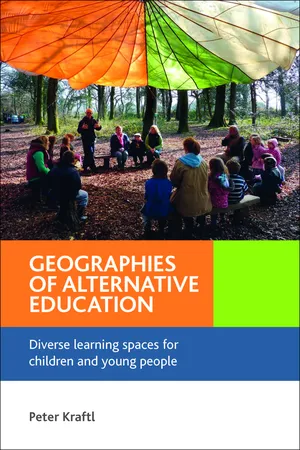
Geographies of Alternative Education
Diverse Learning Spaces for Children and Young People
- 304 pages
- English
- ePUB (mobile friendly)
- Available on iOS & Android
eBook - ePub
Geographies of Alternative Education
Diverse Learning Spaces for Children and Young People
About this book
This book offers a comparative analysis of alternative education in the UK, focusing on learning spaces that cater for children and young people. It constitutes one of the first book-length explorations of alternative learning spaces outside mainstream education - including Steiner, human scale and forest schools, care farms and homeschooling.Based on original research with teachers, parents and young people at over 50 learning spaces, Geographies of alternative education demonstrates the importance of a geographical lens for understanding alternative education. In so doing, it develops contemporary theories of autonomy, emotion/affect, habit, intergenerational relations and life-itself. The book will appeal to academics and postgraduates in the fields of geography, sociology, education and youth studies. Given ongoing concerns about the state's role in providing children's education, and an increase in the number of alternative education providers in the UK and elsewhere, the book also highlights several critical questions for policy makers and practitioners.
Information
References
Adey, P. (2008) ‘Airports, mobility, and the calculative architecture of affective control’, Geoforum, vol 39, pp 438-51.
Adey, P. (2009) Mobility, London: Routledge.
Ahern, G. (2009) Sun at midnight: the Rudolf Steiner movement and gnosis in the West, Cambridge: James Clarke & Co.
Allin, L. and Humberstone, B. (2010) ‘Introducing ‘journey(s)’ in adventure and outdoor learning research’, Journal of Adventure Education and Outdoor Learning, vol 10, pp 71-5.
Allison, P., Carr, D. and Meldrum, D. (2012) ‘Potential for excellence: interdisciplinary learning outdoors as a moral enterprise’, The Curriculum Journal, vol 23, pp 43-58.
Amato, L. and Krasny, M. (2011) ‘Outdoor adventure education: applying transformative learning theory to understanding instrumental learning and personal growth in environmental education’, Journal of Environmental Education, vol 42, pp 237-54.
Amoore, L. and de Goede, M. (2008) ‘Transactions after 9/11: The banal face of the preemptive strike’, Transactions of the Institute of British Geographers, vol 33, pp 173-85.
Anderson, B. (2004) ‘Time-stilled space-slowed: how boredom matters’, Geoforum, vol 35, pp739-54.
Anderson, B. (2006) ‘Becoming and being hopeful: towards a theory of affect’,Environment and Planning D: Society & Space, vol 24, pp 733-52.
Anderson, B. (2010) ‘Preemption, precaution, preparedness: anticipatory action and future geographies’, Progress in Human Geography, vol 34, pp 777-98.
Anderson, B. (2012) ‘Affect and biopower: towards a politics of life’, Transactions of the Institute of British Geographers, vol 37, pp 28-43.
Anderson, B. and Harrison, P. (2010) Taking-Place: non-representational theories and geography, London: Ashgate.
Anderson, B. and Tolia-Kelly, D. (2004) ‘Matter(s) in social and cultural geography’,Geoforum, vol 35, pp669-74.
Anderson, K. and Smith, S. (2001) Editorial: emotional geographies, Transactions of the Institute of British Geographers, vol 26, pp 7-10.
Andrews, G., Kearns, R., Kontos, P. and Wilson, V. (2006) ‘“Their finest hour”: older people, oral histories, and the historical geography of social life’, Social & Cultural Geography, vol 7, pp 153-77.
Ansell, N. (2002) ‘“Of course we must be equal, but …”: imagining gendered futures in two rural southern African secondary schools’, Geoforum, vol 33, pp 179-94.
Ansell, N, (2009) ‘Childhood and the politics of scale: descaling children’s geographies?’, Progress in Human Geography, vol 32, pp 190-209.
Arnot, J. (2002) Reproducing gender? Essays on educational theory and feminist politics, London: Routledge.
Arnot, M. and Reay, D. (2007) ‘A sociology of pedagogic voice: power, inequality and pupil consultation, Discourse: Studies in the Cultural Politics of Education, vol 28, pp 311-25.
Backman, E. (2011) ‘What controls the teaching of friluftsliv? Analysing the pedagogic discourse within Swedish physical education’, Journal of Adventure Education and Outdoor Learning, vol 11, pp 51-65.
Ball, S. (2003) Class strategies and the education market: the middle classes and social advantage, London: Routledge.
Ball, S. (ed) (2004) The RoutledgeFalmer reader in sociology of education, London: Routledge.
Ball, S., Bowe, R. and Gewirtz, S. (1995) ‘Circuits of schooling: a sociological exploration of parental choice of school in social class contexts’, Sociological Review, vol 43, pp 52-78.
Barad, K. (2003) ‘Posthumanist performativity: toward an understanding of how matter comes to matter’, Signs, vol 28, pp 801-31.
Barnett, C. (2005) ‘Ways of relating: hospitality and the acknowledgment of otherness’, Progress in Human Geography, vol 29, pp 5-21.
Barrow, R. (2012 [1978]) Radical education: a critique of freeschooling and deschooling, London: Routledge.
Bartels, A. and Zeki, P. (2004) ‘The neural correlates of maternal and romantic love’, NeuroImage, vol 21, pp 1155-66.
Bauman, K. (2001). Homeschooling in the United States: trends and characteristics; Working paper series, Washington, DC: US Census Bureau Population Division.
Bauman, Z. (1990) Modernity and ambivalence, Cambridge: Polity Press.
Beck, U. and Beck-Gernsheim, E. (2002) Individualization: institutionalized individualism and its social and political consequences, London: SAGE.
Bennett, J. (2010) Vibrant matter: a political ecology of things, Durham, NC: Duke University Press.
Bennett, J. (2011) ‘The solar judgment of Walt Whitman’, in J. Seery (ed) A political companion to Walt Whitman, Lexington, KY: The University Press of Kentucky, pp 131-46.
Bennett, K. (2009) ‘Challenging emotions’, Area, vol 41, pp 244-52.
Bentley G. and Mace, R. (eds) 02009) Substitute parents: alloparenting in human societies, London: Berghahn Books.
Berget, B. and Braastad, B. (2008) ‘Animal-assisted therapy with farm animals for persons with psychiatric disorders’, Annals Ist Super Sanita, vol 47, pp 384-90.
Bielick, S., Chandler, K. and Broughman, S. (2001) Homeschooling in the United States, Washington DC: National Center for Education Statistics.
Biesta, G. (2005) ‘Against learning: reclaiming a language for education in an age of learning’, Nordisk Pedagogik, vol 25, pp 54-66.
Biesta, G. (2006) Beyond learning: democratic education for a human future, Boulder, CO: Paradigm Publishers.
Bilton, H. (2010) Outdoor learning in the early years: management and innovation, London: Routledge.
Bissell, D. (2007) ‘Animating suspension: waiting for mobilities’, Mobilities, vol 2, pp 277-98.
Bissell, D. (2012) ‘Agitating the powers of habit: towards a volatile politics of thought’, Theo...
Table of contents
- Cover
- Title
- Copyright
- Contents
- List of figures
- Notes on author
- Acknowledgments
- one Introduction
- two Conceptual frameworks: towards geographies of alternative education
- three Alternative learning spaces in the UK: background to the case studies used in this book
- four Connection/disconnection: positioning alternative learning spaces
- five Mess/order: materials, timings, feelings
- six Movement/embodiment: learning habits (I)
- seven Inter/personal relations: scale, love and learning habits (II)
- eight Towards the ‘good life’: alternative visions of learning, love and life-itself
- nine Conclusion: geographies of alternative education and the value of autonomous learning spaces
- References
Trusted by 375,005 students
Access to over 1.5 million titles for a fair monthly price.
Study more efficiently using our study tools.
Frequently asked questions
Yes, you can cancel anytime from the Subscription tab in your account settings on the Perlego website. Your subscription will stay active until the end of your current billing period. Learn how to cancel your subscription
No, books cannot be downloaded as external files, such as PDFs, for use outside of Perlego. However, you can download books within the Perlego app for offline reading on mobile or tablet. Learn how to download books offline
Perlego offers two plans: Essential and Complete
- Essential is ideal for learners and professionals who enjoy exploring a wide range of subjects. Access the Essential Library with 800,000+ trusted titles and best-sellers across business, personal growth, and the humanities. Includes unlimited reading time and Standard Read Aloud voice.
- Complete: Perfect for advanced learners and researchers needing full, unrestricted access. Unlock 1.5M+ books across hundreds of subjects, including academic and specialized titles. The Complete Plan also includes advanced features like Premium Read Aloud and Research Assistant.
We are an online textbook subscription service, where you can get access to an entire online library for less than the price of a single book per month. With over 1.5 million books across 990+ topics, we’ve got you covered! Learn about our mission
Look out for the read-aloud symbol on your next book to see if you can listen to it. The read-aloud tool reads text aloud for you, highlighting the text as it is being read. You can pause it, speed it up and slow it down. Learn more about Read Aloud
Yes! You can use the Perlego app on both iOS and Android devices to read anytime, anywhere — even offline. Perfect for commutes or when you’re on the go.
Please note we cannot support devices running on iOS 13 and Android 7 or earlier. Learn more about using the app
Please note we cannot support devices running on iOS 13 and Android 7 or earlier. Learn more about using the app
Yes, you can access Geographies of Alternative Education by Kraftl, Peter,Peter Kraftl in PDF and/or ePUB format, as well as other popular books in Education & Educational Policy. We have over 1.5 million books available in our catalogue for you to explore.