- 192 pages
- English
- ePUB (mobile friendly)
- Available on iOS & Android
eBook - ePub
About this book
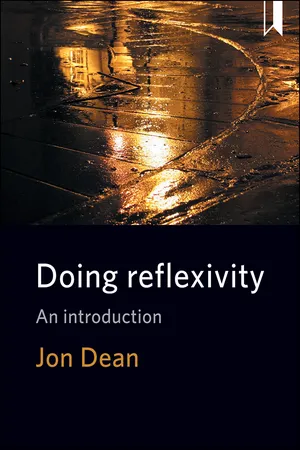
Reflexivity is vital in social research projects, but there remains relatively little advice on how to execute it in practice. This book provides social science researchers with both a strong rationale for the importance of thinking reflexively and a practical guide to doing reflexivity within their research. The first book on the subject to build primarily on the theoretical and empirical contributions of Pierre Bourdieu's reflexive work, it combines academic analysis with practical examples and case studies, drawing both on recent reflexive research projects and original empirical data from new projects conducted by the author. Written in an engaging and accessible style, the book will be of interest to researchers from all career stages and disciplinary backgrounds, but especially early-career researchers and students who are struggling with subjectivity, positionality, and the realities of being reflexive.
Information
References
Abrahams, J. and Ingram, N. (2013) The chameleon habitus: Exploring students’ negotiations of multiple fields. Sociological Research Online, 18(4).
Achen, C. (2014) Why do we need diversity in the Political Methodology Society? The Political Methodologist. http://thepoliticalmethodologist.com/2014/04/30/we-dont-just-teach-statistics-we-teach-students.
Adkins, L. and Skeggs, B. (2004) Feminism after Bourdieu. London: Wiley-Blackwell.
Alvesson, M. and Sköldberg, K. (2000) Reflexive Methodology: New Vistas for Qualitative Research. London: Sage.
Aschwanden, C. (2015) Science isn’t broken. Five Thirty Eight. http://fivethirtyeight.com/features/science-isnt-broken.
Atkinson, W. (2013) Some further (orthodox?) reflections on the notions of ‘institutional habitus’ and ‘family habitus’: A response to Burke, Emmerich, and Ingram. British Journal of Sociology of Education, 34(2): 183–9.
Back, L. (2002) Dancing and wrestling with scholarship: Things to do and things to avoid in a PhD career. Sociological Research Online, 7(4).
Back, L. (2007) The Art of Listening. London: Berg.
Back, L. (2015a) On the side of the powerful: The ‘impact agenda’ and sociology in public. The Sociological Review. http://www.thesociologicalreview.com/information/blog/on-the-side-of-the-powerful-the-impact-agenda-sociology-in-public.html.
Back, L. (2015b) Why everyday life matters: Class, community and making life livable. Sociology, 49(5): 820–36.
Back, L. (n.d.) Writing and scholastic style. Academic Diary. http://www.academic-diary.co.uk/page.php?entryID=31.
Back, L. and Tate, M. (2015) For a sociological reconstruction: W.E.B. Du Bois, Stuart Hall and segregated sociology. Sociological Research Online, 20(3).
Bancroft, A. and Fevre, R. (2016) Dead White Men and Other Important People. London: Palgrave.
Baptist Union of Great Britain, Methodist Church, Church of Scotland and United Reformed Church (2013) The Lies We Tell Ourselves: Ending Comfortable Myths about Poverty. http://www.irishmethodist.org/sites/default/files/Truth-And-Lies-Report-smaller.pdf.
Barnes, M. and Cotterell, P. (2012) Critical and different perspectives on user involvement. In M. Barnes and P. Cotterell (eds) Critical Perspectives on User Involvement. Bristol: Policy Press, pp. 143–7.
Barrett, T. (2015) Storying Bourdieu: Fragments toward a Bourdieusian approach to ‘life histories’. International Journal of Qualitative Methods, 14(5): 1–10.
Bart, P. (1974) Male views of female sexuality, from Freud’s fallacies to Fisher’s inexact test. Paper presented at the second national meeting, special section, on Psychosomatic Obstetrics and Gynaecology, Key Biscayne, Florida.
Bartmanski, D. (2012) How to become an iconic social thinker: The intellectual pursuits of Malinowski and Foucault. European Journal of Social Theory, 15(4): 427–53.
Becker, H. (1967) Whose side are we on? Social Problems, 14(3): 239–47.
Becker, H. (1970) Sociological Work. New Brunswick, NJ: Transaction Books.
Becker, H. (2014) How to keep your sociological imagination alive. The Sociological Imagination. http://sociologicalimagination.org/archives/16120.
Beer, D. (2014) Punk Sociology. Basingstoke: Palgrave.
Bendelow, G. and Williams, S. (1998) Emotions in Social Life: Critical Themes and Contemporary Issues. London: Routledge.
Benhabib, S. (1992) Situating the Self: Gender, Community and Postmodernism in Contemporary Ethics. Cambridge: Polity.
Benson, M. (2015) On Goffman: Ethnography and the ethics of care. The Sociological Review. http://www.thesociologicalreview.com/information/blog/on-goffman-ethnography-and-the-ethics-of-care.html.
Beresford, P. (2016) All Our Welfare: Towards Participatory Social Policy. Bristol: Policy Press.
Berger, B. (1981) The Survival of a Counterculture: Ideological Work and Daily Life Among Rural Communards. Berkeley: University of California Press.
Berger, R. and Quinney, R. (2005) Storytelling Sociology: Narrative as Social Inquiry. Boulder, CO: Lynne Reiner.
Bhatt, C. (2016) White sociology. Ethnic and Racial Studies, 39(3): 397–404.
Bishop, L. (2007) A reflexive account of reusing qualitative data: Beyond primary/secondary dualism. Sociological Research Online, 12(3).
Blackman, S. (2007) Hidden ethnography: Crossing emotional boundaries in qualitative accounts of young people’s lives. Sociology, 41(4): 699–716.
Blumer, H. (1999) What is wrong with social theory? In A. Bryman and R. Burgess (eds) Qualitative Research, vol. I. London: Sage, pp. 25–33.
Bornat, J. (2014) Epistemology and ethics in data sharing and analysis: A critical overview. In L. Camfield (ed.) Methodological Challenges and New Approaches to Research in International Development. Basingstoke: Palgrave Macmillan, pp. 217–37.
Bottero, W. (2004) Class identities and the identity of class. Sociology, 38(5): 985–1003.
Bourdieu, P. (1958) Sociologie de l’Algérie. Paris: PUF.
Bourdieu, P. (1969) Intellectual field and creative project. Social Science Information, 8(2): 89–119.
Bourdieu, P. (1977) Outline of a Theory of Practice. Cambridge: Cambridge University Press.
Bourdieu, P. (1979) Algeria 1960. Cambridge: Cambridge University Press.
Bourdieu, P. (1980) Sartre. London Review of Books, 2(22): 11–12.
Bourdieu, P. (1986) The forms of capital. In J. Richardson (ed.) Handbook of Theory of Research for the Sociology of Education. New York: Greenwood Press, pp. 241–58.
Bourdieu, P. (1988) Vive la crise! For heterodoxy in social science. Theory & Society, 17(5): 773–87.
Bourdieu, P. (1990a) In Other Words: Essays Towards a Reflexive Sociology. Cambridge: Polity.
Bourdieu, P. (1990b) Sociology in Question. Cambridge: Polity.
Bourdieu, P. (1990c) The Logic of Practice. Cambridge: Polity.
Bourdieu, P. (1990d) Homo Academicus. Cambridge: Polity.
Bourdieu, P. (1990e) The scholastic point of view. Cultural Anthropology, 5(4): 380–91.
Bourdieu, P. (1993) Concluding remarks: For a sociogenetic understanding of intellectual works. In C. Calhoun, E. LiPuma and M. Postone (eds) Bourdieu: Critical Perspectives. Chicago, IL: University of Chicago Press, pp. 263–76.
Bourdieu, P. (1994) Academic Discourse. Cambridge: Polity.
Bourdieu, P. (1996) The State Nobility. Stanford, CA: Stanford University Press.
Bourdieu, P. (1998) On Television. New York: The New Press.
Bourdieu, P. (2000a) Entre amis. Awal: Cahiers d’études berbères, 21: 5–10.
Bourdieu, P. (2000b) Pascalian Meditations. Cambridge: Polity.
Bourdieu, P. (2001) Masculine Domination. Stanford, CA: Stanford University Press.
Bourdieu, P. (2003a) Participant objectivation. Journal of the Royal Anthropological Institute, 9: 281–94.
Bourdieu, P. (2003b) Firing Back: Against the Tyranny of the Market 2. London: Verso.
Bourdieu, P. (2005) The Social Structures of the Economy. Cambridge: Polity.
Bourdieu, P. (2007) Sketch for a Self-analysis. Cambridge: Polity.
Bourdieu, P. (2008) The Bachelor’s Ball: The Crisis of Peasant Society in Béarn. Cambridge: Polity.
Bourdieu, P. (2010 [1984]) Distinction: A Social Critique of the Judgement of Taste. London: Routledge.
Bourdieu, P. (2010a) Return to television. In G. Sapiro (ed.) Sociology Is a Martial Art: The Political Writings of Pierre Bourdieu. New York: The New Press, pp. 141–6.
Bourdieu, P. (2010b) The intellectual is not ethically neutral. In G. Sapiro (ed.) Sociology Is a Martial Art: The Political Writings of Pierre Bourdieu. New York: The New Press, pp. 253–60.
Bourdieu, P. (2010c) A sociologist in the world. In G. Sapiro (ed.) Sociology Is a Martial Art: The Political Writings of Pierre Bourdieu. New York: The New Press, pp. 261–78.
Bourdieu, P. (2014) On the State: Lectures at the Collège de France, 1989–1992. Cambridge: Polity.
Bourdieu, P. and de Saint Martin, M. (1978) Le patronat. Actes de la recherche en sciences sociales, 20/21: 3–82.
Bourdieu, P. and Passeron, J.-C. (1977) Reproduction in Education, Society and Culture. London: Sage.
Bourdieu, P. and Wacquant, L. (1992) An Invitation to Reflexive Sociology. Cambridge: Polity.
Bourdieu, P. et al. (1999) The Weight of the World. Cambridge: Polity.
Bourgois, P. and Schonberg, J. (2009) Righteous Dopefiend. London: University of California Press.
Brayton, J. (1997) What makes feminist research feminist? The structure of feminist research within the social sciences. http://www.unb.ca/PAR-L/win/feminmethod.htm.
Breeze, B. and Dean, J. (2012) Pictures of me: User views on their representation in homelessness fundraising appeals. International Journal of Non-profit and Voluntary Sector Marketing, 17(2): 132–43.
Breeze, B. and Dean, J. (2013) User Views of Fundraising: A Study of Charitable Beneficiaries’ Opinion of Their Representation in Appeals. London: Alliance.
Brewer, J. (2004) Imagining The Sociological Imagination: The biographical context of a sociological classic. British Journal of Sociology, 55(3): 317–33.
Brewer, J. (2005) The public and private in C. Wright Mills’ life and work. Sociology, 39(4): 661–77.
Bridges, D. (2001) The ethics of outsider research. Journal of Philosophy of Education, 35(3): 371–86.
Brockes, E. (20...
Table of contents
- Cover
- Title Page
- Copyright Page
- Dedication
- Contents
- List of tables
- About the author
- Acknowledgements
- Prelude
- One: Introduction: a rationale for reflexivity
- Two: Pierre Bourdieu and the development of theory
- Three: Putting yourself in? Bourdieu’s reflexive project
- Four: Standpoints, disciplines, spaces
- Five: Reflexivity in the field: four case studies
- Six: Desert Island discourses: doing a parallel analysis
- Seven: The reflexive me
- Eight: Conclusions
- Coda: on writing in the social sciences
- References
Trusted by 375,005 students
Access to over 1.5 million titles for a fair monthly price.
Study more efficiently using our study tools.
Frequently asked questions
Yes, you can cancel anytime from the Subscription tab in your account settings on the Perlego website. Your subscription will stay active until the end of your current billing period. Learn how to cancel your subscription
No, books cannot be downloaded as external files, such as PDFs, for use outside of Perlego. However, you can download books within the Perlego app for offline reading on mobile or tablet. Learn how to download books offline
Perlego offers two plans: Essential and Complete
- Essential is ideal for learners and professionals who enjoy exploring a wide range of subjects. Access the Essential Library with 800,000+ trusted titles and best-sellers across business, personal growth, and the humanities. Includes unlimited reading time and Standard Read Aloud voice.
- Complete: Perfect for advanced learners and researchers needing full, unrestricted access. Unlock 1.5M+ books across hundreds of subjects, including academic and specialized titles. The Complete Plan also includes advanced features like Premium Read Aloud and Research Assistant.
We are an online textbook subscription service, where you can get access to an entire online library for less than the price of a single book per month. With over 1.5 million books across 990+ topics, we’ve got you covered! Learn about our mission
Look out for the read-aloud symbol on your next book to see if you can listen to it. The read-aloud tool reads text aloud for you, highlighting the text as it is being read. You can pause it, speed it up and slow it down. Learn more about Read Aloud
Yes! You can use the Perlego app on both iOS and Android devices to read anytime, anywhere — even offline. Perfect for commutes or when you’re on the go.
Please note we cannot support devices running on iOS 13 and Android 7 or earlier. Learn more about using the app
Please note we cannot support devices running on iOS 13 and Android 7 or earlier. Learn more about using the app
Yes, you can access Doing Reflexivity by Dean, Jon,Jon Dean in PDF and/or ePUB format, as well as other popular books in Social Sciences & Sociology. We have over 1.5 million books available in our catalogue for you to explore.