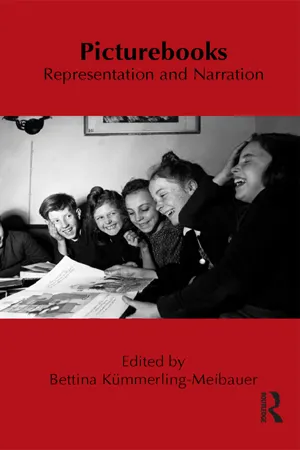
This volume discusses the aesthetic and cognitive challenges of modern picturebooks from different countries, such as Denmark, France, Germany, Norway, Spain, Sweden, United Kingdom, and USA. The overarching issue concerns the mutual relationship between representation and narration by means of the picturebooks' multimodal character. Moreover, this volume includes the main lines of debate and approaches to picturebooks by international leading researchers in the field. Topics covered are the impact of paratexts and interpictorial allusions, the relationship between artists' books, crossover picturebooks, and picturebooks for adults, the narrative defiance of wordless picturebooks, the representation of emotions in images and text, and the depiction of hybrid characters in picturebooks. The enlargement of the picturebook corpus beyond an Anglo-American picturebook canon opens up new horizons and highlights the diverging styles and genre shifts in modern picturebooks. This tendency also demonstrates the influence of specific authors and illustrators on the appreciation of the picturebook genre, as in the case of Astrid Lindgren's picturebooks and the picturebooks created by renowned illustrators, such as Anthony Browne, Wolf Erlbruch, Stian Hole, and Bruno Munari. This book will be the definite contribution to contemporary picturebook research for many years to come.
- 240 pages
- English
- ePUB (mobile friendly)
- Available on iOS & Android
eBook - ePub
Picturebooks: Representation and Narration
About this book
Information
Part I
Crossing Genre Boundaries
Artists’ Books, Wordless Picturebooks, and Picturebooks for Adults
Chapter One
Picturebooks for Adults1
Introduction
Since the 1990s there has been a growing tendency in Scandinavia to publish not only crossover picturebooks but also picturebook-narratives exclusively for adults. Picturebooks for adults that resemble children’s books in the sense that they are published in traditional children’s book format are regarded as something of a Nordic phenomenon.2 This kind of fictional picturebook for adults can be defined as “a narrative text addressed to adults and with a picture on each spread.”3 Both the publisher and the adult addressee distinguish picturebooks for adults from crossover picturebooks produced for children. Crossover picturebooks have a dual address, being aimed at the child and adult simultaneously, not one at the expense of the other4 (Ommundsen 2010). My particular focus here is on picturebooks published for adults with a picture on each spread, although comics and graphic novels for adults are related media in this field, and the boundaries between them are sometimes blurred.5 But the main issue to be discussed in this chapter is not the medium of the graphic novel.6 What interests me is the recent tendency to publish books for adults in the medium that has traditionally been regarded as the exclusive aesthetic expression of children’s literature. The picturebook for adults I shall discuss here is a boundary crossing, a new medium of quality literature deriving from the increasingly advanced picturebook for children.
In what ways does the picturebook for adults differ from the advanced picturebook for children from whom it borrows its visual expression? The medium is the same, but the addressee is different. Using the notions of “addressee” (Wall 1991), “implied reader” (Iser 1978), and “childness” (Hollindale 1997), we can investigate whom the book addresses. I will show this by considering two seemingly similar picturebooks.7
The picturebook Havet og kjærligheten (Sea and Love, 2002) by Lars Elling is published as a picturebook for adults. It is about a lonely lighthouse keeper living on his own on a small islet in the sea. Visually, with its soft charcoal drawings, and thematically, it follows up Elling’s picturebook To og to (Two and Two, 1997), which is a crossover picturebook for children. In both books the main character feels deficient due to his lack of a partner. In Two and Two the main character is a little bear called Pungnesebjørnen. Because the bear belongs to an endangered species, it is crucial for him to find his soul mate. The setting is a ship where all the passengers arrive in pairs except Pungnesebjørnen, who is alone. The obvious intertextual reference is Noah’s ark: “Two by two they went on board. When the rain stopped, all the land had disappeared” (Elling 1997, 1). The book is about love. The message is that love will make life meaningful, solve the loneliness problem, and make the species survive. As the back cover blurb explains: “You have to be two” (Elling 1997, back cover).
Elling’s two books might look similar at first glance, but they are actually quite different. The main difference is that Sea and Love is a picturebook for adults, while Two and Two is a picturebook for children, or more precisely, a crossover picturebook. What makes Two and Two a children’s book, aside from the fact that the publisher issued it for children? According to Barbara Wall (1991), the narrator–narratee relationship defines whether a book is for children or not. Two and Two has a dual address: the narrator addresses both a child reader and an adult reader at the same time. There are multiple implied readers written into the text. (Eco 1994; Iser 1978). If, like Peter Hollindale (1997), we look for childness in this book, we find it in the child’s perspective in the pictures. The viewpoint is located at ground level. The implied reader and the lonesome bear are small, while many of the other animals, such as the elephants, are big. The search for love is a common motif in adult books, but the need to belong to someone is universal. Animal characters appeal to children, and the story of Noah’s ark is a familiar tale for children. The child reader can identify with the little bear who desperately needs to find a partner.
Sea and Love, on the other hand, is a picturebook for adults, both according to the publisher and also by my definition. It uses long, complicated sentences; and although it handles the same themes, the fact of the adult addressee distinguishes it from Two and Two. Sea and Love has a single address, and the implied reader is an adult. The old lighthouse keeper is not an identification figure for children, and his earlier adventures as a sailor, which are referred to throughout the book, are remote from children’s worlds. There are no signs of childness, and the child’s perspective is absent. The register of the Norwegian National Bibliography confirms the view that Two and Two is a children’s book and Sea and Love is an adult book. In this register, To og to is catalogued under Dewey number 839.823 [SU], signifying children and young adult fiction, while Havet og kjærligheten is catalogued under Dewey number 839.823 [S], signifying fiction for adults. As my definition takes the implied reader as its point of departure, it does not say anything about the real readers of the books. Research has shown that the dividing line between competent and non-competent readers does not necessarily relate to age, but rather to literacy, experiences with different texts and means of communication, knowledge, and education. We can easily imagine Two and Two being a typical adult gift to a sweetheart on Valentine’s Day, and some of the picturebooks for adults discussed in this presentation can clearly be read by young adults as well.8
The Pictorial Turn
There are various versions of the idea that we are moving towards—or already live in—a visually oriented society. Typically, many of these ideas are pervaded with fear of a society dominated by images. In 1994, W.J.T. Mitchell launched the concept of the “pictorial turn” (Mitchell 1994). In the same year, independently of Mitchell, the German philosopher Gottfried Boehm coined the idea of the “ikonische Wendung” (Boehm 1994). “The fantasy of a pictorial turn, of a culture totally dominated by images, has now become a real technical possibility on a global scale. Marshall McLuhan’s ‘global village’ is now a fact and not an especially comforting one”, Mitchell wrote pessimistically (Mitchell 1994, 15). A far more positive, enthusiastic image of the picture society is found in Scott McCloud’s Understanding Comics (1994). McCloud presents his theory on comics in the form of a comic. His starting point is the enormous potential the pictorial society offers: “Ours is an increasingly symbol-oriented culture. As the twenty-first century approaches, visual iconography may finally help us realize a form of universal communication” (McCloud 1994, 58). McCloud points out that icons demand the audience’s active participation to create meaning. McLuhan (1964) identified television and comics as “cool media”, meaning “media which command audience involvement through iconic forms” (McCloud 1994, 59).
As McCloud emphasizes, iconic and visual expressions are not new phenomena. The very first artistic expressions by humans were visual. In a sense, we have moved from an early culture dominated by images, with its cave paintings, hieroglyphs, and petroglyphs, to a culture dominated by written texts. As I have already pointed out, many factors suggest that late modern society has returned to being a culture dominated by images. This is, of course, a very simplified description, and one that is clearly Western oriented. In Asian cultures such as China and Japan, iconic and visual expressions have played a more important role, for instance with their iconic notations, than in the Western world. During the past decade there has been an incredible boom in the export of the Japanese Manga tradition to Europe via the US, and it has successfully influenced comics and animation films all over the world. According to Gene Yang, “graphic novel” is a political term: it is “a part of a growing effort to cast the comic-medium in a new, more literary light, apart from the genres usually associated with it” (Yang 2007, 186). Yang himself defines the “graphic novel” simply as a “thick comic book”, rather than a new art form. Readers’ experience with visual media, and their practice in reading pictures, is contributing to the development of a broader and more complex form of visual literacy (Mitchell 1994, 16). Visual literacy gives the reader command of the visual means of communication: film, comics, and picturebooks.
One particular event in the 1980s became crucial for the development of visual literacy. On January 24, 1984, Steve Jobs and Apple Macintosh introduced the first computer that communicated with icons rather than with text by means of a “graphical user interface”, or icon-based information technology. This ushered in a paradigm shift. A year later, in 1985, Will Eisner’s Comics and Sequential Art was published. It is often cited as the first book to examine comics as an art form. In recent decades, creators of comics for adults have strived for, and achieved, increased acknowledgment. As part of this process the Norwegian comics prize, the Sproing award, was established in 1987 with the aim of promoting literary quality, diversity, and greater interest in comics published in Norway. The paradigm change in the 1980s marked the beginning of a transformation towards an increasingly visually oriented culture that continuously demands improved visual literacy. This visually conscious society, and the advanced picturebook for children, have both given rise to a new form of literary expression: the picturebook for adults.
A New Trend in Scandinavian Literature
The picturebook for adults is a new literary trend that emerged in Norway in the 1990s.9 Erlend Loe’s Maria & José (1994) was one of the first Norwegian picturebooks published for adults. Its innovative form confused many critics. The same trend can be observed in Sweden, where Barbro Lindgren and Eva Eriksson’s Titta Max grav (Look Max’s Grave, 1991) seems to be one of the first examples. During the past decade there has been a growing tendency in Sweden to publish graphic novels for adults with a political feminist viewpoint. Examples include Johanna Rubin Dranger’s Fröken livrädd och kärleken (Miss Frightened and Love, 2000), Fröken märkvärdig och karriëren (Miss Frightened and Her Career, 2001), Askungens syster och andra sedelärande berättelser (Cinderella’s Sister and other Moral Tales, 2005), Emilie Östergren’s Evil Dress (2009), and Liv Strömquist’s feminist graphic novels Ja til Liv (Yes to Liv/Life, 2011), which involves political satire, Hundra procent fett (100 % Fat, 2006), Einsteins fru (Einstein’s Wife, 2008), and Drift (Lust, 2007). Drift was published in the series “Femisex: feminist sex entertainment” (!).
Meanwhile, in Denmark, author Oscar K. and illustrator Dorte Karrebæk produced the picturebook Idiot! (2009), the story of a mentally handicapped boy called “the idiot” and his mother. The book ends with the mother killing her son and herself. Oscar K. also published the picturebook De skæve smil (The Crooked Smiles, 2008), with illustrations by Lillian Brøgger. This is about children who were never born. All the main characters are aborted fetuses. The book was published in the middle of a political and ethical debate in Denmark about early ultrasound screening to enable abortion of fetuses with Down’s syndrome. To me it seems both these Danish picturebooks are picturebooks for adults, although the term does not exist in Denmark as yet, and picturebooks are still classified as being solely for children. It is worth noting however, that Danish libraries have put a big stamp on their copies of De skæve smil, declaring: “Not to be loaned to children!”
Different Picturebooks for Adults
In the following, I shall sketch some examples of different kinds of literary picturebooks for adults published in Norway, before analyzing a small selection in greater depth. Following Nikolajeva and Scott’s typology (2001, 12), at the “word” end of the scale there is the narrative text with at least one picture on every spread, in which the text is not dependent on the image. Den trofaste oksen (The Faithful Ox, 1997) with the text by Ernest Hemingway and illustrations by Lars Elling is one example. Obviously, Hemingway and Elling did not collaborate on the book. The narrative can be read without the pictures, which were added later. Towards the same end of the scale is the book by Bjørn Sortland and Fam Ekman, Fallskjermhopparen og Togføraren løyser kryssord (The Skydiver and the Locomotive Driver Solve Crosswords, 1997). Its description as “a novel with pictures” is accurate: it is an illustrated novel in which the written text is not dependent on the pictures. Books such as Welhavens vase (The Vase of Wellhaven, 2004) by Bjørn Rune Lie occupy a central position on the scale. In this picturebook, text and pictures are mutually complementary, filling each other’s gaps. This book could be categorized as a crossover picturebook, but I would argue that it is an adult book, as the book’s morality targets adults alone.
At the other end, the “image” end of the scale, we have books like Øyvind Torseters Avstikkere (Digressions, 2007). This picturebook is almost wordless except for some intra-iconic words inside the pictures. There is no narrative, but each picture contains a number of small stories. Although the book is obviously intended for adults, it nonetheless won a children’s literature prize, the Bologna Ragazzi Award for Children 2008. In the following, I will analyze three different picturebooks for adults. In all three books, words and pictures are mutually interdependent, but the books can still be placed in di...
Table of contents
- Cover Page
- Halftitle Page
- Series Page
- Title Page
- Copyright Page
- Table of Contents
- List of Figures
- List of Tables
- Series Editor’s Foreword
- Permissions
- Introduction: Picturebooks between Representation and Narration
- PART I Crossing Genre Boundaries: Artists’ Books, Wordless Picturebooks, and Picturebooks for Adults
- PART II Change, Emotions, and Hybridity: Characters in Picturebooks
- PART III Interpictoriality and Visual Clues in Picturebooks
- Editor and Contributors
- Index
Trusted by 375,005 students
Access to over 1.5 million titles for a fair monthly price.
Study more efficiently using our study tools.
Frequently asked questions
Yes, you can cancel anytime from the Subscription tab in your account settings on the Perlego website. Your subscription will stay active until the end of your current billing period. Learn how to cancel your subscription
No, books cannot be downloaded as external files, such as PDFs, for use outside of Perlego. However, you can download books within the Perlego app for offline reading on mobile or tablet. Learn how to download books offline
Perlego offers two plans: Essential and Complete
- Essential is ideal for learners and professionals who enjoy exploring a wide range of subjects. Access the Essential Library with 800,000+ trusted titles and best-sellers across business, personal growth, and the humanities. Includes unlimited reading time and Standard Read Aloud voice.
- Complete: Perfect for advanced learners and researchers needing full, unrestricted access. Unlock 1.5M+ books across hundreds of subjects, including academic and specialized titles. The Complete Plan also includes advanced features like Premium Read Aloud and Research Assistant.
We are an online textbook subscription service, where you can get access to an entire online library for less than the price of a single book per month. With over 1.5 million books across 990+ topics, we’ve got you covered! Learn about our mission
Look out for the read-aloud symbol on your next book to see if you can listen to it. The read-aloud tool reads text aloud for you, highlighting the text as it is being read. You can pause it, speed it up and slow it down. Learn more about Read Aloud
Yes! You can use the Perlego app on both iOS and Android devices to read anytime, anywhere — even offline. Perfect for commutes or when you’re on the go.
Please note we cannot support devices running on iOS 13 and Android 7 or earlier. Learn more about using the app
Please note we cannot support devices running on iOS 13 and Android 7 or earlier. Learn more about using the app
Yes, you can access Picturebooks: Representation and Narration by Bettina Kümmerling-Meibauer in PDF and/or ePUB format, as well as other popular books in Literature & Art Theory & Criticism. We have over 1.5 million books available in our catalogue for you to explore.