This book discusses the challenges of running an advertising agency in the early part of the twentieth century and examines the organization and operation of such agencies in great detail. One of the earliest "manuals" on planning and operating an advertising agency, this book was also one of the first to illustrate the vital part that advertising plays in the successful business, using six American advertising agencies as its sources.
eBook - ePub
The Advertising Agency (RLE Marketing)
Procedure and Practice
- 314 pages
- English
- ePUB (mobile friendly)
- Available on iOS & Android
eBook - ePub
CHAPTER XIII
THE FINANCIAL DEPARTMENT
Agency finance is a difficult subject. The financial tasks of an agency represent a mixture of the problems confronting a lawyer who makes a specialty of handling estates and the routine financial work of an ordinary commercial enterprise. Because of the difficulties of the subject it is no matter of surprise that the general run of agency men shun it. Instance after instance could be cited of able men who have started agencies without knowing the answer to a financial question as fundamental as, “Should a discount for cash be deducted from the gross or net amount due for space?”1
Because there is an apparent need for information on this important department it has been decided to give much space to a consideration of its work and method of operation.
A general classification of the work of the Financial Department can be made under the following five headings:
(1) | Credit and collections. |
(2) | Checking advertising. |
(3) | Billing for space, services and material. |
(4) | Keeping of financial records. |
(5) | Investment of funds. |
Credit and Collections.—The same fundamentals of credit management hold good in the advertising business as in any other. That is, as soon as a client fails to take a cash discount for any reason, strenuous efforts should be made at once for the collection of his account. In this way only is it possible to turn up the little bits of information which give the true index of his financial position.
Collection methods for an advertising agent are somewhat simplified because he does business exactly opposite to the ordinary commercial business, in that he receives his payments in comparatively large amounts from a few clients and pays out in relatively small amounts to a large number of publishers. It therefore becomes necessary to write special letters covering individual instances to each client, and, as a personal relation always exists in matters of this kind, extreme tact must be used.
Credit insurance policies that can be modified to fit the advertising agency business with considerable success are issued by responsible companies. The fundamental principle underlying credit insurance is prompt collection. One form of policy provides for a definite period of forty-five days overdue after which the credit insurance company will begin the collection if asked to by the insured. The only possible drawback to credit insurance is the fact that each policy has to be individually negotiated by each agent to fit his particular method of doing business with his clientele.
One important aid to prompt collection is a cash discount reminder Exhibit 39, (page 184), which is sent out two or three days prior to the time an amount falls due. This cash-discount reminder is fitted to a bookkeeping machine, ledger page size, and is really a carbon copy of the client’s account as it stands in the ledger. At the bottom of this cash-discount reminder it carries the phrase, “If this bill is paid before (date inserted), it is subject to a cash discount of (a specified sum in dollars and cents).”
Every item billed out for preparation work should carry a cash discount. The reason for this is quite obvious, because every well-organized Financial Department of a commercial concern sorts out net bills and bills carrying cash discounts. The net bills are paid, as a rule, not at the end of a thirty-day period, but generally at the end of a forty-five or sixty-day period, depending on financial stringency. Cash discount bills, however, are paid with reasonable promptness, which means that the agent who does not add a cash discount to his preparation bills—and in fact to all net bills—will be embarrassed for ready cash because his capital is insufficient to make payments to publishers unless he is paid by the client.
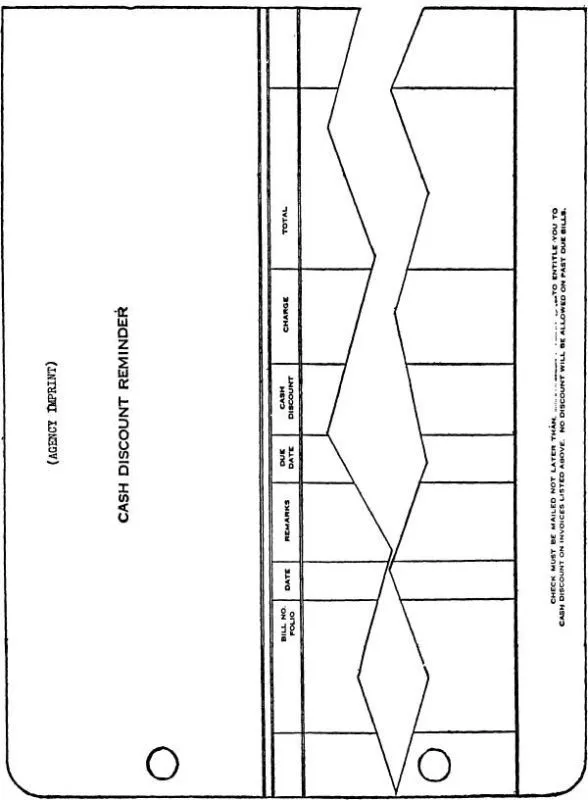
EXHIBIT 39.—Cash Discount Reminder.
This form should be perforated on both sides. (Size inside perforations—6ʺ × 11ʺ.)
This form is slipped in the bookkeeping machine with the ledger sheet and all charges on which cash discounts apply are carboned through at the same time the ledger posting is made.
It is important and desirable to have all correspondence on financial matters carried on by the man having the final financial responsibility within the agency itself. In this way, much embarrassment is taken from the shoulders of the contact man. This does not mean, however, that the contact man should not be kept fully informed.
CHECKING ADVERTISING
Measurements.—The fact that an advertisement is ordered to appear in accordance with definite dimensions does not mean that these measurements can be followed in every case without some slight variation. These variations may be occasioned by shrinkage if mats are used; by difference of opinion as to the proper amount of white space to allow; by the fact that frequently plates are sent publishers which are mortised for dealers’ names and addresses to be set up by the publication; and because of the inability of some publications to meet exact requirements with reference to size and style of type when a complete set-up is made by them.
It is quite obvious, therefore, that the measurements in the order to the publisher should be used only as a guide and not for information purposes in billing the clients. The client’s interest can be protected only by careful steel-rule measurement of each advertisement as it actually appears. Payment to publisher should be made on that basis.
The Checking Department should keep a watchful eye on the position that each advertisement receives in each newspaper or periodical. Poor position sometimes greatly reduces the effectiveness of an advertisement and should be promptly taken up with the publisher to avoid a repetition. Of course, if a special position is specifically ordered the publisher can be held strictly accountable and payment for the advertisement disallowed, if instructions are not followed.
The Checking Department head should be charged with the responsibility of questioning and bringing up for attention any advertising which is indistinct, smudgy, or otherwise poorly printed. He should also keep an eye on the advertising of competitive products.
Insertion Order.—A form furnishing instructions to publications regarding dates of insertion, space measurements, advertisement numbers and titles, position requested, dates, when copy will be forwarded, and kind of plates or cuts to expect is of great importance to the Checking Department. That form is given as Exhibit 38. This form is generally filled in by the Contract or Forwarding Department and enough copies made at one time to provide one each to the Checking, Spacebilling, Contract, and Forwarding Departments, in addition to one for the publisher. It is punched for filing in post binders.
Checking Sheets (Exhibits 40 and 41).—It is wise to have the forms on which insertions are recorded large enough to accommodate different styles of handwriting without cramming. An excellent size for newspaper checking sheets is 14½ʺ × 10½ʺ and for the periodicals 11½ʺ × 8½ʺ. These measurements will also afford ample room for the binding margin. These sizes will help in avoiding mistakes and save the time of clerks in both entering and copying work. It will be noticed that the punching on these forms is on the opposite side of the sheet from those punched in the insertion order (Exhibit 3). This is done to provide for filing both records in the same binders in such a way that when the book is open the insertion order, face up, is on the left side and checking sheet on the right.
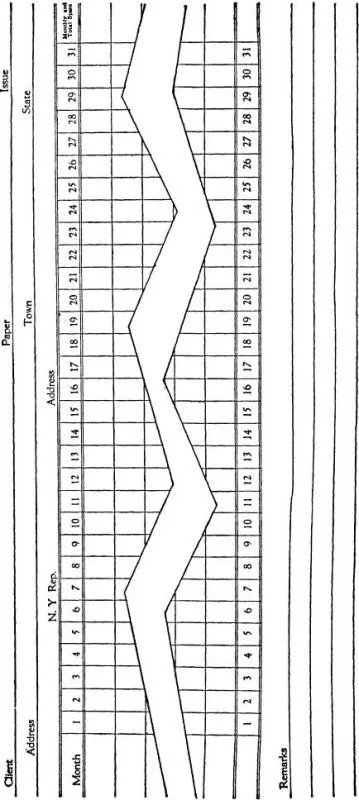
EXHIBIT 40.—Newspaper Checking Sheet. The size, as suggested in Chapter XIII, is 14½ʺ × 10½ʺ.
As explained in the description of this form and of the magazine form much space is provided for recording insertions.
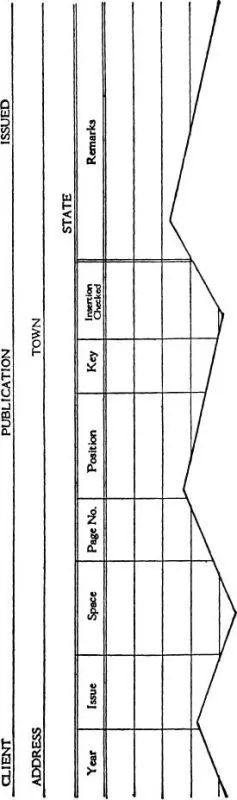
EXHIBIT 41.—Magazine Checking Sheet. (Suggested size 11½ʺ × 8½ʺ.)
A helpful method in speeding up newspaper checking and following up missing insertions is for the checker, upon receiving the insertion order form (Exhibit 38), to section off each square on the checking sheet, corresponding with the date on the insertion order by drawing a line diagonally across it. This will serve as a signal that insertions have been ordered for these specific dates. Whe...
Table of contents
- Cover
- Half Title
- Title Page
- Copyright Page
- Dedication
- Table of Contents
- Acknowledgment
- FOREWORD—ROY S. DURSTINE
- I IN GENERAL AND A BIT HISTORICAL
- II OFFICE LAYOUT AND OFFICE OVERHEAD
- III IDEAL ORGANIZATION CHART
- IV LEGAL SIGN POSTS IN AGENCY PROCEDURE
- V ON WHAT BASIS SHOULD NEW CLIENTS BE SOUGHT?
- VI THE SERVICE DEPARTMENT
- VII COLLECTING DISTRIBUTION AND MARKETING DATA
- VIII THE OPERATION OF A PRODUCTION DIVISION
- IX THE DUTIES OF AN ACCOUNT REPRESENTATIVE
- X HOW AN ART DIRECTOR WORKS
- XI THE SPACE BUYING DEPARTMENT
- XII HANDLING ADVERTISING IN FOREIGN COUNTRIES
- XIII THE FINANCIAL DEPARTMENT
- XIV SOME THOUGHTS ON THE FUTURE
- APPENDICES
- INDEX
Trusted by 375,005 students
Access to over 1.5 million titles for a fair monthly price.
Study more efficiently using our study tools.
Frequently asked questions
Yes, you can cancel anytime from the Subscription tab in your account settings on the Perlego website. Your subscription will stay active until the end of your current billing period. Learn how to cancel your subscription
No, books cannot be downloaded as external files, such as PDFs, for use outside of Perlego. However, you can download books within the Perlego app for offline reading on mobile or tablet. Learn how to download books offline
Perlego offers two plans: Essential and Complete
- Essential is ideal for learners and professionals who enjoy exploring a wide range of subjects. Access the Essential Library with 800,000+ trusted titles and best-sellers across business, personal growth, and the humanities. Includes unlimited reading time and Standard Read Aloud voice.
- Complete: Perfect for advanced learners and researchers needing full, unrestricted access. Unlock 1.5M+ books across hundreds of subjects, including academic and specialized titles. The Complete Plan also includes advanced features like Premium Read Aloud and Research Assistant.
We are an online textbook subscription service, where you can get access to an entire online library for less than the price of a single book per month. With over 1.5 million books across 990+ topics, we’ve got you covered! Learn about our mission
Look out for the read-aloud symbol on your next book to see if you can listen to it. The read-aloud tool reads text aloud for you, highlighting the text as it is being read. You can pause it, speed it up and slow it down. Learn more about Read Aloud
Yes! You can use the Perlego app on both iOS and Android devices to read anytime, anywhere — even offline. Perfect for commutes or when you’re on the go.
Please note we cannot support devices running on iOS 13 and Android 7 or earlier. Learn more about using the app
Please note we cannot support devices running on iOS 13 and Android 7 or earlier. Learn more about using the app
Yes, you can access The Advertising Agency (RLE Marketing) by Floyd Y. Keeler,Albert E. Haase in PDF and/or ePUB format, as well as other popular books in Business & Advertising. We have over 1.5 million books available in our catalogue for you to explore.