- 870 pages
- English
- ePUB (mobile friendly)
- Available on iOS & Android
eBook - ePub
About this book
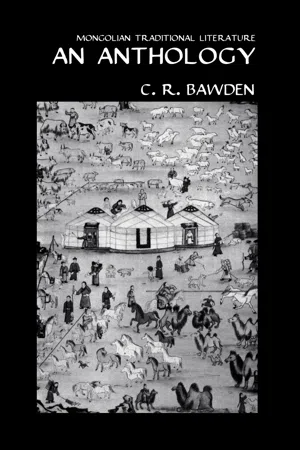
This introduction to both written and oral Mongolian literature from the thirteenth to the nineteenth century provides a rare insight into the changing world views of the Mongolian people: from clan society to Soviet culture. Translated by renowned scholar Charles Bawden, the work is organised into Histories, Legends, Didactic literature, Epics, Shamanistic Incantations, Folk tales, Myths, Sino-Mongolian Prose Literature, Lyrics and Other Verse and Reminiscences, concluding with a modern short story. This important work, which makes the rich tradition of Mongolian literature available for the first time, will be essential reading for many years to come.
Information
FOLK-TALES
MOSTLY SUPERNATURAL
THE OLD MAGICIAN
Once upon a time there was an old magician. One day the khan sent for him. Now this khan was a cruel man, who knew nothing of the sufferings of the poor. The magician came as the khan had commanded, and the khan said, ‘I have heard that you are a great magician. Show me a magic trick.’
The magician said, ‘Khan, what sort of magic trick shall I show you?’
The khan said, ‘I don’t care what sort. Just show me a magic trick.’
So the old man told the khan to go and make a cup of tea and set it down. As the khan went outside to pour the tea into a bowl he saw a fine black ambler by the door. The moment he saw it he mounted that ambler and rode off. The amble is a strange sort of gait. They ambled on and on, and before he knew where he was they came to an unknown desert land where no-one lived. Suddenly the horse reared and threw the khan off, and left him there.
So here was our khan hardly able to keep himself alive in the empty desert, drinking puddle-water and catching locusts and grasshoppers to eat. Soon it turned to autumn, and there were no more locusts and grasshoppers to be found, and then winter set in, and there was no more water. As he was wandering blindly about looking for something to eat and drink, a poor woman came in sight, leading two emaciated children along.
The khan went to meet them and asked them what they were doing, and she said, ‘Everything which I had I have given to the khan and the nobles in taxes, and I have nothing left to live on. Once upon a time I had three children, but I roasted one of them to eat. Now there is nothing for it but to eat another of them,’ and she wept floods of tears. The khan took pity on her, and they set up home and began to live together. But when spring came, the girl died. The khan was deeply upset, and sat weeping against a rock.
Before he knew where he was, he found himself leaning against the head of his bed. The tea he had poured out was still hot.
The old man said, ‘Well, how is it?’
The khan said, ‘It was very distressing.’
The khan said, ‘It was very distressing.’
The old man said, ‘There are many people in greater distress than this,’ and went away.
SOLOMBO KHAN
Once upon a time there was a Khan called Solombo Khan. This Khan was very rich, but he had no children. One of his servants had many children, and the smallest of these was a little shaggy-haired three-year old boy.
One day a great lama came to the Khan’s palace and said, ‘The shaggy-haired boy belonging to that family will devour your patrimony.’
The Khan was very scared when he heard this, for it was a very bad omen if some time or other he was going to lose his patrimony to a beggar-boy. He thought to himself, ‘The sooner I get rid of him the better.’ So one day he went to that servant’s place and said, ‘Give me your little boy.’ His mother was very unwilling to give him up, but his father said, ‘We cannot help giving him up to our Lord the Khan,’ and handed him over. The Khan gave the father and mother something in exchange for the boy, and took him away. One day he took him out into the open country, and left him there buried alive in a snow-drift. But it so happened that an old crone who was gathering dried dung for fuel heard the boy crying near her.
She looked this way and that, but could see nothing. She went in the direction of the weeping, and suddenly there was the child weeping beneath her feet. She looked down, but could see nothing but the snow. She was rather scared, for it might have been a devil or a demoness there, with its body invisible but its voice audible. But there was no mistaking it, a child was crying from beneath the snow, so the old crone dug away the snow with the shaft of her dung-rake, and there she found a little shaggy-haired boy about three years old, almost frozen to death. She put him inside her gown and carried him home, and gave him to a childless couple.
When the boy grew up, he married a beautiful and clever wife. Solombo Khan heard that the boy had not died but was still alive, and could think of nothing else by day, and dream of nothing else by night, than how he might kill him. Then one day he summoned the boy, and ordered him to go to the realm of Erlig Nomyn Khan, the King of the Underworld, and bring back the soul of a dead man.
The boy went home and told his wife of the Khan’s command. When his wife heard this, she said, ‘It is possible to go in the flesh to the realm of Erlig Nomyn Khan. I’ll get ready what you need for the journey.’ When he was about to set off she gave him a bag of eyes, a bag of sinews, and a bag of soda, and said, ‘Take these with you. On your road you will meet a raven, and he will say, ‘You have come from the land of the people with eyes. I am going to pluck out your eyes.’ You must empty out this bag of eyes of yours for him. Further on you will meet an old crone, and she will say, ‘You have come from the land of the people with sinews. I am going to pull out your sinews.’ Give her this bag of sinews of yours. Then further on still you will meet a big camel-stallion. He will say, ‘You have come from the land of the people with soda. I am going to eat your flesh and get the soda from it.’ Give him your bag of soda. Apart from these three you will not meet any special enemy.’
The boy set out, and in the course of his journey he ran into a woman hooked on the horns of a cow. She came to meet him and said, ‘Where are you going?’ The boy replied, ‘I am going to the realm of Erlig Nomyn Khan.’ ‘What a good thing,’ she said. ‘All my life I have been hooked on the horns of this cow. Please ask Erlig Nomyn Khan from me why I can never get free of them.’ The boy promised to do so and continued on his journey, and came across a lot of men trying to build a lamasery. He went over to them, and one of then said, ‘Where are you going, son?’ He said, ‘I am going to the realm of Erlig Nomyn Khan.’ ‘Then please ask Erlig Nomyn Khan something for us. They lamasery we are building won’t stay up, but keeps collapsing. Please find for us why this is.’ The boy promised to do so, and went further on, and found a Russian unable to get out of his boat. As the boy went towards him, the man said, ‘Where are you going? My hand has been stuck to this boat for a long time. Won’t you please ask Erlig Nomyn Khan for me how I can get it away?’ The boy promised to do so and went his way, and saw two mountains, one of gold and one of silver. He was rather surprised at this and, as he continued on his journey, up came a raven, who said, ‘Hey, this looks interesting! Have you come from the land of the people with eyes? I am going to pluck out your eyes and eat them.’ The boy gave him his bag of eyes and continued on his way.
Then he met an old crone, who said, ‘Have you come from the land of the people with sinews? I am going to pull out your sinews.’ The boy gave her his bag of sinews and continued on his way. A big camel-stallion came to intercept him, and said, ‘You are a man from the land of the people with soda. Your flesh is bound to have soda in it.’ The boy poured out the bag of soda which he was carrying for him, and continued on his way. At last he came to the realm of Erlig Nomyn Khan. Just at that time Erlig Nomyn Khan was not at home, and it was his queen who came out. Now the queen of Erlig Nomyn Khan was the boy’s elder sister. When the boy was a baby, this sister of his used to herd the sheep of Solombo Khan, and one day, while she was herding them, a Royal Garudi Bird came and stole her away and gave her to Erlig Nomyn Khan to be his wife. She recognised her brother, and said, ‘No-one has ever come her alive from that other world. How did you get here? I’ll have to hide you.’ So she dug a hole under her hearth, and put the boy in it, and covered him over and whitewashed it, and lighted her fire on top. Her younger brother told her all that had happened to him on his journey, and asked her to get the answers from Erlig Nomyn Khan.
In the evening the Khan came home, and the black horse he was riding snorted through its nose and mouth and shied, and would not come near the tent. The Khan entered his tent and said to his wife, ‘I wonder why my horse shied and would not come near the house? Fetch my cunning yellow divining gear.’ As she fetched the divining gear the queen bestrode it three times, and passed it three times beneath a bitch, before she gave it to him.
The Khan cast his divining gear and looked at it, and what it came out at was, ‘Ash continent, earth continent, wood continent, and under them is a man with a copper snout.’ The Khan said angrily, ‘Wherever can anything like that be? This divining gear does not know anything,’ and he threw it to the ground. He made a search inside his tent, but finding nothing there he ate his meal, and started to go to sleep. Then the queen said, ‘That time when the Royal Garudi Bird brought me here, there was a woman by the road hooked on the horns of a cow. What sort of a person could she have been?’ He said, ‘Once upon a time when a poor person asked her for milk to give to her child, this woman was too stingy to give her any, and that is why she is like that today.’
The queen also asked him, ‘Somewhere else there were a lot of men who could never finish building their lamasery, which used to collapse of itself. Why did it keep collapsing?’ He said, ‘They were people who earlier on had been very destructive, so now, when they wanted to build something, they were unable to.’
‘Also there was a Russian with his hand stuck to his boat. What was the reason for that?’ He said, ‘It got stuck like that because he used to exploit people terribly when ferrying them over the water. If he gave up the idea of exploiting them, he would soon get free.’
The queen asked him, ‘On our way there were two huge mountains, one of gold and one of silver. Could people not take any of it away?’ The Khan replied, ‘Of course they could take a little away according to their needs, as long as they did not dig them up and destroy them.’
Next morning Erlig Nomyn Khan went out again to patrol the earthly continent of Zambutiv. After he had gone, the sister got her brother out and gave him food and tea, and told him the answers to every one of his questions, gave him a soul, and sent him on his way.
On his way home he passed by the mountains of gold and silver and loaded up as much gold and silver as his horse could carry, told the people the answers to their questions, and came back home.
He said happily to his wife, ‘Thanks to all the things you provided me with I have had a safe journey and done all my business. And look how much gold and silver I have brought too.’
Next day he went to Solombo Khan’s and gave him the soul of the dead man, and, telling a deliberate lie, said, ‘I met Erlig Nomyn Khan and had a chat with him. He’s a very nice fellow. He was not a bit standoffish because I was a poor man. And when I was coming back he gave me some gold and silver.’
Solombo Khan was very envious when he heard this, and thought to himself, ‘If this low-down beggar boy can go and get so much gold and silver, how much more would I, the Khan, get if I went, and I would become the richest man in the world.’ And he decided to go and make the acquaintance of Erlig Nomyn Khan.
But though he went off boldly, he had no foreknowledge of the difficulties he would meet on the way, and he got his two eyes plucked out by the ravens and his sinews pulled out by the crone, and he was eaten up by the camel-stallion, and died a horrible death.
And because Solombo Khan was no more, the boy ascended the throne and lived happily ever after.
SCRIPTURE JOY AND JEWEL JOY
Once upon a time there lived on the slopes of the Firewood Mountain a man and a woman who were wood-gatherers. The wood-gatherer husband used to go out to get wood as soon as the red sun rose, and would come home as the yellow sun set. He used the wood he gathered himself, and sold the surplus, and so scraped a living. It was not long before his wife became pregnant, and when her term was up she gave birth to a boy. The father gave his son the name of Scripture Joy. After they had got their son they lived as before by their firewood, and not long passed before the wife was pregnant again, and when her term was up she again gave birth to a boy. The mother called this son Jewel Joy.
The husband and wife now had two sons, and life was good to them. The two boys grew up, and both used to go out gathering firewood from the rising of the red sun to the setting of the yellow sun.
One day the two boys went out at the rising of the red sun to gather firewood, and came back at the setting of the yellow sun without a single thing. Their father said, ‘You always go out at the rising of the red sun and come home at the setting of the yellow sun, with a lot of firewood. How is it that today you have come home empty-handed?’
Scripture Joy and Jewel Joy said, ‘This morning, as we went to gather firewood, we came across a lumpy red tree. It moved, but we could not get it out. What with it moving, and our not being able to get it out, we spent the whole day trying to get it out, but we could not manage it, and so we have come home.’ Their father asked, ‘Did you mark the tree?’ ‘We did.’ He replied, ‘Well then, let us all go there tomorrow and get it out.’
Next morning their father took a great leather rope, and set off with his two sons. The tied the rope round the lumpy red tree and all three pulled, and they just managed to pull it out. Beyond the tree could be seen a dark hole. His father told Scripture Joy to look down the hole and see what was there. He looked down, and said there was nothing to see.
‘Naturally, Scripture Joy.’ Now you go and have a look, Jewel Joy.’ Jewel Joy looked down and said, ‘There is a box of something there.’ His father said, ‘Naturally. Well, go in and fetch it out.’ He went in and fetched it out, and they saw it was an iron box of something. Inside the iron box was a silver box, and inside the silver box was a gold box. From inside the gold box there emerged a white cockerel with a green head. Their father put it back inside the box, saying, ‘This is called the White Cockerel with the Precious Green Head.’ Their father took the cockerel back home, leaving his two sons to go on gathering firewood. They went on living in the same old way.
After some years their mother fell sick and died. They buried their mother where the lumpy red tree had been Some time after their mother died, their father took another wife. This step-mother had a lama who was known as her pillow-lama. So they lived for several years, and then their father fell ill, and was about to die. Before he died, he gave the following instructions to his two sons, ‘Now before very long your father is bound to die. When I am dead, bury me where your mother is buried. Hold a feast for three days and three nights, and eat up the White Cockerel with the Precious Green Head. When you are going to eat it, place it on the rear chest and kotow to it three times, and then it will crow three times. The one who eats its brain will become khan. The one who eats its heart with the main artery will become one of the Four Officials of the Realm. I want Jewel Joy to eat the brain and Scripture Joy to eat the heart and the main artery. Then go away towards the north-west. You will come across a lot of black tents. Do not go into them, but go into the single white tent. If you accomplish other people’s business your own business will be accomplished.
Then their father died. They buried their father where their mother was buried, and continued to live with their step-mother...
Table of contents
- Front Cover
- Books of Related Interest
- Copyright
- Dedication
- PREFACE
- CONTENTS
- Introduction
- A Note on Spelling
- A Short Bibliography And Suggestions for Further Reading
- A Note on the Translations
- History
- Legends
- Didactic Literature
- Epic
- Prayers and Rituals
- Folk-tales
- Sino-Mongolian Prose Literature
- Tales of Indian Origin
- Lyrics and Other Verse
- Reminiscences
- A modern short story
Trusted by 375,005 students
Access to over 1.5 million titles for a fair monthly price.
Study more efficiently using our study tools.
Frequently asked questions
Yes, you can cancel anytime from the Subscription tab in your account settings on the Perlego website. Your subscription will stay active until the end of your current billing period. Learn how to cancel your subscription
No, books cannot be downloaded as external files, such as PDFs, for use outside of Perlego. However, you can download books within the Perlego app for offline reading on mobile or tablet. Learn how to download books offline
Perlego offers two plans: Essential and Complete
- Essential is ideal for learners and professionals who enjoy exploring a wide range of subjects. Access the Essential Library with 800,000+ trusted titles and best-sellers across business, personal growth, and the humanities. Includes unlimited reading time and Standard Read Aloud voice.
- Complete: Perfect for advanced learners and researchers needing full, unrestricted access. Unlock 1.5M+ books across hundreds of subjects, including academic and specialized titles. The Complete Plan also includes advanced features like Premium Read Aloud and Research Assistant.
We are an online textbook subscription service, where you can get access to an entire online library for less than the price of a single book per month. With over 1.5 million books across 990+ topics, we’ve got you covered! Learn about our mission
Look out for the read-aloud symbol on your next book to see if you can listen to it. The read-aloud tool reads text aloud for you, highlighting the text as it is being read. You can pause it, speed it up and slow it down. Learn more about Read Aloud
Yes! You can use the Perlego app on both iOS and Android devices to read anytime, anywhere — even offline. Perfect for commutes or when you’re on the go.
Please note we cannot support devices running on iOS 13 and Android 7 or earlier. Learn more about using the app
Please note we cannot support devices running on iOS 13 and Android 7 or earlier. Learn more about using the app
Yes, you can access Mongolian Traditional Literature by Bawden,Charles R. Bawden in PDF and/or ePUB format, as well as other popular books in Social Sciences & Anthropology. We have over 1.5 million books available in our catalogue for you to explore.