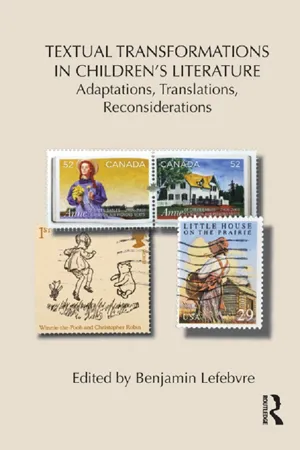
This book offers new critical approaches for the study of adaptations, abridgments, translations, parodies, and mash-ups that occur internationally in contemporary children's culture. It follows recent shifts in adaptation studies that call for a move beyond fidelity criticism, a paradigm that measures the success of an adaptation by the level of fidelity to the "original" text, toward a methodology that considers the adaptation to be always already in conversation with the adapted text. This book visits children's literature and culture in order to consider the generic, pedagogical, and ideological underpinnings that drive both the process and the product. Focusing on novels as well as folktales, films, graphic novels, and anime, the authors consider the challenges inherent in transforming the work of authors such as William Shakespeare, Charles Perrault, L.M. Montgomery, Laura Ingalls Wilder, and A.A. Milne into new forms that are palatable for later audiences particularly when—for perceived ideological or political reasons—the textual transformation is not only unavoidable but entirely necessary. Contributors consider the challenges inherent in transforming stories and characters from one type of text to another, across genres, languages, and time, offering a range of new models that will inform future scholarship.
eBook - ePub
Textual Transformations in Children's Literature
Adaptations, Translations, Reconsiderations
- 224 pages
- English
- ePUB (mobile friendly)
- Available on iOS & Android
eBook - ePub
Textual Transformations in Children's Literature
Adaptations, Translations, Reconsiderations
About this book
Information
Chapter One
Contested Spaces
Reconfiguring Narratives of Origin and Identity in Pocahontas and Princess Mononoke
Narratives of origin are by their nature changeable. Multiple threads cross through them, and we inevitably pick out different strands when we use them to underpin aspects of our identities and values at various stages of our lives. When I was growing up in England, for instance, I used to think of the eleventh-century Norman invasion as imposing a culture from above (the “yoke of the Normans” as it was called) that the “real” spirit of England heroically resisted. Popular versions of the Robin Hood stories shown on television as well as novels such as Walter Scott’s Ivanhoe (1820) reinforced a notion that the old Anglo-Saxon culture lived on in the people, who kept harrying the Norman aristocracy in the centuries after the invasion in stubborn, subversive, and occasionally rebellious ways. Later, when I came to study Chaucer, I understood the most important legacy of the Norman invasion to have been the hybridization of the English language, which made it such an astonishingly rich, nuanced, and subtle medium for literary and other forms of expression. I felt I would have been culturally poorer if the merging of English with French had not taken place all those years ago. Still later, as antipathy toward immigrants and racism became a potent force within Britain, the Norman invasion provided a founding narrative of ethnic as well as linguistic differences being absorbed into British culture across the long reach of history. In this sense, the instance of the Norman invasion became exemplary of the successive merging and incorporation of different cultures within Britain, countering the narratives of “pure” Englishness used to foster and legitimate a political stance that I wanted to repudiate. Each of these versions of English identity redefined the significance of the Norman invasion, engendering a range of stories in the process. Each version also stood in a contradictory—or at least potentially problematic—relation to the others.
I mention this capacity of narratives of origin to perform functions that are both protean and contradictory because it brings into focus the crucial role that popular culture can play, positioning us within shifting landscapes of the mind. After all, if the process of transforming narratives is not innocent of cultural politics, then neither is it unidirectional. In any new version of an old story, we can see elements that draw on existing strengths of the narrative tradition out of which that story emerges, combined with other elements that forge links with new ways of thinking or that engage with shifts in wider cultural formations. This is particularly so in an era of globalized entertainment, where the legends and stories that stand at the heart of a particular country’s sense of itself and its history are often pressed into service to feed the imagination of an international audience that is much more ethnically and culturally diverse. The work that such narratives perform must then, by its nature, be multidirectional. In this chapter, I try to advance our understanding of this process by analyzing the particular instance of two films—Walt Disney Pictures’ Pocahontas and Hayao Miyazaki’s Princess Mononoke—that transform narratives of central importance to the respective national cultures within which they were produced. Both films also engage with significant contemporary concerns within the wider global culture, particularly the clash between modern ideologies predicated on economic growth and older value systems that show more respect for the natural world. The comparison between these animated feature films, produced on opposite sides of the globe (the former in the U.S., the latter in Japan) is in many ways both symptomatic and revealing.
The two films on which this chapter focuses were among the most popular animated features of the 1990s: Pocahontas was released in 1995 and Princess Mononoke (in its English-language version) in 1997. Although they were produced in very different cultural and national contexts, both films were aimed at a family or child audience and focus on a central female figure whose identity is perceived as primitive (or close to the state of nature) by other powerful groups depicted within each story. Both films also situate their narratives at critical points within the development of their respective national histories, so that, it might be claimed, they make substantial contributions to the way dominant perspectives on national identities can be explored and internalized by young audiences. In this respect, they form an ideal site upon which to ground the larger themes and issues with which this book is concerned.
In both cases, the films’ subject matter could be taken to be a reconfiguring of key elements in the historical narratives that have helped shape a sense of their respective national identities. The particular historical narratives at the center of these films can also be understood as epitomizing—or offering paradigms for—the larger forces that have shaped the way each country has developed and been perceived. The films could be seen as exploring narratives of origin, in other words, that are pivotal in shaping the development of the nation. Thus Pocahontas focuses on the invasion and settlement of North America by Europeans at a stage when the outcome of such incursions—the values that would become dominant and the way relations between Native Americans and white settlers would develop—was far from certain. Likewise, Princess Mononoke takes a mythic view of a period in Japanese history when the ideologies that would shape modern Japanese culture were more open and contested than is generally acknowledged.1
Pocahontas draws selectively on legends that surround a historical incident in which a Powhatan Indian chief’s daughter played a key role in ending—at least temporarily—the conflict that had developed between her tribe and the early colonists in Virginia. In the most frequently reiterated episode in the legend, Pocahontas displays heroic and generous courage when she risks her own life to save a white male colonialist, John Smith, from execution by her tribe. This iconic scene remains at the dramatic center of the Disney film, where Pocahontas is depicted as throwing herself over Smith’s body at the crucial moment to prevent the blow that would kill him. The historical details of this episode are hard to disentangle from the legends that grew up around it almost immediately. A number of historians doubt that this specific incident actually occurred (the source for it is John Smith’s 1624 book Generall Historie of Virginia, published more than a decade after the episode allegedly took place, and there is no mention of it in his more contemporary accounts).2 There is certainly evidence, however, to suggest that Pocahontas played a key role in negotiating a temporary peace between the colonists and the Powhatan Indians in some form. Even more skeptical accounts, such as Camilla Townsend’s book Pocahontas and the Powhatan Dilemma (2004), acknowledge a reality within which a powerful intercultural narrative became the seedbed for legendary distortions, although the actual events are conceived as more tawdry than the later heroic or romantic iterations:
In reality, the English kidnapped Pocahontas in the midst of a war against her people and kept her for many months for her father to agree to tribute payments of corn. Pocahontas ended the conflict when she converted to Christianity and married a colonist named John Rolfe. She and several members of her family then chose to travel to Europe, not as prisoners but as free agents intent on gathering information that might clarify the Algonkians’ future course.3
What appears to remain consistent in all accounts, however, is acceptance that Pocahontas’s actions played a decisive role in relation to a cultural conflict that in many ways typified the future development of a modern U.S. What varies from version to version is the significance of her role and the kind of imaginative investment it calls forth from readers and audiences, as the story is performed again and again for succeeding generations.
The Pocahontas film by Walt Disney Pictures is characteristic of this broader narrative tradition, but it also positions itself in distinctive ways within it. The film is conservative in being centered on the romance between Pocahontas and John Smith and on her heroic act in saving him. These were the staple ingredients of popular nineteenth-century versions of the story4 and Disney recycles the romantic legend unquestioningly for a contemporary audience. In other respects, however, the Disney film develops a kind of revisionist history in its own imaginative realm, turning the characteristic Disney mix of song, melodrama, comedy, and romance toward a new ideological purpose. Pocahontas attempts—powerfully at times—to provide images of North American Indian culture that are intended to recognize and affirm its otherness in positive forms. Several of the major Indian characters were voiced by Native American actors (a notable departure from the practice of earlier Disney films),5 and, although the Powhatan Nation website has strongly criticized the film for its distortions,6 there was a substantial degree of consultation with representatives from Native American groups at different stages of the project’s development. Indeed, Russell Means, the American Indian actor who played Chief Powhatan, was quoted extolling Pocahontas as the “single finest work ever done on American Indians in Hollywood.”7
In a sense, the affirmative stance toward American Indian culture that is depicted in Pocahontas could be taken as consistent with the dominant attitude expressed in mainstream Hollywood cinema from at least the 1970s. Films such as Little Big Foot (1970), The Outlaw Josie Wales (1976), Dances with Wolves (1990), and The Last of the Mohicans (1992) had between them effectively rehabilitated the image of American Indians within the popular imagination by the time Pocahontas was released in 1995. Indians were now seen more as victims (who were also knowledgeable about their natural environment in ecologically attuned ways) than as the primitive aggressors—or “savages”—of the classic Hollywood Westerns of earlier decades. It could be argued, however, that the form in which the viewpoint of this emergent liberal consensus was incorporated into Pocahontas remains challenging for a mainstream film for children and for a Disney film in particular. Its attempt to validate the integrity of Native American culture is complemented by a powerful critique of the arrogance and material crassness of the colonialists’ project as they tear up the land in a quest to find the fetishized object of their venture: gold. Indeed, the film’s sustained critique of the colonists, combined with its idealization of the Indians, produces a revisionist history whose ideological underpinnings might be considered too polarized or extreme for it to play readily to a popular consensus generally in the U.S., never mind a child audience within this.
That said, such potential radicalism—which implies that the animistic cosmology of the Indians is ethically superior to the capitalist expansionist drive that is depicted as primarily motivating the colonists—is rechannelled and largely contained by the romance element of the plot. Here the colonists’ most charismatic figure, John Smith, is brought emotionally into alignment with the Indian “princess” Pocahontas, suggesting that a fusion between the conflicting value systems (rather than the genocide and marginalization of Indian culture that actually took place) is feasible. The quest for gold that motivates the colonists turns out to be chimerical and their purpose in settling appears to be redefined (although in an unspecified form) in the coup that finally ousts their decadent and corrupt leader. Hence the film operates off the axis of a vague but comforting utopianism that is characteristic of Disney animation generally8 and functions to heal the ideological rift that its apparently radical revision of the core narratives of American history initially implied. This utopian project is achieved, however, by glossing over real imbalances in power. As Eleanor Byrne and Martin McQuillan suggest in their book Deconstructing Disney (1999), the film tends to erase historical specificity and “universalizes prejudice and hostility irrespective of cultural, political and economic concerns.”9 This is particularly evident in the scene in which the Indians and the colonists are preparing for armed conflict with each other. The accompanying keynote song “Savages” suggests that the conflict is driven by prejudice that is equally prevalent on both sides, so that Pocahontas’s heroic act of love in intervening on John Smith’s behalf breaks a deadlock of inflamed bigotry that is perceived as universal to the human condition. The effect is to erase any sense of the particular circumstances that have generated negative perceptions of the opposing sides and to imply that each is equally to blame.
As in other Disney films, romance is blended with a maturation plot, which also helps to resolve inherent contradictions. Thus the hero has to learn to see things differently, to mature in the course of the action and to win the heroine’s love. The romantic alliance between the hero and the heroine suggests that the obviously flawed values of the colonists can be redeemed in time and the audience is encouraged to adopt a position of retrospective (or perhaps restitutive) wisdom with respect to the conflict between cultures. Native American values, the film suggests, can be incorporated into a pluralist Western society, which, like...
Table of contents
- Cover
- Half Title
- Title Page
- Copyright
- Dedication
- Contents
- List of Illustrations
- Series Editor’s Foreword
- Acknowledgments
- Introduction: Reconsidering Textual Transformations in Children’s Literature
- Chapter 1: Contested Spaces: Reconfiguring Narratives of Origin and Identity in Pocahontas and Princess Mononoke
- Chapter 2: “Popular and Timeless Literature”: Ur-Stories in Graphic Novels for Young People in Contemporary India
- Chapter 3: Preserving Roots: Vietnamese Folktales in Cross-Cultural and Transnational Translation
- Chapter 4: “You Will Think Them Poor Baby Stories to Make Such a Talk About”: Prose Adaptations for Children of Shakespeare’s Venetian Plays
- Chapter 5: Challenges for the Chalet School: From Bookshelf to Blogosphere and Back Again
- Chapter 6: Where (and When) Do You Live, Cinderella? Cultural Shifts in Polish Translations and Adaptations of Charles Perrault’s Fairy Tales
- Chapter 7: Alice Lost and Found: A Queer Book History
- Chapter 8: Patterns, Power, and Paradox: International Book Covers of Anne of Green Gables across a Century
- Chapter 9: An no shinjô [Anne’s Feelings]: Politeness and Passion as Anime Paradox in Takahata’s Akage no An
- Chapter 10: Our Home on Native Land: Adapting and Readapting Laura Ingalls Wilder’s Little House on the Prairie
- Chapter 11: Beyond Happily Ever After: The Aesthetic Dilemma of Multivolume Fiction for Children
- Contributors
- Index
Trusted by 375,005 students
Access to over 1.5 million titles for a fair monthly price.
Study more efficiently using our study tools.
Frequently asked questions
Yes, you can cancel anytime from the Subscription tab in your account settings on the Perlego website. Your subscription will stay active until the end of your current billing period. Learn how to cancel your subscription
No, books cannot be downloaded as external files, such as PDFs, for use outside of Perlego. However, you can download books within the Perlego app for offline reading on mobile or tablet. Learn how to download books offline
We are an online textbook subscription service, where you can get access to an entire online library for less than the price of a single book per month. With over 1.5 million books across 990+ topics, we’ve got you covered! Learn about our mission
Look out for the read-aloud symbol on your next book to see if you can listen to it. The read-aloud tool reads text aloud for you, highlighting the text as it is being read. You can pause it, speed it up and slow it down. Learn more about Read Aloud
Yes! You can use the Perlego app on both iOS and Android devices to read anytime, anywhere — even offline. Perfect for commutes or when you’re on the go.
Please note we cannot support devices running on iOS 13 and Android 7 or earlier. Learn more about using the app
Please note we cannot support devices running on iOS 13 and Android 7 or earlier. Learn more about using the app
Yes, you can access Textual Transformations in Children's Literature by Benjamin Lefebvre in PDF and/or ePUB format, as well as other popular books in Literature & Translating & Interpreting. We have over 1.5 million books available in our catalogue for you to explore.