![]()
PART 1
CHAPTER I Poster Sites and Poster Contractors
CHAPTER II The Outdoor Advertising Agency
CHAPTER III Poster Design
CHAPTER IV Poster Printing
The poster's view of its audience
![]()
Poster Sites and Poster Contractors
OUTDOOR ADVERTISING is advertising by means of posters. Most people will be content to leave it at that and accept the Oxford English Dictionary definition of a poster as ‘a placard posted or displayed in a public place as an announcement or advertisement.’ Something less simple, however, is required to define the subject of this book. To the outdoor advertising agent a poster is a placard or display posted or erected to be seen in a public place (that place not necessarily or usually being an actual point of sale but including public vehicles, transport stations and places of entertainment) as an announcement or advertisement.
Thus outdoor advertising in Britain is taken to include what in America is called ‘transportation advertising.’ Shop signs, by their permanence, do not come within our definition; nor do window displays, which, although they may include posters (in the sense that space in them may have been lent or rented as a hoarding to an advertiser), are not normally available to the outdoor advertising agent.
Sites
Posters can be displayed alone (solus) or in groups with others. They can be displayed in a number of ways as follows:
(a) on hoardings—upright frames erected beside streets or roads (often in front of derelict lots or building works), and varying in size and being constructed to take one or a number of standard-size posters;
(b) on gable ends or walls, also arranged to take one or more standard-size posters;
(c) on sites on station or Underground platforms, in booking halls and on the walls of Underground passages, lifts and escalators;
(d) in panels inside public vehicles, buses, trams, railway and Underground carriages, etc.
(e) on panels on public vehicles, buses, trams, vans, etc.
The sites upon which posters will ultimately be displayed must be rented from their owners or lessees.
On special sites outdoor displays can be erected using neon or other illumination and mechanical movement.
Poster Sizes
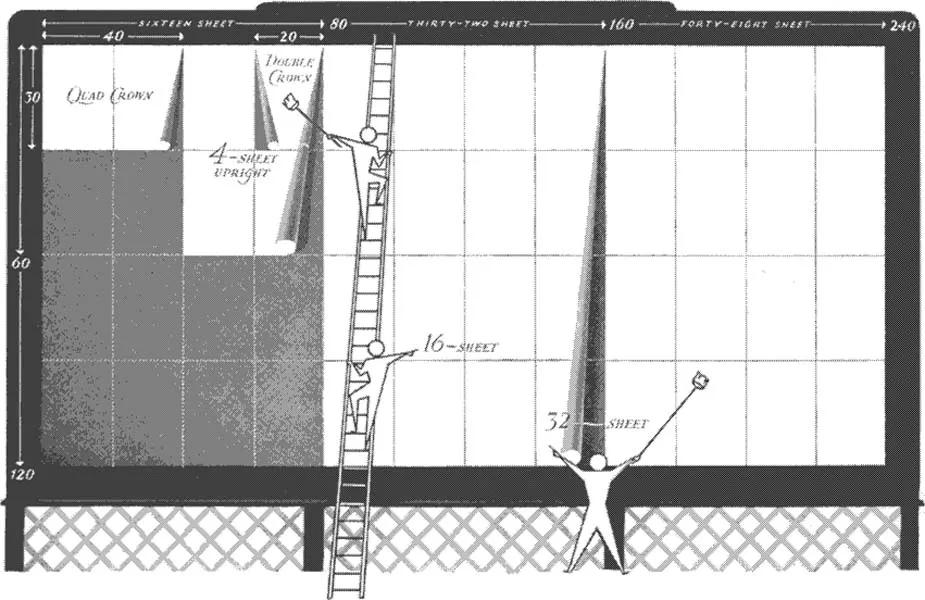
The standard unit of poster size is called ‘double crown’, measuring 20 inches wide by 30 inches deep. This is frequently used on railway stations and passages, where length of vision is limited. Other posters are normally in multiples of the double crown.
The usual size for an outdoor poster is 16-sheet, that is sixteen double crowns, arranged to measure 80 inches wide by 120 inches deep. Bigger sizes are multiples of the 16-sheet—32-sheet, 48-sheet, 64-sheet and so on, all retaining the 120-inch depth.
There are other sizes not necessarily standard and these will mainly be found in buses, underground and main line railway carriages, beside escalators and on the outside of buses and vans.
The Poster's Surroundings
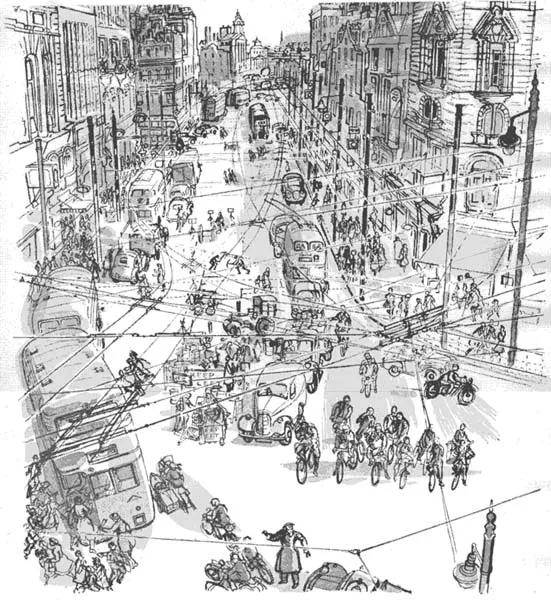
All forms of outdoor advertising have in common the purpose of catching the eye of the passer-by and impressing on him a concise but powerful sales message in the time he takes to pass. Just as the press advertisement has to match its strength with editorial matter, so the poster is normally seen against a background of buildings and amidst the distraction of people and vehicles on the move. It must do all in its power to attract attention by colour and design and with a few well-chosen words at most.
The poster is only one of many ways of getting the attention of the public. Most of the advertising we see and hear comes to us as an apparently free addition to something we have paid for. For example, all press advertising reaches the public in close association with news, information and entertainment: the coppers that are spent on a daily newspaper buy both editorial and advertising matter, but the reader, ignoring the fact that without advertising the paper would cost him nearly twice as much, believes that he pays for the editorial and gets the advertisements thrown in.
In the same way the cinema-goer pays for his ticket and is provided with anything from a few minutes to half an hour of advertising matter as well as the entertainment films he has gone in to see. By now he accepts this as normal and, as long as the advertising matter has entertainment value too, he raises no objection. Commercial radio, also, offers a mixture of news, information, entertainment and advertising. These three, the press, the cinema and the radio, are all media in which the advertiser relies upon the attractive power of their ‘editorial matter’ to bring the associated advertising to the notice of the consumer.
Outdoor advertising is different, and this difference is important. The poster is not directly associated in any way with news or entertainment, in the sense that it must attract attention by its own unaided efforts. Its message is no part of any financial transaction with the consumer: indeed, posters are so free (to the consumer) that nobody who sets foot out of doors can easily avoid being exposed to their influence.
This difference is important. Outdoor advertising is a valuable medium because the poster stands alone and makes its presence felt in a different way from any other form of advertising and because posters can be so positioned as to form the final link in the advertising chain which stretches from information and persuasion to ultimate purchase.
The Poster Contractor
We have said that sites must be rented from their owners or lessees. Who are these owners and lessees?
Statistical information relating to the billposting industry is scanty. An estimate of the number of billposting contractors in the United Kingdom is given in Advertising Expenditure and Revenue of the Press by Kaldor and Silverman, and some indication of the geographical distribution of contractors is to be found in The Poster Advertising Year Book. The statements that follow are derived from these two sources, supplemented where possible by the opinions and estimates of agents and contractors.
Advertising Expenditure and Revenue of the Press says: ‘The regular poster contractors number about 800 firms, but five big combines, each covering a different part of the country, control about 75% of the sites. There are also ‘solus’ poster advertising firms who specialise in erecting boards for single advertisements, while the non-specialist contractors also have some solus sites.’ It seems, however, that there has been an increasing tendency during the last few years towards amalgamation in the billposting industry, and the 1939 figure of 800 poster advertising firms is not now accurate.
The British Poster Advertising Associations states that the members, numbering about 280, include ‘practically all the poster advertising contractors in the United Kingdom,’ and in its Year Book are listed all the towns in Britain and Eire where billposting contractors are operating. Apart from the Solus
Outdoor Advertising Association, which will be reviewed later, there are two main Poster Advertising Associations — the London and the British.
Most billposting contractors are members of one of these Associations. It is understood that members of an Association agree not to enter the areas of, or to compete with, their fellow-members, and consequently to be in the B.P.A.A. is some insurance against undue competition from other members. By arrangement, however, there are some towns where two or more association members are already operating: an analysis of existing data shows that out of 104 towns where two members operate, exactly half are in Scotland and the north of England, and represent areas where two large organisations are competing. There is no agreement affecting undue competition between the B.P.A.A. and the Solus Association.
In addition to contractors concerned with all types of hoarding, there are several contracting organisations specialising in solus sites who control between them a great number of the solus sites all over the country. It is therefore...