This collection gathers together a stellar group of contributors offering innovative perspectives on the issues of language and translation in postcolonial studies. In a world where bi- and multilingualism have become quite normal, this volume identifies a gap in the critical apparatus in postcolonial studies in order to read cultural texts emerging out of multilingual contexts. The role of translation and an awareness of the multilingual spaces in which many postcolonial texts are written are fundamental issues with which postcolonial studies needs to engage in a far more concerted fashion. The essays in this book by contributors from Australia, New Zealand, Zimbabwe, Cyprus, Malaysia, Quebec, Ireland, France, Scotland, the US, and Italy outline a pragmatics of language and translation of value to scholars with an interest in the changing forms of literature and culture in our times. Essay topics include: multilingual textual politics; the benefits of multilingual education in postcolonial countries; the language of gender and sexuality in postcolonial literatures; translational cities; postcolonial calligraphy; globalization and the new digital ecology.
eBook - ePub
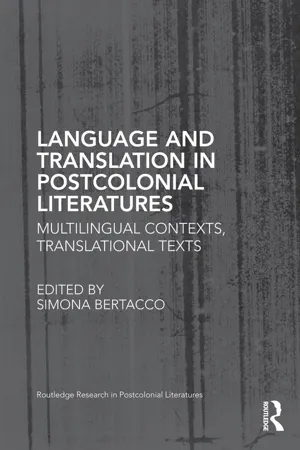
Language and Translation in Postcolonial Literatures
Multilingual Contexts, Translational Texts
- 234 pages
- English
- ePUB (mobile friendly)
- Available on iOS & Android
eBook - ePub
Language and Translation in Postcolonial Literatures
Multilingual Contexts, Translational Texts
About this book
Information
Part I
Translational Texts
1 Bridging the Silence
Inner Translation and the Metonymic Gap
It is a standard assumption that translation represents a deterioration from the original—a deterioration in either meaning or aesthetic value: a translation can be “either beautiful or faithful but not both” as the cliché goes. Salman Rushdie’s well-known response to the supposed inferiority of cross-cultural writing is that something is gained in translation:
The word ‘translation’ comes, etymologically, from the Latin for ‘bearing across.’ Having been borne across the world, we are translated men. It is normally supposed that something always gets lost in translation; I cling, obstinately, to the notion that something can also be gained. (1991: 17)
The postcolonial writer faces in two directions, so to speak. The decision he or she makes is not just how to write ‘between languages,’ but how to make language perform this ‘bearing across’ (indeed, to ‘bear’ this particular ‘cross’) within itself: how to be both ‘source’ and ‘target.’ This might be called ‘inner translation,’ one that occurs when postcolonial writers appropriate English. It provides an added dimension to the debates about translation, and this chapter will discuss the extent to which cultural experience is intentionally withheld, or not fully ‘carried across’ the translation in the literary appropriation of English.
While colonial education systems privileged the teaching of English and in many cases punished pupils for using vernacular language at school (Ngugi 1981: 11), something occurred among speakers and writers of English in British colonies that imperial administrations, and the institution of English literature itself, could not have foreseen. Postcolonial writers took hold of the language with a vengeance, and in so doing took hold of the means of their self-representation. Appropriating the language, producing a variously hybridized English, and transforming the official genres of English literature, they produced a located form of English and interpolated networks of production and distribution to speak to a world audience. This is of course just one side of the argument. The alternative view is that the explosion of interest in postcolonial writers represented the hunger of global publishing systems to produce new and exotic works (Narayanan 2012: 34). The truth is perhaps a combination of both views. Bourdieu’s theory of ‘field’ in The Field of Cultural Production (1993) may be useful for identifying the complex weave of practices that go to make up what we understand as ‘literature.’ But given this complex interrelation, and the fact that the global publishing industry might have had its own reasons for promoting postcolonial writers, the agency of writers in adopting and adapting the language cannot be denied, as they translated cultural realities into English and represented themselves—translated themselves—to a global audience. This translation changed the field of English literature forever.
The issue of language use is a stridently political topic of debate in postcolonial studies, and the reasons are clear to see. We may regard ourselves as belonging to a certain category of race, or being at home in a certain place, but for some mysterious reason we don’t simply have a language. We tend to believe that our language is us—that it inhabits us and we inhabit it. Our language “is not just a language,” says Edgar Thompson, “it is our language, the language of human beings”:
The language of those outside, or what they call a language, is the language of people who babble and answer to silly names; they are barbarians even when they use much the same vocabulary. But in our language we know ourselves as brothers and sisters or as comrades or as fellow countrymen. In it we make love and say our prayers, and in it, too, is written our poetry, our oratory, and our history. (Thompson and Hughes 1965: 237)
Languages may be held to represent various cultural traits, but our language is different; our language is transcendent—it is the language of God Himself. Language is an instrument of communication, but in our heart of hearts, we know God speaks only our language to us, because our language is us.
The political consequence of this in the spread of a global language is the assumption that the language is in the vanguard of neo-imperialism and global capitalism, leading to accusations of ‘linguistic genocide.’ The attack on world Englishes began in earnest with Phillipson’s Linguistic Imperialism (1992). Bruce Moore’s Who’s Centric Now? (2001) explores regional varieties of English in relation to the lively debate about the increasing ‘globalization’ of English, asserting that a new ‘threat’ to regional varieties of English had emerged in the spread of ‘global English’ by electronic communication that has the effect of washing out difference and reducing the cultural diversity of world Englishes. One of the strongest attacks on the spread of world English occurs in many of the essays contained in Mair’s The Politics of English as a World Language (2003). The volume is wide-ranging and indicates the disciplinary differences in approaches to the question, from accusations of English as a “killer language” destroying the linguistic biodiversity of the planet to discussions of Sri Lankan English literary texts as active in cultural conservation. The protest about the dominance of English continues in a recent book by Pavithra Narayanan: What Are You Reading: The World Market and Indian Literary Production (2012).
None of these books says anything about the inventiveness and innovative skill of postcolonial writers in English, who are effectively regarded as mere ciphers for global forces. Beneath the clamorous and overheated political debate around world Englishes is an assumption that is central to the issue of representation and cultural translation: that language itself is culture. Consequently, the argument goes, using a global language alienates you from your culture. Ngugi wa Thiong’o offers the earliest statement of this position in his essay ‘Towards a National Culture,’ collected in Decolonizing the Mind (1981), in which he expresses four general objections to the use of English: (1) the colonial tongue becomes a province of the élite and thus the language itself reproduces colonial class distinctions; (2) language embodies the “thought processes and values” of its culture; (3) learning a colonial tongue alienates a speaker from the “values” of the local language and from the values of the masses (which to Ngugi are the same thing); (4) national language should not exist at the expense of regional languages that can enhance national unity “in a socialist economic and political context.” To various degrees these objections apply today to the use of a global language. The interesting thing is that when Ngugi decided to write novels in Gikuyu (a form that didn’t exist in that culture), he translated them back into English for a world audience.
Chinua Achebe responds to the assertion that African writers will never reach their creative potential till they write in African languages by reiterating the point that a writer’s use of a language can be as culturally specific as he or she makes it. If we ask, “Can an African ever learn English well enough to use it effectively in creative writing?” Achebe’s answer is yes. But the secret such a writer has at his or her disposal is a healthy disregard for its traditions and rules. All writers have a creative sense of the possibilities of language, but the non-English-speaking postcolonial writer has the added dimension of a different mother tongue, a different linguistic tradition from which to draw. If we ask, “Can he or she ever use it like a native speaker?” Achebe’s answer is “I hope not.” His point is one that remains as true today as it was then. The appropriation of English by postcolonial writers is not only possible, but extremely effective and enriches the language. “The price a world language must be prepared to pay is submission to many different kinds of use” (Achebe 1975: 61).
These different kinds of use demonstrate, in fact, the amazing subtlety and robust determination of postcolonial writers to keep their distance from Received Standard English. As far back as The Empire Writes Back (1989), the combination of abrogation and appropriation were used to describe the post-colonial adoption of English. Writers abrogated the centrality and dominance of ‘standard’ English, “dismantling of its imperialist centralism” (Ashcroft, Griffiths, and Tiffin 1989: 43), while appropriating and transforming that language into a culturally relevant vehicle. Rather than being absorbed into the great swamp of English, writers employed techniques of inner translation and transformation to produce an English that was culturally located, culturally specific, and clear in its identification of difference. This rendered the language itself as translation.
The ‘Third Space’ of Translation
The myth that cultural identity is somehow embodied, ‘hard-wired,’ in language would present insurmountable problems to translation if it were true. If our language “is us,” as we tend to assume, how can our cultural identity be translated? The concept of language as itself somehow a ‘third space,’ a vehicle that is by its very nature interstitial, is suggested in Sherry Simon’s discussion of the hybridity and self-doubt characteristic of much contemporary Quebec writing:
These doubts increasingly take the form of the cohabitation within a single text of multiple languages and heterogeneous codes. In this case, translation can no longer be a single and definitive enterprise of cultural transfer. Translation, it turns out, not only negotiates between languages, but comes to inhabit the space of language itself. (1992: 174)
In other words, language itself is transformative, a space of translation. Translation no longer negotiates between languages, for language is itself the site of ceaseless translation. And the critical discovery here is that language—this site of translation—is continually and productively unstable. Because language is never a simple correspondence between signs and referents, a simple translation of reality into words, we may say that all language occupies what Bhabha calls the “Third Space of enunciation” (1994: 37) in its provisionality and untranslatability. This is the space that postcolonial writers inhabit between the imperial and vernacular cultures. But it is one version of the interstitial space that all language occupies.
In his classic essay ‘The Task of the Translator,’ Walter Benjamin rejects the notion that translation can or should be faithful to the original text, for, “the task of the translator […] may be regarded as distinct and clearly different from the task of the poet. The intention of the poet is spontaneous, primary, graphic; that of the translator is derivative, ultimate, ideational” (1969: 76–77). Benjamin’s point is that it is language that presents the ‘problem.’ Poets are doomed to be unfaithful to experience just as translators are doomed to be unfaithful to the poet, because language itself is ‘unfaithful.’
The complaint that a colonial language is inauthentic to local identity assumes that there can be such an ‘authentic’ language. But what if all writers find themselves subtly displaced from language in one way or another? This is certainly the implication of Benjamin’s essay. Postcolonial writers have the added experience of being unfaithful to two languages both of which can only ever be ‘unfaithful’ to experience. Unfaithfulness is the hyperbole that identifies the instability of language. But perhaps even ‘instability’ is not quite the right word. All language is horizonal in that it offers a horizon of representation to experience—all representation intimates a ‘something more’ in the horizon of the statement. Within this horizon of possibilities, language can never be perfectly ‘faithful’ to experience, for experience itself functions in concert with, rather than prior to, language. Without resorting to Whorfian determinism, we ...
Table of contents
- Cover Page
- Half Title page
- Title Page
- Copyright Page
- Dedication
- Contents
- List of Figures
- Acknowledgments
- Introduction: The Fact of Translation in Postcolonial Literatures
- Part I: Translational Texts
- Part II Translation as Pre-Text
- Part III Contexts of Translation
- Part IV Colonial Past, Digital Future
- Contributors
- Index
Trusted by 375,005 students
Access to over 1.5 million titles for a fair monthly price.
Study more efficiently using our study tools.
Frequently asked questions
Yes, you can cancel anytime from the Subscription tab in your account settings on the Perlego website. Your subscription will stay active until the end of your current billing period. Learn how to cancel your subscription
No, books cannot be downloaded as external files, such as PDFs, for use outside of Perlego. However, you can download books within the Perlego app for offline reading on mobile or tablet. Learn how to download books offline
Perlego offers two plans: Essential and Complete
- Essential is ideal for learners and professionals who enjoy exploring a wide range of subjects. Access the Essential Library with 800,000+ trusted titles and best-sellers across business, personal growth, and the humanities. Includes unlimited reading time and Standard Read Aloud voice.
- Complete: Perfect for advanced learners and researchers needing full, unrestricted access. Unlock 1.5M+ books across hundreds of subjects, including academic and specialized titles. The Complete Plan also includes advanced features like Premium Read Aloud and Research Assistant.
We are an online textbook subscription service, where you can get access to an entire online library for less than the price of a single book per month. With over 1.5 million books across 990+ topics, we’ve got you covered! Learn about our mission
Look out for the read-aloud symbol on your next book to see if you can listen to it. The read-aloud tool reads text aloud for you, highlighting the text as it is being read. You can pause it, speed it up and slow it down. Learn more about Read Aloud
Yes! You can use the Perlego app on both iOS and Android devices to read anytime, anywhere — even offline. Perfect for commutes or when you’re on the go.
Please note we cannot support devices running on iOS 13 and Android 7 or earlier. Learn more about using the app
Please note we cannot support devices running on iOS 13 and Android 7 or earlier. Learn more about using the app
Yes, you can access Language and Translation in Postcolonial Literatures by Simona Bertacco in PDF and/or ePUB format, as well as other popular books in Languages & Linguistics & Translating & Interpreting. We have over 1.5 million books available in our catalogue for you to explore.