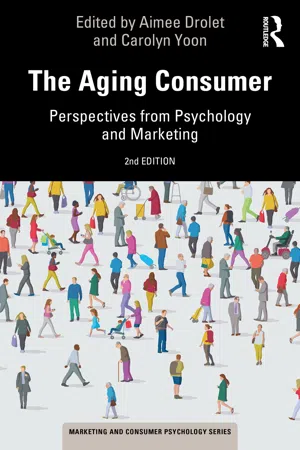
The Aging Consumer: Perspectives from Psychology and Marketing, 2nd edition takes stock of what is known around age and consumer behavior, identifies gaps and open questions within the research, and outlines an agenda for future research.
There has been little systematic research done with respect to the most basic questions related to age and consumer behavior, such as whether older adults versus young and middle-age adults respond to marketing activities including pricing, promotions, product design, and distribution. Written by experts, The Aging Consumer compiles research on a broad range of topics on consumer marketing, from an individual to a societal level of analysis. This second edition provides new versions of chapters contained in the 2010 volume that have been updated to reflect the latest psychological and marketing research and thinking. Included also are ten new chapters which cover exciting new ground, such as changes in metacognition in older adults, motivated cognition of the aging consumer, and a global perspective on aging and the economy across cultures.
This updated volume is beneficial for researchers and practitioners in marketing, consumer behavior, and advertising. Additionally, The Aging Consumer, 2nd edition will appeal to professionals in other fields such as psychology, decision sciences, gerontology and gerontological social work, and those who are concerned with normal human aging and its implications for the everyday behavior of older individuals. It will also be of interest to those in fields concerned with the societal implications of an aging population, such as economics, policy, and law.
Nishaat Mukadam, Krystal Leger, and Angela Gutchess
Cognitive Neuroscience of Aging
Many people think about the cognitive and neural changes that occur with age as being due to neurodegenerative diseases such as dementia. However, healthy aging is also associated with widespread changes to the brain and many cognitive abilities. In this chapter, we will review some of the age-related changes that reflect typical developmental processes, many of which emerge gradually after young adulthood and continue throughout later life. The chapter focuses first on changes that occur to the structure and function of the brain, considering widespread systems. Next, the chapter focuses on domain-specific changes, considering changes to abilities such as sensation and memory. Finally, we discuss the possibility of preserved social and emotional abilities, relating these to changes reviewed in other cognitive abilities.
Neural Changes with Age
Changes to the brain with age are widespread, impacting the structure of both gray and white matter in the brain (Driscoll et al., 2009; Resnick, Pham, Kraut, Zonderman, and Davatzikos, 2003) as well as the function of the brain. All of these changes have implications for cognitive and other abilities. This section focuses on these structural and functional changes that are seen in healthy aging and how these changes influence older adults’ cognitive abilities, including implications for their behavior as consumers.
Structural Changes
Gray Matter
Just as other organs undergo age-related decline, so too does the brain. Structural changes in gray matter that occur with age involve a reduction in the volume of gray matter and thinning of the cortex (C. D. Good et al., 2001; Salat et al., 2004). As seen in Figure 1.1, these changes result in atrophy, or shrinkage of the overall brain size (Driscoll et al., 2009) and enlargement of the ventricles, the spaces through which cerebrospinal fluid flows (Kwon, Jang, and Yeo, 2014; Resnick et al., 2003). Gray matter volume and cortical thickness may predict cognitive performance on some tasks. Not only is the amount of gray matter considered, but also the rate of change from one time point to another. Some studies have found that healthy individuals undergo significant amounts of brain shrinkage even in a short period of time (Raz, Ghisletta, Rodrigue, Kennedy, and Lindenberger, 2010). Thus, it may be the case that the rate of change over only a few years could serve as an important predictor of who is at risk for accelerated cognitive decline with age or perhaps already exhibiting signs of disorder.
FIGURE 1.1 Illustrates some of the structural changes that occur with age. Compared to the younger adult brain (left), the older adult brain (right) shows loss of tissue volume. This atrophy can be seen in the enlargement of spaces around the cortex, including the ventricles (dark space in the center of each image).
Gray matter loss typically occurs in a progressive and slow manner with age and is not uniform across different regions of the brain (Raz et al., 2005b; Resnick et al., 2003). Patterns of loss tend to be linear, at a consistent rate over time, in some regions and non-linear (e.g., the rate potentially accelerating at a faster rate in later years) in other regions (Raz et al., 2005a). Through the use of magnetic resonance imaging (MRI), both cross-sectional (studying different groups of individuals at different ages) and longitudinal (studying the same individuals over time as they age) studies have consistently found that the most prominent loss occurs in regions of the prefrontal cortex, particularly the inferior and orbitofrontal regions (Driscoll et al., 2009; Farokhian, Yang, Beheshti, Matsuda, and Wu, 2017; C. Good et al., 2001; Raz et al., 2010; Raz et al., 1997; Resnick et al., 2003). Other gray matter changes also include loss in the insular, cingulate, superior parietal cortices (Driscoll et al., 2009; Farokhian et al., 2017; Resnick et al., 2003), pre and post central gyri (C. Good et al., 2001), the caudate, the cerebellum, and the hippocampus (Raz et al., 2010; Raz et al., 2005b). In contrast, there tends to be more preservation in the occipito-parietal, subcortical (Farokhian et al., 2017; C. Good et al., 2001), entorhinal (Raz et al., 2005b), and the mesial temporal (Resnick et al., 2003) regions.
These age-related declines in gray matter were initially attributed to neuronal death, though more recent work suggests that the number of neurons may be relatively consistent with age. Instead, losses of volume may actually reflect reductions in neuron size, the number of synapses, or synaptic spikes (Esiri, 2007; Freeman et al., 2008). Age-related gray matter changes are also responsible for many of the types of changes with age in cognitive functioning that are reviewed in a later section of this chapter.
White Matter
The white matter in the brain plays a role in connecting regions, allowing for the transmission of information across the brain. Figure 1.2 depicts some white matter tracts. White matter consists of myelinated and unmyelinated axons of neurons and myelin-producing glial cells. Myelin is the fatty substance wrapped around the axon of some neurons which helps to speed transmission of neural signals down the axon; myelinated axons form the majority of white matter. White matter, like gray matter, also undergoes global volume loss with age (Resnick et al., 2003). Despite the amount of attention paid to gray matter, imaging studies have shown that white matter change is actually more pronounced in normal aging than gray matter changes (Liu et al., 2017). Age-related white matter changes involve the loss of myelin, known as demyelination. This loss is most significant in the anterior thalamic radiations (Farokhian et al., 2017; C. Good et al., 2001) the optic radiations, frontal regions (C. Good et al., 2001), and the prefrontal cortex (Raz et al., 2005b; Salat et al., 2004). Although there is significant white matter loss seen in aging, there is also some white matter preservation in the posterior frontal lobes, cerebellum, and right temporal lobes (C. Good et al., 2001) and even an increase in the white matter volume in the pericentral and occipital areas (Farokhian et al., 2017). Changes in white matter with age also involve the development of white matter hyperintensities (Habes et al., 2016) which are lesions in the brain that show up as bright spots on T2 weighted MRI scans and seem to be linked to reduced cerebrovascular health.
FIGURE 1.2 Depicts white matter tracts in the brain. These can serve as short- or long-range connections between regions of cortex. With aging, the integrity of these tracts can be reduced, which can impact the communication between regions. Reprinted from Madden et al. 2004, Diffusion tensor imaging of adult age differences in cerebral white matter: Relation to response time. NeuroImage, Vol 21, p. 1174–1181, Copyright 2004, with permission from Elsevier.
Structural changes in white matter seen in normal aging play an important role in the age-related cognitive decline observed in the older adult population (Valdes Hernandez Mdel et al., 2013). Because of the role that myelin plays in the speed of signal transmission, demyelination and white matter hyperintensities seen with age lead to a decline in the speed at which neuronal signals are transmitted, and is manifested cognitively as slower speed of processing. This further influences other cognitive processes as well. For example, a greater number of white matter hyperintensities seem to be linked to impairments in cognitive performance (Gunning-Dixon, Brickman, Cheng, and Alexopoulos, 2009).
Although both gray and white matter show notable and more or less uniform changes in the aging population, there is some degree of individual variability seen in the rate and magnitude of progression of gray and white matter (Raz et al., 2005b; Resnick et al., 2003). This variability can be attributed to early life experiences and opportunities which we will discuss in a later section.
Functional Changes
Neural Activation
In addition to the effects of age on the brain's physical tissue, neural activity also changes with age. This includes changes in the onset, intensity, location, and extent of activation, all of which have implications for cognitive processing and behavior.
There are a couple of notable patterns of activation change with age. One observed difference between younger and older adults is in the bilaterality of neural activations (Cabeza et al., 1997; Grady et al., 1995; Reuter-Lorenz et al., 2000). This refers to the activation of regions in both hemispheres rather than only in one hemisphere. Younger adults generally activate left or right prefrontal cortex during tasks such as working memory, due to the largely lateralized activity for verbal tasks (left prefrontal cortex) or visuospatial tasks (right prefrontal cortex). In contrast, older adults are more likely to activate the same region in both hemispheres. Regions tend to be recruited in both hemispheres that are homologous to one another—i.e., the same region in each hemisphere. This framework of age-related neural change is known as the hemispheric asymmetry reduction in older adults—or HAROLD—model. Another characterization of age-related changes is the posterior-anterior shift in aging, or PASA. This model posits a relationship between increases in frontal lobe activity and decreases in occipital lobe activation (S. W. Davis, Dennis, Daselaar, Fleck, and Cabeza, 2008).
A prevailing explanation for these changes is that the increases in activation in certain areas are compensatory. This explains the HAROLD pattern such that older adults are recruiting resources in both hemispheres in order to achieve performance comparable to what young adults achieve with unilateral activation. For the PASA pattern, increased activation in the frontal lobes in response to decreased occipital lobe activity with age also aligns with the compensatory explanation. As visual processing becomes more difficult and less precise with age, higher-order frontal lobe processes (such as attention, or regions reflecting increased cognitive effort) need to be called upon to compensate for the impoverished sensory information. Indeed, these explanations are supported by data comparing different performance levels (e.g., Cabeza, Anderson, Locantore, and McIntosh, 2002; Gutchess et al., 2005) and reaction times (e.g., Madden et al., 1997).
However, it should be noted that increased activation as a compensatory response is not a completely straightforward process, especially when considering aging disorders (e.g., Alzheimer's disease) and the typical approach of comparing between groups. Thus, researchers have specified criteria for differentiating successful compensation from attempts at compensation. Though the relationship between increased neural activity and brain atrophy reflects compensation as a response to cognitive decline, this mechanism cannot be sustained as the brain conti...
Table of contents
Cover
Endorsements
Half-Title
Series
Title
Copyright
Dedication
Contents
List of contributors
Preface
PART I Cognitive Changes with Age
PART II Influence of Aging on Decision-Making
PART III Implications of Aging on Consumer Behavior
PART IV New Directions in Aging Research
Index
Trusted by 375,005 students
Access to over 1.5 million titles for a fair monthly price.
Study more efficiently using our study tools.
Frequently asked questions
Yes, you can cancel anytime from the Subscription tab in your account settings on the Perlego website. Your subscription will stay active until the end of your current billing period. Learn how to cancel your subscription
No, books cannot be downloaded as external files, such as PDFs, for use outside of Perlego. However, you can download books within the Perlego app for offline reading on mobile or tablet. Learn how to download books offline
Perlego offers two plans: Essential and Complete
Essential is ideal for learners and professionals who enjoy exploring a wide range of subjects. Access the Essential Library with 800,000+ trusted titles and best-sellers across business, personal growth, and the humanities. Includes unlimited reading time and Standard Read Aloud voice.
Complete: Perfect for advanced learners and researchers needing full, unrestricted access. Unlock 1.5M+ books across hundreds of subjects, including academic and specialized titles. The Complete Plan also includes advanced features like Premium Read Aloud and Research Assistant.
Both plans are available with monthly, semester, or annual billing cycles.
We are an online textbook subscription service, where you can get access to an entire online library for less than the price of a single book per month. With over 1.5 million books across 990+ topics, we’ve got you covered! Learn about our mission
Look out for the read-aloud symbol on your next book to see if you can listen to it. The read-aloud tool reads text aloud for you, highlighting the text as it is being read. You can pause it, speed it up and slow it down. Learn more about Read Aloud
Yes! You can use the Perlego app on both iOS and Android devices to read anytime, anywhere — even offline. Perfect for commutes or when you’re on the go. Please note we cannot support devices running on iOS 13 and Android 7 or earlier. Learn more about using the app
Yes, you can access The Aging Consumer by Aimee Drolet, Carolyn Yoon, Aimee Drolet,Carolyn Yoon in PDF and/or ePUB format, as well as other popular books in Psychology & Consumer Behaviour. We have over 1.5 million books available in our catalogue for you to explore.