eBook - ePub
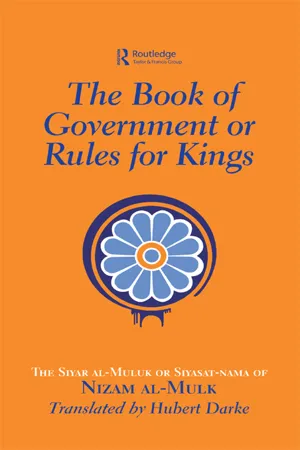
The Book of Government or Rules for Kings
The Siyar al Muluk or Siyasat-nama of Nizam al-Mulk
- 292 pages
- English
- ePUB (mobile friendly)
- Available on iOS & Android
eBook - ePub
The Book of Government or Rules for Kings
The Siyar al Muluk or Siyasat-nama of Nizam al-Mulk
About this book
A translation of a classic 11th-century Persian text on behaviour and conduct in government, written between 1086 and 1091 by Nizam al-Mulk, who for over 30 years was Chief Minister of two successive rulers of the Seljuk, who had created an Empire which stretched from India to Egypt.
Information
[Part One]
Chapter I
On the turn of Fortune’s wheel and in praise of The Master of the World—may Allah confirm his Sovereignty
1 In every age and time God (be He exalted) chooses one member of the human race and, having endowed him with goodly and kingly virtues, entrusts him with the interests of the world and the well-being of His servants; He charges that person to close the doors of corruption, confusion and discord, and He imparts to him such dignity and majesty in the eyes and hearts of men, that under his just rule they may live their lives in constant security and ever wish for his reign to continue.
2 Whenever – Allah be our refuge! – there occurs any disobedience or disregard of divine laws on the part of His servants, or any failure in devotion and attention to the commands of The Truth (be He exalted), and He wishes to chasten them and make them taste the retribution for their deeds – may God not deal us such a fate, and keep us far from such a calamity! – verily the wrath of The Truth overtakes those people and He forsakes them for the vileness of their disobedience; kingship disappears altogether, opposing swords are drawn, blood is shed, and whoever has the stronger hand does whatever he wishes, until those sinners are all destroyed in tumults and bloodshed, and the world becomes free and clear of them; and through the wickedness of such sinners many innocent persons too perish in the tumults; just as, by analogy, when a reed-bed catches fire every dry particle is consumed and much wet stuff is burnt also, because it is near to that which is dry.
3 Then by divine decree one human being acquires some prosperity and power, and according to his deserts The Truth bestows good fortune upon him and gives him wit and wisdom, wherewith he may employ his subordinates every one according to his merits and confer upon each a dignity and a station proportionate to his powers. He selects ministers and their functionaries from among the people, and giving a rank and post to each, he relies upon them for the efficient conduct of affairs spiritual and temporal. If his subjects tread the path of obedience and busy themselves with their tasks he will keep them untroubled by hardships, so that they may duly pass their time in the shadow of his justice. If one of his officers or ministers commits any impropriety or oppression, he will only keep him at his post provided that he responds to correction, advice or punishment, and wakes up from the sleep of negligence; if he fails to mend his ways, he will retain him no longer, but change him for someone who is deserving; and when his subjects are ungrateful for benefits and do not appreciate security and ease, but ponder treachery in their hearts, shewing unruliness and overstepping their bounds, he will admonish them for their misdeeds, and punish them in proportion to their crimes. Having done that he will cover their sins with the skirt of pardon and oblivion. Further, he will bring to pass that which concerns the advance of civilization, such as constructing underground channels, digging main canals, building bridges across great waters, rehabilitating villages and farms, raising fortifications, building new towns, and erecting lofty buildings and magnificent dwellings; he will have inns built on the highways and schools for those who seek knowledge; for which things he will be renowned for ever; he will gather the fruit of his good works in the next world and blessings will be showered upon him.
4 Since the decree of God was such that this should be the era by which bygone ages are dated and the standard by which the deeds of former kings are judged, whereby He might bestow on His creatures a felicity granted to none before them, He caused The Master of the World, the mightiest king of kings, to come forth from two noble lines whose houses were cradles of royalty and nobility, and had been so from generation to generation as far back as the great Afrasiyab;1 He furnished him with powers and merits such as had been lacking in the princes of the world before him, and endowed him with all that is needful for a king – such as a comely appearance, a kindly disposition, integrity, manliness, bravery, horsemanship, knowledge, [skill in] the use of various kinds of arms and accomplishment in several arts, pity and mercy upon the creatures of God, [strictness in] the performance of vows and promises, sound faith and true belief, devotion to the worship of God and the practice of such virtuous deeds as praying in the night,2 supererogatory fasting, respect for religious authorities, honouring devout and pious men, patronizing men of learning and wisdom, giving regular alms, doing good to the poor, being kind to subordinates and servants, and relieving the people of oppressors. Following all this God gave him power and dominion as befitted his worthiness and good faith, and made all the world subject to him, causing his dignity and authority to reach all climes; all the dwellers on earth are his tributaries, and as long as they seek his favour they are safe from his sword.
5 Now in the days of some of the caliphs, if ever their empire became extended it was never free from unrest and the insurrections of rebels; but in this blessed age (praise and thanks be to Allah) there is nobody in all the world who in his heart meditates opposition to our lord and master, or ventures his head outside the collar of obedience to him – may God perpetuate this empire until the resurrection and keep the evil eye far from the perfectness of this kingdom, so that His creatures may pass their days under the equity and authority of The Master of the World and be ever intent on blessing him.
6 Such is the happy state of this great empire; and in proportion to its greatness it is blessed with an abundance of wise and good institutions. The wisdom of The Master of the World is like a taper from which many lamps have been lighted; by its light men find their way and emerge from the darkness. He has no need of any counsellor or guide; nevertheless he is not without cares, and perhaps he wishes to test his servants, and assess their intelligence and wisdom. So when he commanded his humble servant to write down some of those good qualities that are indispensable to a king, and make note of every principle which kings have followed in the past but now do not observe, indicating what is good and what is bad, whatever came to the mind of his humble servant that he had seen, learnt, read or heard, was written down, and The Sublime Command was fulfilled; these few chapters were composed in the manner of an epitome, and what was proper to each chapter was mentioned in that chapter in a clear style.
Chapter II
On recognizing the extent of God’s grace towards kings
1 It is for kings to observe His pleasure (His name be glorified) and the pleasure of The Truth is in the charity which is done to His creatures and in the justice which is spread among them. A kingdom which is blessed by its people will endure and increase from day to day, while its king will enjoy power and prosperity; in this world he will acquire good fame, in the next world salvation, and his reckoning will be the easier. Great men have said [in Arabic], ‘A kingdom may last while there is irreligion, but it will not endure when there is oppression.’ (The meaning is …1)
2 Tradition tells that when Joseph the prophet (the prayers of Allah and His peace be upon him) went out from this world, they were carrying him to Abraham’s tomb (upon him be peace) to bury him near his forefathers, when Gabriel (upon him be peace) came and said, ‘Stop where you are; this is not his place; for at the resurrection he will have to answer for the sovereignty which he has exercised.’ Now if the case of Joseph the prophet was such, consider what the position of others will be.
3 It has come down in a tradition from The Prophet (may Allah bless him and save him) that on the day of the resurrection, when anyone is brought forward who [in his life] wielded power and command over God’s creatures, his hands will be bound; if he has been just, his justice will loose his hands and send him to paradise; but if he has been unjust, his injustice will cast him into hell as he is, with his hands bound in chains.
4 There is also a tradition that on resurrection day whoever had any command in this world over God’s creatures, even2 over the inhabitants of his own house or over his own underlings, will be questioned about it; likewise the shepherd who tended his sheep will be required to answer for that too.
5 They say that at the time of his father’s leaving this world Abd-Allah ibn ‘Umar ibn al-Khattab (may Allah be pleased with them both) asked, ‘O father, where and when shall I see you again?’ ‘Umar said,’ In the next world.’ ‘Abd-Allah said, ‘I would it were sooner.’ He said, ‘You will see me in a dream tonight, tomorrow night, or the next night.’ Twelve years passed by without his appearing in a dream. Then one night he saw him in a dream and said, ‘O father, did you not say that within three nights I should see you?’ He said, ‘O son, I was occupied, because in the country around Baghdad3 a bridge had become dilapidated and officials had not attended to repairing it. One day a sheep’s forefoot fell into a hole on that bridge and was broken. Till now I have been answering for that.’
6 Of a certainty The Master of the World (may Allah perpetuate his reign) should know that on that great day he will be asked to answer for all those of God’s creatures who are under his command, and if he tries to transfer [his responsibility] to someone else he will not be listened to. Since this is so it behoves the king not to leave this important matter to anyone else, and not to disregard the state of God’s creatures. To the best of his ability let him ever acquaint himself, secretly and openly, with their conditions; let him protect them from extortionate hands, and preserve them from cruel tyrants, so that the blessings resulting from those actions may come about in the time of his rule and benedictions will be pronounced upon his age until the resurrection.
Chapter III
On holding court for the redress of wrongs and practising justice and virtue
1 It is absolutely necessary that on two days in the week the king should sit for the redress of wrongs, to extract recompense from the oppressor, to give justice and to listen to the words of his subjects with his own ears, without any intermediary. It is fitting that some written petitions should also be submitted if they are comparatively important, and he should give a ruling on each one. For when the report spreads throughout the kingdom that on two days in the week The Master of the World summons complainants and petitioners before him and listens to their words, all oppressors will be afraid and curb their activities, and no one will dare to practise injustice or extortion for fear of punishment.
2 I have read in the books of the ancients that most of the Persian [Sasanian] kings used to put up a high platform and sit up there on horseback so that they could see all the complainants gathered round about, and they would redress the grievances of every one. The reason for this was that when the king sits in a place protected by doors, gates, locks, vestibules, screens and chamberlains, self-interested and oppressive persons can keep people back and not let them go before the king.
3 I have heard that a certain king was rather hard of hearing. He was anxious lest the chamberlains and persons who acted as interpreters might not report the words of the complainants correctly, and that he, not knowing the true facts, might give an order quite unsuitable to the case. So he commanded that all complainants were to wear red clothes, so that he could recognize them; no one else at all was to wear red. This king used to appear on the plain seated upon an elephant, and wherever he saw people in red clothes, he ordered them to be collected in a group. Then he would sit in a place apart and they were brought before him; they stated their cases in a loud voice and he gave them justice.
Men have taken all this care so that they may not be found ignorant when they have to give their answer in the next world.
The story of The Just Amir and the Saffarids
4 One of the kings of the Samanid line was called Isma‘il ibn Ahmad. He was extremely just, and his good qualities were many. He had a pure faith in God (to Him be power and glory) and he was generous to the poor – to name only one of his notable virtues. His seat was at Bukhara. Khurasan, ‘Iraq1 and Transoxiana all belonged to his ancestors.
5 Ya‘qub ibn Laith emerged in revolt from the City of Sistan [Zaranj] and took the whole of Sistan; then he went to Khurasan, and captured that province; from Khurasan he went to ‘Iraq, and seized the whole of ‘Iraq. Propagandists deceived him and he secretly swore allegiance to the Isma‘ilis; he hardened his heart against the calph of Baghdad. Then he mustered the armies of Khurasan and ‘Iraq and prepared to march to Baghdad to kill the caliph and overthrow the house of the ‘Abbasids.
6 The caliph received information that Ya‘qub was marching upon Baghdad. He sent a messenger to say, ‘You have no business at Baghdad; it were better that you should attend to Kuhistan of ‘Iraq and Khurasan, and administer them so that no disorder or anxiety may arise. Turn back.’ He did not obey the command, but said ‘It is my desire that without fail I should come to the court, and carry out the rites of homage and renew my obligations; until I have done this, I will not turn back.’ However many messengers the caliph sent, he gave this same answer. Then he moved his army towards Baghdad. The caliph became suspicious of him; he summoned the nobles of the state and said, ‘I see that Ya‘qub ibn Laith has withdrawn his head from the collar of obedience to us, and is coming here with treacherous intenr, for we have not commanded him to come and yet he is coming; we command him to turn back; he turns not. At all events he has some evil design in his heart and I think he has sworn allegiance to the Batinis;2 he will not reveal it until he arrives here. We must not neglect to take precautions against him; what is the best way to deal with this matter?’
They settled on the following plan: that the caliph would not stay in the city, but go into the open country and pitch camp, and the courtiers and nobles of Baghdad and all of his retinue would be with him; so that when Ya‘qub arrived and saw the caliph encamped in the open country with his troops, his plan would misfire and his rebellion against The Commander of the Faithful would become manifest; thereupon men would go to and fro from one camp to the other; for if he were starting a rebellion, not all the nobles and chiefs of ‘Iraq and Khurasan would agree with him and assent to his plans: if he openly shewed his rebelliousness they would contend with his troops as best they could, but if they failed and were unable to cope with him in battle, very well – the road would be open before them and they would not be caught like prisoners within four walls; they would betake themselves wherever they could. This plan was acceptable to The Commander of the Faithful. Thus they did. And this caliph was al-Mu‘tamid ‘ala’ llah Ahmad.
7 When Ya‘qub arrived he dismounted opposite the caliph’s camp and pitched his tents; and the men of the two armies mingled together. On that very day he bid defiance to the caliph and sent a messenger to him to say, ‘Give up Baghdad and go where you like.’ The caliph asked for two months’ grace; Ya‘qub refused him. When night came on, the caliph secretly sent someone to the officers of Ya‘qub’s army to say, ‘He has openly revolted, and made common cause with the Seveners3; he has come on purpose to overthrow our house, and set our adversary in our place. Are you too in sympathy with him in this, or not?’ One party said, ‘From him we have received our subsistence and by virtue of service to him we enjoy the position and prosperity which we have. Whatever he has done we have done.’ The majority said, ‘We are not aware of these circumstances of which The Commander of the Faithful speaks; we do not think that he will oppose The Commander of the Faithful; hereafter if he openly rebels, we shall entirely disapprove; on the day of confrontation we shall be with you, not with him, and in the hour of battle we shall come to your aid.’ This party consisted of the army-commanders of Khurasan.
8 When the caliph heard the words of the chiefs of Ya‘qub’s army on this wise, he was glad. The next day in a bold spirit he sent a message to Ya‘qub, saying, ‘NOW that you have openly displayed your ingratitude and have made an agreement with my adversary, the sword is betwixt me and you; I am not afraid because my forces are few and yours are many. God (to Him be power and glory) is the helper of the right, and He is on my side. Those troops which you have really belong to me.’ He gave the command, and his troops armed themselves, beat the drums of war and blew the trumpets; they went forth from the camp and drew ranks upon the plain.
9 When Ya‘qub heard the caliph’s message in those terms, he said, ‘I am now attaining my desire.’ And he too gave orders for the drums to be beaten; all his troops mounted and went in formation on to the plain and drew ranks opposite the caliph’s forces. On the one side the caliph came and took up his position in the centre, and on the other side Ya‘qub ibn Laith. Then the caliph ordered a certain man who had a powerful voice to go between the two arrays, and proclaim aloud, ‘O assembly of Muslims, know that Ya‘qub is a rebel and has come on purpose to overthrow the house of ‘Abbas, and to bring the caliph’s adversary to replace him; he wishes to remove the sunna [orthodox tradition] and make heresy rife. Whoever opposes the caliph [successor] of The prophet of God, has opposed The Prophet himself; and if any man plucks his head out of the collar of obedience to The Prophet (upon him be peace), it is as if he has renounced obedience to God and quitted the circle of Islam; as God (be He exalted) says in His incontrovertible book [Qur’an 4. 62], “Obey Allah, and obey The Messenger and those of you who are in authority.” Who is there now amongst you who will choose heaven instead of hell, and will assist the truth and turn his face from vanity? Then let him be with me, not with my enemy.’
10 When the army of Ya‘qub ibn Laith heard these words the commanders of Khurasan turned with one accord and approached the caliph and said, ‘We thought that he was coming to your presence in obedience to your command; now that he has declared his opposition and rebellion, we are with you, and as long as we have life, we shall wield the sword on your behalf.’
11 When the caliph had thus acquired strength he ordered his to...
Table of contents
- Cover Page
- Half Title Page
- Title Page
- Copyright Page
- Contents
- Introduction
- This is the Book of Rules for Kings Composed by the Vazir, the Wise, the Just, the Successful, the Victorious, Nizam Al-Mulk Hasan1 of Tus
- Part One
- Part Two
- Notes
- Index
Trusted by 375,005 students
Access to over 1.5 million titles for a fair monthly price.
Study more efficiently using our study tools.
Frequently asked questions
Yes, you can cancel anytime from the Subscription tab in your account settings on the Perlego website. Your subscription will stay active until the end of your current billing period. Learn how to cancel your subscription
No, books cannot be downloaded as external files, such as PDFs, for use outside of Perlego. However, you can download books within the Perlego app for offline reading on mobile or tablet. Learn how to download books offline
Perlego offers two plans: Essential and Complete
- Essential is ideal for learners and professionals who enjoy exploring a wide range of subjects. Access the Essential Library with 800,000+ trusted titles and best-sellers across business, personal growth, and the humanities. Includes unlimited reading time and Standard Read Aloud voice.
- Complete: Perfect for advanced learners and researchers needing full, unrestricted access. Unlock 1.5M+ books across hundreds of subjects, including academic and specialized titles. The Complete Plan also includes advanced features like Premium Read Aloud and Research Assistant.
We are an online textbook subscription service, where you can get access to an entire online library for less than the price of a single book per month. With over 1.5 million books across 990+ topics, we’ve got you covered! Learn about our mission
Look out for the read-aloud symbol on your next book to see if you can listen to it. The read-aloud tool reads text aloud for you, highlighting the text as it is being read. You can pause it, speed it up and slow it down. Learn more about Read Aloud
Yes! You can use the Perlego app on both iOS and Android devices to read anytime, anywhere — even offline. Perfect for commutes or when you’re on the go.
Please note we cannot support devices running on iOS 13 and Android 7 or earlier. Learn more about using the app
Please note we cannot support devices running on iOS 13 and Android 7 or earlier. Learn more about using the app
Yes, you can access The Book of Government or Rules for Kings by Hubert Darke in PDF and/or ePUB format, as well as other popular books in Social Sciences & Ethnic Studies. We have over 1.5 million books available in our catalogue for you to explore.