One of the most powerful dynasties to rule in the medieval Middle East, the Seljuks played a critical role in the development of Anatolia's multi-ethnic, multi-confessional identity. Under Seljuk rule (c. 1081-1308) the formerly Christian Byzantine territories of Anatolia were transformed by the development of Muslim culture, society and politics, and it was then – well before the arrival of the Ottomans – that a Turkish population became firmly established in these lands. But these developments are little understood, and the Seljuk dynasty remains little studied. Yet the Seljuks of Anatolia were one of the most influential dynasties of the thirteenth-century Middle East, controlling some of the major trade routes of the period, playing a crucial role in linking East and West of the medieval world.
Here, Andrew Peacock and Sara Nur Yildiz explore the history of Anatolia under Seljuk rule in the twelfth and thirteenth centuries, examining developments in culture, politics, religion and society and shedding new light on the influence of the dynasty within Anatolia and throughout Western Asia. The Seljuks of Anatolia examines the crucial aspect of the Seljuk dynastic identity, and how this related to their royal households, and to the material and literary arts they sought to influence and promote through patronage. It also demonstrates how the Seljuks played a critical role in the development of Islamic culture in Anatolia, with strong influences from Iran, Syria and further afield. By taking this critical role into account, this book offers an analysis of the religious transformations that occurred during this period, from the Byzantine and Christian identities that prevailed amongst the Seljuks to the Sufis that held key positions in the Seljuk court.
With its lively discussion of Seljuk identity, politics and culture, The Seljuks of Anatolia will be of great interest to researchers with interests in Byzantium as well as the material culture and society of the medieval Islamic world.
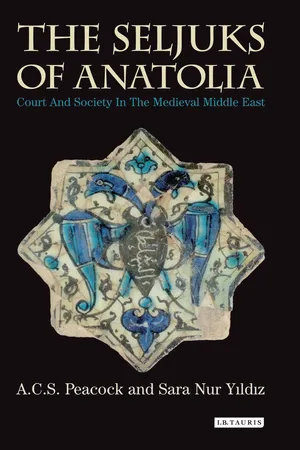
eBook - ePub
The Seljuks of Anatolia
Court and Society in the Medieval Middle East
- 336 pages
- English
- ePUB (mobile friendly)
- Available on iOS & Android
eBook - ePub
The Seljuks of Anatolia
Court and Society in the Medieval Middle East
About this book
Information
Table of contents
- Cover
- About the Author
- Title Page
- Copyright Page
- Contents
- List of Illustrations
- Acknowledgements
- A Note on Usage and Transliteration
- List of Contributors
- Chapter One Introduction
- Part One Dynastic Identity and the Great Seljuk Inheritance
- Chapter Two The House of Mengüjek in Divriği: Constructions of Dynastic Identity in the Late Twelfth Century
- Chapter Three ‘The King of the East and the West’: The Seljuk Dynastic Concept and Titles in the Muslim and Christian Sources
- Chapter Four A Nadīm for the Sultan: Rāwandī and the Anatolian Seljuks
- Part Two The Royal Household
- Chapter Five Harem Christianity: The Byzantine Identity of Seljuk Princes
- Chapter Six Paper, Stone, Scissors: ‘Alā’ al-Dīn Kayqubād, ‘Ismat al-Dunyā wa ’l-Dīn, and the Writing of Seljuk History
- Part Three Sufis at Court and in Society
- Chapter Seven In the Proximity of Sultans: Majd al-Dīn Ishāq, Ibn ‘Arabī and the Seljuk Court
- Chapter Eight Sufis and the Seljuk Court in Mongol Anatolia: Politics and Patronage in the Works of Jalāl al-Dīn Rūmī and Sultān Walad
- Chapter Nine Futuwwa in Thirteenth-Century Rūm and Armenia: Reform Movements and the Managing of Multiple Allegiances on the Seljuk Periphery
- Chapter Ten Conclusion: Research on the Seljuks of Anatolia. Some Comments on the State of the Art
- Genealogical Table of Seljuk Sultans of Anatolia
- Glossary of Terms
- Select Bibliography
Trusted by 375,005 students
Access to over 1.5 million titles for a fair monthly price.
Study more efficiently using our study tools.
Frequently asked questions
Yes, you can cancel anytime from the Subscription tab in your account settings on the Perlego website. Your subscription will stay active until the end of your current billing period. Learn how to cancel your subscription
No, books cannot be downloaded as external files, such as PDFs, for use outside of Perlego. However, you can download books within the Perlego app for offline reading on mobile or tablet. Learn how to download books offline
Perlego offers two plans: Essential and Complete
- Essential is ideal for learners and professionals who enjoy exploring a wide range of subjects. Access the Essential Library with 800,000+ trusted titles and best-sellers across business, personal growth, and the humanities. Includes unlimited reading time and Standard Read Aloud voice.
- Complete: Perfect for advanced learners and researchers needing full, unrestricted access. Unlock 1.5M+ books across hundreds of subjects, including academic and specialized titles. The Complete Plan also includes advanced features like Premium Read Aloud and Research Assistant.
We are an online textbook subscription service, where you can get access to an entire online library for less than the price of a single book per month. With over 1.5 million books across 990+ topics, we’ve got you covered! Learn about our mission
Look out for the read-aloud symbol on your next book to see if you can listen to it. The read-aloud tool reads text aloud for you, highlighting the text as it is being read. You can pause it, speed it up and slow it down. Learn more about Read Aloud
Yes! You can use the Perlego app on both iOS and Android devices to read anytime, anywhere — even offline. Perfect for commutes or when you’re on the go.
Please note we cannot support devices running on iOS 13 and Android 7 or earlier. Learn more about using the app
Please note we cannot support devices running on iOS 13 and Android 7 or earlier. Learn more about using the app
Yes, you can access The Seljuks of Anatolia by A.C.S. Peacock, Sara Nur Yildiz, A.C.S. Peacock,Sara Nur Yildiz in PDF and/or ePUB format, as well as other popular books in History & European Medieval History. We have over 1.5 million books available in our catalogue for you to explore.