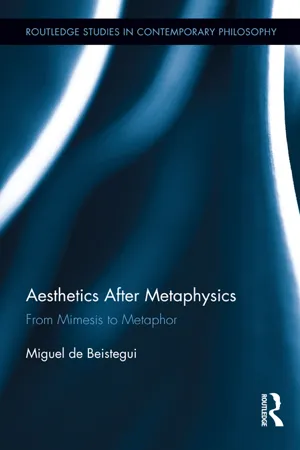
This book focuses on a dimension of art which the philosophical tradition (from Plato to Hegel and even Adorno) has consistently overlooked, such was its commitment – explicit or implicit – to mimesis and the metaphysics of truth it presupposes. De Beistegui refers to this dimension, which unfolds outside the space that stretches between the sensible and the supersensible – the space of metaphysics itself – as the hypersensible and show how the operation of art to which it corresponds is best described as metaphorical. The movement of the book, then, is from the classical or metaphysical aesthetics of mimesis (Part One) to the aesthetics of the hypersensible and metaphor (Part Two). Against much of the history of aesthetics and the metaphysical discourse on art, he argues that the philosophical value of art doesn't consist in its ability to bridge the space between the sensible and the supersensible, or the image and the Idea, and reveal the sensible as proto-conceptual, but to open up a different sense of the sensible. His aim, then, is to shift the place and role that philosophy attributes to art.
- 204 pages
- English
- ePUB (mobile friendly)
- Available on iOS & Android
eBook - ePub
About this book
Trusted by 375,005 students
Access to over 1.5 million titles for a fair monthly price.
Study more efficiently using our study tools.
Information
Topic
PhilosophySubtopic
Art Theory & CriticismPart I
Towards the Hypersensible
1 Aesthetics and Metaphysics I
The Mimetic Schema
1 Plato
It is Plato who, famously, set the scene for the meaning and value of the work of art—a scene that was taken up, adapted, and modified throughout the history of philosophy and aesthetics, before it was finally and radically called into question by Nietzsche. Despite its many mutations and permutations, the Platonic schema remained firmly in place. From Plato to Hegel, art was thought of metaphysically, that is, from within the space that Platonic metaphysics opened up, the space that stretches between the sensible (αἰσθητόν) and the supersensible (νοητόν). To the things of sense apprehended perceptually, through the faculty of αἴσθησις, Plato opposes the things that can be apprehended intellectually, through the faculty of νόησις. From the start, and throughout, it was a question of identifying the place that art occupies within that space, the extent to which and the manner in which art bridges that space, orients one’s own sensibility towards the intelligible, that is, towards the world of ideas and concepts—a world, as Hegel claimed, in which truth finally exists in its true form—or, on the contrary, chains us to the (merely) sensible, to the world of appearances and sensations. Kant’s own mature views on art, to which I shall eventually turn, are informed by that very metaphysical distinction, which he refines and defines very specifically in his Inaugural Dissertation of 1770.1 From that early, pre-critical work, as well as from the Critique of Pure Reason, we learn that, for Kant, the sensible world is not reducible to the empirical world of sensations and impressions. The latter require space and time as the a priori conditions of their own givenness. On the Form and Principles of the Sensible and Intelligible World identifies those two principles of the sensible world, or, to be more precise, those principles of “sensuous cognition, not, as in intellectual knowledge, general concepts” (§15, corollary), but as pure intuitions. Kant argues that neither intuition may be abstracted from the senses; on the contrary, the senses presuppose space and time (§§14–15), which are therefore pure and not empirical data. It is their character as pure intuitions that distinguish them from qualities abstracted from objects of sense, but also from concepts, because objects of sense are conceived of as “situated in time, and not as contained under the concept of time.” As a collection of appearances corresponding to sensations, the sensible world is thus, Kant argues in the Critique of Pure Reason, “given to us” through our sensibility, which is a receptive faculty (A 19/ B 32) that nonetheless contains and requires the pure, a priori principles of space and time. It is only when combined with concepts of the understanding that the objects thus given can become objects of theoretical knowledge. As for the “intelligible objects,” Kant defines them as “those things thought through pure categories” without schemas of sensibility. As such, they cannot be objects of experience and therefore knowledge in the theoretical sense. This is how, departing from the Platonic view, Kant condemns the “illegitimate” use of theoretical reason and the “transcendent” conception of the intelligible world as an existent realm behind appearances, and subjected to cognition. In a way that will have decisive consequences for his conception of the beautiful in art, Kant claims that the only permissible intelligible world is the moral world, the main object of which is freedom (A 809/ B 837). The sensible and intelligible worlds thus coincide with the worlds of nature and freedom, which “can coexist together without any conflict, in the same actions, according to their intelligible or to their sensible cause” (A 541/B 569). For us, it will be a matter of understanding how this reconfiguration of the Platonic distinction calls for a revaluation of the place and role of art, yet one that is not radical to the point of calling the distinction itself into question.
Let me begin, then, by tracing that history—schematically, all too economically—before raising the question of how, if at all, art can be thought outside that schema, and why it ought to be.2
Plato’s seminal discussion and denunciation of art takes place in Book 10 of the Republic. Two highly significant features of that discussion need to be mentioned from the start. Firstly, Socrates envisages the work of art as a specific kind of image. Yet because the status of the image is itself, as we shall see, essentially ambiguous, it is necessary to establish the sort of image that the work of art is, and the relation to the original that characterises the work. Secondly, Plato’s discussion takes place in the context of a dialogue concerned with the construction in λόγος of the ideal city, which, as the image or allegory of the cave at the beginning of Book 7 suggests, requires that each soul liberate itself from its bondage to images, that is, from its inability to see them as images or shadows, and ascend towards the vision of the original, in what amounts to a philosophical elevation, or conversion, and a political liberation. It is remarkable that, wanting to warn us against the power of images, and mistaking images for the truth, Plato himself speaks in images and myths, thus performing the very operation against which he wishes to warn us. This type of strategy is repeated later on in the Republic when, after his famous denunciation of poetry, Socrates himself turns into a kind of poet and tells the story of Er’s visit to the underworld. Much is at stake in this discussion, then, and most specifically the place and rank of philosophy and art in relation to truth, and the place they ought to be given in the ideal city. The question of the place of art in relation to truth and in the polis is one that will remain central to the philosophical discourse on art and in fact define metaphysical aesthetics.
The work of artists—poets and painters—is a matter of what Plato calls “imitation” (μίμεσις). And it is precisely insofar as artists rely on such an imitative τέχνη that, Socrates tells us, they should be banned from the city. Why should there be no place for imitation in the ideal city? What is the power of images, such that they can threaten the very existence of the city? And how can Plato condemn, and indeed ban, the use of images produced by way of imitation, and at the same time speak through images and stories? This tension seems to point to an essential ambiguity of the image itself, which has the power to disclose the original, but also to conceal it, and deceive us into believing that it is the original. This ambiguity is actually reflected in a conceptual distinction that underpins the discussion of images that we find not only in the Republic, but also in the Sophist (236b, 264c). Some images, Socrates claims in the Sophist, look like the original. Such images have the ability to draw one’s vision to the original and provide an access—albeit limited and insufficient—to the thing as it is in truth. Those are the type of images that Plato himself uses, time and again, as an heuristic device to set us on the way to truth, and away from mere appearances, or semblances. In the Phaedo, for example, Socrates speaks of the need to examine “beings in their truth” (99e) by presenting an image (εἰκών) of them in logos, rather than by looking at them directly and risk having one’s soul blinded (99d–e). In that context, and to borrow Sallis’ words, “the logoi serve as images only in the sense of that in and through which the beings themselves, the originals, are made manifest.”3 As such, they should be clearly distinguished from another kind of image, which the sophist and the artist (or at least some artists) alike use. The image in question is not a likeness (εἰκών) that allows us to see the original, albeit only partially, but a phantom or semblance (φαντάσμα) that directs our gaze away from the original, and towards the appearance itself, as if the appearance were the original. But the appearances (φαινόμενα), after which poems and paintings are forged, are themselves only manifestations of things that are in truth, or real beings (ὄντα), and which Plato calls “ideas.” Phantasms are precisely such that they deny us the possibility of seeing them as images and relating them to the original of which they would be the copy. Far from pointing to “the being itself in its own nature” (αὐτὸ τὸ ἐν τῇν φύσει), they are only a simulacrum of being, and are no more real than the reflection of things in a mirror.4 It is perhaps not surprising that the image of art as, in the words of Hamlet, a “mirror held up to nature,” is a recurrent feature in the history of art and literature, from Leonardo to Shakespeare and Stendhal—even if, of course, from the point of view of those artists, imitative art, at least ideally, is seen as a reflection of truth itself, and not as its mere simulacrum.5 By making the case for art’s relation to truth in terms of its ability to represent nature as a whole, and human nature in particular, the image in question repeats the Platonic schema, whilst also calling into question the illusion and perversion of truth Plato associates with the pro-duction of artworks.
We should be careful, then, not to confuse the two types of images or image-making (εἰδωλοποιικὴ τέχνη), namely, likeness-making (εἰκαστικὴ τέχνη), such as that of the cabinetmaker, which “produces an image [εἰκών] or imitation by following the proportions of the original, of the paradigm, and by giving the right colour to each part,” and mere semblances, which require a technique that Plato characterises as phantastic (φανταστική τέχνη). Such are the images produced by imitation: they are only imitations of imitations (of a couch, for example, or a table), and thus thrice removed from the original, or the idea, in which the thing is given as such, or selfgiven. Once in the grip of such deceiving images, the souls are riveted to non-being, and oblivious of truth. But that is not all. Their danger and threat—to truth, and to the possibility of constructing a city that would be built on truth—consists in their ability to present themselves as if they were true, that is, as if beings were nothing other than (their) appearance or look, as if there was no truth beyond appearance. And that, Plato claims, is the ultimate deception and the source of all corruption. As Sallis puts it: “by making images (εἴδολα) that are far removed from the truth, both the painter and the imitative poet produce a bad regime (πολιτεία) in the souls of individuals.”6 Because mimetic art is “far removed from truth,” and “associates with the part in us that is remote from intelligence,” it is, Socrates concludes, “an inferior thing” that “belongs to the inferior elements of the soul” and engenders “inferior offspring.”7 As such, it has no place in the ideal city. It is important, then, to distinguish between two senses of the image and the sensible in Plato. Both are apprehended perceptually. But whereas, according to the first sense, which Plato wants to retain, the sensible is oriented towards the intelligible from the start, and thus has always already begun to slip into the other sense of sense as meaning or signification, according to the second sense, which Plato wishes to neutralise, the sensible resists such an orientation and signals its own diversity and purely phenomenal reality.
It would be a mistake, therefore, to reduce Platonism to the mere distinction between the world of essences and the world of appearances, or the intelligible and the sensible. There is another, more fundamental distinction, which characterises Platonism proper, inasmuch as it signals the motivation behind the distinction that defines the space of metaphysics. The distinction, internal to the world of appearances (φαινόμενα), is that between icons and phantasms, or images and simulacra. Between the two types of images, there is not so much a difference of degree as of kind. What characterises Platonism—at least that of the Sophist and the Republic—is that, although recognising the existence of such untamed differences, or such a multiplicity without tutelage, it sees it as a threat to thought, morality, politics, and art, and finds in it the seeds of anarchy. Platonism, and the specific problem it has with imitative art, is therefore a response to a political “event” in the broad sense of the term, which presupposed the advent of democracy as a society of equals, and of philosophy as a society of friends. Far from being a merely academic or even metaphysical matter, Platonism, and the place it attributes to art, is a response and a solution to a problem posed by a political order in which, in the words of a commentator, anyone can lay claim to anything, and can “carry the day by the force of rhetoric.”8 It’s that political transformation which, in the absence of the old hierarchy, generates the problem of Platonism; and it is to that potential anarchy and crisis of power that Plato responds by turning philosophy as metaphysics into the ultimate source of authority. Platonism is the systematic effort to nip this anarchy and rebellion in the bud, to hunt down, as Plato says, simulacra and rogue images of all kinds, by providing the philosophical tools that will allow one to discriminate between genuine and false images. It is, as Deleuze puts it, “a matter of distinguishing the splendid and wellgrounded Apollonian appearances from the other, insinuative, malign and maleficent appearances. . . .”9 Subsequently, Deleuze goes on to remark, “the world of representation will more or less forget its moral origin and presuppositions.”10 But that origin will continue to shape and orient it, and even determine its metaphysical concepts and hierarchies, as well as the place and value it ascribes to art. The liberation of art from its metaphysical framework would thus require that we not only wrest art from the space that stretches between the sensible and the intelligible, but also, as a matter of ethical and political priority, from the distinction between true and false images. It would require that, in place of such distinctions and hierarchies, we think of art as stemming from, and opening up, the hypersensible.
2 Aristotle
Although Aristotle envisages art, and especially poetry, as a form of mimesis, he seems to depart quite radically from Plato’s own conception. In fact, he seems to reject it entirely. In Chapter 4 of the Poetics, Aristotle emphasises the fact that imitation is “natural to man from childhood” and that he is in fact “the most imitative creature in the world.” Imitation, Aristotle goes on to say, is itself oriented towards learning: man “learns at first by imitation.”11 And because learning is the greatest pleasure achievable for men, imitation and, more generally, knowledge through representation, should not be rejected, but embraced. The reason why, Aristotle claims, we are able to delight in works that represent objects that, in the flesh as it were, seem to us ugly or inferior, such as “the lowest animals” or “dead bodies,” is because we learn something about those things. By emphasising this immediate and natural connection between learning, or the acquisition of knowledge, and mimesis, Aristotle calls into question the radical separation that Plato had established between those images produced through mimesis and the original of which they are the image, and which alone is true. Poetry, which is a valuable source of knowledge f...
Table of contents
- Cover Page
- Half Title page
- Title Page
- Copyright Page
- Dedication
- Contents
- List of Figures
- Introduction
- Part I Towards the Hypersensible
- Part II The Aesthetics of Metaphor
- Appendix
- Notes
- Index
Frequently asked questions
Yes, you can cancel anytime from the Subscription tab in your account settings on the Perlego website. Your subscription will stay active until the end of your current billing period. Learn how to cancel your subscription
No, books cannot be downloaded as external files, such as PDFs, for use outside of Perlego. However, you can download books within the Perlego app for offline reading on mobile or tablet. Learn how to download books offline
Perlego offers two plans: Essential and Complete
- Essential is ideal for learners and professionals who enjoy exploring a wide range of subjects. Access the Essential Library with 800,000+ trusted titles and best-sellers across business, personal growth, and the humanities. Includes unlimited reading time and Standard Read Aloud voice.
- Complete: Perfect for advanced learners and researchers needing full, unrestricted access. Unlock 1.5M+ books across hundreds of subjects, including academic and specialized titles. The Complete Plan also includes advanced features like Premium Read Aloud and Research Assistant.
We are an online textbook subscription service, where you can get access to an entire online library for less than the price of a single book per month. With over 1.5 million books across 990+ topics, we’ve got you covered! Learn about our mission
Look out for the read-aloud symbol on your next book to see if you can listen to it. The read-aloud tool reads text aloud for you, highlighting the text as it is being read. You can pause it, speed it up and slow it down. Learn more about Read Aloud
Yes! You can use the Perlego app on both iOS and Android devices to read anytime, anywhere — even offline. Perfect for commutes or when you’re on the go.
Please note we cannot support devices running on iOS 13 and Android 7 or earlier. Learn more about using the app
Please note we cannot support devices running on iOS 13 and Android 7 or earlier. Learn more about using the app
Yes, you can access Aesthetics After Metaphysics by Miguel Beistegui in PDF and/or ePUB format, as well as other popular books in Philosophy & Art Theory & Criticism. We have over 1.5 million books available in our catalogue for you to explore.