eBook - ePub
October
About this book
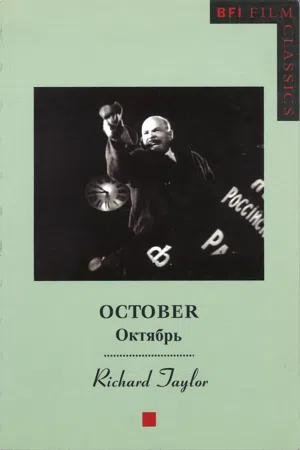
Richard Taylor asks to what extent the film can lay claim to 'authentic' history. He then examines 'October''s relationship to the politics of the period and explains the theory and its application, as well as placing 'October' in the wider context of Eisenstein's career.
Tools to learn more effectively

Saving Books

Keyword Search

Annotating Text

Listen to it instead
Information
'OCTOBER'

Potemkin has something of the Greek temple, October is a little Baroque. There are parts of October which are purely experimental. Methods of intellectual film-making that I think will develop. For me, from the experimental point of view, October is more interesting.
Sergei Eisenstein4
Sergei Eisenstein first came to international prominence with his second feature film, The Battleship Potemkin, released in the Soviet Union in January 1926.5 His reputation, both at home and abroad, ensured that he was one of the directors invited by the official Anniversary Commission in the autumn of 1926 to make a film to mark the tenth anniversary of the October 1917 Revolution. Among the other directors already recruited were Vsevolod Pudovkin (The End of St Petersburg), Dziga Vertov (The Eleventh Year), Esfir Shub (The Great Way) and Boris Barnet (Moscow in October). President Mikhail Kalinin handed Eisenstein a copy of John Reed's Ten Days that Shook the World, 'Here's a good book. Lenin thought highly of it. It might help you.' Eisenstein's assistant, Grigori Alexandrov, later recalled, 'Thus began an incredible cine-storm.'6
The decision to mark the tenth anniversary in this way built upon a long tradition of revolutionary celebration and carnival, dating back to the storming of the Bastille during the French Revolution and beyond – back to the bread and circuses of ancient Rome.7
In the Soviet context these festivals have been described as 'the behavioural dimension of ideology' and 'a means to structure and maintain power relations'.8 In the spring of 1920, Anatoli Lunacharsky, People's Commissar for Enlightenment, argued:
There can be absolutely no doubt that the main artistic fruit of revolution has always been and always will be popular festivals.
Generally speaking, any genuine democracy strives naturally towards popular festival. Democracy presupposes the free life of the masses.
In order to acquire a sense of self the masses must outwardly manifest themselves and this is possible only when, in Robespierre's words, they become a spectacle unto themselves.
If the organised masses march to music, sing in unison or perform extensive gymnastic manoeuvres or dances, in other words, organising a kind of parade – not a military parade but one that is saturated with the ideological essence, the hopes, curses and all the other emotions of the people – then the others, the unorganised masses, lining all the streets and squares where the festival is taking place, will merge with the organised masses so that one can say: the whole people is manifesting its soul to itself.9
Specifically, one major inspiration for Eisenstein's own re-creation of October 1917 was the November 1920 re-enactment of The Storming of the Winter Palace, directed by Nikolai Evreinov, to celebrate the third anniversary of the October 1917 Revolution.10 Evreinov later described some elements of the spectacle:
Silhouettes of those locked in battle were visible through the lighted windows of the Winter Palace ... The crackle of gunfire and rifle shots, the thunder of artillery guns ... two to three minutes of continuous din ... then a rocket soared up and everything instantly subsided only to be filled with the new sound of the 'Internationale' as sung by the forty-thousand chorus. As the lights in the windows were being extinguished, five-pointed red stars lit up and a huge red banner was raised above the Palace itself.11
The 8,000 participants in the 1920 spectacle far exceeded the number of people who had actually occupied the Palace three years before and, although rain reduced the size of the audience to around 100,000, this still represented a quarter of the city's population at that time. The audience was placed in Palace Square in the middle of the action and 150 spotlights were mounted on the roofs of surrounding buildings to highlight the action on two stages. When these lights were switched on, the power supply to parts of the city had to be switched off.
In practical as well as artistic terms, The Storming of the Winter Palace was to act as a model for October. Both offered a distillation of the same historical event, both contributed to the development of the foundation myth of the Soviet state. Crucially, both improved upon the original event for both artistic and political reasons, and neither Evreinov nor Eisenstein laid any claim to documentary authenticity or precise historical accuracy. As the libretto for the 1920 re-enactment put it:
The tone of the historical events that serve as the raw material for the making of this spectacle is here reduced to a series of artistically simplified moments and stage situations. The directors of the current spectacle did not give any consideration to a precise reproduction of the events that took place in the square in front of the Winter Palace three years ago. They did not, and indeed could not, because theatre was never meant to serve as the minute-taker of history.12


The Storming of the Winter Palace: the 1920 re-enactment
Festivals like this were designed to create a sense of identification between the audience and the event re-enacted through the spectacle itself and the act of collective memory that it both embodied and provoked. But, as James von Geldern has argued: 'A festival is not a neutral or "transparent" system; it is an artistic system in and out of itself, with its own rules of aesthetic construction that it imposes on the material at hand. In this process remembered events are changed.'13 This is especially true when the memory of remembered events acquires its own momentum in what he calls a 'reformation of recollection'. One of the consultants for both re-enactments was Nikolai Podvoisky. He had been one of those in charge of the occupation of the Winter Palace in 1917 and in 1927 was to be both the chairman of the Anniversary Commission and a consultant for Eisenstein's film. Yet Podvoisky later admitted that he 'could not remember how [he] crossed the barricades'.14 This is scarcely surprising, since he had not done so. Furthermore, Eisenstein himself was not present in Petrograd in either October 1917 or November 1920, although he would have read newspaper reports of both the Revolution and its more spectacular re-enactment and may well have seen the newsreel reportage of the latter. Even the design sketches for the production would have provided visual references for his cinematic reenactment seven years later.
Like Potemkin, October began as a larger-scale project also covering the Red Army's victories in the Civil War that followed the October Revolution. The film that eventually emerged was but a single episode from the original project, the scale of which can be seen from a report published in the film industry newspaper Kino on 6 November 1926, almost exactly a year before the actual tenth-anniversary celebration: 'Eisenstein and Tisse are to begin work on 1 January [1927] on filming an anniversary film on the grand scale. The film will be nine months in production and will include: the preparations for October; October at the centre [Petrograd] and elsewhere; and scenes from the Civil War.'
In fact it was Eisenstein and Grigori Alexandrov who began work on October in January 1927: as cameraman, Eduard Tisse's contribution was to come later. Eisenstein dictated the script to Alexandrov, who then read back his notes, which the two then discussed and revised. While the Committee considered the first version of the script, Eisenstein was cutting his film about collectivisation, The General Line (1929). At the Committee's insistence October was honed down to focus on the nine months from February to October 1917. The rest was to be covered by a second film that would be made if the time were available.15 The censor's office Glavrepertkom also made changes so that, when Eisenstein was asked by an American correspondent who was writing the script, he immediately replied 'the Party'.16
On 8 March 1927 the script was finally accepted by the censors and five days later Eisenstein and his crew left for Leningrad, as Petrograd had become after Lenin's death early in 1924. Before he left Moscow, Esfir Shub, who had given Eisenstein his first cinematic experience re-editing imported films for Soviet distribution, showed him the documentary footage that she had found of the events of 1917 for her compilation film, The Great Way (1927), also commissioned for the tenth anniversary. Once in Leningrad, Eisenstein visited the historical locations – the Palace, the Peter and Paul Fortress and the Smolny Institute – with two of the men who had directed the events: Nikolai Podvoisky, already mentioned, and Vladimir Antonov-Ovseyenko, the man who had arrested the Provisional Government in the Winter Palace, both of whom are portrayed in the film.17
On 31 March Eduard Tisse returned from Berlin with a new Bell & Howell camera and the latest lenses. He was severely critical of the Sovkino studio's lack of interest in equipping the crew for a considerable amount of filming at night and in winter when the light that far north was less than adequate: 'It is typical that this trip was not only arranged on our own initiative, but quite independently and without any assistance from the organisation responsible. For Sovkino apparently the technical perfection of our production is quite beside the point.'18
The Potemkin triumvirate – Eisenstein, Alexandrov and Tisse – thus reassembled, shooting began with the scenes of fraternisation at the front. The scale of the film – undoubtedly the film of the anniversary year as far as the authorities were concerned – was gigantic. When Eisenstein had been handed the commission, Podvoisky had promised him, 'Leningrad Bolsheviks will provide the authors of The Battleship Pot...
Table of contents
- Cover
- Title Page
- Contents
- Acknowledgments and Note on Versions of 'October'
- 'October'
- Notes
- Credits
- Bibliography
- Also Published
- Bm
- Bm
- eCopyright
Frequently asked questions
Yes, you can cancel anytime from the Subscription tab in your account settings on the Perlego website. Your subscription will stay active until the end of your current billing period. Learn how to cancel your subscription
No, books cannot be downloaded as external files, such as PDFs, for use outside of Perlego. However, you can download books within the Perlego app for offline reading on mobile or tablet. Learn how to download books offline
Perlego offers two plans: Essential and Complete
- Essential is ideal for learners and professionals who enjoy exploring a wide range of subjects. Access the Essential Library with 800,000+ trusted titles and best-sellers across business, personal growth, and the humanities. Includes unlimited reading time and Standard Read Aloud voice.
- Complete: Perfect for advanced learners and researchers needing full, unrestricted access. Unlock 1.4M+ books across hundreds of subjects, including academic and specialized titles. The Complete Plan also includes advanced features like Premium Read Aloud and Research Assistant.
We are an online textbook subscription service, where you can get access to an entire online library for less than the price of a single book per month. With over 1 million books across 990+ topics, we’ve got you covered! Learn about our mission
Look out for the read-aloud symbol on your next book to see if you can listen to it. The read-aloud tool reads text aloud for you, highlighting the text as it is being read. You can pause it, speed it up and slow it down. Learn more about Read Aloud
Yes! You can use the Perlego app on both iOS and Android devices to read anytime, anywhere — even offline. Perfect for commutes or when you’re on the go.
Please note we cannot support devices running on iOS 13 and Android 7 or earlier. Learn more about using the app
Please note we cannot support devices running on iOS 13 and Android 7 or earlier. Learn more about using the app
Yes, you can access October by Richard Taylor in PDF and/or ePUB format, as well as other popular books in Media & Performing Arts & Film & Video. We have over one million books available in our catalogue for you to explore.