eBook - ePub
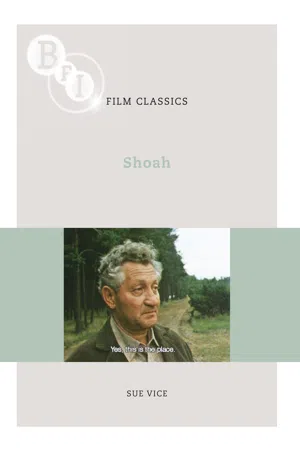
Shoah
About this book
Claude Lanzmann's epic 1985 film 'Shoah' tells the story of the Holocaust through interviews with survivors of the extermination camps, bystanders who watched or participated in mass murder, and some of the perpetrators of genocide. Sue Vice addresses Lanzmann's central role in the film and the issue of representing the unrepresentable.
Information
1 Lanzmann as Film-maker
Lanzmann’s 2009 autobiography, Le Lièvre de Patagonie, is named for the wily Patagonian hare with which its author clearly identifies. In Le Lièvre he paints a portrait of himself as a man of action as well as a central figure in French post-war intellectual life. Lanzmann fought with the French resistance in 1944 at the age of eighteen, flew with a daredevil Israeli fighter pilot while making his 1994 film Tsahal, and was a natural in the saddle when he tried his hand at horse-riding. Although Lanzmann is best known, particularly outside France, as a film-maker, he first made his name as a writer. Lanzmann describes his hesitation at embarking on the project of Pourquoi Israel, having never taken a single course on film-making.7 Rather, his training was philosophical. As a student after the war, Lanzmann wrote a postgraduate thesis on the impossibility of choice in Leibniz’s work, of which he drily observes: ‘It’s not by chance that Shoah runs for nine and a half hours.’8 It was as the result of a series of articles published in Le Monde in 1952 on the continuing presence of Nazism in German higher education, drawing on his time spent teaching and studying at the universities of Tübigen and Berlin, that Lanzmann was invited by Jean-Paul Sartre to work on the radical journal Les Temps modernes, of which he is the editorial director to this day. Lanzmann became a close colleague and friend of Jean-Paul Sartre, and was for several years Simone de Beauvoir’s (one and only) live-in lover. He spent many years as an investigative writer for a variety of publications, including Les Temps modernes, Le Monde, Elle and L’Express, covering a great range of contemporary subjects including life in North Korea and China in the 1950s, the life of the Dalai Lama, the fight for independence in Algeria, as well as the faits divers of assorted crimes and legal trials. It is tempting to see in this range the seeds of Shoah’s methodology of approaching a historical event by means of small, concrete details.
Lanzmann’s high regard for Sartre as a man and as a thinker is evident throughout his autobiography, although he tried (fruitlessly) to prevent his sister Évélyne becoming the philosopher’s lover: thus both Sartre and de Beauvoir ended up with, as Frederic Raphael pithily puts it, ‘a pet Lanzmann’. Raphael goes on to claim that Shoah could be seen as a ripose of sorts to Sartre’s disembodied view of Jewish life in his Anti-Semite and Jew.9 Lanzmann recounts with obvious relish Sartre’s comment, having seen Shoah, that its director showed that Jews are not simply the construction of antisemitism. A decisive event for Lanzmann was a commission to write a series of articles for Le Monde on Israel in 1952. After a long visit to the new state, he decided that a journalistic format was not suitable for a topic that had such personal resonance for him. He rejected Sartre’s advice to write a book on the subject, and a visit to Suez in the late 1960s to make a film for French television inspired him to turn to film-making instead. The result was Pourquoi Israel, Lanzmann’s first feature. The format of editing together interviews from a range of sources without an authoritative voiceover is used here by Lanzmann for the first time, as a way of representing irreconcilable views and perspectives on the subject. Pourquoi Israel was released in October 1973, just at the time of the Yom Kippur War in which Israel eventually gained the upper hand over the attacking Egyptian and Syrian armies.
Both parts of Lanzmann’s persona, the man of action and the intellectual, are evident in his on-screen persona as interviewer and auteur – and, some would say, film-star10 – in all his films but most strikingly in Shoah. He is often present in both the mise en scène and soundtrack of Shoah at personal risk to himself, for instance in the secretly filmed sequences with former Nazis, and as part of a film-making philosophy that lays bare the mechanisms of question and answer.
In Le Lièvre de Patagonie, Lanzmann observes that he is the ‘absolute contemporary’ of the Holocaust years. Born in Clermont-Ferrand, Paris, in 1925 to first-generation French citizens Armand and Paulette and raised in a secular Jewish household, Lanzmann was fourteen when the war began, and he recounts how the Nazis’ racial policies affected his family. Lanzmann père dug a hiding-place in the garden and made Claude, his brother Jacques and sister Évélyne practise until they were able to dress silently and leave the house within moments of waking in the night, in case the Gestapo should appear at the door.11 Yet, despite living under such a threat, until he began work on Shoah Lanzmann saw the Holocaust itself as ‘legendary’ rather than a historical event or one to which he was a direct witness. Tellingly, he describes seeing a column of Ukrainian refugees in the immediate aftermath of the war whom he later came to realise were fleeing the Polish death camps where they had been guards; his view of the Holocaust itself was distant and oblique. Critics have regretted the absence from Shoah of any interviewee from occupied western Europe, particularly considering Lanzmann’s experience of Vichy France,12 but this experience does not fit the film’s philosophical or aesthetic concerns. Shoah is about the industrialised mass death of the Holocaust years,13 and its form is constructed to represent this genocide although not to show it. It is about the witness and remembrance of an attempted total destruction. Lanzmann approaches the subject of mass death by means of interviews with those who were the closest witnesses to the process of industrialised killing set alongside footage of the locations of death in the present day. Hence his reliance on two particular kinds of shot construction: the zoom, used in close-ups of witnesses’ faces and the details of buildings and landscapes, and, by contrast, the tracking shots of landscapes and train-lines, which re-enact the experience of a deathly journey.
Lanzmann shot around 350 hours of footage for Shoah and rigorously edited this material into the nine-and-a-half-hour-long feature film that was released in 1985. During the long years of filming Shoah, Lanzmann travelled to fourteen countries and interviewed over fifty individuals. Some, including Abraham Bomba, who had worked as a barber at the death camp Treblinka, took years of painstaking research to track down, while others, such as the former Nazis Franz Schalling, who had been a guard at the death camp Chelmno, and Walter Stier, who was responsible for the railway system of Nazi Germany, were filmed without their knowledge. In Shoah we see Lanzmann’s encounters with survivors, bystanders and perpetrators; he also interviewed others with less easily definable connections to the events of the Holocaust, including Jan Karski, former courier to the Polish government in exile; Albert Spiess, prosecutor at the 1960 Treblinka trial; and the historian Raul Hilberg. But Shoah does not simply amount to a series of interviews. The project was mooted by Alouf Hareven, a member of the Israeli foreign office, who argued that on the strength of his earlier Pourquoi Israel Lanzmann was the only film-maker capable of creating a film that would ‘not be about the Shoah but which would be the Shoah’.14 In other words, the film would itself constitute a piece of reality and not be simply a reflection of it.
Lanzmann conceived of this commission in terms of a philosophical and filmic meditation on, and investigation of, an unprecedented crime. Although the film’s form – its editing, shot construction, soundtrack – is crucial to that project, its look was also determined by the difficulty Lanzmann experienced in funding the film. He relied upon French and Israeli sources, and describes the process of putting together sufficient financial support as a constant ‘relay’ in which the torch of funding was passed from one sponsor to another, many of whom were personal friends.15 Despite a gruelling schedule of visits to many American cities, Lanzmann describes himself with a mixture of pride and ruefulness as a ‘terrible fund-raiser’, unable to respond when asked what the ‘message’ of his film would be: thus ‘there wasn’t a single American dollar in Shoah’s budget’.16 According to an interview with the director just after the film’s release, it cost between $3 and $4 million to make, and Lanzmann had to take out a loan of 4 million francs to complete it.17 For reasons of economy, as well as his commitment to simplicity, all of the footage, apart from that recorded secretly, was shot using a single 16mm camera which meant a change of reel every eleven minutes. Lanzmann insisted on recording the soundtrack at the same time as the image and making no post-production changes to either, apart from ordering and cutting the 350 hours of footage, so as to preserve the authenticity of how, and for how long, utterance takes place. With typical aesthetic and ethical forthrightness, the director declares, ‘It’s the assassination of time that is immoral!’, seen most typically in televisual editing where material can be cut and juxtaposed to construct a particular argument.18 Lanzmann presents himself as an auteur whose individual creative vision is imprinted on his films.
In an interview with Max Dax about Tsahal, his film on the Israeli army, Lanzmann explains that his aim is not to present a balanced, rounded version of historical fact, but rather an aesthetic, auteurist vision. He contrasts the material in the outtakes of Shoah, held at the United States Holocaust Memorial Museum, which has the status of raw data, with the artefact that is the final cut: ‘I am the creator, director and author of Shoah.’19 Although he often appears, of necessity, on screen, Lanzmann was also always responsible for the set-up of the shot, its framing and construction. When Lanzmann was not able to conduct the filming himself, he developed a system of gesture and touch to signal to the cameraman what he wanted.20 The constraints of location filming could sometimes be turned to advantage, as in the case of the apparently insoluble conundrum of how to film in Chelmno, a ‘peasant village of absolutely no beauty’, where low terraced houses crowded along each side of the main street. Lanzmann decided to film from a horse-and-cart, and we see the result in the footage of Chelmno that accompanies the interviews with Srebnik and with Frau Michelson, wife of the Nazi schoolteacher stationed there: ‘the camera could include in a single frame the muddy road, the houses, the church, the rump and tail of the horse … the regular beat of hooves on the asphalt making Frau Michelson’s words even more horrifying’.21
In his autobiography Lanzmann describes how he chose those he interviewed, and then ‘the exceptional personalities’22 from among these interviewees whom he included in the final cut of Shoah. These include the three survivor ‘heroes’, to use Lanzmann’s term, Richard Glazar, Filip Müller and Rudolf Vrba, who, as Czechs, were among the first to be deported; as well as individuals such as Karski, Bomba and Srebnik, whose interviews are the best known and most widely discussed. Lanzmann located his ‘heroes’ and other protagonists through a variety of means. Reading the transcripts of the Treblinka trial held in Frankfurt in 1960 led him to Glazar and Suchomel, while the West German justice agency in Ludwigsburg dedicated to tracking down former Nazis furnished him with the names of those who had been perpetrators. Some of the former Nazis who appear in Shoah, including Suchomel and Stier, were paid to be interviewed, much to the chagrin of Lanzmann’s cinematographer William Lubtchansky, whose father had died in Auschwitz and who questioned the ethics of acting hospitably towards such individuals. Almost all of the Jewish ‘protagonists’ in the film are former Sonderkommando members, those who were responsible for the disposal of the bodies and belongings of people who were gassed, because they are ‘the only direct witnesses of the extermination of their people’.23 Lanzmann’s reading of Hilberg’s historical account, The Destruction of the European Jews, which does not focus on the voices of survivors but describes and cites ‘the Nazi protagonists’, convinced him that he could not make such a film without also featuring in it the killers.24...
Table of contents
- Title Page
- Contents
- Acknowledgments
- Introduction
- 1 Lanzmann as Film-maker
- 2 Documentary or ‘fiction of the real’?
- 3 Archive Footage
- 4 ‘Reincarnating’ the Past
- 5 Mise en scène
- 6 Lanzmann as Interviewer
- 7 Poland: The Ethics of Filming
- 8 Testimony
- Appendix: Overview of Shoah
- Notes
- Credits
- Bibliography
- eCopyright
Trusted by 375,005 students
Access to over 1.5 million titles for a fair monthly price.
Study more efficiently using our study tools.
Frequently asked questions
Yes, you can cancel anytime from the Subscription tab in your account settings on the Perlego website. Your subscription will stay active until the end of your current billing period. Learn how to cancel your subscription
No, books cannot be downloaded as external files, such as PDFs, for use outside of Perlego. However, you can download books within the Perlego app for offline reading on mobile or tablet. Learn how to download books offline
Perlego offers two plans: Essential and Complete
- Essential is ideal for learners and professionals who enjoy exploring a wide range of subjects. Access the Essential Library with 800,000+ trusted titles and best-sellers across business, personal growth, and the humanities. Includes unlimited reading time and Standard Read Aloud voice.
- Complete: Perfect for advanced learners and researchers needing full, unrestricted access. Unlock 1.5M+ books across hundreds of subjects, including academic and specialized titles. The Complete Plan also includes advanced features like Premium Read Aloud and Research Assistant.
We are an online textbook subscription service, where you can get access to an entire online library for less than the price of a single book per month. With over 1.5 million books across 990+ topics, we’ve got you covered! Learn about our mission
Look out for the read-aloud symbol on your next book to see if you can listen to it. The read-aloud tool reads text aloud for you, highlighting the text as it is being read. You can pause it, speed it up and slow it down. Learn more about Read Aloud
Yes! You can use the Perlego app on both iOS and Android devices to read anytime, anywhere — even offline. Perfect for commutes or when you’re on the go.
Please note we cannot support devices running on iOS 13 and Android 7 or earlier. Learn more about using the app
Please note we cannot support devices running on iOS 13 and Android 7 or earlier. Learn more about using the app
Yes, you can access Shoah by Sue Vice in PDF and/or ePUB format, as well as other popular books in Media & Performing Arts & Film History & Criticism. We have over 1.5 million books available in our catalogue for you to explore.