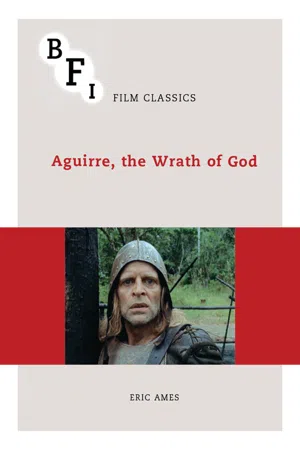
Eric Ames draws on original archival research to provide fresh perspectives on Werner Herzog's breakthrough 1972 film, Aguirre, the Wrath of God (Aguirre, der Zorn Gottes), which portrays an expedition by Spanish conquistadors led by Aguirre (played by Klaus Kinski) to find the legendary city of El Dorado. Ames explores how the film is remembered: for its breathtaking visual style and narrative power, but also for Herzog's tense, behind-the-scenes relationship with star Kinski. Did Herzog really direct him at gunpoint? Did they plot each other's murder? The legends begin here …
Ames reconstructs the film as an experiment in visualising the past from the viewpoint of the present. Aguirre is not a history film in the narrow sense, but it does engage a specific episode in the conquest of the New World, and it explores that history in terms of vision. Interweaving close analysis with extensive archival research, Ames explores Aguirre as a seminal film about the madness and hopelessness of Western striving. In addition, as an appendix, he offers for the first time a complete translation of an infamous, secretly recorded argument between Herzog and Kinski on the set.
- 96 pages
- English
- ePUB (mobile friendly)
- Available on iOS & Android
eBook - ePub
Aguirre, the Wrath of God
About this book
Information
1 Visionary History
‘A Film by Werner Herzog’ holds a promise that originates with this one from 1972. Aguirre, the Wrath of God/Aguirre, der Zorn Gottes (1972) is and perhaps always will be the German director’s most important film, a source of tremendous influence not only on other directors and films (Francis Ford Coppola’s Apocalypse Now [1979] being only the most well-known example), but also within Herzog’s own body of work, even on his documentaries, such as The Great Ecstasy of Woodcarver Steiner (1973), Little Dieter Needs to Fly (1997) and Grizzly Man (2005). Over time, Aguirre has become a ‘classic’ in many different senses of the word: as a film that inspires repeated viewings and new discoveries with each pass; as a film that was made in a particular context, yet speaks to audiences across time and space; as a film to which the most diverse artists and authors refer; and as a film that seems to encompass the entire world, offering a way to see it through the lens of a camera.
What makes Aguirre so important? There are several things, some of them less obvious than others. Shot on location in the Amazon jungle, Aguirre took the historical adventure film out of the studio and moved it to the great outdoors. At the time of its release, the very experience of seeing ‘history’ from the perspective of a shoulder-mounted camera, its lens splashed with mud and water as the operator waded through swamps and floated down raging rivers – the experience of viewing itself was thrilling. As one reviewer put it, ‘If the conquistadors had brought a cameraman along with them, his footage might have looked like this.’1 From another perspective, that of the director, Aguirre marks Herzog’s international breakthrough. At home in West Germany he would remain little known, but in France, Italy, England, the United States and elsewhere, Herzog gained a surprising amount of attention, usually in association with the New German Cinema, and especially after Aguirre. In Paris, the film ran for more than twenty weeks straight at the famous Studio des Ursulines, the avant-garde theatre that premiered the work of Buñuel, Vigo and Vertov, among others. Though it never entered the commercial mainstream, Aguirre put Herzog on the map of world cinema. He was just twenty-eight years old when he began planning it. But the film’s importance also derives from his tense relationship on the set with the notoriously difficult actor Klaus Kinski. Did Herzog really direct him at gunpoint? Did they plot each other’s murder? The legends begin here. The very blurring of the film with the ordeal of its production makes Aguirre a key to understanding Herzog’s work. In a way, he has returned to this film again and again, making Fitzcarraldo (1982), Wings of Hope (1999), My Best Fiend (1999) and My Son, My Son, What Have Ye Done (2009), all on or around the same locations in Peru. Add to these the many other films he has made about survival – and death – in hostile environments, and the seminal role of Aguirre becomes clear.
At the time of its release, however, Aguirre was seen as ‘something of a departure for Herzog’. According to Tony Rayns in Sight & Sound, the film’s ‘relatively lavish budget’ of $370,000 reflected more than just the participation of Kinski: ‘Herzog has used it to engage – for the first time – in a specific historical reconstruction.’2 Much of the film is admittedly invented by Herzog. But some of it comes from historical sources. In order to understand what he does with this material, and what he invents, we need at least a sense of the history behind the film.

Herzog returns to Aguirre in My Best Fiend (1999)
According to the written accounts, of which there are many, Lope de Aguirre was born around 1511 to a family of poor but noble Basques. As a young man, he travelled from Spain to the New World in search of adventure and riches, departing from Seville, arriving at Cartagena de Indias in 1536 and continuing on to Peru. There, he found employment first as a horse trainer, then as a soldier of fortune. He participated in numerous revolts and fought for many different, even opposing, sides (the civil wars that followed the conquest of the Inca Empire involved various groups, not just Spaniards versus Indians). Physically, Aguirre was ‘of short stature, and sparely made, ill-featured, the face small and lean, beard black, with eyes like a hawk’s, and when he looked, he fixed them sternly, particularly when angry’.3 Lame in the left foot as a result of being shot by a crossbow, he walked with a limp.
Aguirre had been in Peru almost twenty-five years when he joined an expedition led by Pedro de Ursúa, an ambitious young nobleman who had made his reputation commanding a war against freed black slaves in Panama. Intent on becoming a conquistador on a par with Hernán Cortés and Francisco Pizarro, Ursúa acquired a licence in Lima to conquer El Dorado and Omagua, the legendary kingdoms of gold. The resulting expedition, one of the largest ever to explore the Amazon, consisted of 300 Spaniards, 100 mestizos (Indians who learned Spanish), 600 Indian servants and 20 African slaves (men and women). It also included a number of mestizas (women of mixed descent, Indian and Spanish), most notably Aguirre’s teenage daughter, Elvira, and Ursúa’s beautiful mistress, Inés de Atienza. But even before it began, the expedition went awry. An advance party, sent out to gather provisions, slaughtered a group of peaceful natives – news that quickly spread, so that the expedition would later encounter many abandoned villages. Back upstream, Ursúa’s men worked for months building ships, all but one of which sank upon launching. To avoid further delay, they built canoes and rafts to accommodate the people, and abandoned their livestock and luggage.
On 26 September 1560, the expedition departed from its jungle base camp to head downriver. By the year’s end, having made little progress under increasingly drastic living conditions, discontent led to mutiny. A group of soldiers, including Aguirre and a young nobleman named Fernando de Guzmán, assassinated Ursúa on New Year’s Day. Later, they murdered his mistress. Taking command of the expedition, the rebels named Guzmán prince of Peru and all Tierra Firme, and swore their allegiance to him (as opposed to the Spanish king). They also changed their objective: rather than chase a fantasy through the wilderness, they would return and reconquer Peru.
As the journey continued, so did the killing. ‘The cruise of Aguirre’, as chroniclers called it, was marked by the bodies of all those shot, strangled or garrotted – no fewer than sixty Spaniards – on various charges, real and invented. Guzmán himself, seven of his followers and a priest would soon be murdered, as would everyone suspected of conspiring against Aguirre. After the killing of Guzmán, in an impassioned speech, Aguirre declared himself to be the ‘wrath of God’, ‘prince of liberty’ and ruler of all the West Indies. Months later, having reached the Atlantic Ocean, the mutineers sailed to the island of Margarita, in Venezuela, where the atrocities multiplied in scale, number and capriciousness: the troops destroyed towns, pillaged estates and murdered civilians as they went. Moving inland, they reached the town of Valencia, where Aguirre proclaimed the country’s liberation and wrote an infamous letter to King Philip II. In it, he declared war on Spain, offered advice on how to administer the colonies, condemned the injustices of the vassal relationship and lamented the corruption of judges and missionaries, all the while boasting of his own crimes and virtues. The end came little more than a year later, on 27 October 1561, when, surrounded by loyalist troops, his soldiers deserted him. First, Aguirre stabbed and killed his own daughter, so that she wouldn’t be raped by soldiers. Then he was shot and killed by his own men, his body quartered and put on display along with his banners, the garments worn by his daughter and the dagger he used to kill her.4
The body count alone makes it easy to see why commentators frame the expedition in extreme terms. German explorer Alexander von Humboldt calls it ‘one of the most dramatic episodes of the history of the conquest’.5 With this expedition, writes British geographer Clements Markham, ‘all that is wildest, most romantic, most desperate, most appalling in the annals of Spanish enterprise seems to culminate in one wild orgie of madness and blood’.6 The perception of Aguirre himself becomes wildly exaggerated. American author Robert Silverberg (using a pseudonym) describes him as ‘perhaps the single most villainous figure in the annals of the Spanish conquest’. Writing after the Holocaust, Silverberg goes further: ‘Very much like Hitler in his bunker in Berlin in the spring of 1945, Aguirre refused to listen to any talk of defeat, urged his men wildly on to renewed confidence, and slaughtered anyone whose faith seemed to waver.’7
The widespread use of extreme hyperbole, however, points to a creative dynamic of fictionalisation that comes from the source material itself. Many documents narrating the expedition have been preserved, including ten reports written by soldiers and presented to legal authorities. All these reports, as Beatriz Pastor Bodmer observes, were written for the purpose of justifying the author’s ‘highly questionable involvement or direct participation in the uprising’. In order to prove his innocence, every writer had to separate himself from Aguirre and assert his loyalty to the king by condemning both the rebellion and its participants. So Aguirre and his followers ‘are characterized in absolutely negative terms’.8 Desperate efforts to win mercy from royal authorities, first-hand accounts can afford no room for ambiguity. On the contrary, Bodmer explains, ‘every aspect of rebellion must be misrepresented’ in order for Aguirre alone to be responsible.9 In a further twist, one that also has implications for our understanding of Herzog’s film, these documents have generally been taken at face value. Though written as narratives of self-exculpation, over time they have become factual accounts and recycled as such by other commentators, from Renaissance chroniclers to nineteenth-century historians, to contemporary authors and film directors.10
Herzog says that he found this material by chance, stumbling across a book about adventurers and discoverers, in which Aguirre receives a mere ten lines, the implication being that his story is essentially fabricated, the film created ex nihilo.11 But he must have read some of the historical materials, if only to find the film’s subtitle. That Aguirre once called himself ‘the wrath of God’ (ira de Dios) was not widely known before the appearance of Herzog’s film.12 Herzog certainly had access to a transcription of Aguirre’s letter to King Philip, even if he changed its content for the film.13 His unpublished ‘Preliminary Remarks on the Screenplay’ identify specific differences between the proposed film and its historical sources – a move that he makes in early interviews as well.14 Speaking with journalists in Peru, for instance, Herzog acknowledges that the film ‘deliberately confused some of Aguirre’s history with that of [Francisco de] Orellana’.15 The screenplay also demonstrates familiarity with the expeditions of Cortés and Pizarro, among others. All claims to the contrary notwithstanding, Herzog works with historical sources and adapts them to his own particular vision. The resulting film is more than just ‘fabricated’. It is an experiment in visualising the past from the viewpoint of the present and about seeing the world through the lens of a camera.
This book proceeds from the conviction that Aguirre deserves a closer, more sustained appraisal than it usually receives. As we work our way through the scenes more or less chronologically, I will provide as much information as I can about the making of the film, some of it from Herzog’s production archive in Berlin. When I quote from the screenplay, I do so strategically, in order to demonstrate how Aguirre works as a film. And when I quote from historical reviews and interviews, I do so mainly in order to recover the language as well as the urgency that surrounded the film’s appearance, but also to pursue leads that commentators since then have either overlooked or neglected.
Only by doing both close analysis and archival research did I come to understand how Aguirre engages the problem of vision in its relation to history. Both terms are doubled. Vision refers to images both internal and external, while history refers both to the past and to, simply, a story. Aguirre tells a story more clearly and explicitly than any of Herzog’s previous films. For this reason, critics regarded it as his most accessible film to date.16 And yet, the story is told through an elaborate choreography of magnified faces and looks that engages our own experience as film viewers. Aguirre is not a history film in the narrow sense, but it is based...
Table of contents
- Cover Page
- Title Page
- Contents
- Acknowledgments
- 1. Visionary History
- 2. The Descent
- 3. Assembling the Troops
- 4. Visions of the World
- 5. The Act of Conquest
- 6. Into the Quiet
- 7. Hallucination
- 8. Aguirre Lives
- Appendix: Shooting with Kinski
- Notes
- Credits
- eCopyright
Trusted by 375,005 students
Access to over 1.5 million titles for a fair monthly price.
Study more efficiently using our study tools.
Frequently asked questions
Yes, you can cancel anytime from the Subscription tab in your account settings on the Perlego website. Your subscription will stay active until the end of your current billing period. Learn how to cancel your subscription
No, books cannot be downloaded as external files, such as PDFs, for use outside of Perlego. However, you can download books within the Perlego app for offline reading on mobile or tablet. Learn how to download books offline
Perlego offers two plans: Essential and Complete
- Essential is ideal for learners and professionals who enjoy exploring a wide range of subjects. Access the Essential Library with 800,000+ trusted titles and best-sellers across business, personal growth, and the humanities. Includes unlimited reading time and Standard Read Aloud voice.
- Complete: Perfect for advanced learners and researchers needing full, unrestricted access. Unlock 1.5M+ books across hundreds of subjects, including academic and specialized titles. The Complete Plan also includes advanced features like Premium Read Aloud and Research Assistant.
We are an online textbook subscription service, where you can get access to an entire online library for less than the price of a single book per month. With over 1.5 million books across 990+ topics, we’ve got you covered! Learn about our mission
Look out for the read-aloud symbol on your next book to see if you can listen to it. The read-aloud tool reads text aloud for you, highlighting the text as it is being read. You can pause it, speed it up and slow it down. Learn more about Read Aloud
Yes! You can use the Perlego app on both iOS and Android devices to read anytime, anywhere — even offline. Perfect for commutes or when you’re on the go.
Please note we cannot support devices running on iOS 13 and Android 7 or earlier. Learn more about using the app
Please note we cannot support devices running on iOS 13 and Android 7 or earlier. Learn more about using the app
Yes, you can access Aguirre, the Wrath of God by Eric Ames in PDF and/or ePUB format, as well as other popular books in Media & Performing Arts & Film & Video. We have over 1.5 million books available in our catalogue for you to explore.