eBook - ePub
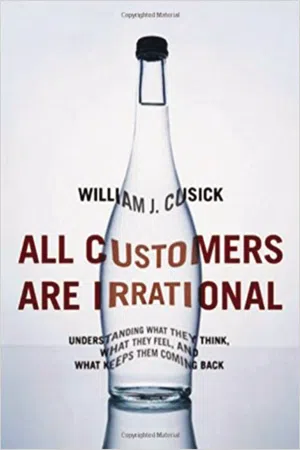
All Customers Are Irrational
Understanding What They Think, What They Feel, and What Keeps Them Coming Back
- 240 pages
- English
- ePUB (mobile friendly)
- Available on iOS & Android
eBook - ePub
All Customers Are Irrational
Understanding What They Think, What They Feel, and What Keeps Them Coming Back
About this book
As many businesses are discovering, customer behavior doesn't always make sense. That really shouldn't be surprising. As recent studies have shown, people tend to base their decisions on more subconscious, emotional desires than on rational, practical choices. What's more, customers aren't able to tell you accurately why they do what they do. Combining recent research findings with real-world examples from his consulting practice on customer experience, William J. Cusick examines how the subconscious part of the brain drives the decisions and behavior of every customer on a daily basis and introduces the concept of "the irrational customer." All Customers Are Irrational shows why businesses must change their approach to attracting and retaining customers, and proposes ways they can alter their strategies on everything from customer research, product design and website development to call center management, employee recruitment, and retail store layouts, by focusing on what customers are actually doing instead of what they're saying. Honest, direct and insightful, All Customers Are Irrational will help businesses tap into the impulses and motivations that both attract and retain consumers for the long haul.
Information
Subtopic
Consumer BehaviourIndex
BusinessPart
I
A New World:
The Economics and
Mechanics of Irrational
Customers
Chapter 1
The Bottom Line: Why
Customer Experience
Really Matters
Your customers are your only profit center.Marshall Field
Given that we are all, on some level, irrational customers, throughout this book we’ll be exploring how it’s possible to create powerful, emotional, irrational experiences that drive key customer behaviors and, ultimately, profit.
But first, you might be asking yourself: Who cares? After all, companies have been profitable for decades—even centuries—by taking a business-like approach to delivering acceptable customer service and customer communications, if they have paid attention to customer experience at all. In fact, most companies have achieved success by focusing almost exclusively on customer acquisition, the hunt for the new customer. Year after year, budgets for marketing, advertising, and prospecting swell with the goal of increasing amorphous categories like “awareness” and “mindshare.” Customer experience has been an afterthought.
But your customers can no longer be ignored! They’re important. There are compelling social, technological, and economic reasons to pay more attention to how you design your customer research, processes, products, and communications.
It’s no longer just about acquisition. The numbers, as we’ll see in this chapter, bear this out. But more important, how you sell to, and interact with, your customers, has changed. That’s because your customers—just like you—think and act in an emotional, irrational manner. Our brains are funny. We have odd ways of viewing the world. Context matters. Words matter. How you ask customers about their feelings matters. And whether you pay attention, and interact in ways that connect with that irrationality, matters.
It’s Comcastic! How Times
Have Changed
Stop me if you’ve heard this one: Several years ago, in November 2006, a Comcast technician arrived at a customer’s apartment on a service call to replace the customer’s modem. Apparently, the technician ran into a problem, and called into the Comcast service line. If you have any type of cable television or broadband computer connection, you’ve probably had a similar experience. It turns out the technician (being paid by Comcast) was put on hold (by Comcast) . . . for a long time.
At some point, the customer wandered in to his living room to find the technician sitting on his couch—phone to his ear, laptop open and leaning precariously on his knee, his head lolling back and a soft snoring noise emitting from his open mouth.
A few years ago, this would have resulted in one teed-off or amused customer (depending on one’s personality), who may well have told a few people about his experience when the subject of cable or Internet connections arose. It would have been a negative incident for the company that had almost no repercussions, one lonely tree falling in a forest, with nobody around.
But times have changed. We are now living and working in a Web 2.0 world. So instead of shrugging it off, the customer quietly popped open his digital video recorder and filmed a few minutes of the inert, snoring Comcast technician. He then loaded it to his computer and added a few simple graphics explaining the context that he spliced in throughout the video:
“A Comcast technician came to replace my cable modem,”“He spent over an hour on hold with Comcast.”“He fell asleep on my couch.”(Then the customer got angry).“Thanks, Comcast . . .”“. . . for high prices”“. . . for three missed appointments”“. . . for promising to call back, and then not calling.”“Thanks, Comcast, for everything.”
Next, he posted the video on YouTube. You can still see it there, along with the thousands of comments from among its 1.2 million viewers (as of this writing). The popularity of the video made it a broader news story, appearing (or at least mentioned) on countless news broadcasts around the country.
What’s really amazing is the shelf-life of this thorn in Comcast’s side. As opposed to an angry letter, or even an item that appears on the evening news once, the video lives on. Even now, more than two years later, there are comments posted on YouTube every day. The majority of them relate primarily to other customers’ frustrations with—and in some cases, hatred of—Comcast in all its different markets and manifestations.
Although the public relations damage to Comcast was significant, the company either had no reaction or whatever reaction it did have was undetectable. At the time, Comcast enjoyed a near-monopoly in many markets, at least for cable television service, and didn’t appear overly concerned. Since then, however, as a result of more deregulation in the industry, competition has heated up, and customers have a choice of which cable, computer, and phone companies to do business with. The experience of Comcast customers now has a real and direct impact on the bottom line.
If you read what many customers have to say—not just on YouTube, but around the various virtual corners, watercoolers, and assorted other Internet forums where people gather to chat—it seems that Comcast is truly a poster child for poor, and sometime egregious, customer service.
So, do customers matter? I think you know the answer.
Are Companies Getting the Hint?
Even a company as seemingly indifferent to customer experience as Comcast is finally getting the message. It has recently asked several employees to leverage online Web 2.0 tools and forums like Twitter (the online “micro-blogging” social networking site) to monitor just what folks are saying about the company. Specifically, people like @comcastcares are now part of the discussion reaching out in real time to those who are complaining about specific service issues. The beauty is that the few Comcast people involved seem to have the power—or at least access within the labrynthine catacombs of Comcast’s service structure—and the inclination to quickly help disgruntled customers get a resolution to an issue or problem.
This could be a dangerous move if seen by online users as disingenuous or simply a public relations ploy. But by all indications thus far (including my own observations on Twitter), they are engaging in real dialogues with customers and trying to help them solve problems. The company is just starting to dig itself out of a large hole in terms of public perception. It’s safe to say that most consumers will not give Comcast the benefit of the doubt, given its track record. Still, overall it’s a great move and could start rapidly building good will among a core group of Comcast customers.
But time will tell.
A New Dynamic: Customers Bite Back
I don’t mean to be glib. It’s always mattered whether your customers stay or leave, whether they buy more, what they say about your company. But there is now a new dynamic at play. The stakes have been raised when you treat your customers like second-class citizens; customers now have the very real ability to affect your profitability—not just by leaving, not just by telling their friends, but by tapping into the power of the media. Be it YouTube, Facebook, MySpace, Twitter, LinkedIn, Digg, or other online social networks, an individual customer can now—based on a single experience—influence the perceptions and actions of millions of other customers as well as potential customers. Add to that the electronic connection that most of us now utilize through instant and text messaging, allowing for real-time and viral spreading of both good or bad experiences as well as the connections between social and mass media (like CNN i-reports), and the stakes grow significantly.
Yet this is a customer environment that senior management at many companies has still failed to grasp. By understanding these social and technological factors, companies can take advantage of them, exploiting them in ways that enhance customer experience and perception. The future is, indeed, now. If you know you need to pay attention to these new dynamics, but don’t know where to start, here’s a suggestion: Stroll up to the desks of some of your twenty-something employees. As you approach, you’ll see them close out their instant message conversation on their computer screen, minimize their Twitter screen, then hit “send” for the text message on their cell phone, put it down, take off their oversized earphones and hit “stop” on their i-pod, and look up expectantly at you.
They may have some ideas.
The Stunning Economics
of Customer Retention
Of course, it’s not just the sea change over the last few years in terms of access to information for the average consumer, or the instant connection to others through the various social media, that presents serious consequences—positive and negative—for today’s companies. Another aspect to consider is the sheer efficiency to be gained by devoting more resources and attention to your customer experience. The fact is that in most industries, any effort made to keep your best customers is exponentially more rewarding than your efforts to acquire new customers. How much more rewarding? In most industries, try three-, five-, even tenfold from a revenue and (more important) a profit standpoint.
The efficiencies are astonishing if you dig a little into the costs of acquiring a customer compared to working to simply keep a good one. For example, for every dollar you spend to keep a customer, you need to spend $5 to $10 to acquire a new one.1 In banking, research has shown that it costs over $200 for the acquisition of a new customer; meanwhile many banks lose 30 percent or more of their overall customer base every year—customers who would, theoretically, cost one-tenth of that $200 to keep.2 That’s your choice: $20 or $200? It’s even more pronounced in the cell phone industry. Acquisition costs top $300, and yet customer churn is rampant.3 Even more egregious: For many of these industries, customers are typically unprofitable through the first year, only hitting a breakeven point later in the relationship (if they stay).4 Yet these potentially valuable assets are walking out the door with little thought or effort put into retaining them.
The fact is that there is an exponential financial impact of focusing more on retention to drive growth. Yet companies still don’t get it. Here’s what I mean . . .
“Thank You, Sir. May I Have Another?”
Like many business people, I carry a Blackberry (no iPhone yet) around with me to stay in the loop by phone and email and, to some extent, instant and text messaging. (My employees and my wife sometimes get irritated when I shut it off so that I’m NOT connected, but that’s a different book.) A few months ago, my Blackberry Pearl started going batty, screen flickering, track-ing ball inoperable, suddenly shutting off. I wandered into a T-Mobile cellular store and the employee helpfully pulled the battery out and put it back in. “Seriously?” I wondered. That’s the solution? I had done this myself several times already, of course.
Several days and several store visits, software patches, and a new battery later, I was officially defeated. Striding to the counter I pronounced my device the sufferer of a terminal disease. A replacement was therefore required. The customer service employee—let’s call him Biff to be clear it’s a fictitious name—grimaced as he perused the screen of his computer. “Your warranty on this was up two weeks ago,” he said, shaking his head and feigning sympathy.
I felt my ire rising. “So you can’t replace it?” I asked. “We’ve been paying you guys a hefty monthly fee for this corporate account.” This was true.
Biff shrugged. “You’re going to have to buy a new one.” He waved his hand, both dismissing me and indicating the assorted phones arrayed throughout the store. I wandered over to the newer version of my model (same phone, but now in different colors!). The tag stated a price of $99. I shrugged and moved back to the counter.
“I guess I’ll go with the Blackberry Pearl,” I said, pointing at the phone that was identical to the one I was throwing away, except in blue.
“That will be $349,” Biff muttered.
I winced. “But,” I stammered. “The tag says $99.”
“That’s if you are a new customer and sign up for a T-Mobile contract.”
“But I already have a T-Mobile contr...
Table of contents
- Cover Page
- Title Page
- Copyright Page
- Dedication
- Contents
- Introduction
- Part I: A New World: The Economics and Mechanics Of Irrational Customers
- Part II: A Fresh Approach: Strategies and Tactics for Keeping Your Irrational Customers
- Notes
- Index
- About the Author
Trusted by 375,005 students
Access to over 1.5 million titles for a fair monthly price.
Study more efficiently using our study tools.
Frequently asked questions
Yes, you can cancel anytime from the Subscription tab in your account settings on the Perlego website. Your subscription will stay active until the end of your current billing period. Learn how to cancel your subscription
No, books cannot be downloaded as external files, such as PDFs, for use outside of Perlego. However, you can download books within the Perlego app for offline reading on mobile or tablet. Learn how to download books offline
Perlego offers two plans: Essential and Complete
- Essential is ideal for learners and professionals who enjoy exploring a wide range of subjects. Access the Essential Library with 800,000+ trusted titles and best-sellers across business, personal growth, and the humanities. Includes unlimited reading time and Standard Read Aloud voice.
- Complete: Perfect for advanced learners and researchers needing full, unrestricted access. Unlock 1.5M+ books across hundreds of subjects, including academic and specialized titles. The Complete Plan also includes advanced features like Premium Read Aloud and Research Assistant.
We are an online textbook subscription service, where you can get access to an entire online library for less than the price of a single book per month. With over 1.5 million books across 990+ topics, we’ve got you covered! Learn about our mission
Look out for the read-aloud symbol on your next book to see if you can listen to it. The read-aloud tool reads text aloud for you, highlighting the text as it is being read. You can pause it, speed it up and slow it down. Learn more about Read Aloud
Yes! You can use the Perlego app on both iOS and Android devices to read anytime, anywhere — even offline. Perfect for commutes or when you’re on the go.
Please note we cannot support devices running on iOS 13 and Android 7 or earlier. Learn more about using the app
Please note we cannot support devices running on iOS 13 and Android 7 or earlier. Learn more about using the app
Yes, you can access All Customers Are Irrational by William J. CUSICK in PDF and/or ePUB format, as well as other popular books in Business & Consumer Behaviour. We have over 1.5 million books available in our catalogue for you to explore.