If you’re in marketing, advertising, or branding, consider this: While it used to take three television spots for a product to register with its intended audience, it can now take as many as seventy. Are people simply tuning out marketing messages? No. They’re simply choosing which messages to tune in. Thanks to wireless technology, customers now have the luxury of responding (or not responding) to advertising when, where, and however they like. Leading companies such as Wal-Mart, McDonald’s, Starbucks, Kellogg’s, NBC, MTV, Procter & Gamble, DaimlerChrysler, and others are already reaching millions of customers, one at a time, wirelessly. The technology gives these companies an unprecedented view of buying patterns and the ability to identify and market specifically to the most likely customers. In Branding Unbound, author Rick Mathieson reveals how your business can emulate some of the most powerful and successful branding strategies in the world. In addition, Mathieson has conducted exclusive, insightful Q&As with some of the modern legends of cutting-edge marketing and business: * Seth Godin, author of Permission Marketing, Unleashing the Idea Virus, and Purple Cow, discusses permission marketing in a wireless landscape. * Tom Peters, ""the father of the postmodern corporation"" and author of The Brand You 50 and In Search of Excellence, offers the Peters Principles for the wireless era. * Don Peppers, world-renowned marketing thought leader and author of Enterprise One-to-One, talks about how mobility will alter the brand experience. * Christopher Locke, author of The Cluetrain Manifesto and Gonzo Marketing, presents a ""Cluetrain Manifesto"" for the Mobile Age. * Chet Huber, President of OnStar, describes how the demand for in-vehicle services and information will change drivers’ relationships with their vehicles. * Gary Hamel, Chairman of Strategos and author of Leading the Revolution and Competing for the Future, discusses the first priority of the wireless age: strategic transformation. * Howard Rheingold, author of Smart Mobs and The Virtual Community, champions the new ""self-organized entertainment"" of ""flash mobs."" Branding Unbound also offers a jargon-free look at current and emerging wireless technologies, examines the impact of social networking on mBranding strategy, and reveals the Top Ten Secrets of Successful Mobile Advertising. In the wireless marketing era, your brand can enjoy whole new levels of differentiation and customer recognition, while consumers benefit from on-the-spot convenience and a message individually tailored to their needs. Branding Unbound shows just how to harness the virtually limitless power of this amazing convergence of advanced technology and progressive business strategy to create the truly remarkable experience that will keep customers’ attention and win their loyalty.
eBook - ePub
Branding Unbound
The Future of Advertising, Sales, and the Brand Experience in the Wireless Age
- 256 pages
- English
- ePUB (mobile friendly)
- Available on iOS & Android
eBook - ePub
Branding Unbound
The Future of Advertising, Sales, and the Brand Experience in the Wireless Age
About this book
Information
Subtopic
AdvertisingIndex
BusinessCHAPTER ONE
The Rise of mBranding
If today is like most others, Darla Marcomb will spend a few leisurely hours gazing out at the sparkling ocean from one of eighteen bay windows in her sprawling seaside home.
But Marcomb, a controller for a San Francisco–area HMO, hasn’t exactly scored a palatial view of the Pacific from some pricey Bay-area mansion. Instead, her diversion is of the digital kind—perched within an astonishing online world simply known as There.
“I make the analogy that There is like an online Club Med,” she says. “It’s a place where you can go and do as little, or as much, as you want.”
At its most essential, There is an Internet chat room with an eye-popping twist: A visually rich, 3D virtual environment—a bucolic island motif—that is akin to immersing oneself in some Gen-Y fantasy of Disney-does-Hedonism-on-the-South Pacific.
There’s members select and customize so-called “avatars”—sophisticated cartoon character representations of themselves. They then proceed to race hover boards, fly jetpacks, play volleyball, explore a 6,000-kilometer world nearly the scale of Earth, or simply hang out and chat with family and friends.
Type in what you want to say, and text chat appears in comic book–style word balloons above your onscreen character’s head. In an especially appealing bit of creative flair, “emoticons”—the emotive keystrokes ubiquitous in e-mail and instant messaging conversations—are instantly translated into your character’s facial expressions.
The brainchild of former Electronic Arts wunderkind Will Harvey, There was launched after five years of development and over $37 million in investment capital from folks like Trip Hawkins, founder of Electronic Arts and mobile entertainment firm Digital Chocolate, and Jane Metcalfe and Louis Rosetto, cofounders of Wired magazine. Beyond the visual impact of this world, There is built from the ground up to help its members feed another fundamental human drive—the desire to make money.
Harvey and his team worked with an IMF economist to develop a working, laissez-faire economy based on Therebucks, a faux currency that members can buy for real dollars, with a conversion rate of something like 1,500 Therebucks per $1.
Buy a pair of virtual Levi’s jeans, and your character’s hipness quotient goes up. Buy a pair of virtual Nike AirMax shoes, and your character suddenly runs faster. It’s addicting: In her first nine months as a subscriber, Marcomb says she spent over $1,100 very real dollars to rent and furnish her house, and to buy clothes, hairdos, and other products for her avatar. “I’m really into fashion,” she says. “And I really like to shop.”
Like the half-dozen other online virtual worlds that have hit the Internet since the early 1990s, There is based on an amazing concept. Using an Internet connection, you, your friend in New York, your uncle in St. Louis, and your brother in Sydney can log on and play chess, chat by a campfire, even conduct business, while jacked into virtual versions of your real-world selves from anywhere on earth. It’s the Matrix without the lame dialogue.
“It’s a way for people to create meaningful relationships with other people—and have a lot of fun together—even though they aren’t geographically nearby,” explains Marcomb.
Of course, in a conversation about wireless, that notion will take on new meaning in an emerging anywhere, anytime world where we will one day be able to access such virtual worlds from mobile devices.
But There is far more than just that. Because what Marcomb and other members may not realize is that for all its amazing features, the imaginary world of There offers a very real glimpse of the future of wireless that will be of great interest even to those who couldn’t give a hoot about the virtual worlds of avatars and hover boards.
A BOOM WITH A VIEW
It’s the sunglasses. When you’re in There, you (as the invisible hand behind your character) use the computer screen built into your character’s sunglasses to instantly access a pervasive, always-on, global “wireless” network.
Once “logged on,” you can toggle between There’s “real world” and its “wireless Internet.” You can check your buddy list to see where your friends are, conduct transactions, join chat clubs, read news reports, view personal ads, rent dune buggies, place bids in auctions, and do an endless array of daily tasks from the beach, the back roads, or even above the clouds.
“The moment you see something you want, as instantly as the click of a button, it’s yours,” says Joe Laszlo, a senior analyst with Jupiter Research who has spent time in There. “That kind of instant gratification may well start to translate to the real world over the next couple of years as people get used to carrying around always-on data connections.” See Figures 1-1 and 1-2.
In our own real world, that’s what wireless is all about: empowering the user to interact—and transact—with people, places, even things via the most personal of devices.
The late Michael Dertouzos, director of MIT’s Laboratory for Computer Science, once explained to me that tricked-out glasses could very well be a popular mechanism by which we augment our experience of reality. Charmed Technologies is working on a host of such “wearable computing” devices, including glasses, necklaces, and wristwatches. Its first product: a conference badge that records the contact information of other “CharmBadge” wearers as they come into range, and relays the information to an Internet portal for later review. Meanwhile, Ars Electronica Futurelab in Linz, Austria, is even working on “smart glasses” for automobile windshields, called Information and Navigation Systems Through Augmented Reality (INSTAR).1 Designed to offer location-based information on nearby restaurants, hotels, gas stations, and other at tractions, INSTAR will even give directions to the desired destination as you drive the interstate.
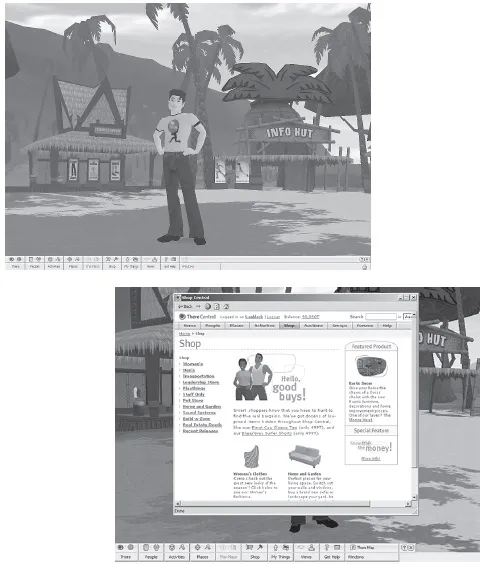
Figures 1-1 and 1-2. The 3D online world known as There offers a glimpse of a future where we can instantly toggle between the real world and a global, wireless Internet. Images courtesy of Forterra Systems.
These are just a few of the possibilities. In his 1997 book, What Will Be, Dertouzos predicted that within this century, all sort of networks will work seamlessly together, and we’ll all employ “BodyNets”—technology that provides an always-on mobile connection no matter where we go, via smart glasses or other devices. We’ll check e-mail and exchange personal contact information and even multimedia with our friends and colleagues while on the go; place transactions without ever reaching for a wallet or purse; and look like lunatics as we walk down the street jabbering away on hands-free phone calls.
“Seamless mobility . . . that’s where we think the future is headed,” is how Motorola chief technology officer Padmasree Warrior put it at a recent conference called AlwaysOn at Stanford University.2
Today, that vision is still a ways off (except for the part about looking like a fool on a hands-free call). And it remains to be seen what forms it all will take.
The cell phone or PDA, as we know them today, may go away, morph into whole new forms, or just get smaller and more functional.
The Canesta Projection Keyboard, for instance, turns any mobile device into a virtual computer by using a tiny pattern projector to create the image of a full-size keyboard on a flat surface in front of a cell phone or PDA. The technology can read your finger movements as you “type” on the projected keyboard in real-time—making e-mail, Web surfing, and other data-intensive applications more portable than ever, while creating whole new roles for these devices. A new breed of sub-sub notebooks like the FlipStart PC from Paul Allen’s Vulcan Ventures feature full PC functionality, powerful processors, and Wi-Fi connectivity in a compact device with a folding keyboard. Toshiba and others are rolling out wristwatch PDAs. And devices with larger screens and mini “qwerty” keyboards like the BlackBerry from RIM and the Hiptop from Danger have long been popular, as have hybrids from palmOne and Hewlett-Packard.
Regardless of the form, the combination of these devices, services, and emerging wireless networks mean the day of the “Body-Net” is coming—one that gives us access to a whole new world of services and capabilities.
MOBILE MARVELS
Some new services will be driven by type-based data entry. Craving a Steak Burrito Dos Manos with extra salsa from Baja Fresh? Already, cell phone users in Washington, D.C., can enter a short code on their cell phones, and 650 calories worth of gut-busting goodness will be waiting for them at the store’s no-cash, no-wait line.
Other services will be based on sound. Hear a song you like on TV or the radio? Today, AT&T Wireless subscribers can hit #43 on their cell phones, hold their handsets up to the speaker, and within seconds, they’ll receive the name of the artist and song so they can track it down for purchase.
Still other services will use that original human interface—the voice—to open up whole new possibilities. Novel solutions from Nuance, TellMe, and others already enable consumers to use virtually any cell phone to interface with computer systems and services that respond back in a human-like voice—complete with distinct personas, accents, and back stories. Delta Airline’s low-cost carrier, Song, uses such voice-recognition technology to power its 1-800-FLYSONG service. Customers can make reservations by interfacing with an idiosyncratic, computerized voice that makes quips and comments based on the airline’s fresh, cool brand identity.
“A few years from now, the phone call is going to be the lowest piece on the food chain,” says Kenny Hirschorn, the director of strategy, imagineering, and futurology for U.K.–based mobile carrier Orange, one of the many companies working on creating this wireless future. “Of course, we will still facilitate voice communication. But on a daily basis, we will also awaken you in the morning. We will read you your e-mail. We will start the oven. We will arrange your transportation to and from wherever you want to go. At the office, we will provide you with information and news. We will translate information into foreign languages, or translate information into your language for you. We will track your health. We will track the location of your family members, if that’s what you want. We’ll be your bank. We’ll proactively order the groceries. We’ll provide you entertainment and customized news. And we’ll even watch your home when you sleep at night, because we will be jacked in to the security system. Very little of that has anything to do with making a telephone call.”3
That’s not to say that the cell phone will necessarily become our universal, movies-music-games-communications device for these kinds of services.
More likely, new products and services will deliver different types of content and applications to different devices and appliances: digital music to your car, movies from your PC to any plasma screen (or even any wall) in the house, games and even e-mail to your Nokia N-Gage handset or wireless Game Boy, software upgrades to your refrigerator or dishwasher.
You may control many of these services from your handheld or from a traditional Web portal. Other emerging technologies, like machine-to-machine (M2M) solutions, may deliver these services to any number of devices based on preset preferences, automatically as they become available.
Even in the here and now, cell phones, PDAs, and wireless-enabled laptops grow smaller, lighter, and more powerful by the day, linking to newfangled networks that are rapidly creating a mesh of Web technologies that extend the Internet, with apologies to Visa, “everywhere you want to be.”
And most marketers have no idea what to do with it.
What does wireless mean to businesses trying to keep up with—and serve—the increasingly mobile masses? What happens when eyeballs we once aggregated by “gross ratings points” and “mass markets” now gather in micromarkets and “niches of one”? How do we redefine “advertising” and the “brand experience” when the most direct link to the consumer is less and less the 52-inch flat screen television in the living room, or the 17-inch PC monitor in the den or office, and more and more the completely personal, interactive device in the hands of virtually every man, w...
Table of contents
- Cover Page
- Title Page
- Copyright Page
- Dedication
- Contents
- Introduction
- Chapter One: The Rise of mBranding
- Q&A: Don Peppers: 1:1 Marketing Goes Wireless
- Chapter Two: Reach Out & Sell Someone: The Top 10 Secrets of Successful Mobile Advertising
- Q&A: Christopher Locke: “Cluetrain Manifesto” for the Mobile Age
- Chapter Three: Dialing for Dollars: M-Commerce Puts Sales In Motion
- Q&A: Gary Hamel: Leading the (Wireless) Revolution
- Chapter Four: A Moving Experience: The New World of Place-Based Marketing
- Q&A: Chet Huber: Driving Ambition
- Chapter Five: The Wireless Point of Persuasion: Shopping for Insights At the Store of the Future
- Q&A: Seth Godin: Permission Marketing and “My Own Private Idaho”
- Chapter Six: Service With a Stylus: Creating the Ultimate Guest Experience
- Q&A: Tom Peters: The Gospel According to St. Peters
- Chapter Seven: No Wires, New Rules: The Wireless World’s New Social Fabric—and What It Means to Marketers
- Q&A: Howard Rheingold: The Mobile Net’s New “Mob” Mentality
- Chapter Eight: Marketing 2020: The Future According to Spielberg
- Notes
- A Glossary of mBranding: A Quick Reference Guide
- Acknowledgments
- Index
- About the Author
Trusted by 375,005 students
Access to over 1.5 million titles for a fair monthly price.
Study more efficiently using our study tools.
Frequently asked questions
Yes, you can cancel anytime from the Subscription tab in your account settings on the Perlego website. Your subscription will stay active until the end of your current billing period. Learn how to cancel your subscription
No, books cannot be downloaded as external files, such as PDFs, for use outside of Perlego. However, you can download books within the Perlego app for offline reading on mobile or tablet. Learn how to download books offline
Perlego offers two plans: Essential and Complete
- Essential is ideal for learners and professionals who enjoy exploring a wide range of subjects. Access the Essential Library with 800,000+ trusted titles and best-sellers across business, personal growth, and the humanities. Includes unlimited reading time and Standard Read Aloud voice.
- Complete: Perfect for advanced learners and researchers needing full, unrestricted access. Unlock 1.5M+ books across hundreds of subjects, including academic and specialized titles. The Complete Plan also includes advanced features like Premium Read Aloud and Research Assistant.
We are an online textbook subscription service, where you can get access to an entire online library for less than the price of a single book per month. With over 1.5 million books across 990+ topics, we’ve got you covered! Learn about our mission
Look out for the read-aloud symbol on your next book to see if you can listen to it. The read-aloud tool reads text aloud for you, highlighting the text as it is being read. You can pause it, speed it up and slow it down. Learn more about Read Aloud
Yes! You can use the Perlego app on both iOS and Android devices to read anytime, anywhere — even offline. Perfect for commutes or when you’re on the go.
Please note we cannot support devices running on iOS 13 and Android 7 or earlier. Learn more about using the app
Please note we cannot support devices running on iOS 13 and Android 7 or earlier. Learn more about using the app
Yes, you can access Branding Unbound by Rick MathiesonR in PDF and/or ePUB format, as well as other popular books in Business & Advertising. We have over 1.5 million books available in our catalogue for you to explore.