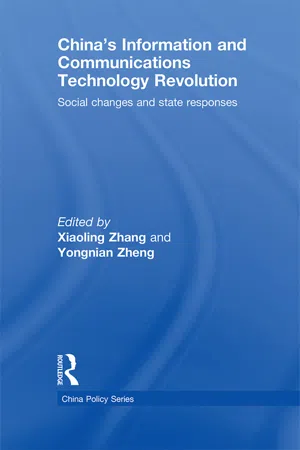
In recent years, China has experienced a revolution in information and communications technology (ICT), in 2003 surpassing the USA as the world's largest telephone market, and as of February 2008, the number of Chinese Internet users has become the largest in the world. At the same time, China has overtaken the USA as the world's biggest supplier of information technology goods. However, this transformation has occurred against the backdrop of a resolutely authoritarian political system and strict censorship by the Party-state. This book examines China's ICT revolution, exploring the social, cultural and political implications of China's transition to a more information-rich and communication-intensive society. The pace of the development of ICT in China has precipitated much speculation about political change and democratisation. This book explores the reality of ICT in China, showing clearly that whilst China remains a one-party state, with an ever-present and sophisticated regime of censorship, substantial social and political changes have taken place. It considers the ICT revolution in all its aspects, outlining the dominant trends, the impact on other countries of China as an ICT exporter, strategies of government censorship and use of ICT for propaganda, the implications of censorship for Chinese governance, the political implications of internet culture and blogging, and the role of domestic and foreign NGOs. Overall, this book is a vital resource for anyone seeking to understand a rapidly transforming China, both today and in the years to come.
eBook - ePub
China's Information and Communications Technology Revolution
Social changes and state responses
- 176 pages
- English
- ePUB (mobile friendly)
- Available on iOS & Android
eBook - ePub
China's Information and Communications Technology Revolution
Social changes and state responses
About this book
Trusted by 375,005 students
Access to over 1.5 million titles for a fair monthly price.
Study more efficiently using our study tools.
Information
1 Historical imagination in the study of Chinese digital civil society1
Guobin Yang
For years, media scholars have lamented the lack of historical methods and sensibilities in communication studies, especially in political communication. They have called for more attention to the culture and institutions of communication.2 Current studies of the Chinese Internet suffer from a similar deficit of historical imagination. This is partly because the Internet has only a short history in China. It is partly also because the Internet scene changes so fast that it may appear as a moving target. With the rush to catch the target, there is little time left to look back. But the Internet is no more a moving target than other social processes. Historical imagination is just as important for understanding it.
Historical imagination is not just about providing the historical background for what is happening at present. Nor is it about discovering historical precedents of a new phenomenon and thereby implying that nothing under the sun is new. Historical sociology views social formations as the outcomes of the interactions between social action and social structure. It is about how people make history under conditions not of their own making. Such analysis is about changes and processes. In them, the past is neither just data nor background, but the very conditions that constitute the present.3
One way of infusing historical imagination into studies of the Chinese Internet is to stop viewing its history as a continuous flow of time still unfolding before our eyes. Such a view ironically gives the wrong impression of an eternity and minimizes the sense of change. Although the history of the Internet in China is short, it is possible to analyze it by breaking it down into smaller sections using the strategy of periodization, thus making it possible to highlight both continuities and discontinuities and to identify their underlying conditions. It can reveal change.
My analysis will focus on digital civil society, a new social formation that has emerged from the interactions between the Internet and civil society. I will make a distinction between two periods of digital civil society development in China. The period of emergence dates from the mid-1990s to 2002. Beginning in 2003, Chinese digital civil society entered a stage of expansion. The two periods evince the same logic of complex interactions among multiple actors, especially the interactions among the state, market and civil society actors. This explains both the emergence of digital civil society in the first period and its expansion in the second. Yet the dynamics of interactions assume some new features in the second period with all the major actors modifying their strategies, partly in response to the first stage of development. This complicates the interaction dynamics in the second stage.
The logic of complex interdependence and the origins of digital civil society
Lester M. Salamon and Helmut K. Anheier proposed an influential “social origins” theory of civil society to explain national variations in non-profit sector development. Their theory is instructive for understanding the development of a Chinese digital civil society. Salamon and Anheier argue that while most other theories are single-factor explanations, the “social origins theory” takes into account the complex constellation of conditions that shape the non-profit sector. They trace their theoretical roots to Barrington Moore’s theory of the origins of fascism and democracy and Esping-Anderson’s theory of the origins of the modern welfare state. As they put it,
complex social phenomena – for example, the emergence of the “welfare state” or “democracy” – cannot be easily understood as the product of the unilinear extension of a single factor, such as industrialization, diversity, or education. Rather, much more complex interrelationships among social classes and social institutions are involved.4
One weakness in current studies of the socio-political impact of the Internet is a focus on single factors – typically the Internet technology or the state. This leads to the ironical result of either exaggerating the influence of technology at the expense of politics or the other way round. The tensions, contradictions and synergies that arise out of the interactions among multiple arenas of technology, politics, culture, society and economy are often neglected. The formation of Chinese digital civil society is a historical process involving the interactions between civil society and the Internet under conditions of complex interdependence. These conditions provide the structure of opportunities and constraints for social action, but do not determine it. Rather, structure and action are mutually constitutive. This means that the historical formation of a Chinese digital civil society has no teleology. Its path is not predetermined but is open to struggle and negotiation.
Political, economic, technological and social conditions act on the development of digital civil society, but also react to it. Interaction is the dominant dynamics. The concept of complex interdependence helps to capture these interactions. Complex interdependence refers to the mutual influences among multiple actors. Developed for the study of international relations, the theory of complex interdependence originally refers to mutual influences resulting from “international transactions – flows of money, goods, people and messages across international boundaries.”5 The emphasis is on the interactions and interdependence among multiple actors and the ascending role of civil society actors.
The information revolution has changed one feature of complex interdependence by vastly increasing the number of channels of contact between societies.6 Because of the plenitude of free information, credibility becomes an essential basis of influence. Thus the influence of states will depend increasingly on their ability to remain credible. This ability can now be more easily challenged by non-state actors, however, because the information revolution gives citizens the means to transmit critical information across vast distances more easily.
The concept of complex interdependence can be extended to the study of national politics. In China, economic reform has moved Chinese society increasingly closer to conditions of complex interdependence. Whereas the state dominated Chinese economy and society in earlier times, the reform has brought about structural differentiation. A “halting” pluralism appeared that provided the structural conditions for the co-evolution of the Internet and civil society.7 Although the state remains dominant, it is increasingly subject to pressure from non-state actors such as business interests and citizens. Complex interdependence means that in the age of information, total control of information is impossible. The potential to expose false information and reveal hidden information always exists, while citizens and citizen groups will use multiple information channels to challenge state actors. As some scholars have argued, the media revolution has put constraints on the Chinese government even in foreign policy,8 a field that traditionally is insensitive to external pressure. It is in this context that the Internet and civil society have energized each other in their co-evolution, leading to the rise of a new social formation – a digital civil society.
Digital formations and Chinese digital civil society
Digital formations are social forms that emerge around and through the use of information technologies. In formulating this concept, Robert Latham and Saskia Sassen discuss such cases of digital formations as electronic markets, Internet-based large-scale conversations, and knowledge spaces arising out of NGO networks.9 A focus on digital formations has the advantage of avoiding technological determinism. A common form of technological determinism makes statements like “television has altered our world.”10 The Internet version of such statements would run like: “the Internet has altered our world.” Negative statements like “the Internet does not change anything” or “the Internet does not lead to democractization” are guided by similar assumptions of technological determinism. Indeed, they represent a more deceptive form of technological determinism because they make it appear as if they were opposed to it. An analytical focus on digital formations does not ask questions about the impact of the Internet per se. Instead, attention is directed at dynamics and outcomes of the interactions between technology and society. Such an analysis proceeds on the condition that the interactions have taken place for long enough to produce recognizable social formations.
The interactions between the Internet and Chinese civil society have been sustained for well over a decade. What are the main components of a Chinese digital civil society formation? When scholars talk about Chinese civil society, they focus, with varying degrees of emphasis, on civic organizations, popular resistance, or public channels and spaces for communication.11 An important recent study of Asian civil societies follows a similar conceptualization, where civil society is broadly defined to include all the above components:
as a distinct public sphere of organization, communication and reflective discourse, and governance among individuals and groups that take collective action deploying civil means to influence the state and its policies but not capture state power, and whose activities are not motivated by profit.12
Following this conceptualization, I will consider civic associations, civic spaces of communication and civic action as the core elements of civil society. With respect to civic associations, Chinese digital civil society encompasses the large numbers of online communities, web-based social networks and loose organizations, as well as the active online presence of offline civic associations. In terms of civic spaces of communication, it consists of numerous BBS forums, blogs and online magazines. Finally, I will consider Internet-based activism and contentious activities as the third element of a Chinese digital civil society.
Periodization and the study of the Chinese Internet
Periodization literally means identifying different periods of a historical process. It is based on the assumption that social processes have both continuities and discontinuities. By identifying periods, analysts can identify common and distinct features. As Bob Jessop puts it,
The main aim of any periodization is to interpret an otherwise undifferentiated “flow” of historical time by classifying events and/or processes in terms of their internal affinities and external differences in order to identify successive periods of relative invariance and the transitions between them.13
The criteria of periodization vary with the object of analysis. In some cases, historical periods are ready-made and the analyst simply follows existing schemes. Historians of the Cultural Revolution in China, for example, follow the officially established periodization of the Cultural Revolution as the decade from 1966 to 1976. Periodization is often contested because it can have important political implications. Thus for some analysts of the Cultural Revolution, it did not last until 1976 but ended in 1969. My point is that there are no “objective” criteria for cutting up history. And yet periodization is a useful way of framing history. In this sense, periodization serves the same function as a picture frame. It is best seen as a heuristic analytic tool.
Several attempts have been made to periodize the history of the Internet in China. The “official” attempt was made in a public exhibit about the development of the Internet. This exhibit was organized by the Chinese Internet Network Information Center on the occasion of the Third China Internet Conference in September 2004. The exhibit divided the history into five periods. The first period, from 1987 to 1994, was the exploratory stage.14 The second period, from 1994 to 1996, was called the stage of “readiness” (xushi daifa). Between 1996 and 1998, the third period, the Internet began to take off. The fourth period was from 1999 to 2002, when the Internet gathered momentum. Finally, the Internet entered a fifth period in 2003. This is the period of prosperity.15
Ernest Wilson’s comparative study of the information revolution in developing countries contains a periodization of the commercial development of the Internet in China. He identifies four phases of market structuring. The first, precommercial phase was from 1987 to about 1993. The second, from 1993 to 1995, was a transitional period to the commercial. The third phase, from 1996 to 1997, was commercialization. The fourth, from 1998 to 2000, was the competitive period. Although Wilson’s study ends around 2000 and therefore does not have a fifth phase, he does suggest that following the c...
Table of contents
- Cover Page
- Title Page
- Copyrigt Page
- List of figures
- List of tables
- List of contributors
- Acknowledgements
- Introduction
- 1 Historical imagination in the study of Chinese digital civil society
- 2 Dancing thumbs: mobile telephony in contemporary China
- 3 Regulating e gao: futile efforts of recentralization?
- 4 In the name of good governance: e-government, Internet pornography and political censorship in China
- 5 Chinese intellectuals and the Internet in the formation of a new collective memory
- 6 From “foreign propaganda” to “international communication”: China’s promotion of soft power in the age of information and communication technologies
- 7 Web engineering in the Chinese context: “let a hundred flowers bloom, a hundred schools of thought contend”
- 8 The political cost of information control in China: the nation-state and governance
Frequently asked questions
Yes, you can cancel anytime from the Subscription tab in your account settings on the Perlego website. Your subscription will stay active until the end of your current billing period. Learn how to cancel your subscription
No, books cannot be downloaded as external files, such as PDFs, for use outside of Perlego. However, you can download books within the Perlego app for offline reading on mobile or tablet. Learn how to download books offline
Perlego offers two plans: Essential and Complete
- Essential is ideal for learners and professionals who enjoy exploring a wide range of subjects. Access the Essential Library with 800,000+ trusted titles and best-sellers across business, personal growth, and the humanities. Includes unlimited reading time and Standard Read Aloud voice.
- Complete: Perfect for advanced learners and researchers needing full, unrestricted access. Unlock 1.5M+ books across hundreds of subjects, including academic and specialized titles. The Complete Plan also includes advanced features like Premium Read Aloud and Research Assistant.
We are an online textbook subscription service, where you can get access to an entire online library for less than the price of a single book per month. With over 1.5 million books across 990+ topics, we’ve got you covered! Learn about our mission
Look out for the read-aloud symbol on your next book to see if you can listen to it. The read-aloud tool reads text aloud for you, highlighting the text as it is being read. You can pause it, speed it up and slow it down. Learn more about Read Aloud
Yes! You can use the Perlego app on both iOS and Android devices to read anytime, anywhere — even offline. Perfect for commutes or when you’re on the go.
Please note we cannot support devices running on iOS 13 and Android 7 or earlier. Learn more about using the app
Please note we cannot support devices running on iOS 13 and Android 7 or earlier. Learn more about using the app
Yes, you can access China's Information and Communications Technology Revolution by Xiaoling Zhang,Yongnian Zheng in PDF and/or ePUB format, as well as other popular books in Politics & International Relations & Politics. We have over 1.5 million books available in our catalogue for you to explore.