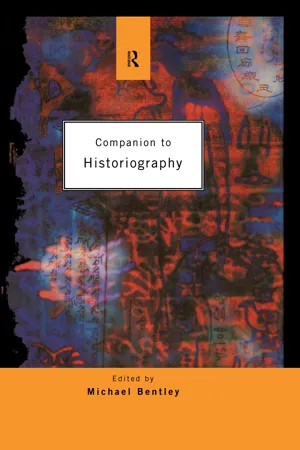
The Companion to Historiography is an original analysis of the moods and trends in historical writing throughout its phases of development and explores the assumptions and procedures that have formed the creation of historical perspectives. Contributed by a distinguished panel of academics, each essay conveys in direct, jargon-free language a genuinely international, wide-angled view of the ideas, traditions and institutions that lie behind the contemporary urgency of world history.
- 1,024 pages
- English
- ePUB (mobile friendly)
- Available on iOS & Android
eBook - ePub
Companion to Historiography
I BEGINNINGS – EAST AND WEST
INTRODUCTION
THE ANXIETY OF AMBIGUITY
History, the word, has a Greek etymology, being derived ultimately from a root meaning eyewitness, judgement and enquiry.1 But only in our ‘natural history’ is that etymological connection at all closely maintained, and ‘history’ itself – whether the past, or the study of it, or of some of it – is and must remain a radically ambiguous term. Whence the coinage of ‘historiography’, struck in order to distinguish the study of and writing about some past facts from the facts themselves. But, since the distinction of facts from the writing about or of them is actually not at all clearcut – indeed is eminently contestable – a further meaning has been accorded to historiography, as meta-history or the study, from various standpoints, of the writing of history by others than the historiographer.2 Both these senses are in play in Peter Heather's chapter (5), on the historiographical invention of ‘Late Antiquity’ as a concept.
Ancient historians, however, that is historians of Antiquity, tend as a breed not to concern themselves primarily with such higher-order semantic or (still less) philosophical issues. For most of them most of the time, history is history is history, as it were, and at least until quite recently Antiquity has unproblematically meant Greece and Rome, that is the world or worlds of Greek- and Latin-speakers divided off chronologically from the more or less text-free universe of the archaeological prehistorians at the upper end, and at the lower end from the far less easily defined post-Roman ‘medieval’ universe: in round figures, from c. 1000 BC (or – see below – BCE) to c. AD/CE 500. Introspection and doubts, however, are steadily creeping into even this fairly hermetically sealed scholarly domain. For example, the difficulty of a specification of ‘ancient’ that excludes China, source of the oldest historiographical tradition in the world, is manifest: hence in part the decision to print David Morgan's chapter (1) first below, as a small gesture towards historiographical rectification and recuperation. Another sign of altering perspec-tives is the increasing use by ancient historians of the non-Christian BCE/CE (Before/Common Era) chronographic notation, in belated recognition of the need to problematize and avoid a form of chauvinistic or ethnocentric cultural determinism and, conversely, of the desirability of fostering a non-teleological cultural pluralism.
However, respect for the primacy of texts, and texts written in at least two ‘dead’ languages requiring a lengthy period of linguistic and cultural immersion before they can be ‘read’ at even the most straightforward level, has tended to inhibit any Gadarene rush towards modernity, let alone postmodernity, of local or global interpretation in this field of historiography. Ancient historians have even been relatively slow to deploy systematically the ‘ancillary’ disciplines of archaeology, epigraphy and numismatics to eke out or contextualize their preferred literary sources, let alone indulge in the consensual interdisciplinarity and comparativism rightly desiderated below by Jairus Banaji (Chapter 6), across the whole range of thematic and material issues confronting them in their potentially highly hetero-geneous area and period. As for theory – or Theory – that, despite (or because of) its Aristotelian pedigree, has typically always been at a discount among them, more so than among their literary Classicist colleagues.
Yet, as ever, there have been exceptions, and some of the exceptional ancient historians have made contributions within ancient history and historiography, the impact and import of which have been felt and acknowledged quite widely beyond conventional disciplinary boundaries (themselves in process of dissolution). Three such historians writing in English (but not only in English) deserve special mention here, all born – not coincidentally – within four years of each other (1908–12): the Piedmontese Italian-Jewish intellectual historian Arnaldo Momigliano (a refugee to England from fascist persecution, d. 1987); the concept-driven sociological historian Moses Finley (American-Jewish by birth, but British by adoption following McCarthyite witchhunting, d. 1986); and, still alive and writing, the Marxist Geoffrey de Ste. Croix (of Huguenot descent, born to Christian missionaries in Macao).3 Not for the first time one notices the impact of exile and transpatriation on ancient historiography, a trend set by Herodotus and Thucydides at its very outset. Only Momigliano, moreover, experienced fully the conventional, if dubiously beneficial, philological training of the typical classical historian.
NEW VARIETIES OF HISTORY: PROGRESS OR CHANGE?
To the ancient Greeks and Romans what was old, traditional, and ancestral was in principle good, what was new, the reverse: hence, Greek neoterismos (‘innovationism’) or neotera pragmata (‘newer transactions’) meant revolution in an unwelcome negative sense, and precisely the same went for the Romans' res novae (‘new things’) (Finley 1986b). Of course, the Greeks and Romans did actually and inevitably innovate almost all the time, not least in historiography, which had after all to be invented and was so – for the Greeks – by Herodotus (fl. c. 450 BCE), and – for the Romans some two and a half centuries later – by Fabius Pictor (though he wrote in Greek, the then culturally fashionable literary language). But Thucydides' reception of Herodotus set the dominant tone and mode: one might legitimately hope to improve on the manner of one's predecessor or predecessors, but not usually his or their matter. The prescribed limit of wholly acceptable novelty was to find a subject not treated historically hitherto, namely the major event or events of one's own lifetime, and it was then sometimes – but not always -thought to be an advantage for the historian to have been an eventmaker rather than a mere observer. ‘New’ historiography in the sense of radically innovatory kinds of writing about the past was almost by definition considered bad or worse historiography.4
To us, in the sharpest possible contrast, new is cool, the newer is the better. That in itself is a revolution (in a positive sense). Since the 1960s wave upon wave of supposedly new histories have beaten against the supposedly hidebound bastions of traditional historiography – the traditions attacked having typically been invented in the later Victorian era of positivism and scientism, intellectually speaking, and of macho drum-and-trumpet activism, pragmatically speaking. There is, though, an element of caricatural rhetoric in the representation of both sides of this opposition: the post-Victorian traditions were not quite as one-dimensional as they have been painted, the new traditions (though that word was of course avoided like the plague) not quite as unprecedented as their proponents and exponents have liked to pretend. Yet there is also an element of truth, in the sense of correspondence to the facts, in the claims of the New. After about 1960 History did seriously and irrevocably begin to decompose into a plethora of smaller histories (social, economic, religious, intellectual, cultural, women's and so forth), narrative history of events (meaning typically large-scale public events of politics, diplomacy and war) did cede pole position to analytical accounts of deep structures and spatio-temporal conjunctures, and new -isms (especially feminism, comparativism and constructionism) have joined the older empiricist and Marxist tendencies. (Rabb and Rotberg 1982; Hunt 1989; Burke 1991; see also n. 5).
Indeed, the pace of change has been such that the fashion for social and economic history (e.g. history from the bottom up, attempting to restore a voice to the voiceless, whether they be earth-coloured rustics or other literally as well as metaphorically enslaved and silenced majorities) was quite quickly succeeded by a still apparent rage for cultural and intellectual history, and innovative modes such as the women's history of the 1960s and 1970s have been fairly rapidly subsumed or superseded by even newer ones such as the gender/sexuality studies of the 1980s and 1990s (Scott 1988; Abelove et al. 1994). Worse still, from the point of view of conservatives, self-styled ‘progressive’ historiography, most noticeably in its postmodernist or New Historicist forms, not only has abandoned even the weakest versions of the nineteenth-century positivist claim that history was a science, no more and no less, but has even questioned the sacred notion of historical truth, in the name either of a rhetoric of discourse or of an ethical and/or cultural relativism.5
Of all this ferment the ancient world's accredited historians were blissfully innocent and ignorant. After Herodotus, the father not only of history for the Greeks but also of what some moderns might approve as having a more than passing resemblance to Annales-style total history, political history – sometimes enlarged by consideration of social, economic, intellectual and cultural factors, but more usually not – ruled the ancient roost more or less unchallenged. A moral point of view was not to be hidden behind the mask of faceless objectivity but rather, at least in the Roman case, proclaimed as the historian's ultimate task. Rhetoric, so far from being shunned as a shameful distortion or disguise, was praised and pursued as the necessary adornment of an essentially literary genre. Above all, history was regularly touted as useful, not merely diverting, and centrally important, a proper study for the ancient world's movers and shakers to whom it was mostly directed.6
THE NEW ANCIENT HISTORY AND THE OLD
Modern historians of antiquity find themselves for the most part in a very different situation, addressing small, socially unrepresentative readerships whose hands are far removed from the levers of power. Classics, once thought just the thing for aspiring nineteenth-century imperial administrators, now must not only run the gauntlet of non-academic debunkers without but also face the friendly fire of canon-debunkers within. Orientalists in the old and supposedly harmless descriptive sense now find themselves accused of orientalism in its new, unambiguously charmless signification. In response, some defenders of the old faith rather petulantly ask why we should study the Greeks and the Romans in particular if not as our admirable and imitable cultural ancestors and models. But others more open-mindedly and more boldly take the attacks on the chin, investigating historiographically how and why it was that such phrases as the Glory that Was Greece and the Grandeur that was Rome could ever have attained such general currency. The relativists and anthropologizers among them, moreover, rather than merely knocking the Greeks and Romans off their factitious paradigmatic pinnacle, seek to account for their undoubtedly inspired as well as inspirational cultural achievements through the medium of a more inclusive historiography than the ancients themselves could have countenanced.7
It is precisely in this context that the ancient historians themselves have come under renewed critical scrutiny. Fathers of history and truth – or Fathers of lies, fiction, and rhetoric? Such has been the emphasis on what for want of a better word might be called the ancient historians' inventiveness that one leading student of Greece has recently felt obliged to mount a ‘defence of the Greek hi...
Table of contents
- Cover Page
- Half Title page
- Title Page
- Copyright Page
- Contents
- Editorial Board
- Contributors
- General Introduction: The Project of Historiography
- Part I: Beginnings — East and West
- Part II: The Medieval World
- Part III: Early Modern Historiography
- Part IV: Reflecting on the Modern Age
- Part V: Contexts for the Writing of History
- Index
Trusted by 375,005 students
Access to over 1.5 million titles for a fair monthly price.
Study more efficiently using our study tools.
Frequently asked questions
Yes, you can cancel anytime from the Subscription tab in your account settings on the Perlego website. Your subscription will stay active until the end of your current billing period. Learn how to cancel your subscription
No, books cannot be downloaded as external files, such as PDFs, for use outside of Perlego. However, you can download books within the Perlego app for offline reading on mobile or tablet. Learn how to download books offline
We are an online textbook subscription service, where you can get access to an entire online library for less than the price of a single book per month. With over 1.5 million books across 990+ topics, we’ve got you covered! Learn about our mission
Look out for the read-aloud symbol on your next book to see if you can listen to it. The read-aloud tool reads text aloud for you, highlighting the text as it is being read. You can pause it, speed it up and slow it down. Learn more about Read Aloud
Yes! You can use the Perlego app on both iOS and Android devices to read anytime, anywhere — even offline. Perfect for commutes or when you’re on the go.
Please note we cannot support devices running on iOS 13 and Android 7 or earlier. Learn more about using the app
Please note we cannot support devices running on iOS 13 and Android 7 or earlier. Learn more about using the app
Yes, you can access Companion to Historiography by Michael Bentley in PDF and/or ePUB format, as well as other popular books in History & Historiography. We have over 1.5 million books available in our catalogue for you to explore.