Over the last twenty years the camorra of Naples and the surrounding region has risen to a level of strength rivalling that of the Sicilian mafia.
This is not a new organization: the Camorra first emerged in the last century, several decades before the mafia. Tom Behan traces the history of the organization from its inception to the present. Until the 1970s the extent of its influence fluctuated, although it always maitained close relationships with the politiciains of the region. However, since the 1970s new and more powerful forms of camorra have developed: Raffaele Cutola's 'mass camorra' of unemployed youth specialise in protection rackets, Lorenzo Nuvoletta's 'business camorra' has reinvested drug money into construction following the 1980 earthquake, and Carmine Alfieri's 'political camorra' has become extremely profitable through its ability to obtain public sector contracts.
The Camorra is a fascinating account of the transformation of the small-time cigarette smugglers of the 1960s to the international entrepreneurs of the 1990s.
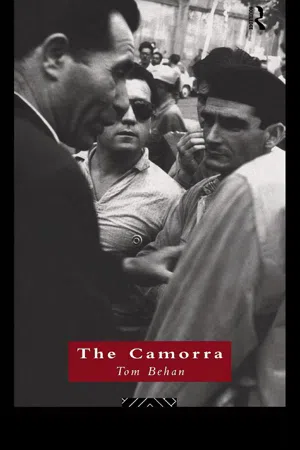
- 234 pages
- English
- ePUB (mobile friendly)
- Available on iOS & Android
eBook - ePub
About this book
Information
Chapter 1
The origins of the Camorra and the
Mafia
Death is only a possibility, but hunger is certain.
—Victor Serge
THE ORIGINS OF THE CAMORRA
The origins of a Neapolitan criminal organisation called the Camorra are far from clear. Some writers have claimed a history which goes back as far as the sixteenth century, arguing that it is the direct descendant of a Spanish secret society, the Garduna, founded in 1417 and subsequently introduced by officials of the Spanish monarchy to Naples.1
Another possibility is that the members of a criminal organisation called Camorra were a new type of lazzaroni, a word used to describe a very poor common thief. But as Naples grew both in size and wealth criminality began to change. The lazzaroni were individuals, whereas camorristi were part of an organisation.
A far more likely explanation is that the Camorra grew out of Neapolitan society during the period of the French Revolution between the end of the eighteenth century and the beginning of the nineteenth century.
What is beyond doubt is that throughout the centuries there is evidence of small criminal gangs operating in Naples. All of these gangs arose amongst the city’s poor—people who never kept written records due to their illiteracy; hence the difficulty in establishing any categorical evidence about what kind of organisation, if any, the Camorra grew out of.
It is therefore not surprising that there are also differing opinions on the origin of the word itself. The first official use of the word occurred in 1735, when a royal circular authorised the establishment of eight gaming-houses in Naples, including the ‘Camorra avanti palazzo’ (the ‘Camorra in front of the Palace’), the Royal Palace in today’s Piazza del Plebiscito, where a gaming-house had existed for many centuries. In this instance, the word is almost certainly an amalgamation of capo (boss) and the Neapolitan street game, the morra. The morra is still one of Italy’s more popular games, in which two players open their fists varying the numbers of fingers on display. The player who guesses the right number, which they must shout out as the fists are opened, is the winner.2
Alternatively, it was the word used to describe the rake-off earned by camorristi from goods being delivered or transported around the city; in other words, it was a word used to describe extortion.
Despite the disputes surrounding the precise origins of the Camorra, what is certainly beyond doubt is the following:
When the Camorra emerges into the life of Naples it does not seem a totally new fact, it is rather the point of arrival, or the result, of the city’s long history, and it almost seems the most natural expression of the history of the Neapolitan popular classes.3
This is not to say that ordinary Neapolitans had some inbuilt biological instinct which led them to create a large criminal organisation; rather, a combination of political ignorance and autocratic repression probably left them incapable of creating any other form of organisation.
Indeed it is the history of Naples itself which explains why such an organisation arose here and not elsewhere, and why organised crime has remained such a dominant feature of the city during the last two hundred years.
The city of Naples had been Europe’s third largest city for three hundred years, from around 1500 to the early 1800s; with a population of approximately 350,000 throughout the sixteenth century, it often vied with Paris for the title of Europe’s second largest city.
But towards the end of the seventeenth century it began to experience economic difficulties due to a fall in its exports of silk, wheat, oil and wine, caused in turn by an international economic recession and the rise of new competitors. Furthermore, the plague of 1656 led to 60 per cent of the city’s population either dying or leaving the city.
Despite such calamities, throughout this period many thousands of people migrated from the countryside to Naples because the city offered the possibility of work; furthermore, the ruling aristocracy had decreed that taxes were not to be paid within the city walls. Work, however, was often scarce, so for the ruling aristocracy the city’s key problem was the existence of masses of impoverished and unemployed people desperate for money and some kind of solution to their misery. The authorities needed a repressive network able to control an unpredictable population which could suddenly break out into violent revolt, such as the popular rebellion led by Masaniello in 1647–8.
Three-quarters of southern Italian trade passed through Naples, with large numbers being employed in the port, the warehouses and in the distribution of commodities; the servicing of the aristocracy and the middle classes also employed many people. As the eighteenth century came to an end, the rest of Europe and northern Italy were experiencing huge economic expansion during the industrial revolution, while Naples was stuck in a virtually feudal system, run by a monarchy terrified of any innovation. The city’s role as a capital also meant it had a large number of non-productive inhabitants: it has been estimated that in 1792 over a third of the entire population was made up of clerics, aristocrats and the bourgeoisie.4
As the decades and centuries progressed it became clear that population growth was not being matched by an increase in production. Indeed, by 1871 35,000 people, out of an active population of 220,000, were still employed as cooks, chamber-maids and gardeners, the same percentage as in the first half of the seventeenth century.5
Another related problem which affected the city at the time, and which is arguably still important today, was the absence of a dynamic entrepreneurial spirit amongst the middle classes. Up until the French Revolution, Naples had been a residential centre for the ruling classes of the South, as well as a bureaucratic and administrative capital. Most of the middle classes lived off government monopolies and the production of commodities such as tobacco, silk and linen, which were protected by tariff barriers, and therefore had no interest in innovation. Although only 1,356 ‘merchants’ were recorded in the 1845 census (out of a population of 400,000), most of these were shopowners. Very few were engaged in investment and manufacture; and most decisions were made within the immediate family circle.6
It is likely that the Camorra emerged in this period as a result of the failure of the Neapolitan Republic, proclaimed in 1799 on the wave of the French Revolution. If the Masaniello revolt 150 years earlier had been a revolution made by the people without leaders, the 1799 revolt was carried through by liberal leaders without the people. This allowed the whole experiment to be quickly destroyed by an alliance of the Bourbons, the Church and the British navy under Horatio Nelson. Although the Bourbon dynasty was not fully restored until 1815, the Camorra first emerged during the chaotic vacuum of power in the years between 1799 and 1815.
In the following period, the middle classes organised themselves into secret societies such as the Freemasons and the Carbonaria, and negotiated with the Bourbons. But for the vast majority of Neapolitans the Camorra became their only voice, the only way in which their presence was felt: ‘in this fashion the Camorra was a class-based mass phenomenon, one of the most popular illegal manifestations of nineteenth-century European history.’7
At this time economic development was completely different in northern Italy and the rest of Europe: trade was blossoming between states and with overseas territories, industrialisation had begun, along with the widespread building of railways. Yet in the early part of the nineteenth century the only railways built in southern Italy linked up the three royal palaces.
In many areas of his kingdom, Ferdinand II was known as ‘King Bomba’, because during the 1848 revolutions he ordered the bombardment of Palermo and Messina. He reigned for thirty years (1830–59) as a total autocrat and was highly distrustful of any innovations, at one point even banning the introduction of the first cameras into the city. Marco Monnier, a Swiss academic living in Naples during this period, described the king’s attitude towards ordinary people thus:
He never considered for a moment raising the people up from their level of degradation; on the contrary, he wanted to keep them there until the end of time as he knew very well that, given the nature of the period we live in, an absolute monarchy is only possible if it rules over a degraded and exhausted populace.8
The first official news of the Camorra as an organisation dates from 1820, when police records detail a disciplinary meeting of the Camorra. Such an event indicates a qualitative change: the Camorra and camorristi were no longer simply local gangs living off theft and extortion; they now had a fixed structure and some kind of hierarchy. The first written statute of a Camorra organisation was also discovered in 1820, once again indicating a stable organisational structure amongst the underworld, and the second statute was discovered in 1842.9 There were initiation rites, and funds set aside for the families of those imprisoned.
In the early part of the nineteenth century, Naples was both economically and politically stagnant. The general level of poverty is illustrated by the outbreak of cholera—a water-borne disease primarily caused by impure water and lack of public and personal hygiene—in 1836–7, which killed 20,000 people.10 This mass poverty, together with the lack of any political outlet, made for a chaotic and ungovernable city, and under these conditions the capacity to unleash a widespread reign of terror is an important consideration for those in power. The control of the impoverished and alienated masses was a service which the Camorra could offer local rulers. And for many of the Neapolitan poor, the use of violence was the only way out of their miserable existence; the static economic climate blocked any other solution.
One of the Camorra’s first strongholds developed within the prison system. This is how Marco Monnier described an inmate’s relationship with the Camorra:
he wasn’t allowed to eat, drink, smoke or gamble without a camorrista’s permission. He had to give him a tenth of all the money he was sent, and had to pay for the right to buy and sell, as well as paying for both essential and superfluous things. He even paid to get legal advice, as if he were granted a privilege: he even paid when he was poorer and more naked than the walls of his cell, he was forced to deprive himself of everything. Those who refused to accept such impositions ran the risk of being clubbed to death.11
Camorristi also took money from the prison authorities, as they effectively guaranteed order. Interestingly, however, they generally left the few aristocratic and middle-class prisoners alone; even though some camorristi had considerable wealth, they still felt some deference towards those in a higher social position.
The revolution of 1848 appeared to offer new political hope to the city, with Ferdinand II initially granting a liberal constitution. But the key weakness of the revolt was its lack of mass popular support, as the same writer noted a few years afterwards:
that revolution, if it can be called such, took the form of a simple demonstration of gentlemen, without even one sword being drawn. The common people supported the absolute monarchy. In the insurrection of 15 May the barricades were defended by heroic young men, who were all from good families.12
Conscious that ordinary people ‘cared little about whether they were a citizen or a subject’,13 the king was soon able to clamp down again, suspending the new constitution and imprisoning leading liberals. But he was not only spurred on by the inherent weakness of the Neapolitan revolt, he was also worried because liberals had taken power in cities such as Milan and Venice. Both Ferdinand and the Pope were strongly opposed to liberalism; indeed the Pope sheltered in Naples during the Roman republic of 1848–9, and Neapolitan forces contributed to the overthrow of the Roman republic led by Garibaldi and Mazzini.
Hopes of any immediate change were dashed, and communication with the outside world became very difficult:
You found yourself living among people who were isolated from the rest of Europe, extraneous to all the issues which interested the two Worlds, imprisoned in their beautiful cell, where neither ideas, beliefs, or the material discoveries of our century could penetrate… Foreign newspapers could only be obtained through foreign legations, booksellers hid forbidden books under their beds and then sold them at exorbitant prices: people then dug out holes in the walls of their rooms to hide their illicit and forbidden fruits.14
This repression not only affected liberals and the educated middle classes, it also conditioned people in the business world, both Neapolitan and foreign: ‘I have seen highly respected foreign merchants and industrialists buying portraits, chalk busts, or little bronze and terracotta statues of the King and Queen. They then placed them around their premises so they wouldn’t be suspected of liberalism.’15
The effect on ordinary people, and the consequences, were even more serious:
any social, political or religious links had been destroyed through terror. As with the intelligentsia, the healthy forces in the country are directionless and worn out because they are too isolated and dispersed. No cohesion whatsoever was possible: the authorities even banned groups of people who met to play chess… What emerges from this is that in all the popular classes no ssociation could be created to counteract the dominance of the wicked.16
Despite the liberals’ ineptitude, their lack of popular support and the strict rule of Ferdinand II, demands for change continued throughout the 1850s. The southern economy continued to grow slowly, with the vast majority of goods passing through Naples. Between 1838 and 1852 grain exports increased sixfold, with fruit exports also doubling from 1832 to 1859. Naples’ dock was now handling a huge amount in trade; in 1855–9 alone the port doubled its activity.17
The Camorra was i...
Table of contents
- COVER PAGE
- TITLE PAGE
- COPYRIGHT PAGE
- ACKNOWLEDGEMENTS
- INTRODUCTION
- CHAPTER 1: THE ORIGINS OF THE CAMORRA AND THE MAFIA
- CHAPTER 2: THE POSTWAR DEVELOPMENT OF THE CAMORRA
- CHAPTER 3: THE ‘ADMINISTRATIVE ECONOMY’ AND THE 1980 EARTHQUAKE
- CHAPTER 4: THE ‘BUSINESS CAMORRA’ OF THE NUVOLETTA GANG
- CHAPTER 5: THE CIRILLO AFFAIR
- CHAPTER 6: HOW THE CAMORRA WORKS
- CHAPTER 7: CRIMINAL POLITICS
- CHAPTER 8: WHO WILL STOP THE CAMORRA?
- CONCLUSION ‘HA DDA PASSÀ ‘A NUTTATA’
- NOTES
Trusted by 375,005 students
Access to over 1.5 million titles for a fair monthly price.
Study more efficiently using our study tools.
Frequently asked questions
Yes, you can cancel anytime from the Subscription tab in your account settings on the Perlego website. Your subscription will stay active until the end of your current billing period. Learn how to cancel your subscription
No, books cannot be downloaded as external files, such as PDFs, for use outside of Perlego. However, you can download books within the Perlego app for offline reading on mobile or tablet. Learn how to download books offline
Perlego offers two plans: Essential and Complete
- Essential is ideal for learners and professionals who enjoy exploring a wide range of subjects. Access the Essential Library with 800,000+ trusted titles and best-sellers across business, personal growth, and the humanities. Includes unlimited reading time and Standard Read Aloud voice.
- Complete: Perfect for advanced learners and researchers needing full, unrestricted access. Unlock 1.5M+ books across hundreds of subjects, including academic and specialized titles. The Complete Plan also includes advanced features like Premium Read Aloud and Research Assistant.
We are an online textbook subscription service, where you can get access to an entire online library for less than the price of a single book per month. With over 1.5 million books across 990+ topics, we’ve got you covered! Learn about our mission
Look out for the read-aloud symbol on your next book to see if you can listen to it. The read-aloud tool reads text aloud for you, highlighting the text as it is being read. You can pause it, speed it up and slow it down. Learn more about Read Aloud
Yes! You can use the Perlego app on both iOS and Android devices to read anytime, anywhere — even offline. Perfect for commutes or when you’re on the go.
Please note we cannot support devices running on iOS 13 and Android 7 or earlier. Learn more about using the app
Please note we cannot support devices running on iOS 13 and Android 7 or earlier. Learn more about using the app
Yes, you can access The Camorra by Tom Behan in PDF and/or ePUB format, as well as other popular books in Politics & International Relations & Politics. We have over 1.5 million books available in our catalogue for you to explore.