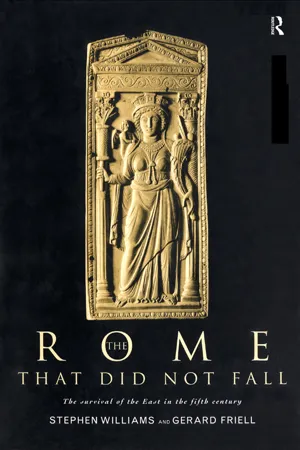
The Rome that Did Not Fall provides a well-illustrated, comprehensive narrative and analysis of the Roman empire in the east, charting its remarkable growth and development which resulted in the distinct and enduring civilization of Byzantium. It considers:
* the fourth century background
* the invasions of Attila
* the resources of the east
* the struggle for stability
* the achievements of Anastasius.
eBook - ePub
The Rome that Did Not Fall
The Survival of the East in the Fifth Century
- 286 pages
- English
- ePUB (mobile friendly)
- Available on iOS & Android
eBook - ePub
The Rome that Did Not Fall
The Survival of the East in the Fifth Century
About this book
Part 1
SEPARATION
1
CRISIS AND PARTITION
Theodosius I, the last single Roman emperor ever to rule the whole of both the Eastern and Western halves of the empire, was preoccupied for much of his difficult reign with reaching and sustaining an accommodation with the Goths within his territories. This was forced upon him after the crushing defeat of the Romans under emperor Valens by the Visigoths at Adrianople (Edirne in modern Turkey) in 378. About two-thirds of the available Eastern Roman field army was wiped out, and their emperor with it; the strategic balance had shifted against the empire.1 There was no longer any practical military way of expelling the Visigoths from imperial territories, whatever ignorant patriotic opinion might say. There was nowhere else for them to go, since the newly arrived Huns had expelled them from their traditional homelands north of the Danube, except for a minority who had migrated to Transylvania and others who remained as subjects of their Hun conquerors.2
After a few minor victories, mainly achieved by starving the Visigoths of supplies, Theodosius brought them to a treaty in 382. It was the best that could be had in the circumstances, but nonetheless altered permanently the power relations between Romans and barbarians. They were settled as treaty ‘allies’ (foederati) in Moesia (northern Bulgaria), accepting the emperor as overlord and obliged to supply forces to him on demand. In the military emergencies, a similar settlement had been negotiated by the Western emperor Gratian with the Ostrogoths and Huns in Pannonia (western Hungary) from which they could no longer be excluded.
Of course, the Romans had many treaties with allied tribes immediately bordering their frontiers; they had taken in many barbarian peoples as disarmed settlers, mainly from the Germanic tribes, and Romanised German troops were a large component of the army, including many of its top commanders. But the treaty of 382 was a distinctly new departure, and both sides knew it. Imperial propaganda papered over the details and presented it merely as continuing traditional practices. ‘Which is better,’ demanded the panegyric of Themistius, ‘to fill Thrace with corpses or with farmers? With graves or with people?’3 In reality, the Visigoths were now a foreign nation in arms within the empire’s territories under their own chieftains, not a settlement subject to Roman administration. Their soldiers were not integrated into the Roman command structure as barbarians had always been before, but fought as separate allied armies for specific campaigns under their own tribal leaders.
Still, the treaty held more or less successfully, with some strains, for the next twelve years, and Theodosius hoped it would not prove a precedent. He cultivated the Goths assiduously, impressing them with the power and wealth of Rome, promoting their nobles in his service, and generally persuading them of the advantages of peace and friendship. The aged Gothic king Athanaric, finally forced to make his peace with the once-hated Romans, was dazzled by the power, splendour and wealth of Constantinople, and his magnificent reception there, as he was clearly intended to be.4
Theodosius no doubt hoped that, given time, the Visigoths could be peacefully assimilated and their national identity diluted, as so many others had been. The policy was rational and had some success: many Gothic nobles responded, like Athanaric. But it depended heavily on Theodosius’ own personal and diplomatic qualities, and the Gothic leaders saw the treaty in their own traditional way as a personal pact between rulers, which might or might not be renewed. Certainly the policy of accommodation was unpopular in the Greek East, where many people heartily detested the Goths: because of the plundering and ravaging of their lands, because of their uncouth customs, because their Christianity was Arian, not Orthodox, or simply because they were ‘barbarians’, that is non-Hellenic.
Theodosius’ reign was punctuated by two costly civil wars, which depleted the already overstretched armies of the time. They illustrated only too well the near-impossibility of a single man ruling effectively over the whole of the beleaguered empire, and the wisdom of the customary dual rule of East and West. Originally, he had ruled the East only: the West was ruled by his colleague Gratian, who had appointed him after the disaster of Adrianople, and the two had co-operated closely and fraternally. But in 383, shortly after the treaty with the Visigoths, Gratian was overthrown and murdered in a military coup, originating in Britain and led by the general Magnus Maximus with the strong support of most of the army. Before Theodosius was in any position to intervene—even if he wanted to—Maximus had secure control of Britain, Spain and Gaul up to the Alps. He had been elected emperor by the army and accepted by the civil bureaucracy, and immediately put out peace feelers to Theodosius, promising coexistence: they were both Spaniards and old military colleagues, and Maximus hoped he could come to an agreement. His coins and official portraiture showed the two of them as brother-emperors.
Theodosius withheld recognition but made no immediate move against Maximus, which would have been a great military gamble at that time. Gratian’s younger brother, the twelve-year old boy Valentinian II, was still alive and recognised as the legitimate Western emperor at Milan, with his mother Justina acting as de facto regent. Maximus ruled his portion of the empire competently, defended the Rhine frontier and was generally popular. Theodosius had no great wish for war, but felt he could not abandon the legitimate dynasty of Valentinian I to which he owed his own elevation. For several years there was an uneasy truce, interpreted in different ways by the influential groups of either side. Cautious unofficial embassies were exchanged, exploring the possibilities of accommodation, but they came to nothing.
The decision was made in 387, when Maximus suddenly invaded across the Alps and occupied Italy, against little resistance. The boy emperor, his mother and the court at Milan fled to the East to seek protection and military support from Theodosius. He chose to support them and, being recently widowed, joined himself to the Valentinianic dynasty by marrying the sister of Gratian and Valentinian, Galla. The other part of the alliance was a commitment to civil war against Maximus. In a lightning campaign in 388, he launched a double attack on the West, took Maximus off guard, defeated him utterly in a set battle near modern Lubljiana, then captured and executed him. The Western senatorial aristocracy rushed to make their peace with Theodosius, which was easily done: there were no reprisals, and he genuinely impressed them with his clemency, his urbanity and warm, easy manner, just as he had impressed his former Gothic enemies.
Yet in the longer term his victory was a strangely hollow one. He had done his duty to the dynasty of Valentinian and crushed Maximus, but he now had two growing sons of his own, Arcadius and Honorius. Like every successful emperor he was a dynast, and he clearly intended that they should eventually succeed him on the thrones of East and West when the time came. He had little enthusiasm for restoring the seventeen-year old Valentinian II as emperor of the West, and in fact he was restored in name only.
Here, dynastic ambitions and the demands of political and military realism pulled in opposite directions. It was obvious that the West, facing enormous pressure from barbarian tribes along the whole of the Rhine and upper Danube, needed a strong and warlike military emperor. Maximus had been this. Honorius was still a young child, and Valentinian was quite inexperienced. Theodosius therefore appointed what amounted to a guardian for him, in the shape of his trusted general Arbogast, who became the supreme military commander in the West. Because of his barbarian origin he could not aspire to the throne as Maximus had done, but he wielded far greater power than any general, appointing officials and issuing instructions in the name of Valentinian II—as Theodosius in distant Constantinople intended he should.
Arbogast used his power well, governed from the imperial capital of Trier and defended the Rhine frontier vigorously, but he could not solve the awkward problem of the boy emperor. Valentinian felt humiliated, a puppet emperor only, prisoner in his own palace. He sent despairing messages to Theodosius for help; he attempted in vain to dismiss Arbogast. Finally, in 392, he was found hanged in his own quarters. Arbogast claimed it was suicide, and it probably was, but this was not believed in the East. Once again, Theodosius vacillated. He was not sufficiently interested in the problems of the West, yet could not ignore them. Arbogast protested his loyalty, but his own authority was in suspension without a legitimate emperor and the West was officially rulerless. Receiving no instructions or assurances from Theodosius, after three months he set up his own emperor to rule through, a civil official Eugenius, and once again sought friendship with Constantinople. Once again, Theodosius, thinking primarily of his own dynasty, plunged into the hazard of another civil war. In 394, at the battle of the Frigidus on the border of Italy, Arbogast and Eugenius were defeated after heavy losses on both sides. Especially heavy were the losses among Theodosius’ Visigothic allies, who fought loyally in the front line under their chieftain Alaric. This they resented: the Romans, they suspected, much preferred to shed Gothic blood than their own. They may also have wondered why they were fighting in the emperor’s own civil quarrels, instead of against foreign enemies such as the Huns.
Very soon after this victory, in January 395, Theodosius died suddenly at Milan. Almost all the circumstances were ominous. The main part of the empire’s total field army was in the West. Theodosius’ two sons, Arcadius and Honorius, heirs to the twin thrones of East and West respectively, were inept and immature youths aged eighteen and ten (indeed, Honorius verged on mental backwardness). Real power devolved on Theodosius’ trusted general and son-in-law Stilicho, who for the moment commanded the combined armies. But as a semi-barbarian (his father had been a Vandal commander in Roman service) he could not aspire to the throne in his own right, even had he wanted to. With some legitimacy he claimed to have been appointed ‘guardian’ of the two imperial children and, as regent, claimed all the delegated powers of the late emperor. In fact, there was no legal office of regent in Roman law, and his claim was based narrowly on an unwritten, unwitnessed ‘bequest’ by Theodosius on his deathbed. But it was strongly upheld by bishop Ambrose of Milan in his funeral oration, and Stilicho’s authority was generally accepted in the West by the army, the civil bureaucracy and of course, the boy emperor Honorius, to whom he betrothed his own daughter.5
Stilicho was an energetic and capable ruler, wholly devoted to the interests of the empire as he saw them, but his constitutional position was always an anomaly, just as Arbogast’s had been. He was supreme military commander of cavalry and infantry in the West (Comes et Magister Utriusque Militiae), and quickly brought the other top commanders and their staffs under his direct control. Based on his guardianship and marriage link with the imperial family (parentela) he made appointments and issued laws, but only in the emperor’s name. When the emperor came of age, or even came under a rival influence, what then? He expected to inherit all the authority of Theodosius, but from the beginning his claims were utterly rejected in the East, especially by the Praetorian Prefect Rufinus, who managed the young emperor Arcadius and was himself the de facto ruler at Constantinople.6 A rift opened, which was never completely healed.
The disgruntled Visigoths were returned to their allotted homelands in Thrace, which in their absence were being raided by their enemies the Huns. They quickly proclaimed their chieftain Alaric king, and began a plundering migration well beyond their assigned territory, at one stage threatening Constantinople. The Eastern government, effectively controlled by Rufinus, had no adequate forces to stop them, and was forced to buy them off with subsidies and promises. The intrigues between East and West allowed Alaric to enhance his position. What he wanted was both larger and richer lands to settle his people, and also the post of a top Roman military commander (Magister Militum), which had been firmly refused by Theodosius.
The intrigues and conflicts between the effective governments of East and West (not the helpless boy emperors) were to continue destructively for the next thirteen years. On the peremptory command of Constantinople, the Eastern portion of the army was dutifully returned, but on its arrival its Gothic commander Gainas, allegedly acting on Stilicho’s secret orders, assassinated Rufinus in a blatantly public killing under the eyes of the emperor himself. The Prefect had accompanied the young emperor to greet the returning army on the great parade field of the Hebdomon immediately outside the city. As he greeted or inspected the troops their ranks quietly encircled Rufinus, and he and his Hun bodyguard were cut to pieces. The violence of the act may have shocked the emperor and others, but it was widely popular as Rufinus was detested by almost all classes: by the military because of his bloody purges and assassinations; by the civil rulers because he was a Gaul by origin and seen as an outsider; and by the population because of his rapacious confiscations and taxation. According to Claudian, his head was joyfully carried through the city on a spear.7
But if Gainas had ever expected to take Rufinus’ place as the leading man in the East, as Stilicho was in the West, he was quickly thwarted. In place of Rufinus, the eunuch Chamberlain Eutropius became the new power behind the throne and defied Stilicho as before, with the support of the other civil ministers. They were glad to be rid of Rufinus, but had no intention of letting a powerful general become dominant. Gainas retained his position, but was denied the command and rank of Magister Militum which, after loyal service to Theodosius, he expected as his due.8
Stilicho confronted and defeated Alaric and the Visigoths in several engagements, but never decisively. After the costly civil war of 394, the defection of the Visigoths and the return of the Eastern portion of the army, Stilicho was now operating with the last substantial Roman field armies available in the West, which had to be kept in being at all costs. Apart from border garrisons, often composed of barbarians granted frontier lands and expected to defend them, these forces, numbering perhaps 60,000 at most, were all that existed to protect the heartlands of Gaul and Italy, as well as the more outlying provinces of Britain, Spain, Raetia, Noricum and Pannonia.9 Stilicho could not now afford a victory over Alaric that involved heavy troop losses. Despite conscription, recruitment of Roman provincials was becoming increasingly difficult: landowners were reluctant to part with scarce manpower, and connived with their equally reluctant peasants to avoid the draft, often substituting a cash payment which could be used to hire barbarian troops. As a leader well qualified to handle barbarians, Stilicho no doubt hoped to pressurise Alaric back to his earlier alliance and use his military strength once again in Roman service.
Stilicho’s propaganda, specifically against Eutropius, left no doubt that he still claimed authority over the Eastern boy emperor too. The Eastern government had begun to fear him as a military threat. When his campaign against Alaric led him to land an army temporarily in Greece, which was part of the Eastern half, Eutropius used the pretext to officialise the whole simmering conflict and ha...
Table of contents
- Cover
- Half Title
- Title Page
- Copyright Page
- Table of Contents
- List of illustrations
- Acknowledgements
- List of abbreviations
- Introduction
- PART 1 Separation
- PART 2 On the defensive
- PART 3 The resources
- PART 4 The struggle for stability
- PART 5 Stability attained
- Appendix 1: List of emperors
- Appendix 2: The Theodosian dynasty
- Notes
- Bibliography
- Index
Trusted by 375,005 students
Access to over 1.5 million titles for a fair monthly price.
Study more efficiently using our study tools.
Frequently asked questions
Yes, you can cancel anytime from the Subscription tab in your account settings on the Perlego website. Your subscription will stay active until the end of your current billing period. Learn how to cancel your subscription
No, books cannot be downloaded as external files, such as PDFs, for use outside of Perlego. However, you can download books within the Perlego app for offline reading on mobile or tablet. Learn how to download books offline
Perlego offers two plans: Essential and Complete
- Essential is ideal for learners and professionals who enjoy exploring a wide range of subjects. Access the Essential Library with 800,000+ trusted titles and best-sellers across business, personal growth, and the humanities. Includes unlimited reading time and Standard Read Aloud voice.
- Complete: Perfect for advanced learners and researchers needing full, unrestricted access. Unlock 1.5M+ books across hundreds of subjects, including academic and specialized titles. The Complete Plan also includes advanced features like Premium Read Aloud and Research Assistant.
We are an online textbook subscription service, where you can get access to an entire online library for less than the price of a single book per month. With over 1.5 million books across 990+ topics, we’ve got you covered! Learn about our mission
Look out for the read-aloud symbol on your next book to see if you can listen to it. The read-aloud tool reads text aloud for you, highlighting the text as it is being read. You can pause it, speed it up and slow it down. Learn more about Read Aloud
Yes! You can use the Perlego app on both iOS and Android devices to read anytime, anywhere — even offline. Perfect for commutes or when you’re on the go.
Please note we cannot support devices running on iOS 13 and Android 7 or earlier. Learn more about using the app
Please note we cannot support devices running on iOS 13 and Android 7 or earlier. Learn more about using the app
Yes, you can access The Rome that Did Not Fall by Gerard Friell,Stephen Williams in PDF and/or ePUB format, as well as other popular books in History & Ancient History. We have over 1.5 million books available in our catalogue for you to explore.