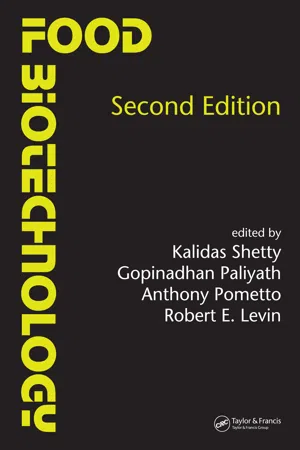
Revised and updated to reflect the latest research and advances available, Food Biotechnology, Second Edition demonstrates the effect that biotechnology has on food production and processing. It is an authoritative and exhaustive compilation that discusses the bioconversion of raw food materials to processed products, the improvement of food
- 2,011 pages
- English
- PDF
- Available on iOS & Android
eBook - PDF
Food Biotechnology
About this book
Information
Table of contents
- Front Cover
- Preface
- Editors
- Contributors
- Contents
- 1.01 Food Microbiology
- 1.02 Principles of Biochemistry and Molecular Biology
- 1.03 Fermentation Technology and Bioreactor Design
- 1.04 Process Developments in Solid-State Fermentation for Food Applications
- 1.05 Metabolic Engineering of Bacteria for Food Ingredients
- 1.06 Technologies Used for Microbial Production of Food Ingredients
- 1.07 Production of Carotenoids by Gene Combination in Escherichia coli
- 1.08 Production of Amino Acids: Physiological and Genetic Approaches
- 1.09 Biotechnology of Microbial Polysaccharides in Food
- 1.10 Genetics of Dairy Starter Cultures
- 1.11 Genetic Engineering of Baker’s Yeast: Challenges and Outlook
- 1.12 The Biotechnology of Wine Yeast
- 1.13 Stress Tolerance, Metabolism, and Development: The Many Flavors of Trehalose
- 1.14 Production of Pectinases and Utilization in Food Processing
- 1.15 Biotechnology of Citric Acid Production
- 1.16 Microbial Biotechnology of Food Flavor Production
- 1.17 Microbial Production of Oils and Fats
- 1.18 Potential Uses of Cyanobacterial Polysaccharides in the Food Industry
- 1.19 Food Applications of Algae
- 1.20 Butanol Production from Agricultural Biomass
- 2.01 Methods in Plant Tissue Culture
- 2.02 Clonal Screening and Sprout Based Bioprocessing of Phenolic Phytochemicals for Functional Foods
- 2.03 Genomic Basics for Food Improvement
- 2.04 Molecular Design of Soybean Proteins for Enhanced Food Quality
- 2.05 Genetic Modification of Plant Starches for Food Applications
- 2.06 Bioprocessing of Starch Using Enzyme Technology
- 2.07 Genetic Modification of Plant Oils for Food Uses
- 2.08 Molecular Biotechnology for Nutraceutical Enrichment of Food Crops: The Case of Minerals and Vitamins
- 2.09 Potential Health Benefits of SoybeanIs of lavonoids and Related Phenolic Antioxidants
- 2.10 Functional Phytochemicals from Cranberries: Their Mechanism of Action and Strategies to Improve Functionality
- 2.11 Rosmarinic Acid Biosynthesis and Mechanism of Action
- 2.12 Bioprocessing Strategies to Enhance L-DOPA and Phenolic Antioxidants in the Fava Bean (Vicia faba)
- 2.13 Phytochemicals and Breast Cancer Chemoprevention
- 2.14 Biotechnology in Wine Industry
- 2.15 Biotechnology of Nonnutritive Sweeteners
- 2.16 Biotechnological Approaches to Improve Nutritional Quality and Shelf Life of Fruits and Vegetables
- 2.17 Genetic Modification of Peanut as a Solution to Peanut Allergy
- 2.18 Recombinant Lipoxygenases and Oxylipin Metabolism in Relation to Food Quality
- 2.19 Genetic Modification of Production Traits in Farm Animals
- 2.20 Enzyme Technology for the Dairy Industry
- 2.21 Egg Yolk Antibody Farming for Passive Immunotherapy
- 2.22 Application of Transgenic Fish Technology in Sea Food Production
- 2.23 The Production, Properties, and Utilization of Fish Protein Hydrolysates
- 2.24 Human Gut Microflora in Health and Disease: Focus on Prebiotics
- 2.25 Immunomodulating Effects of Lactic Acid Bacteria
- 2.26 Biochemical Markers for Antioxidant Functionality
- 2.27 Enzymatic Synthesis of Oligosaccharides: Progress and Recent Trends
- 3.01 Molecular Evolution and Diversity of Food Borne Pathogens
- 3.02 Genetics and Physiology of Pathogenicity in Food Borne Bacterial Pathogens
- 3.03 Biofilm Production by Listeria monocytogenes
- 3.04 Application of Microbial Molecular Techniques to Food Systems
- 3.05 Control of Food Borne Bacterial Pathogens in Animals and Animal Products through Microbial Antagonism
- 3.06 Bacteriocins: Antimicrobial Activity and Applications
- 3.07 Genetic Characterization of Antimicrobial Peptides
- 3.08 Phenolic Antimicrobials from Plants for Control of Bacterial Pathogens
- 3.09 Genetic Mechanisms Involved in Regulation of Mycotoxin Biosynthesis
- 3.10 Application of ELISA Assays for Detection and Quantitation of Toxins in Foods
- 3.11 Biosensors for Food Quality Assessment
- 3.12 Enzymatic Bioprocessing of Tropical Seafood Wastes
- 3.13 Cold Active Enzymes in Food Processing
- 3.14 Biotransformations as Applicable to Food Industries
- 3.15 Solid-State Bioprocessing for Functional Food Ingredients and Food Waste Remediation
- 3.16 Fermentation Biotechnology of Traditional Foods of Africa
- 3.17 Fermentation Biotechnology of Traditional Foods of China
- 3.18 Fermentation Biotechnology of Traditional Foods of the Indian Subcontinent
- 3.19 Fermentation Biotechnology of Plant Based Traditional Foods of the Middle East and Mediterranean Region
- 3.20 Fermentation Biotechnology of Animal Based Traditional Foods of the Middle East and Mediterranean Region
- 3.21 Anaerobic Processes for the Treatment of Food Processing Wastes
- 3.22 International Aspects of the Quality and Safety Assessment of Foods Derived by Modern Biotechnology
- 3.23 Patenting Inventions in Food Biotechnology
- Index
Trusted by 375,005 students
Access to over 1.5 million titles for a fair monthly price.
Study more efficiently using our study tools.
Frequently asked questions
Yes, you can cancel anytime from the Subscription tab in your account settings on the Perlego website. Your subscription will stay active until the end of your current billing period. Learn how to cancel your subscription
No, books cannot be downloaded as external files, such as PDFs, for use outside of Perlego. However, you can download books within the Perlego app for offline reading on mobile or tablet. Learn how to download books offline
Perlego offers two plans: Essential and Complete
- Essential is ideal for learners and professionals who enjoy exploring a wide range of subjects. Access the Essential Library with 800,000+ trusted titles and best-sellers across business, personal growth, and the humanities. Includes unlimited reading time and Standard Read Aloud voice.
- Complete: Perfect for advanced learners and researchers needing full, unrestricted access. Unlock 1.5M+ books across hundreds of subjects, including academic and specialized titles. The Complete Plan also includes advanced features like Premium Read Aloud and Research Assistant.
We are an online textbook subscription service, where you can get access to an entire online library for less than the price of a single book per month. With over 1.5 million books across 990+ topics, we’ve got you covered! Learn about our mission
Look out for the read-aloud symbol on your next book to see if you can listen to it. The read-aloud tool reads text aloud for you, highlighting the text as it is being read. You can pause it, speed it up and slow it down. Learn more about Read Aloud
Yes! You can use the Perlego app on both iOS and Android devices to read anytime, anywhere — even offline. Perfect for commutes or when you’re on the go.
Please note we cannot support devices running on iOS 13 and Android 7 or earlier. Learn more about using the app
Please note we cannot support devices running on iOS 13 and Android 7 or earlier. Learn more about using the app
Yes, you can access Food Biotechnology by Anthony Pometto, Kalidas Shetty, Gopinadhan Paliyath, Robert E. Levin in PDF and/or ePUB format, as well as other popular books in Technology & Engineering & Food Science. We have over 1.5 million books available in our catalogue for you to explore.