- 224 pages
- English
- ePUB (mobile friendly)
- Available on iOS & Android
eBook - ePub
About this book
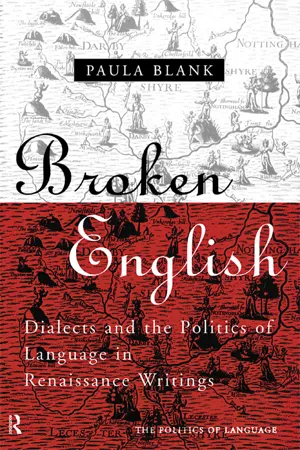
The English language in the Renaissance was in many ways a collection of competing Englishes. Paula Blank investigates the representation of alternative vernaculars - the dialects of early modern English - in both linguistic and literary works of the period. Blank argues that Renaissance authors such as Spenser, Shakespeare and Jonson helped to construct the idea of a national language, variously known as 'true' English or 'pure' English or the 'King's English', by distinguishing its dialects - and sometimes by creating those dialects themselves. Broken English reveals how the Renaissance 'invention' of dialect forged modern alliances of language and cultural authority. This book will be of interest to scholars and students of Renaissance studies and Renaissance English literature. It will also make fascinating reading for anyone with an interest in the history of English language.
Information
1 THE RENAISSANCE DISCOVERY OF DIALECT
Thus today we are, for the most part, Englishmen not speaking English and not understood by English ears.
Alexander Gill, Logonomia Anglica1
The earliest recorded use of the word “dialect,” referring to a manner of speaking, dates from 1577, according to the Oxford English Dictionary.2 John Bullokar’s An English Expositor (1616), an early precursor of the OED, was the first vernacular dictionary to include the term:
Dialect, a difference of some words, or pronunciation in any language: as in England the Dialect or manner of speech in the North, is different from that in the South, and the Western dialect differing from them both…. So every country hath commonly in divers parts thereof some difference of language, which is called the Dialect of that place.3
The term “dialect” was also current among literary authors from the latter half of the sixteenth century. In 1579, E.K., in his defense of the language of The Shepheardes Calender, warned his readers that, despite the example of Edmund Spenser’s own poetic idiom, they ought not to corrupt “the commen dialecte and maner of speaking” by using too many archaisms in verse.4 E.K., in contrasting archaisms with the “commen dialecte and maner of speaking,” implicitly suggests that old words represent an “uncommon” dialect of English. Ben Jonson, in his Poetaster (1602), invokes the word in reference to another contemporary experiment in English diction—coining new words, often by borrowing or adapting Latin forms. The “Poetaster” of his title, also known as Crispinus, is forced to purge the Latinate neologisms in his own verse by means of an emetic administered by Horace. After Crispinus vomits up the offending words, Virgil advises him:
You must not hunt for wild, out-landish terms,
To stuff out a peculiar dialect;
But let your matter run before your words:
And if, at any time, you chaunce to meet
Some Gallo-belgic phrase, you shall not straight
Racke your poore verse to give it entertainement;
But let it passe: and doe not thinke your selfe
Much damnified, if you do leave it out;
When, nor your understanding, nor the sense
Could well receive it. This fair abstinence,
In time, will render you more sound, and cleere;
And this have I prescrib’d to you, in place
Of a strict sentence.5
For these writers, the “difference of language” referred to as dialect was not always defined in regional terms; in the Renaissance, dialect refers to any manner of speaking or writing that is judged as either a “common” or “peculiar” variety of the language.
The English spoken in the sixteenth and seventeenth centuries was not a standard language, if by “standard” we mean fixed or uniform.6 There were as yet no official, codified rules for vernacular usage.Yet Renaissance writers refer, again and again, to a variety of English they describe as the “commen dialecte” or common language. As early as 1490, William Caxton discriminates “comyn termes that be dayli used” from “rude,” “curyous,” and “auncyent” ones. Thomas Wilson urges his countrymen to avoid “straunge” or “outlandishe” English and rather to “so speake as is commonly received.” Alexander Gill locates the communis dialectus in relation to northern, southern, eastern and western varieties of the language. The word “common” in these statements refers, it seems, not so much to a ruled language as to a shared one, to a “commonality” of usage and of understanding. George Puttenham, in his Arte of English Poesie (1589), defines language itself in such terms, as “a speach… fully fashioned to the common understanding, & accepted by consent of a whole countrey.”7 By a “common language,” in other words, Renaissance authors intend a national language—an English pertaining, by consensus, to the “whole countrey.” This language, also described by contemporaries as “pure” English or “true” English, was rhetorically distinguished from “uncommon” dialects in terms that suggest they are not English at all, but rather “strange,” “counterfeit,” or “foreign.” In speaking of common and uncommon words, Renaissance writers affirm which ones are “really” English.
In the present chapter, I aim to show how the idea of dialect, or early modern constructions of the “difference of English,” conditioned the rise of vernacular language study in the Renaissance, and the production of the first English dictionaries, grammars, and works on vernacular orthography. These treatises represent some of the earliest English attempts—like Virgil’s in Poetaster—at linguistic “prescription,” efforts to identify, and disseminate, the best forms of the language. Prescriptivism as a motivating force in English language study, along with the project of “standardizing” the language, has long been viewed as the legacy of the eighteenth century, and there is no doubt that modern notions of “correctness” in language have their origins in the work of men like Bishop Lowth and Samuel Johnson. 8 Yet one of the purposes of this chapter will be to marshal the overwhelming evidence that prescriptivism has its sources in the linguistic researches of the sixteenth century, although it did not manifest itself as any official system of prescriptions or rules. Rather, sixteenth-and early seventeenth-century prescriptivism was diagnostic in its methods and its aims; its implicit end was discrimination—the differentiation of English forms, and the valuation of those differences. In England, the idea of authority in language was a corollary of a process, initiated in the sixteenth century, by which the relative value of alternative native forms was distributed for the first time.
In continental studies, this is hardly news: The sixteenth-century linguistic scene in Italy has long been characterized by what contemporaries referred to as the questione della lingua—the debate over which of the numerous dialects of Italian then current was worthy of being advanced as a national language. This “question,” however, had been posed as far back as the fourteenth century. Dante’s De Vulgari Eloquentia (c. 1303) may be understood as the ultimate source of debates on the vernacular throughout early modern Europe. This treatise is well known for the aggressive challenge it posed to the cultural status of Latin and for its defense of the modern Italian vernacular as superior to its classical ancestor. At the start of his work, Dante celebrates the vulgar tongue as “that language, which we learn without any rules by imitating a nurse,” pronouncing it nobler than Latin “because it is natural for us, whereas the other is instead artificial.”9 Yet beyond a few initial remarks to that effect, Dante expends little effort advancing the claims of Italian over Latin in this treatise.10 The status of Italian with respect to Latin was not Dante’s primary concern at all, if we accept as evidence the emphasis in his own text. Dante, who declares at the start that his subject is “the correct and elegant use of the vernacular,” spends the better part of the first book attempting to establish which of the numerous regional dialects of Italian then current was worthy of advancing as “correct and elegant,” as superior—not so much to Latin as to rival Italian dialects. In Book I of his treatise, he leads his readers through a guided tour of the provinces and, one by one, discommends fourteen alternative varieties of Italian as he searches for what he calls an “illustrious” Latin vernacular. Dante’s sixteenth-century heirs—not only in Italy but in France and England as well—would make analogous journeys in search of the national language.
The course of Dante’s own journey is instructive: Promising “to help the language of the common people” (1.1), Dante claims that the vulgare illustre is a language that belongs, inclusively, to all Italians:
For just as is the finding a certain vernacular which is peculiar to Cremona, so is the finding a certain one which is peculiar to Lombardy; and just as is the finding one which is peculiar to the whole left side of Italy…so also [one may find] that one which is of all Italy.
(19.1)
At the end of Book 1, Dante at last announces his “discovery” of a vernacular that transcends regional borders: “I proclaim an illustrious, cardinal, royal, and courtly vernacular in Italy, which is of every Latin city, and seems to be of none” (16.6). Yet the dialect that, in Dante s riddle, is at once of all places and of none turns out to be the one that had been used by certain exceptional poets, the “doctores illustres” among whom Dante counted himself.11 And in a final repudiation of the altruism that seems to have inspired his efforts, he declares the “illustrious” vernacular a medium that only the best, most “illustrious” poets, are worthy to employ (19.1). Although Dante originally hails Italian as superior in its natural state to the artificial Latin, the entire second book of the treatise is taken up not with the “unruled” vernacular, but with the rules for writing a canzone, Dante’s favored literary form. Dante’s work is not broadly nationalistic in the way it is sometimes characterized, for he is not as concerned with the advancement of “Italian” as with a particular kind of Italian that he—along with a small coterie of elite poets—was privileged to wield. The early chapters of the De Vulgari had invoked an ideal language to which the modern vernaculars could only aspire: Not Latin, but the original lingua franca, the language given to Adam in Paradise. In a sense, this is where the treatise ends as well. De Vulgari Eloquentia begins with Adam and ends with a new Adam—the poet Dante—whose “universal” Italian is also, in a sense, a language of his own making.
Dante’s views on language were rediscovered by sixteenth-century Italian writers, who explicitly invoked the De Vulgari in the debate on the questione della lingua.12 Remarkably, Dante’s vision of a literary conquest of the language was ultimately achieved, thanks to the work of Pietro Bembo and his followers, who promoted the fourteenth-century Florentine dialect of the poets Dante, Petrarch, and Boccaccio as a national language. Bembo’s poetic standard for Italian was one explicitly set by an elite:
It is not the masses who give repute and authority to the literature [and language] of any particular time, but in every age the people, who are unable to judge directly by themselves, trust to the judgement of a small number of men considered more learned than the rest.13
Bembo, indeed, made explicit what was only implicit in Dante’s treatise: The idea that literary language was, or should become, the representative language of the nation as a whole. This language was to be determined by a “small number of men considered more learned than the rest”—namely, poets. Bembo’s determination was made official by the Accademia della Crusca, founded in 1583 to foster the development of the vernacular as an expression of emergent Italian nationalism. In 1612, the Accademia published its official Dizionario, which established the vocabulary of Dante, Petrarch, and Boccacio as a national treasury of words.14
The Italian question of the language was not so easily settled, however. Many sixteenth-century writers argued strongly against adopting a literary idiom as a national standard. Among these, Baldassare Castiglione stressed the idea that language was essentially an instrument of communication and must be determined by current, spoken usage; like Dante at the start of his treatise, Castiglione privileged native, “natural” speech against the artifice of written language. In his Epistle prefacing The Courtier (1528), Castiglione writes that the “force or rule of speach doeth consist more in use, then in anye thinge els: and it is alwayes a vice to use wordes that are not in commune speache.” He explains his own choice of diction accordingly: “Therefore it was not meete I should have used many that are in Boccaccio, which in his time were used, and now are out of use emonge the Tuscans them selves.” His Count Lewis, in the dialogue that constitutes the text of The Courtier adds
it [would be] a straunge matter to use those words for good in wryting, that are to bee eschewed for naughtie in every manner of speach: and to have that which is never proper in speach, to bee the properest way a man can use in wryting.
Because spoken usage sets the standard, Castiglione argues that no dialect can claim to be more authoritative than any other. He denounces Bembo s advocacy of an archaic Tuscan precisely because it is a version of Italian known only to a very few; the language of Dante, Petrarch, and Boccaccio, he asserts, is a “hard and secret” tongue. Castiglione stresses the importance of perspicuity, in writing even more than in speech: “Because they that write are not alwaies present with them that reade as they that speake with them that speak.”15
But there’s a catch to Castiglione s cult of usage, as another participant in the dialogue, Sir Fredericke, points out, taking Count Lewis to task on his notion of custom:
Custome, that you make so much a doe off, appeareth unto me very daungerous…. If any vice of speech be taken up of many ignorant persons, me thinke for all that it ought not to be received for a rule…. Besides this, customes be many and diverse, and yee have not a notable Citie in Italie, that hath not a diverse manner of speach for al the rest. Therefore if ye take not the paines to declare which is the best, a man may as well give him selfe to the Bergamaske tongue, as to the Florentine, and to follow your advice, it were no errour at all.16
Sir Fredericke underscores the necessity of establishing a single, educated guide, a man of taste and learning whose function it is to choose among competing forms of the vernacular. Castiglione himself ultimately makes such a choice, promoting a language largely based on contemporary, courtly Tuscan, as a “universal and noble” pan-Italian language.17 Although he designates the courtier, rather than the poet, as the ideal arbiter of national linguistic differences, Castiglione, like Bembo, ultimately forsakes the mother tongue (at least, in most of her guises) in favor of an elite dialec...
Table of contents
- COVER PAGE
- THE POLITICS OF LANGUAGE
- TITLE PAGE
- COPYRIGHT PAGE
- FIGURES
- ACKNOWLEDGMENTS
- A NOTE ON THE TEXTS
- INTRODUCTION
- 1 THE RENAISSANCE DISCOVERY OF DIALECT
- 2 THE THIEVES OF LANGUAGE
- 3 REGIONS OF RENAISSANCE ENGLISH I: SOUTH OF THE BORDER
- 4 REGIONS OF RENAISSANCE ENGLISH II: THE NORTH COUNTRY
- 5 LANGUAGE, LAWS, AND BLOOD: THE KING’S ENGLISH AND HIS EMPIRE
- NOTES
- BIBLIOGRAPHY
Trusted by 375,005 students
Access to over 1.5 million titles for a fair monthly price.
Study more efficiently using our study tools.
Frequently asked questions
Yes, you can cancel anytime from the Subscription tab in your account settings on the Perlego website. Your subscription will stay active until the end of your current billing period. Learn how to cancel your subscription
No, books cannot be downloaded as external files, such as PDFs, for use outside of Perlego. However, you can download books within the Perlego app for offline reading on mobile or tablet. Learn how to download books offline
Perlego offers two plans: Essential and Complete
- Essential is ideal for learners and professionals who enjoy exploring a wide range of subjects. Access the Essential Library with 800,000+ trusted titles and best-sellers across business, personal growth, and the humanities. Includes unlimited reading time and Standard Read Aloud voice.
- Complete: Perfect for advanced learners and researchers needing full, unrestricted access. Unlock 1.5M+ books across hundreds of subjects, including academic and specialized titles. The Complete Plan also includes advanced features like Premium Read Aloud and Research Assistant.
We are an online textbook subscription service, where you can get access to an entire online library for less than the price of a single book per month. With over 1.5 million books across 990+ topics, we’ve got you covered! Learn about our mission
Look out for the read-aloud symbol on your next book to see if you can listen to it. The read-aloud tool reads text aloud for you, highlighting the text as it is being read. You can pause it, speed it up and slow it down. Learn more about Read Aloud
Yes! You can use the Perlego app on both iOS and Android devices to read anytime, anywhere — even offline. Perfect for commutes or when you’re on the go.
Please note we cannot support devices running on iOS 13 and Android 7 or earlier. Learn more about using the app
Please note we cannot support devices running on iOS 13 and Android 7 or earlier. Learn more about using the app
Yes, you can access Broken English by Paula Blank in PDF and/or ePUB format, as well as other popular books in Languages & Linguistics & Linguistics. We have over 1.5 million books available in our catalogue for you to explore.