- 392 pages
- English
- ePUB (mobile friendly)
- Available on iOS & Android
eBook - ePub
The Archaeology of the Arabian Gulf
About this book
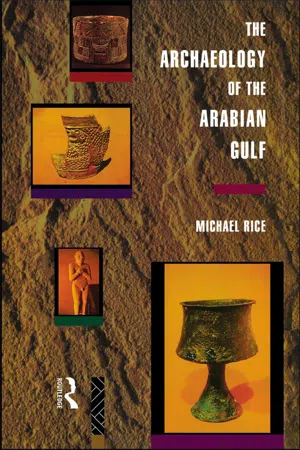
The archaeological remains in the Gulf area are astounding, and still relatively unexplored. Michael Rice has produced the first up-to-date book, which encompasses all the recent work in the area. He shows that the Gulf has been a major channel of commerce for millenia, and that its ancient culture was rich and complex, to be counted with its great contempororaries in Sumer, Egypt and south-west Persia.
Information
1
THE ARABIAN GULF IN ANTIQUITY
Four thousand years ago a man walked barefoot across the newly plastered floor of a curious building on a small island, close to the placid waters of an enclosed and distant sea.1 What manner of man he was we have no way of knowing, except, a little absurdly, that his feet were remarkably large; we know, too, that he was not alone, for he was one of several to walk over the plaster laid down on the floor, and that one of his companions was a dog. Whether he was a labourer engaged on the construction of the building (though surely a singularly careless one), or a stranger who did not know of the work which was in progress so close to the whispering sea and, perhaps at night and in the darkness, stumbled across the still damp surface, are now beyond speculation.
In this remote episode it is the location, and not the walker by the shore, which is important; the building was a sacred place, part of a complex of monumental buildings raised to the glory of gods who, at the time when the careless (or perhaps deliberate) feet crossed the plaster floor, had already been worshipped there for upwards of 500 years in handsome stone-built temples and, in less substantial structures, perhaps for longer still. From the middle years of the third millennium BC a temple had stood upon this site, skirted by palm-trees and lapped by the nearby, shallow sea. Here men had sought both to honour and to propitiate the forces of nature and the unknown which they eternalized as gods. It is possible only to guess at the name of the principal divinity who was commemorated in this ancient place; but everything that now is known about it leads to the conviction that he was a great god, the lord and protector of a people for long totally forgotten, without whose lives the world would not be quite as it is today.
The temples on this distant island stand at a special point in time and space: from the earliest of them to the latest they span one of those periods in human history when the most intense social, technological and cultural changes were set in train. It will perhaps surprise some to be told that the island and its temples lie close to the origins of the modern world; the search for their own origins was a preoccupation of the people most closely identified with the mysteries enshrined in the temples.2 That search itself forms part of the substance of this study.
The island itself is both the geographical centre as well as the focus of much legend and of elaborate religious cults. Its oecumene, if that is not too pretentious a word for so modest a land, stretched far to the north, deep into Iraq, and southwards out into the Indian Ocean beyond the horizons of the Arabian peninsula, of which it is a geographical dependency.
The island lies in the shallow waters of the Arabian (sometimes called the Persian) Gulf: today it is called Bahrain. In ancient times it was variously named: Dilmun, Tilmun, Tylos, Awad, Samak, Awal,3 but whatever its name, it was the epicentre of a region which was to exercise a profound influence on the history of the western world. That region was bounded by the marshlands of southern Iraq to the north and, to the south, by the mountains of Oman; between these points on the western littoral of the Arabian peninsula lies the scatter of little shaikhdoms which make up the states of the Gulf. To the east is Iran.
Only in the very recent past has the rest of the world been reminded even of the existence of this small part of it and then not for reasons of its high antiquity nor for any contribution which it may have made to an understanding of some of the most deep-seated preoccupations of mankind. For its people, entire millennia passed in neglect and forgetfulness. Fifty years ago or less the Arabian shores of the Gulf supported some of the least endowed of the world’s populations, living in tiny settlements on the edge of the harsh and inhospitable desert.4 With infinite toil and in the face of an often merciless climate, its people wrested a bare subsistence from the sea and the lean herds of goat and camel which the land could barely nourish. But in modern times the kaleidoscope of human fortune has shattered and reformed totally; today the people of the Gulf enjoy per capita incomes which are amongst the highest in the world and a level of prosperity and social welfare which makes them the object of the often malicious envy of those who have been less favoured by the caprice of fate.
It was, of course, oil which effected this phenomenal transformation, from abject poverty to wealth limited only by the extent of the black lakes on which much of south-western Asia floats. With the accession of such great riches came the interplay of politics and the complex games of more powerful nations which quickly saw the control of the Gulf lands as a prize worth any amount of conflict and chicanery.
Half a century of external influence has marked the region’s most recent history, an influence not always entirely maleficent. But, curiously, in all that time and with the hordes of western officials, engineers, buccaneers, businessmen and their attendant flocks of journalists, academics and all manner of miscellaneous commentators who followed in their train, few people ever gave thought to what had preceded the Gulf’s sudden plunge into the twentieth century.
To their credit, however, some few did. Archaeological excavation of a sort had been carried out, with varying degrees of intensity, efficiency and perception, for over a century, notably in Bahrain.5 The work of more recent years and the improved techniques of excavation and analysis now available to the archaeologist’s hand are beginning, if still only dimly, to suggest the profoundly important role which this region played in the early centuries of the development of urban cultures and in their diffusion over formidable distances.
As with so many other disciplines, in the past twenty years archaeology has witnessed the recasting of many of its most fervently defended concepts of earlier times. Archaeology is concerned with the extraction and evaluation of those material evidences of the past which can either be recovered or reconstructed. More scientific methodology, a greater awareness among many of the nations, the successors of the ancient cultures, of the significance of their heritage, and the sophisticated processing and publication of the results of an ever-increasing number of excavations throughout the world, have contributed to the transformation of what modern man believes he knows about his predecessors and hence about his own origins. At the same time there has been, amongst all types and conditions of humanity, an immeasurably increased awareness of and concern for the origins of these societies which have been constructed, in the course of an uncertain progress from a brute nature to the prospect, diminishing though it must seem to be in our own time, of enlightenment. Ironically, two of the less elevating accessories of our contemporary culture, television and tourism, have done much to make the public at large aware of antiquity.
The Near East, despite increasing competition from other areas, is still the most profitable region for the study of man’s past. But the inevitable shortcomings of the reliance by archaeology on the evidence which is actually available is nowhere more tellingly demonstrated than in the case of Arabia’s position in scholarship. Until very recently few works of general archaeological or historical reference contained any mention of the Gulf in their indices, or indeed of Arabia in pre-Islamic times at all, except perhaps for the trade in aromatics. This was usually mentioned incidentally, with perhaps a passing reference to the southern Arabian kingdoms which grew out of its prosperity. But beyond these glances, virtually nothing.
Thus Henri Frankfort, one of the most perceptive of the archaeologists of this century, could write in the preface to The Birth of Civilisation in the Ancient Near East: ‘I have confined myself to Egypt and Mesopotamia, the cultural centres of the Ancient Near East; for in the peripheral regions civilisation arose late and was always, to some extent, derivative.’6
In this case Frankfort was, to a degree, misguided. He was, however, hardly likely to think otherwise for, in his day, the evidence was scarcely available for a more enlightened or informed view to prevail, though some scholars did perceive, however dimly, that Arabia and its littorals represented a blank page in man’s history which demanded to be filled. Since his study was written, of course, other regions such as Anatolia, the Levant, even the far west of Europe, have come to be revalued and their contribution to the development of that confusing concept, civilization, accepted as far greater than Frankfort could ever have realized.
It might be imagined that it would be difficult to overlook the Arabian peninsula, the ‘Island of the Arabs’, that great land mass which divides Africa from Asia and which in surface area is approximately the size of western Europe. Yet historians and archaeologists had largely succeeded in doing this, from late Roman times to the very recent past. Such neglect is careless, to say the least, the more so because by no stretch of even the most perverse imagination could Arabia ever really have been said to be terra incognita. For over 1,400 years now it has been the focus of one of the most pervasive and powerful of the world’s faiths, whose adherents are enjoined to travel to the Arabian holy places at least once in their lifetimes. This fact alone has meant the accumulation of a gigantic traffic of humanity and of experience over the centuries; that traffic’s existence at least has been well known to Europeans since Crusader times, if not before.7
Nor has Arabia experienced any lack of spirited, if variously motivated, foreigners who have sought to penetrate the peninsula’s interior wastelands of sand and wind-scoured rock. From them has descended the enduring myth of the dauntless, fierce but noble-hearted tent dwellers, customarily but inaccurately called the ‘Bedouin’. The desert was furrowed with the tracks of all manners and conditions of purposeful explorers, seeking who knows what enchantment or release in the harsh purity of Arabia’s empty spaces.
But, for whatever reason, few of Arabia’s explorers were even of a modest archaeological bent. Admittedly the pickings were sparse when compared with Egypt, the Levant or Mesopotamia; politics, too, largely ignored Arabia in the nineteenth century, the high point of Near Eastern exploration and western exploitation, leaving the peninsula generally, with the exception of its western littoral and the south which controlled the route to India, to slumber under the formidable power of the Ottoman Empire. Egypt had been opened to the West and to the pursuits of scholars, first by Napoleon’s expedition (‘Four thousand years look down on you, Soldiers’) and then by Mohammad Ali’s Europeanizing policies. Mesopotamia attracted an early interest and her sites were being dug, however inexpertly, early in the nineteenth century. But, as was most markedly the case in the Levant and the Syro-Palestinian desert, one of the primary motivations for archaeological activity in the Land of the Two Rivers was to prove the historicity of the Bible.
The Biblical orientation of much European archaeology survived well into the twentieth century; the Bible was still considered a primary, if somewhat selective, source of an understanding of the ways of the ancient world, before the Redemption. All over the lands of the ancient Near East there continued to plod, sometimes in extreme discomfort but always in confident certainty, an army of learned men. They were often clergymen who espoused passionately the claims of this or that small piece of desert or river bank as the site of such and such a recorded intervention of the Divine in the affairs of man. That the topography usually did not fit, at least according to the Bible’s directions, did not deter them at all.
Sadly, the winds of time have, as often as not, blown away the theories that they laboured so hard to construct. But Arabia shared rarely in these Biblical excursions, mostly, perhaps, because, other than in certain instances, Arabian sites do not feature largely in the Biblical record, and even taking into account the often over-excited terms which seem to have determined the character of much Biblical archaeology, there were few scholars who would readily venture into such unpromising territory. Then, of course, there was the uncomfortable fact that Arabia was firmly held, as it were, by the competition, which, despite all the efforts of the missionary societies of the day, had shown a marked and peremptory disinclination to accept the precepts of Christian proselytizers and firmly resisted any attempt by infidels to involve themselves with the exclusive land of Arabia. From this land, in its inhabitants’ view, had sprung the last and greatest of the Prophets and the ultimate Revelation of God’s purpose to man. Ideological constraints, too, militated against the unearthing of the material evidences of ‘the Age of Ignorance’, which to the devout Muslim was represented by the whole course of human history prior to AD 622. Deep revulsion was also expressed at the actions of those who disturbed the tombs of the dead, even if they were not, in strict terms, the burials of believers.
Then, of course, there was the simple but compelling fact of Arabia’s extreme physical discomfort. Whilst this did not actually discourage all interested scholars, it may be that the pleasures of excavation in the Nile Valley or by the shores of the sun-blessed Aegean were discernibly greater than those attending similar work in Arabia. There were also the discommoding facts of the sheer immensity of the desert and the lack of enthusiasm towards foreigners looking for gold (for the search for gold is a fact well known to every desert-dweller about every archaeologist) which was demonstrated, sometimes fatally for the wouldbe searchers, by its people.
Arabian archaeology is in fact essentially a twentieth-century phenomenon; indeed, with one or two exceptions, it is to all intents and purposes a post- World War II development. It is one of the less immediately predictable byproducts of the exploitation of the Arabian peninsula’s staggering reserves of fossil hydrocarbons, the oil for which the industrial world so desperately thirsts. It is pertinent to this study that the reserves of Arabia’s oil are located beneath the eastern province of Saudi Arabia and the states of the peninsula’s eastern littoral which form the substance of this book. Commerce, in any serious, organized sense, began here, more than 4,000 years ago; it is the pursuit of commercial gain which has brought the region back to the consciousness of the world.
The unremitting pursuit of the one resource which is all that most of the oil-bearing lands possess has been, generally speaking, equivocal. The West has almost exhausted itself in devising machines and whole economies which depend upon this sole resource of a people whose consequent prosperity is not only dependent upon those very machines and economies, but is also often bitterly resented. Now, the political power deriving from the ownership of so much of the world’s energy resources has given the states of the Arabian peninsula a disconcerting influence on the lives of a substantial portion of the people who live on this planet. It is perhaps as well to try to understand something of their history. In doing so, we will find that we are discovering much about our own.
Thus far we have spoken of Arabia and the Arabian peninsula. Now we must become a little more specific, narrowing the focus down to one particular part of the peninsula with which this study will be concerned. This region is that which contains, in contemporary geopolitical terms, Kuwait, the Eastern Province of the Kingdom of Saudi Arabia, the State of Qatar, the archipelago of islands which comprise the State of Bahrain, the seven shaikhdoms of the United Arab Emirates and the Sultanate of Oman. Collectively this region is described as ‘eastern Arabia’; it is also the western littoral of that inland sea, the gulf which divides Arabia from Iran and which, by reason of the controversy which attends whichever territorial adjective (Arabian or Persian) is employed to identify it, is most generally described simply as ‘the Gulf’. This results in the infinite confusion of those living in the Americas, to whom the term generally has meant the Gulf of Mexico. Perhaps the conflict in the Arabian Gulf following the invasion of Kuwait will have served to identify it, for all nations.
This story is therefore concerned with the antiquity of eastern Arabia and of the Gulf. As such it is partial and limited, necessarily disregarding by far the largest part of the Arabian peninsula and concentrating only on one quadrant of it. There are three main reasons why this should be so.
The first is that, compared with the rest of Arabia, the eastern quadrant has generally been far better researched, to the extent at least that it is possible to lay out, with reasonable assurance, a historical sequence for it based on the evidence brought to light by the combination of chance and archaeology. For the past fifty years or thereabouts, access for non- Muslims to eastern Arabia has also been much easier than to any other part of the peninsula. Because they are the oil-producing regions of Arabia, the states have all maintained a substantial and increasing degree of contact with the outside world, sustaining significant populations of foreigners, includi...
Table of contents
- COVER PAGE
- TITLE PAGE
- COPYRIGHT PAGE
- THE EXPERIENCE OF ARCHAEOLOGY
- LIST OF ILLUSTRATIONS
- INTRODUCTION
- PREFACE
- ACKNOWLEDGEMENTS
- 1: THE ARABIAN GULF IN ANTIQUITY
- 2: THE PROGRESS OF GULF ARCHAEOLOGY
- 3: CLIMATE, SEA-LEVELS, MAN AND HIS COMPANIONS
- 4: DILMUN, THE ANCIENT CULTURE OF THE GULF
- 5: THE POLITY OF THE ANCIENT GULF
- 6: THE MYTHS OF SUMER AND DILMUN
- 7: BAHRAIN The Blessed Island
- 8: DILMUN’S NEIGHBOURING LANDS
- 9: THE MERCHANTS OF DILMUN
- 10: GILGAMESH, THE GULF AND THE LAND OF THE LIVING
- 11: THE ENIGMA OF DILMUN
- THE CHRONOLOGY OF THE ARABIAN GULF 7000–300 BC
- ABBREVIATIONS
- NOTES
- BIBLIOGRAPHY
Trusted by 375,005 students
Access to over 1.5 million titles for a fair monthly price.
Study more efficiently using our study tools.
Frequently asked questions
Yes, you can cancel anytime from the Subscription tab in your account settings on the Perlego website. Your subscription will stay active until the end of your current billing period. Learn how to cancel your subscription
No, books cannot be downloaded as external files, such as PDFs, for use outside of Perlego. However, you can download books within the Perlego app for offline reading on mobile or tablet. Learn how to download books offline
Perlego offers two plans: Essential and Complete
- Essential is ideal for learners and professionals who enjoy exploring a wide range of subjects. Access the Essential Library with 800,000+ trusted titles and best-sellers across business, personal growth, and the humanities. Includes unlimited reading time and Standard Read Aloud voice.
- Complete: Perfect for advanced learners and researchers needing full, unrestricted access. Unlock 1.5M+ books across hundreds of subjects, including academic and specialized titles. The Complete Plan also includes advanced features like Premium Read Aloud and Research Assistant.
We are an online textbook subscription service, where you can get access to an entire online library for less than the price of a single book per month. With over 1.5 million books across 990+ topics, we’ve got you covered! Learn about our mission
Look out for the read-aloud symbol on your next book to see if you can listen to it. The read-aloud tool reads text aloud for you, highlighting the text as it is being read. You can pause it, speed it up and slow it down. Learn more about Read Aloud
Yes! You can use the Perlego app on both iOS and Android devices to read anytime, anywhere — even offline. Perfect for commutes or when you’re on the go.
Please note we cannot support devices running on iOS 13 and Android 7 or earlier. Learn more about using the app
Please note we cannot support devices running on iOS 13 and Android 7 or earlier. Learn more about using the app
Yes, you can access The Archaeology of the Arabian Gulf by Michael Rice in PDF and/or ePUB format, as well as other popular books in Social Sciences & Archaeology. We have over 1.5 million books available in our catalogue for you to explore.