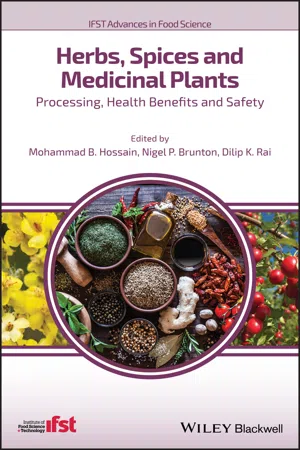
Herbs, Spices and Medicinal Plants
eBook - ePub

Herbs, Spices and Medicinal Plants

Processing, Health Benefits and Safety

  1. English
  2. ePUB (mobile friendly)
  3. Available on iOS & Android
eBook - ePub

Herbs, Spices and Medicinal Plants

Processing, Health Benefits and Safety

About this book

The latest research on the health benefits and optimal processing technologies of herbs and spices

This book provides a comprehensive overview of the health benefits, analytical techniques used, and effects of processing upon the physicochemical properties of herbs and spices. Presented in three parts, it opens with a section on the technological and health benefits of herbs and spices. The second part reviews the effect of classical and novel processing techniques on the properties of herbs/spices. The third section examines extraction techniques and analytical methodologies used for herbs and spices.

Filled with contributions from experts in academia and industry, Herbs, Spices and Medicinal Plants: Processing, Health Benefits and Safety offers chapters covering thermal and non-thermal processing of herbs and spices, recent developments in high-quality drying of herbs and spices, conventional and novel techniques for extracting bioactive compounds from herbs and spices, and approaches to analytical techniques. It also examines purification and isolation techniques for enriching bioactive phytochemicals, medicinal properties of herbs and spices, synergy in whole-plant medicine, potential applications of polyphenols from herbs and spices in dairy products, biotic and abiotic safety concerns, and adverse human health effects and regulation of metal contaminants in terrestrial plant-derived food and phytopharmaceuticals. 

  • Covers the emerging health benefits of herbs and spices, including their use as anti-diabetics, anti-inflammatories, and anti-oxidants
  • Reviews the effect of classical and novel processing techniques on the properties of herbs and spices
  • Features informed perspectives from noted academics and professionals in the industry
  • Part of Wiley's new IFST Advances in Food Science series

Herbs, Spices and Medicinal Plants is an important book for companies, research institutions, and universities active in the areas of food processing and the agri-food environment. It will appeal to food scientists and engineers, environmentalists, and food regulatory agencies.

Trusted by 375,005 students

Access to over 1.5 million titles for a fair monthly price.

Study more efficiently using our study tools.

Information

Year
2020
Print ISBN
9781119036616
Edition
1
eBook ISBN
9781119036630

1
Thermal Processing of Herbs and Spices

Anjali H. Kurup1, Shweta Deotale1, Ashish Rawson1, and Ankit Patras2
1 Indian Institute of Food Processing Technology, Thanjavur, TN 613005, India
2 Department of Agricultural and Environmental Sciences, College of Agriculture, Tennessee State University, Nashville, TN 37209, USA

1.1 Introduction

Herbs and spices are fresh or dried aromatic products obtained from a plant used to impart flavor to foods of plant and animal origin (Shelef 1984; Sung et al. 2012). More than 100 varieties of spices exist across the globe, which are significantly affected by the climatic conditions of the region (Gottardi et al. 2016). Asia is the leading producer of spices, particularly cinnamon, pepper, nutmeg, cloves, and ginger, while in Europe mainly basil, bay leaves, celery leaves, chives, coriander (cilantro), dill tips, thyme, and watercress are produced. America produces spices which include pepper, nutmeg, ginger, allspice, and sesame seed (Prasad et al. 2012; Gottardi et al. 2016). From ancient times, spices and herbs have been used not only for flavoring and preserving foods, but also for medicinal and cosmetic purposes (Simmonds 1982; Subbulakshmi and Naik 2002; Srinivasan 2005). As spices possess antimicrobial, antiviral, and strong flavoring properties, they are used to mask spoilage or off‐flavor in many food products (Risch 1997). India is the largest producer and exporter of spices, which include pepper, followed by Capsicum fruits, turmeric, ginger, cardamom seed spices, curry powders, spice oils, and oleoresins (Risch 1997; Subbulakshmi and Naik 2002; Srinivasan 2005).
The term “herb” is referred to as a subset of spice or leafy spice and belongs to plant sources with aromatic leaves valued for its medicinal and aromatic properties (Zheng and Wang 2001). Spices and herbs are considered rich sources of powerful antioxidants with high bioactivity (Sackewitz 1956; Embuscado 2015). Spices and herbs have also been used for preservation of foods and beverages primarily due to the presence of bioactive phytochemicals (Peter 2006; Singhal et al. 2017). Spices and herbs have been used as antioxidants in the form of whole or ground spice/herb, extracts, encapsulated or as emulsions (Embuscado 2015). Spices and herbs are classified and selected on the basis of their characteristics, such as flavor and color, that they impart to foods, i.e. hot (pepper), pungent (garlic), aromatic (cinnamon, clove), herbaceous (sage, rosemary), and coloring (turmeric) (Clark 1970). By flavor characteristics, spice concentrations in foods are determined, normally ranging from 0.5% to 1% in finished food products (Fischetti 1980). Some of the common spices along with their functional component, parts used, and common names are tabulated in Table 1.1.
Table 1.1 Nomenclature of spices and herb its part which is used as spice and its active component
Source: NIIR Board of Consultants and Engineers (2006), Gottardi et al. (2016), Sorensen (2015).
Common name Botanical name/Scientific name Part used Active/principle component Uses
Ajowan Trachyspermum ammi Whole seed Thymol (35–60%)
α‐pinene, ρ‐cymene
Spice blend, chat masala
Allspice
(clove pepper)
Pimento dioica Whole or ground seed Eugenol (80–90%) Baked goods, chewing gums, candy, ice cream, fruit soups, tea.
Anise/Aniseed
(sweet cumin)
Pimpinella anisum Spice: whole or ground Herb: leaf, fresh or dried. Trans‐anethol (80–90%) Sweet rolls, cakes, marinated meat and fish, beef stew, salad dressing, sausages
Annatto Bixa orellana Seed Bixin Butter, margarine, ice cream, sausages, cheese
Asafoetida (hing) Ferula asa‐foetida L Resin, dried granules, chunks or powder 2‐butyl‐1‐propenyl disulfide,
Sulfur compounds, ferulic ester
Spice blend, chat masala
Basil (tulsi) Sweet basil: Ocimum basilicum
Holi basil: Ocimum sanctum
Herb: fresh dried leaves
Spice: paste
Linalool (40%), methyl chavicol (25%) Spice blend
Bay/ Laurel leaf (tejpatta) Laurus nobilis leaf 1–8‐cineole (35%), methyl eugenol (4%), α‐pinene (12%) Spice blend, curry blends
Caraway (shai jeera) Carum carvi Herb: leaf
Spice: dried, ripe fruit, root, seed
d‐carvone (50–85%) and limonene (20–30%) Soups and salads,
pickle blend, spice blend
Cardamom (false or greater) Amomum subulatum Linn. Fruit and seed 1–8‐cineole (70%) Garam masala, curry powder
Cardamom (true or lesser) Elettaria cardamomum Fruit and seed 1–8‐cineole (25–45%), α‐terpineol acet...

Table of contents

  1. Cover
  2. Table of Contents
  3. About the IFST Advances in Food Science Book Series
  4. List of Contributors
  5. 1 Thermal Processing of Herbs and Spices
  6. 2 Non‐Thermal Processing of Herbs and Spices
  7. 3 Recent Developments in High‐Quality Drying of Herbs and Spices
  8. 4 Conventional Extraction Techniques for Bioactive Compounds from Herbs and Spices
  9. 5 Novel Extraction Techniques for Bioactive Compounds from Herbs and Spices
  10. 6 Approaches to Analytical Techniques – Characterizing Phytochemicals in Verbascum spp.
  11. 7 Purification and Isolation Techniques for Enrichment of Bioactive Phytochemicals from Herbs and Spices
  12. 8 Medicinal Properties of Herbs and Spices: Past, Present, and Future
  13. 9 Synergy in Whole Plant Medicine: Crataegus spp.: An Example
  14. 10 Potential Applications of Polyphenols from Herbs and Spices in Dairy Products as Natural Antioxidants
  15. 11 Biotic and Abiotic Safety Concerns for Herbs and Spices
  16. 12 Adverse Human Health Effects and Regulation of Metal Contaminants in Terrestrial Plant‐Derived Food and Phytopharmaceuticals
  17. Index
  18. End User License Agreement

Frequently asked questions

Yes, you can cancel anytime from the Subscription tab in your account settings on the Perlego website. Your subscription will stay active until the end of your current billing period. Learn how to cancel your subscription
No, books cannot be downloaded as external files, such as PDFs, for use outside of Perlego. However, you can download books within the Perlego app for offline reading on mobile or tablet. Learn how to download books offline
Perlego offers two plans: Essential and Complete
  • Essential is ideal for learners and professionals who enjoy exploring a wide range of subjects. Access the Essential Library with 800,000+ trusted titles and best-sellers across business, personal growth, and the humanities. Includes unlimited reading time and Standard Read Aloud voice.
  • Complete: Perfect for advanced learners and researchers needing full, unrestricted access. Unlock 1.5M+ books across hundreds of subjects, including academic and specialized titles. The Complete Plan also includes advanced features like Premium Read Aloud and Research Assistant.
Both plans are available with monthly, semester, or annual billing cycles.
We are an online textbook subscription service, where you can get access to an entire online library for less than the price of a single book per month. With over 1.5 million books across 990+ topics, we’ve got you covered! Learn about our mission
Look out for the read-aloud symbol on your next book to see if you can listen to it. The read-aloud tool reads text aloud for you, highlighting the text as it is being read. You can pause it, speed it up and slow it down. Learn more about Read Aloud
Yes! You can use the Perlego app on both iOS and Android devices to read anytime, anywhere — even offline. Perfect for commutes or when you’re on the go.
Please note we cannot support devices running on iOS 13 and Android 7 or earlier. Learn more about using the app
Yes, you can access Herbs, Spices and Medicinal Plants by Mohammad B. Hossain, Nigel P. Brunton, Dilip K. Rai, Mohammad B. Hossain,Nigel P. Brunton,Dilip K. Rai in PDF and/or ePUB format, as well as other popular books in Technology & Engineering & Food Science. We have over 1.5 million books available in our catalogue for you to explore.