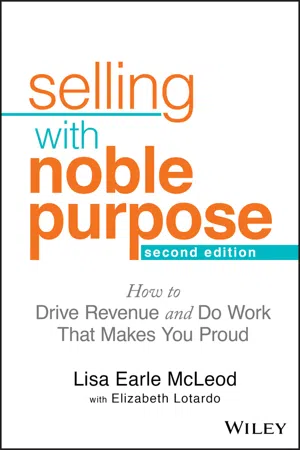
Don't let anyone tell you that you have to choose between making money and making a difference.
Selling With Noble Purpose: How to Drive Revenue and Do Work That Makes You Proud, 2nd Edition is an update of the acclaimed book that changed the game in sales. Using real-world data, compelling stories and psychological research, Selling With Noble Purpose explains why salespeople who genuinely understand how they can make a difference to customers outsell those who only focus on internal targets and quotas.
Sales leadership experts McLeod and Lotardo reveal how a Noble Sales Purpose (NSP) can drive a team to outstanding sales numbers. Whether you're an executive, manager or aspiring sales leader, you'll discover how to find your own Noble Sales Purpose and create a sales force of True Believers. This new edition covers:
How firms overcome ferocious competition and how you can do the same
Why sales organizations with a clear NSP outperform traditional sales teams
How to avoid the trap of behaving like a transactional salesperson
Why well-intended leaders often unknowingly erode purpose and differentiation
How to use your NSP to increase customer engagement
Why an NSP gives you clarity during times of uncertainty
In an era where organizations often believe that money is the primary way to motivate salespeople, Selling with Noble Purpose offers and exciting and sustainable alternative.
In the end, it is impossible to have a great life unless it is a meaningful life. And it is very difficult to have a meaningful life without meaningful work.
—Jim Collins, author of Good to Great
Making a living and making a difference are not incompatible. As a leader, you can do both. You must do both.
In Part 1, you'll learn how a Noble Sales Purpose (NSP) can reframe your sales narrative to create more competitive differentiation and emotional engagement. And you'll learn why an NSP is crucial during times of uncertainty and volatility. We'll explore what an NSP is and what it's not—and why it matters to you and your sales force.
We'll look at some surprising information about why overemphasizing profit has an alarmingly negative effect on salespeople and customers and how you can reframe the profit question inside your company. You'll learn the brain science behind NSP and where it fits within the structure of your larger organization.
You'll also learn why passion, despite its high value, is not enough to sustain performance. Finally, we'll address the leadership question that changes everything, and how you can use it to jump‐start your team.
If you're thinking, “We're just an average (accounting, software, landscape, furniture, fill‐in‐the‐blank) firm. I'm not sure our work is noble,” we'll tell you right now: if your customers are buying from you, then you are adding some value. You do have a Noble Purpose, and it's time for us to find it.
CHAPTER 1 The Great Sales Disconnect
I stayed the course … from beginning to the end, because I believed in something inside of me.
—Tina Turner, entertainer
Suppose you wrote the following goal on your office whiteboard: “I want to make as much money as possible.” Now suppose your clients saw it. How would they feel? How would you feel knowing that they'd seen it? Would you be proud or embarrassed?
What if you went over your prospect list, and the only thing written next to each prospect's name was a dollar figure and a projected close date? Would your prospects be happy if they saw that? Would they want to do business with you? Probably not; it reduces them to nothing more than a number. Yet that's exactly how most organizations talk about their customers on a daily basis.
Imagine a salesperson walking into a customer's office and opening the sales call by plopping a revenue forecast down on the customer's desk announcing, “I have you projected for $50,000 this month. Give me an order now!”
That rep would be thrown out in a second. Yet that's the kind of language most organizations use when they talk about their customers internally. It's like two different worlds.
Think about the typical conversation a sales manager has with his or her sales rep. It usually goes something like this:
“When are you going to close this? How much revenue will it be? Are all the key decision‐makers involved? Who's the competition? What do you need to close this deal?”
All the questions are about when and how we're going to collect revenue from the customer. These questions matter, but they aren't enough to create any kind of differentiated conversation (internally or externally).
Very few managers ask about the impact the sale will have on the customer's business or life.
We expect salespeople to focus on customers' needs and goals when they're in front of customers, but the majority of internal conversations are about the organization's own revenue quotas.
Although it's an unintended disconnect, it's a fatal one.
Unfortunately, the current sales narrative of most organizations is flawed, fatally out of sync with what really matters to salespeople and customers. Salesforce CEO Marc Benioff articulates the transactional mindset that so many sales teams used to embody, describing it this way: “If you were meeting with a customer, your singular goal was to leave the room with a signed contract—in as short a time as possible.”
Benioff points out the flaw in this approach, writing in his book Trailblazer: “It didn't incentivize anyone to consider whether the customers on the other side of these transactions really needed the software or whether it helped them make progress on their business goals.”
In a traditional sales organization, the entire ecosystem surrounding the sales team—the customer relationship management (CRM) system, weekly sales meetings, conversations with managers, recognition, and everything else that influences seller behavior—are all pointed toward targets.
It's assumed that sellers will focus on customers when they're interacting with customers. But are we surprised when they don't? Everything in the ecosystem is driving them toward thinking about nothing but their own quota.
Most organizations want to have a positive impact on their customers' lives. It makes good business sense, and it appeals to our more noble instincts. Yet when managers are caught up inside the pressure cooker of daily business, their desire to improve the customer's life is eclipsed by quotas, quarterly numbers, and daily sales reports.
This results in salespeople who don't have any sense of a higher purpose other than “making the numbers.” It sounds fine enough in theory, but customers can tell the difference between the salespeople who care about them and those who care only about their bonuses. Sales targets are important, but they don't create a compelling narrative.
The great disconnect between what we want salespeople to do when they're in the field (focus on the customer) versus what we emphasize and reinforce internally (our own targets and quotas) results in mediocre sales performance.
What Lack of Purpose Costs a Sales Force
When the customer becomes nothing more than a number to you, you become nothing more than a number to the customer—and your entire organization suffers.
When you overemphasize financial goals at the expense of how you make a difference to customers, you make it extremely difficult for your salespeople to differentiate themselves from the competition. And the problem doesn't stop there. It has a ripple effect, causing salespeople who:
Think only about the short term
Fail to understand the customer's environment
Cannot connect the dots between your products and customers' goals
Cannot gain access to senior levels within the customer
Then the problem escalates:
Customers view you as a commodity.
You have little or no collaboration with them.
Customers place undue emphasis on minor problems.
Contracts are constantly in jeopardy over small dollar amounts.
Salespeople's default response is to lower the price.
Sales has a negative perception in the rest of the organization.
Top performers become mid‐level performers.
Salespeople view their fellow salespeople as the competition.
Customer churn increases.
Salespeople try to game the comp plan.
Sales force morale declines.
It's not a pretty picture. When the internal conversation is all about money, the external conversation becomes all about money. And all of a sudden, that's the last thing you're making.
Companies have tried a variety of methods to solve this problem. Organizations spend millions on sales training programs teaching salespeople how to ask better questions and engage the customers. They spend even more millions on CRM systems to capture critical customer information. They host off‐site retreats to create mission and vision statements. They hire expensive consultants to craft lengthy slide decks articulating their value proposition.
The results are short‐lived at best. Salespeople abandon the training the minute a high‐stakes deal is on the table. No one updates the customer intel in CRM. The mission and vision are put on a meaningless placard in the lobby. And the value sto...
Table of contents
Cover
Table of Contents
Praise for Selling with Noble Purpose
Introduction
PART 1: Sales: A Noble Profession?
PART 2: Naming and Claiming Your Noble Sales Purpose
PART 3: Activating Your Purpose with Customers
PART 4: Creating a Tribe of True Believers
Conclusion: Life on Purpose
APPENDIX A: Techniques and Tools
APPENDIX B: Glossary
APPENDIX C: Frequently Asked Questions
Acknowledgments
About the Authors
Index
End User License Agreement
Trusted by 375,005 students
Access to over 1.5 million titles for a fair monthly price.
Study more efficiently using our study tools.
Frequently asked questions
Yes, you can cancel anytime from the Subscription tab in your account settings on the Perlego website. Your subscription will stay active until the end of your current billing period. Learn how to cancel your subscription
No, books cannot be downloaded as external files, such as PDFs, for use outside of Perlego. However, you can download books within the Perlego app for offline reading on mobile or tablet. Learn how to download books offline
Perlego offers two plans: Essential and Complete
Essential is ideal for learners and professionals who enjoy exploring a wide range of subjects. Access the Essential Library with 800,000+ trusted titles and best-sellers across business, personal growth, and the humanities. Includes unlimited reading time and Standard Read Aloud voice.
Complete: Perfect for advanced learners and researchers needing full, unrestricted access. Unlock 1.5M+ books across hundreds of subjects, including academic and specialized titles. The Complete Plan also includes advanced features like Premium Read Aloud and Research Assistant.
Both plans are available with monthly, semester, or annual billing cycles.
We are an online textbook subscription service, where you can get access to an entire online library for less than the price of a single book per month. With over 1.5 million books across 990+ topics, we’ve got you covered! Learn about our mission
Look out for the read-aloud symbol on your next book to see if you can listen to it. The read-aloud tool reads text aloud for you, highlighting the text as it is being read. You can pause it, speed it up and slow it down. Learn more about Read Aloud
Yes! You can use the Perlego app on both iOS and Android devices to read anytime, anywhere — even offline. Perfect for commutes or when you’re on the go. Please note we cannot support devices running on iOS 13 and Android 7 or earlier. Learn more about using the app
Yes, you can access Selling With Noble Purpose by Lisa Earle McLeod,Elizabeth Lotardo in PDF and/or ePUB format, as well as other popular books in Business & Leadership. We have over 1.5 million books available in our catalogue for you to explore.