eBook - ePub
Available until 26 Dec |Learn more
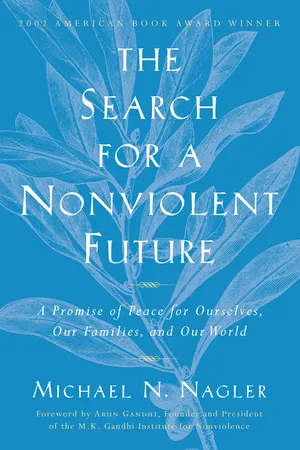
The Search for a Nonviolent Future
A Promise of Peace for Ourselves, Our Families, and Our World
This book is available to read until 26th December, 2025
- 360 pages
- English
- ePUB (mobile friendly)
- Available on iOS & Android
eBook - ePub
Available until 26 Dec |Learn more
The Search for a Nonviolent Future
A Promise of Peace for Ourselves, Our Families, and Our World
About this book
Beginning with the achievements of Mahatma Gandhi, and following the legacy of nonviolence through the struggles against Nazism in Europe, racism in America, oppression in China and Latin America, and ethnic conflicts in Africa and Bosnia, Michael Nagler unveils a hidden history. Nonviolence, he proposes, has proven its power against arms and social injustice wherever it has been correctly understood and applied.
Nagler's approach is not only historical but also spiritual, drawing on the experience of Gandhi and other activists and teachers. Individual chapters include A Way Out of Hell, The Sweet Sound of Order, and A Clear Picture of Peace. The last chapter includes a five-point blueprint for change and "study circle" guide. The foreword by Arun Gandhi, the grandson of Mahatma Gandhi, is new to this edition.
Tools to learn more effectively

Saving Books

Keyword Search

Annotating Text

Listen to it instead
Information
CHAPTER ONE
HARD QUESTIONS, HARD ANSWERS

All major natural and human systems are in crisis or transition. The signs of this change range from the crash of fisheries around the world, the depletion of rainforests, the declining credibility of government, the growing inequality between rich and poor, and the crisis in meaning and sense of emptiness that comes with an overemphasis on material consumption.
—Positive Futures Network Newsletter
For pain does not spring from the dust
or sorrow sprout from the soil:
man is the father of sorrow,
as surely as sparks fly upward.
—Job 5:6–7
A FRONT-PAGE photo in the Sunday New York Times on August 17, 1997, showed a grieving woman, Linda Reid, putting flowers on the gravestone of her son, who had hanged himself at the age of seventeen. He was the sixth teenager from that community to hang himself or herself that year. Why? The well-written article describing the suicides in this south Boston area talked about community pride putting too much pressure on young people, about racial tensions, lack of economic opportunity—all things we are well aware of but that hardly explain why a young person in a country like ours would take his life. Or hers. The real explanation must lie much deeper than community pride and economic opportunity. In 1998, the surgeon general reported that children between the ages of ten and fourteen are twice as likely to take their own lives as they were fifteen years earlier. What is the explanation? As though sensing that all the talk about community pride and the like was a smoke screen, the writer finally quoted a local priest: “There really aren’t any answers.”
I refuse to accept this. I refuse to believe in the journalistic cliché “meaningless violence.” I refuse to believe that there are no answers to the cheapening of life and the rise of violence against it. Two young men murder their own parents to get their money; a murder-suicide leaves a celebrity and his wife, apparently happy for years, dead in their palatial home; a teenager is shot dead in the street for his running shoes—why? It may be easy to say that there are no answers, but it’s not acceptable. If we have no answers to such a basic matter as why we can’t live in peace with one another, often can’t go on living at all, maybe we’re asking the wrong questions.
In one respect, it’s only too clear that we are doing just that. It’s even clear why: violence is “reported” to us every day by the mass media in a wash of meaningless detail. “Joe X, twenty-six, was shot three times with a 9-millimeter handgun purchased the previous Tuesday for $23.” Or, “This month the homicide rate in Dayton was 1.8 percent lower than last month.” Frequently, we are solemnly told the trivial “reasons” offered by flustered survivors who hardly understand what is happening to them, and there is no limit to how absurd, how downright insulting to human nature these can be. In what would be called today a frivolous lawsuit, the wife of James Oliver Huberty, who killed twenty-one people in the McDonald’s San Ysidro massacre of 1984, said that her husband’s murderous rampage was caused by the excessive MSG in McDonald’s hamburgers. The way violent events are reported (and this is a large part of what we read and think about today) is virtually always trivializing. It comes to us as a barrage of incidental details, often of cold statistics. Engrossed in one sensational detail or another, one particular violent episode or another, we never think about violence itself.
The right questions, then, are not: Why are very young students turning their schools into battlefields? Why is there an increase in hate crimes right now against gays in Florida or a decrease in sex offenses in New England? They are:
What is violence?
Why is it getting worse? and
How do we make it stop?
STIRRINGS OF CHANGE
Despite discouragement by the mass media, there is evidence that people want to confront these questions; they are becoming more dissatisfied with the “no answer” school and other forms of dismissal— rightly, for to dismiss something as dangerous as rising violence is treacherous. The tendency to deny violence has been with us for a long time, to be sure, but there are signs that it is weakening. Considering the enormous role played by violence throughout history, Hannah Arendt wrote in her classic study On Violence in 1969, “It is . . . rather surprising that violence has been singled out so seldom for special consideration.”1 She was reflecting the fact that a new awareness is dawning, that many feel the time to get past denial and face the issue head-on is right now. It has been half a century since Gandhi observed that the world was “sick unto death with blood-spilling,”2 and at about that same time, French philosopher Jacques Ellul made the shrewd observation that our era “is not at all the age of violence; it’s the age of the awareness of violence.”3
In other words, what really characterizes our time is not so much that there is so much violence—there have been such times before— but that we are challenged, possibly as never before, to deal with it. This being true, the mass media could not have chosen a worse time to make violence appear trivial and incomprehensible. They are doing a singular and untimely disservice to human civilization.
Confronting violence is a little like turning around to face a bright light that’s been projecting all kinds of fascinating images and shadows out in front of us (yes, I’ve been influenced by Plato). It’s hard to peer into that glare, but when we succeed, we find ourselves going through a kind of Alice’s looking glass. Suddenly we feel like the character from that popular sixties poster, with his head stuck into a whole other universe—or that convict in a cartoon staring wistfully through the bars at a little patch of sky while all along the door to his cell stands wide open behind him.
It is a much wider world out there; the light is harsh at first, but when we face it, problems that seemed impossible to cope with now seem to come teamed with all kinds of solutions—solutions with unexpected good side effects, instead of bad ones.
The prevailing method of dealing with violence has a dreadful tendency to create more problems than it solves. For example, we try to stop young people from bringing guns to school by installing metal detectors. It does cut down on the number of guns they bring in, of course—and it demoralizes the students because it implies that they cannot be trusted. It intensifies the excitement of the “game” of sneaking guns into school. And most of all it normalizes the violence. It blunts the shock. How could we have allowed a situation like this to happen, where young people have guns at all, much less carry them in school? And without that shock, where do we get the motivation to act? Where’s the impetus to confront the real problem, of which guns in school is only one form: the problem of violence?
MOVING TOWARD THE TRUTH
I have been identifying the mass media as a major source of our problem, and I’m going to continue, for one simple reason: that is where it would be most effective to make a change. In all honesty, however, we cannot put all the blame on them. When Hannah Arendt said it is “rather surprising” that violence has not been given special attention before now, she was giving us a scholarly hint that we have a natural inclination to avoid thinking directly about violence, which is understandable: we would be thinking about the most negative side of human nature, which means the most negative side of ourselves. I don’t like this any more than you do. But although it must be done, it doesn’t have to be done destructively. That is, we can peer into the depths of human nature—of ourselves—in a balanced way, seeing what is good as well as what is discouraging about us. Today, by emphasizing the shadow side of humanity—and “emphasizing” may be too mild for our obsession with the ugly and violent today—our culture seems to be making us more and more ignorant of our human stature. Let me throw that claim into relief by quoting a brief passage from an era, namely, the fourteenth century, when that was not yet true:
Beneath you and external to you lies the entire created universe. Yes, even the sun, the moon and the stars. They are fixed above you, splendid in the firmament, yet they cannot compare to your exalted dignity as a human being.4
It seems almost fantastic to us that a writer could matter-of-factly describe humanity in these glowing terms; but it would have seemed just as fantastic to him that we matter-of-factly bill ourselves as “natural born killers”—just as fantastic and much more dangerous.
The obsession with negativity that we take for granted paradoxically makes it nearly impossible to understand our negative side; it has blocked us from getting down to the causes of violence, those that lie within us, by creating a sense that only causes of violence lie within us. As we shine our light into the murk, therefore, it is essential to be watching for the seeds of change and regeneration that surely lie hidden there along with the drives, the impulses, and blindness that make us violent. Opposites can strangely be the same.
The other day as I was walking across Sproul Plaza, made famous in the sixties as the scene of the free speech movement, I saw a cluster of students handing out leaflets around a hastily knocked-together kiosk. Nothing unusual, for Berkeley. They were clearly agitated (also not too unusual), and I went over to read their large, hand-lettered sign: “Anti-Asian Hate Crimes on the Rise.” I was shocked and hurt. At Berkeley, so many of my students and friends and colleagues are Asian that this hit me personally and hard, quite apart from the fact that this kind of thing should not be happening in Berkeley or anywhere in this century. But I’ve learned something over the years: if I wanted to do something about this, something effective, something that would last, I would have to get my initial reactions under control; I would have to take a step back and try to see the bigger picture.
To be more precise, in this case, I would have to take three steps back. Like letting myself down a chain into murky waters, hand over hand, I would have to back down in my thinking, from:
anti-Asian hate crimes
to hate crimes
to hate.
Hate is the real problem. The more hate there is, the more it will express itself in whatever form. Some of those forms will be illegal— crimes, in other words—and some of those will be directed against Asians. But the underlying reason anti-Asian hate crimes are on the rise—in Berkeley or anywhere—has nothing to do with Asians or even racism: it is that hate is on the rise. Today it might be Asians; tomorrow it could be Jews, it could be blacks, homeless people, gays and lesbians; yesterday it was Communists—but since these are all only the targets of some people’s hate, only forms that hatred then takes, trying to cope with each victimized group individually is like trying to fix one leak at a time in a rusted-out plumbing system. Wouldn’t it be more effective to shut off the water? Or, to modify that image, hatred is a tide that raises all boats: we won’t get far trying to rescue the boats—or even groups of boats—one at a time.
These students were not the only ones trying to deal with one problem of victimization in isolation. We are all doing this, because it has become our culture-wide style. As John Burton, former secretary of Australia’s Department of External Affairs and now a well-known scholar of conflict, wrote, “In so far as specific problems are being tackled by authorities as though they were separate problems, there can be no lasting cures for any of them.” What civilizations are passing through, he pointed out, is in reality a clash between the systems we’ve built and the actual human needs they were supposed to address.5 Not, that is, an isolated clash between group and group.
The trouble with trying to stop one leak at a time is, first of all, that it does nothing about the others. Have a teach-in, raise consciousness, or, if you really want to be unimaginative, provide Asians with more “security” measures. You may see some reduction of anti-Asian hate crimes (I will be arguing later that even this isn’t guaranteed), but what about anti-black, anti-lesbian, anti-Caucasian hate crimes? What about road rage? What about war?
On the other hand, if you could somehow do something to control hate, all the manifestations of hate would subside to that degree. The effect on specific hate crimes might be less obvious at first because it would be indirect, but in the long run it would be much, much more reliable. You simply cannot have anti-Asian hate crimes if you don’t have hate. On the whole, this is so obvious that the only reason to repeat it is that as soon as some particular form of violence gets in our face, so to speak—witness my first reaction at the kiosk—it draws all our attention to the details. Emergencies are great motivators, but they create a terrible atmosphere for really solving problems. To solve problems you need to have a little self-control, a little distance, a lot of patience. You need to see, for example, that the problem is not hate against group A or B: it’s hate.
Incidentally, as I headed back to my office, whom should I run across but a well-known Berkeley personality haranguing the passersby in a voice I recognized all too well. It’s the kind of voice that makes you wince before you even hear what it’s saying. I’m not sure what his problem is or why he chooses to bring it on campus, but he’s extremely angry and attacks people for hours in a voice raucous with bitterness. He’s popularly called the Hate Man. I had the odd feeling that I might be the only one on campus noticing the connection.
SCIENCE AND SERENDIPITY
It sounds simple, but no sooner have we worked our way down the chain from anti-Asian hate crimes to hate crimes to hate—which is not easy to do when we’re caught up in a hateful situation—than we have not only an answer to the question, why this kind of crime?, but the beginnings of a way to solve it. Once we’ve gotten down to the emotional cause, we start seeing a pragmatic measure that we’ll be able to apply, mutatis mutandis, to just about every form of violence: since the underlying cause of the violence is hate, we could fix the problem if we had a way to turn hate into something else. And there is evidence that this t...
Table of contents
- Cover Page
- Title Page
- Copyright
- Contents
- Dedication
- Foreword
- Preface
- Acknowledgments
- Introduction
- 1. Hard Questions, Hard Answers
- 2. Hope In Dark Times
- 3. No Power To Describe: The "Nonviolent Moment" As Peak Experience
- 4. "Work" Versus Work
- 5. A Way Out Of Hell
- 6. Constructive Programme
- 7. A Clear Picture Of Peace
- 8. Fighting Fire With Water
- 9. Toward A Metaphysics Of Compassion
- Epilogue
- Action Guide
- Notes and References
- Resources and Oppor tunities
- Index
- Backmatter
Frequently asked questions
Yes, you can cancel anytime from the Subscription tab in your account settings on the Perlego website. Your subscription will stay active until the end of your current billing period. Learn how to cancel your subscription
No, books cannot be downloaded as external files, such as PDFs, for use outside of Perlego. However, you can download books within the Perlego app for offline reading on mobile or tablet. Learn how to download books offline
Perlego offers two plans: Essential and Complete
- Essential is ideal for learners and professionals who enjoy exploring a wide range of subjects. Access the Essential Library with 800,000+ trusted titles and best-sellers across business, personal growth, and the humanities. Includes unlimited reading time and Standard Read Aloud voice.
- Complete: Perfect for advanced learners and researchers needing full, unrestricted access. Unlock 1.4M+ books across hundreds of subjects, including academic and specialized titles. The Complete Plan also includes advanced features like Premium Read Aloud and Research Assistant.
We are an online textbook subscription service, where you can get access to an entire online library for less than the price of a single book per month. With over 1 million books across 990+ topics, we’ve got you covered! Learn about our mission
Look out for the read-aloud symbol on your next book to see if you can listen to it. The read-aloud tool reads text aloud for you, highlighting the text as it is being read. You can pause it, speed it up and slow it down. Learn more about Read Aloud
Yes! You can use the Perlego app on both iOS and Android devices to read anytime, anywhere — even offline. Perfect for commutes or when you’re on the go.
Please note we cannot support devices running on iOS 13 and Android 7 or earlier. Learn more about using the app
Please note we cannot support devices running on iOS 13 and Android 7 or earlier. Learn more about using the app
Yes, you can access The Search for a Nonviolent Future by Michael N. Nagler in PDF and/or ePUB format, as well as other popular books in Politics & International Relations & Peace & Global Development. We have over one million books available in our catalogue for you to explore.