The Memory Effect
eBook - PDF

The Memory Effect

The Remediation of Memory in Literature and Film

  1. 364 pages
  2. English
  3. PDF
  4. Available on iOS & Android
eBook - PDF

The Memory Effect

The Remediation of Memory in Literature and Film

About this book

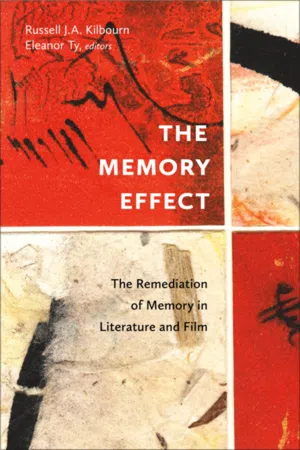
The Memory EffectĀ is a collection of essays on the status of memory—individual and collective, cultural and transcultural—in contemporary literature, film, and other visual media. Contributors look at memory's representation, adaptation, translation, and appropriation, as well as its mediation and remediation. Memory's irreducibly constructed nature is explored, even as its status is reaffirmed as the basis of both individual and collective identity.

The book begins with an overview of the field, with an emphasis on the question of subjectivity. Under the section title Memory Studies: Theories, Changes, and Challenges, these chapters lay the theoretical groundwork for the volume. Section 2, Literature and the Power of Cultural Memory/Memorializing, focuses on the relation between literature and cultural memory. Section 3, Recuperating Lives: Memory and Life Writing, shifts the focus from literature to autobiography and life writing, especially those lives shaped by trauma and forgotten by history. Section 4, Cinematic Remediations: Memory and History, examines specific films in an effort to account for cinema's intimate and mutually constitutive relationship with memory and history. The final section, Multi-Media Interventions: Television, Video, and Collective Memory, considers individual and collective memory in the context of contemporary visual texts, at the crossroads of popular and avant-garde cultures.

Frequently asked questions

Yes, you can cancel anytime from the Subscription tab in your account settings on the Perlego website. Your subscription will stay active until the end of your current billing period. Learn how to cancel your subscription.
No, books cannot be downloaded as external files, such as PDFs, for use outside of Perlego. However, you can download books within the Perlego app for offline reading on mobile or tablet. Learn more here.
Perlego offers two plans: Essential and Complete
  • Essential is ideal for learners and professionals who enjoy exploring a wide range of subjects. Access the Essential Library with 800,000+ trusted titles and best-sellers across business, personal growth, and the humanities. Includes unlimited reading time and Standard Read Aloud voice.
  • Complete: Perfect for advanced learners and researchers needing full, unrestricted access. Unlock 1.4M+ books across hundreds of subjects, including academic and specialized titles. The Complete Plan also includes advanced features like Premium Read Aloud and Research Assistant.
Both plans are available with monthly, semester, or annual billing cycles.
We are an online textbook subscription service, where you can get access to an entire online library for less than the price of a single book per month. With over 1 million books across 1000+ topics, we’ve got you covered! Learn more here.
Look out for the read-aloud symbol on your next book to see if you can listen to it. The read-aloud tool reads text aloud for you, highlighting the text as it is being read. You can pause it, speed it up and slow it down. Learn more here.
Yes! You can use the Perlego app on both iOS or Android devices to read anytime, anywhere — even offline. Perfect for commutes or when you’re on the go.
Please note we cannot support devices running on iOS 13 and Android 7 or earlier. Learn more about using the app.
Yes, you can access The Memory Effect by Russell J.A. Kilbourn, Eleanor Ty, Russell J.A. Kilbourn,Eleanor Ty in PDF and/or ePUB format, as well as other popular books in Media & Performing Arts & Social History. We have over one million books available in our catalogue for you to explore.

Table of contents

  1. Cover
  2. Contents
  3. Acknowledgements
  4. Part I: Memory Studies: Theories, Changes, and Challenges
  5. Part II: Literature and the Power of Cultural Memory/Memorializing
  6. Part III: Recuperating Lives: Memory and Life Writing
  7. Part IV: Cinematic Remediations: Memory and History
  8. Part V: Multimedia Interventions: Television, Video, and Collective Memory
  9. Works Cited
  10. About the Contributors
  11. Index